Practical salon management strategies, scheduling systems, retention tactics, revenue optimization ideas, AI-powered operational insights, and real-world beauty business growth advice for modern salon owners and teams.
Centralized supplier program: scoring tiers, consolidated PO rules, negotiation playbooks, quarterly performance gates and templates to reduce cost and variability across locations while protecting fill rates.
Juan CabreraFounder of SoftWorks Global & Business Systems Researcher
Recurring governance pack: scenario cards, facilitator scripts, pass/fail gates, vendor continuity clause snippets and an after-action repository to close resilience gaps across locations and standardize vendor continuity obligations.
Juan CabreraFounder of SoftWorks Global & Business Systems Researcher
Operations-first acquisition pipeline that locks marketing spend to booking capacity via campaign-to-capacity gates, simple salon-tailored attribution rules, experiment-ready budget templates, and campaign reconciliation sheets owners can run without analytics teams.
Juan CabreraFounder of SoftWorks Global & Business Systems Researcher
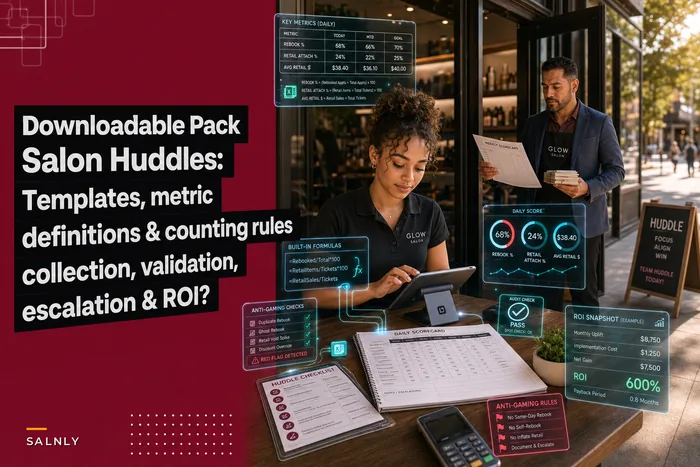
A downloadable, ready‑to‑use implementation pack that fills the execution gaps: one‑page laminated huddle checklist (printable), printable daily scorecard (PDF/PNG), an editable spreadsheet with built formulas (rebook %, retail attach %, avg retail $), precise metric definitions and counting rules, sample numeric targets with baseline method, a simple data collection and validation protocol, an escalation/timeline matrix for corrective actions, anti‑gaming controls and audit steps, 3–5 retail‑recommendation scripts with a short role‑play and observed‑behavior checklist, a manager micro‑training plan (5–10 minute modules), tailored KPI/huddle variants for common salon business models, and a short ROI worked example to make the business case.
Juan CabreraFounder of SoftWorks Global & Business Systems Researcher
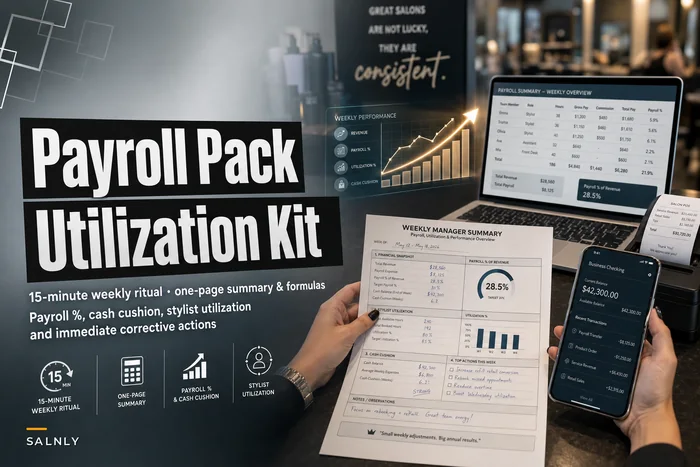
Minute‑by‑minute weekly pack linking exact metrics (payroll %, cash, utilization) to corrective actions and a one‑page weekly summary template managers can use without deep accounting skills.
Juan CabreraFounder of SoftWorks Global & Business Systems Researcher
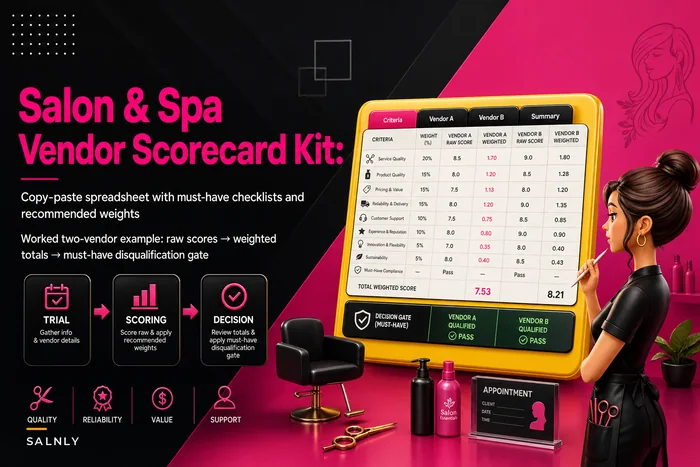
A practical, ready-to-use companion toolkit that owners can copy, paste and use right away. Includes: a downloadable spreadsheet (copyable tab layout and formulas) with prioritized must-have vs nice-to-have feature lists for single‑location and multi‑location businesses; recommended default weightings and salon‑type presets (color‑heavy, room/resource spas, high walk‑in barbers); an explicit 1–5 scoring rubric and measurable thresholds (uptime, SMS delivery, support SLAs, migration accuracy); a fully worked example scoring two vendors (shows raw scores → weighted totals → decision threshold); and short interpretation guidance so owners can rank vendors immediately.
Juan CabreraFounder of SoftWorks Global & Business Systems Researcher
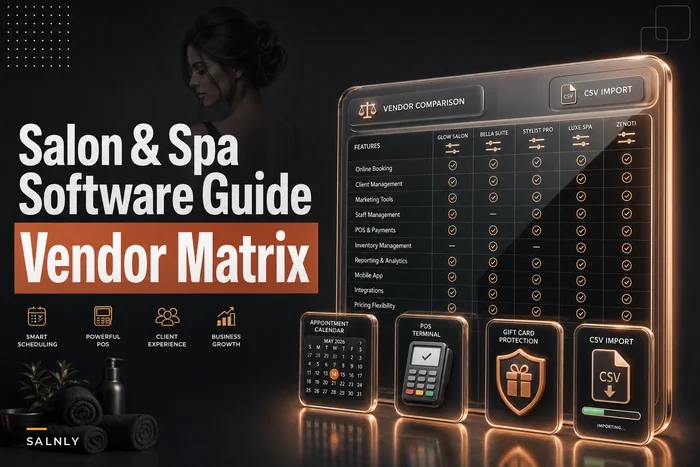
Purpose: an evergreen, vendor‑agnostic product discovery and comparison guide for salon and spa owners/managers who are at the awareness or consideration stage. This article fills the site gap for broad, head‑term discovery queries ("salon and spa software") without changing or cannibalizing the existing narrow buyer’s checklist page.
Scope and structure (recommended):
- Quick definition: what salon & spa software is and who uses it (150–200 words).
- 4 buyer personas: solo stylist, multi‑room day spa, multi‑location franchise, hybrid salon+retail (200–300 words total).
- Feature taxonomy: must‑have vs. nice‑to‑have features (appointments, POS/payments, client records/Loyalty, inventory, staff/commissioning, multi‑location management, reporting/analytics, integrations, mobile apps, security/compliance) with 1–2 lines explaining business value for each feature (400–600 words).
- Vendor categories and when to choose each (cloud‑first appointment apps, POS‑centric suites, enterprise/multi‑location platforms, all‑in‑one boutique solutions) (250–350 words).
- Side‑by‑side comparison matrix (interactive or downloadable spreadsheet) showing 8–12 representative vendors across categories and columns for core features, target size, price tier, integrations, support, and free trial availability.
- Pricing overview: typical price ranges and pricing models (per‑stylist, per‑location, flat subscription, transaction fees) with examples and how to compare TCO (200–300 words).
- High‑level migration & integration checklist (not step‑by‑step): data export/import types, timelines, common pitfalls (150–200 words).
- Quick decision flowchart: which category to shortlist based on business size and priorities (visual).
- FAQs and quick answers (structured for FAQ schema).
- CTAs and next steps: downloadable vendor comparison template, link to the deeper buyer’s checklist and pilot plan (internal link), request a demo/free trial guidance.
Format and SEO: 1,800–2,500 words, H2/H3 headings, comparison table (HTML + downloadable CSV), at least 6 optimized FAQs for schema, meta title ~55–60 chars including primary keyword, meta description 140–155 chars. Include SoftwareApplication and FAQ schema. Add internal link prominently to the existing buyer’s checklist: /blog/how-to-choose-salon-spa-software-a-practical-buyers-checklist. Visual assets: comparison table, persona illustrations, flowchart, sample screenshots of scheduling and POS UIs.
Conversion: primary CTA to download the comparison spreadsheet and secondary CTA to read the detailed buyer’s checklist (internal link).
Juan CabreraFounder of SoftWorks Global & Business Systems Researcher
Franchise-ready operational architecture: mandatory SOP library requirements, licensee scorecards, central support SLAs, compliance audit templates and licensee onboarding rules to scale brand consistency without dilution.
Juan CabreraFounder of SoftWorks Global & Business Systems Researcher
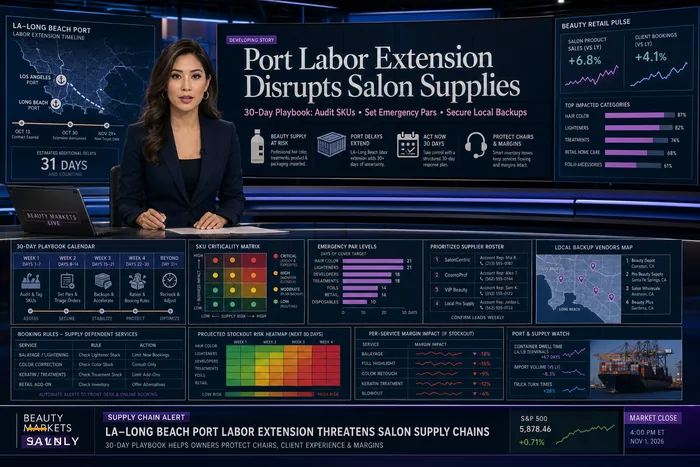
Explains the LA/Long Beach port labor extension, why it threatens salon supply chains ahead of the holidays, and gives a concise 30‑day playbook: audit critical SKUs, set emergency par levels, triage supplier orders, switch to local/backfill vendors, adjust booking rules for supply‑dependent services, and scripts to communicate shortages to clients.
Juan CabreraFounder of SoftWorks Global & Business Systems Researcher