


Most salon owners think they have a marketing problem. They don't. They have a coordination problem dressed up as a marketing problem.
The pattern plays out almost everywhere: an owner spends $1,500 on a "20% off first visit" promo, the phone rings, new clients book — and then the schedule collapses. Senior stylists are slammed, juniors sit empty, the front desk is apologizing to people who can't get a Saturday slot for three weeks, and half the new clients who did get in never rebook because the whole experience felt rushed. The campaign technically "worked" and still lost money.
The problem isn't the ad. It's that the ad had no idea how much capacity the salon actually had to sell. A salon customer acquisition system that doesn't talk to your booking calendar is basically a faucet with no drain gauge — you keep pouring with no idea whether the sink is full, empty, or already overflowing.
This article is about building that drain gauge: a pipeline where marketing spend is locked to real booking capacity, attribution is simple enough to run without an analytics hire, and you can actually reconcile what you spent against what came back.
The core idea: spend should follow open capacity, not the other way around
One sentence frames the whole thing: you should only be spending to acquire the demand you can actually serve profitably this month.
That sounds obvious until you look at how salons actually run campaigns. The budget gets set by what the owner feels comfortable spending, what's left in the account, or some vendor's recommended monthly minimum. None of those numbers have anything to do with how many open, high-value hours exist on the calendar over the next 30 days.
The mismatch goes both directions:
-
Over-spending into full capacity. The salon is already booked solid Thursday through Saturday, but ads keep driving demand into those exact windows. New clients can't get a slot, get annoyed, and don't come back. You paid to create a bad first impression.
-
Under-spending into open capacity. Tuesday mornings and the 2pm–4pm block run at 40% utilization week after week, but no campaign is specifically targeting those gaps. Inventory rotting on the shelf while marketing points elsewhere.
A campaign-to-capacity system fixes both by keeping one thing true at all times: how much you spend — and where you point it — is gated by where you actually have open, profitable hours.
Campaign-to-capacity gates: the mechanism that stops the bleeding
A "gate" is just a rule that says money can't flow unless a capacity condition is met. You're putting a valve between your ad budget and your booking system.
Stop losing appointments in the chaos.
Salnly helps you book, confirm & manage every appointment—efficiently.
- Centralized appointment management
- Client notifications
- Calendar & staff scheduling
No credit card required
Before any dollar gets committed for the next period, you check three things:
-
How many open hours do you have, and when? Split your week into blocks — prime vs. off-peak. A salon that's 90% booked in prime but 45% booked off-peak doesn't have a demand problem. It has a distribution problem. The gate routes spend toward off-peak.
-
What's the profitable fill target? You don't want 100% utilization. You want enough slack for walk-ins, rebookings, and overruns. Most salons run healthiest somewhere around 80–85% booked. The gate caps spend once projected demand would push a block past that.
-
Which chairs can take new clients? A new-client campaign that fills your single colorist's book while three junior stylists sit idle isn't acquisition — it's a bottleneck generator. Gates need to factor which capacity is open, not just how much.
> If projected bookings for a time block are tracking below target fill → open the gate, increase spend pointed at that block. > If tracking at or above target fill → close the gate, pause or redirect spend.
This is the part almost no one does. Everyone talks about "scaling what works," but scaling an ad that fills already-full Saturdays is how you burn money while feeling productive. The gate forces the question your calendar should be answering: do we even have room to sell this?
What breaks when you skip the gate
-
Front desk gets overwhelmed and starts turning away or over-booking.
-
New clients land in the worst available slots and get a rushed first visit.
-
Rebook rates on acquired clients crater — because a bad first appointment is the single biggest predictor of never seeing them again.
-
Your cost-per-acquired-client looks fine on paper but your cost-per-retained-client is brutal, and no one's measuring that.
If you want to go deeper on why the first visit makes or breaks the whole economics, the salon client lifecycle breakdown is worth reading alongside this — acquisition is only the front door of a much longer system.
Here's a simple visual of the gate workflow.
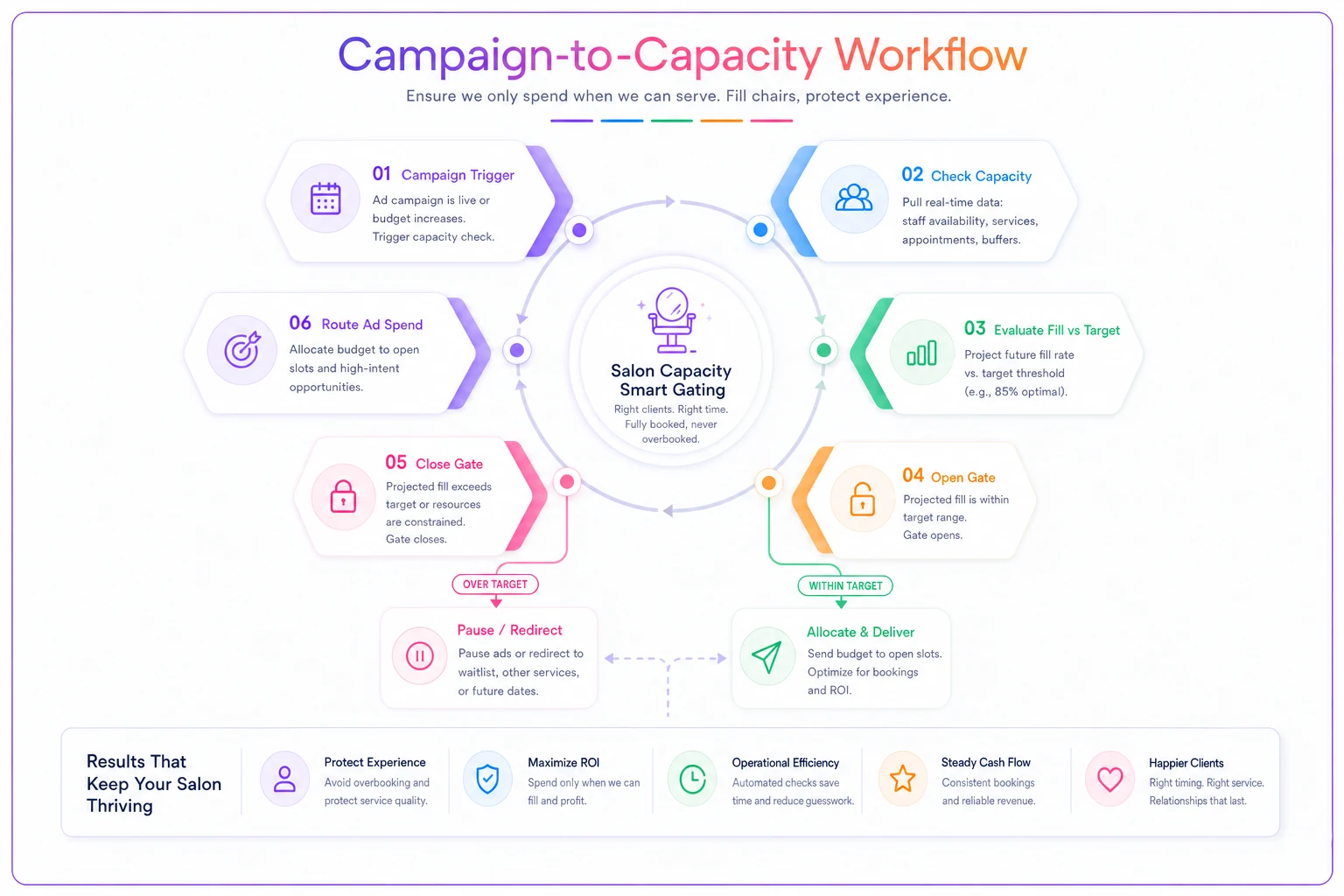
Putting the gate logic in place forces ad decisions to answer the calendar question first, not after the fact.
Attribution that a salon owner can actually run
Most attribution advice is useless for salons. Every marketing article tells you to "track attribution," then hands you a model built for an e-commerce store with tens of thousands of monthly transactions. You run a salon with a front desk, a phone, and a booking tool. You don't have an analytics team and you shouldn't need one.
Use simple salon-tailored attribution rules — a deliberately crude system that's right often enough to make real budget decisions, instead of a precise system nobody maintains.
Rules that hold up in real salons:
-
"How did you hear about us?" at booking, forced-choice. Not open text. Give 5–6 options: Instagram, Google, Friend/Referral, Walk-by, Promo, Other. Forced-choice beats a free text box that staff forget to fill.
-
Promo code = ground truth. If a campaign has a unique code or dedicated booking link, that's your cleanest signal. Treat it as the primary attribution and the "how did you hear" answer as secondary.
-
First-touch for new clients, last-touch for reactivations. New clients get credited to whatever brought them in the door. Lapsed clients coming back get credited to the reactivation campaign that reached them. Keeping these separate stops you from double-counting.
-
A 7-day window. If someone saw the ad and booked within a week, count it. Beyond that, stop trying to be clever. Salon decision cycles are short.
Is this perfectly accurate? No. Will it tell you whether your $800 Google spend produced 11 new clients or 2? Yes. That's the actual decision you need to make.
The mistake owners make is chasing precision they'll never use. You don't need to know a campaign drove exactly 14.3 clients. You need to know whether it's in the "working" bucket or the "dead" bucket, and roughly how profitable it was against the chair time it filled.
Budget templates built for experiments, not guesswork
Once spend is gated to capacity and attribution is simple, the budget stops being a lump sum and becomes a set of small, testable bets.
The structure that works is splitting the monthly budget into three tiers:
| Budget Tier | % of Spend | Purpose | Gating Rule |
|---|---|---|---|
| Proven | ~60% | Channels and campaigns with known cost-per-client and rebook rate | Scales up only while target capacity blocks are below fill |
| Testing | ~30% | New angles, off-peak offers, new channels | Fixed small budget per test with a hard stop date |
| Reserve | ~10% | Fill emergencies — a slow week or a cancellation wave | Released only when utilization drops below a set trigger |
The reserve tier is subtle and most people skip it. Demand is lumpy. When a block of cancellations hits or a holiday week runs soft, you want a pre-approved pool of money that can fire a same-day or same-week fill offer without an owner having to panic-approve spend. The gate for the reserve isn't "is this working" — it's "are we suddenly under capacity."
For the testing tier, the discipline that matters most is the hard stop date and a minimum sample. A test should run until it hits a predefined number of bookings or a predefined number of days — whichever comes first — then you kill it or promote it. No "let's give it another week" drift. That drift is where most salon ad budgets quietly die.
One caution: be careful your promos don't cannibalize full-price demand you already had. Pointing a discount at a block that was going to fill anyway is pure margin donation. The logic for protecting full-price slots while still filling the soft ones is covered in this piece on building a capacity-safe promo calendar — the two systems are meant to run together.
The reconciliation sheet: where the whole thing becomes real
Everything above is theory until you sit down at the end of the month and match money spent against capacity filled and clients retained. This is the part owners avoid because it feels like accounting. It's not. It's the feedback loop that makes next month's gates smarter.
A reconciliation sheet an owner can actually maintain has one row per campaign and these columns:
-
Spend — what you put in.
-
Attributed new clients — from promo codes plus "how did you hear."
-
Attributed revenue (first visit) — what those clients spent on visit one.
-
Target block filled? — did this campaign fill open hours, or already-full ones?
-
Rebook count (30 days) — how many came back. This is the number that separates real acquisition from vanity.
-
Cost per retained client — spend ÷ rebooked clients.
That last metric reorganizes everything. A campaign with a $22 cost-per-new-client looks great until you see only 1 in 5 rebooked, making your cost-per-retained-client $110. Another campaign at $38 per new client with a 50% rebook rate is quietly the better buy at $76 retained. The reconciliation sheet is the only place that truth shows up.
Running the reconciliation monthly
-
Pull total spend per campaign from each ad platform.
-
Pull new-client count per campaign from promo codes and the booking "how did you hear" field.
-
Tag each campaign
did it fill open capacity blocks or already-full ones?
-
Check the 30-day rebook count for each campaign's acquired clients.
-
Calculate cost-per-retained-client, not just cost-per-booking.
-
Promote winners into the Proven tier, kill losers, and re-set next month's gates based on which blocks are still soft.
This takes maybe 30–45 minutes a month once your booking tool is tagging sources cleanly. It compounds — every month your spend gets pointed more precisely at the capacity that's actually open and the clients who actually stay.
A real scenario
A two-location salon, roughly 11 chairs total, was spending around $2,800/month across Instagram and Google with a vague "grow new clients" goal. Bookings were technically up year over year, but profit wasn't moving. When they put together a reconciliation sheet for the first time, two things jumped out immediately.
Nearly 70% of their ad-driven new clients were booking into Thursday–Saturday prime slots that were already close to full — meaning the ads were mostly displacing clients who'd have come anyway, and generating a wave of "sorry, nothing available" calls. Meanwhile, their Tuesday-through-Thursday daytime blocks were running around 45% utilization with almost no spend pointed there.
They rebuilt the budget around capacity gates: capped prime-time acquisition spend, shifted the testing tier toward an off-peak daytime offer aimed at those soft blocks, and split attribution into first-touch vs. last-touch so they stopped double-counting reactivations as new clients.
Over about two months, off-peak daytime utilization moved from the mid-40s into the low-60s. Total ad spend actually came down slightly to around $2,400. And their 30-day rebook rate on acquired clients improved noticeably — because new clients were landing in calmer, properly-staffed windows instead of a packed Saturday where everything felt rushed. Same money, aimed at the right hours, produced clients who stayed.
When this system makes sense — and when it doesn't
This makes sense when:
-
You're spending real money on acquisition — say, over $1,000/month — with no clear read on what's working.
-
You have persistent soft blocks in your week that never seem to fill.
-
Your rebook rate on new clients feels lower than it should be and you suspect the first visit is the culprit.
This is a bad idea when:
-
You have zero open capacity and a waitlist. If you're turning people away every day, you don't need an acquisition system — you need pricing, staffing, or a third location. Spending to acquire demand you can't serve is lighting money on fire.
-
Your booking data is a mess. The gates and attribution depend on halfway-clean source tracking. If no one's filling in "how did you hear" and you have no promo codes, fix that first.
Who should not do this: a brand-new salon with no utilization history. You don't have capacity patterns yet to gate against. Spend your first few months learning your demand shape, then layer this on top.
Where the tooling actually helps (and where it doesn't)
You can run all of this in a spreadsheet, and plenty of owners do. The spreadsheet breaks at scale — specifically when you cross multiple locations, or when "check capacity before releasing budget" needs to happen weekly instead of monthly, or when nobody has time to pull the numbers by hand.
That's where operational software with AI automation earns its place — not by running your marketing for you, but by keeping the gate logic live without requiring someone to manually check it. The practical wins are mundane: the system reads your real-time utilization by block, flags when a capacity block is drifting below its fill target, and surfaces which campaigns are driving retained clients versus one-and-done bookings — automatically, instead of you reconstructing it from three separate dashboards. The AI automation piece is useful mostly for the tedious coordination work: tagging booking sources consistently, catching soft blocks before they go to waste, and reconciling spend against capacity without a manual export every week.
Automate booking-source tagging to avoid repeated manual reconciliation work each month.
The real friction it removes is the human bottleneck — the fact that the owner is usually the only one who knows how to check capacity and read the ad spend and decide what to pause. When that lives in one person's head, it only happens when they have a slow Sunday. Automating the signal part means the decision happens on time, not whenever someone gets around to it.
None of this replaces the operational fundamentals, though. If your booking flow leaks visitors before they confirm, no gate will save you — fixing that is upstream of everything here, and the booking-flow audit approach pairs naturally with this system.
The shift in thinking
The real change here isn't a tool or a template. It's a reframe: stop treating marketing as a growth lever and start treating it as a capacity-balancing tool.
A salon isn't a store with unlimited shelf space. Every unsold hour is gone forever, and every oversold hour damages the client who got squeezed into it. The job of acquisition spend isn't to generate "more" — it's to generate the right amount, pointed at the right hours, filled by the right chairs, by clients who'll come back. Gate the money to the calendar, keep attribution simple enough that you'll actually maintain it, and reconcile honestly every month. Do that consistently, and marketing stops being the thing that breaks your schedule and starts being the thing that smooths it out.
Ready to simplify your salon operations?
Join 1,000+ salons using Salnly to save time, reduce scheduling chaos, and deliver better client experiences.