
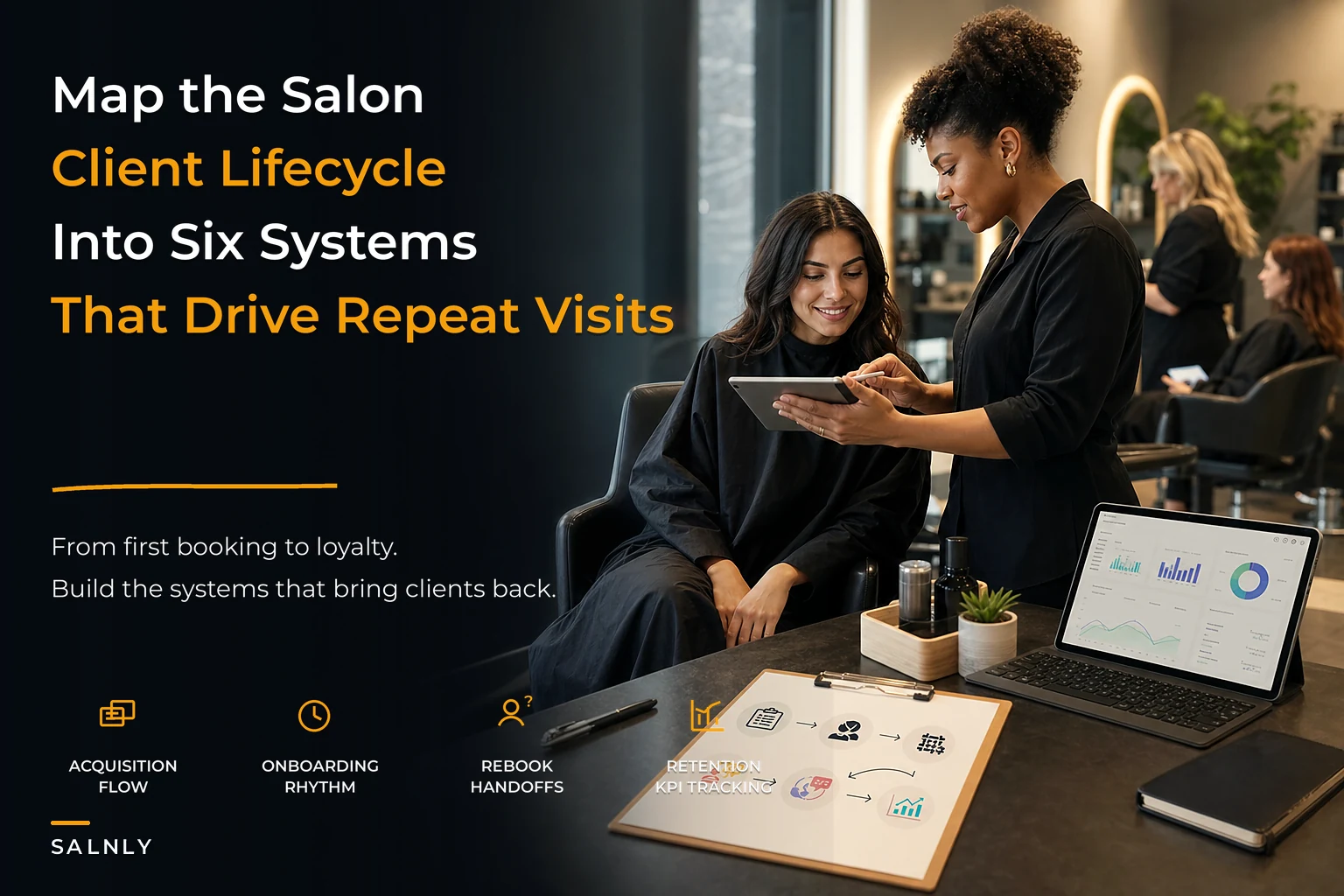

Most salons think about retention as one problem. Send birthday discounts. Train stylists to ask about rebooking. Maybe run a referral program. But after working with retention data across hundreds of salons, the pattern becomes obvious — retention isn't one system that breaks. It's six different systems that nobody connects.
A client's journey from stranger to regular involves completely different operational mechanics at each stage. The system that gets someone through the door won't keep them coming back. What works for visit three fails at visit ten. The loyalty program that excites new clients actually annoys three-year veterans.
When you map out the full salon client lifecycle operationally — not as marketing fluff but as actual workflow mechanics — you start seeing where clients really fall off. Usually it's not where owners think.
The acquisition trap that poisons everything downstream
A salon runs a Groupon offering 50% off highlights. They get 200 new bookings in two weeks. The owner celebrates. Three months later, those same clients have a 12% return rate while regular clients dropped their visit frequency because they couldn't get appointments during the promotion surge.
This happens because most salons treat acquisition as a volume game instead of a filtering system. The operational reality? Every client you acquire wrong costs you twice — once in the discount you gave them, and again in the opportunity cost of the right client you didn't get.
The acquisition system that actually feeds retention looks different:
Channel-to-service matching: Track which acquisition channels bring clients for which services. Instagram brings color corrections at $180+ average tickets. Google Ads brings basic cuts at $45. Yet most salons run the same offers everywhere. One salon started segmenting their new-client offers by channel — color consultations for Instagram, express blowouts for Google — and their 90-day retention jumped from 28% to 44%.
Capacity-aware intake: Your acquisition system needs to know your actual capacity, not your theoretical capacity. If your colorist is booked three weeks out, stop promoting color services to new clients. Route them to services with immediate availability. This sounds basic but most booking systems can't actually do this — they show all services regardless of realistic availability.
Pre-qualification friction: Not every client should book online instantly. High-touch services need a consultation call first. One salon added a required 5-minute phone consultation for any new client booking over $200 in services. Their no-show rate for those appointments dropped to nearly zero, and average ticket increased by $65 because stylists could properly set expectations.
The onboarding sequence everyone skips
Visit one is where you either create a relationship or a transaction. Most salons focus entirely on the service delivery but ignore the operational wrapper around it. The difference between 30% and 70% return rates often comes down to what happens in the 48 hours after that first appointment.
Stop losing appointments in the chaos.
Salnly helps you book, confirm & manage every appointment—efficiently.
- Centralized appointment management
- Client notifications
- Calendar & staff scheduling
No credit card required
A proper onboarding system has four operational checkpoints:
Intake documentation happens before they arrive, not in the chair. Send a digital form 24 hours before their appointment. Capture not just contact info but service history, product allergies, and style goals. This data feeds every downstream system. Store it somewhere the whole team can access it, not in one stylist's personal notes.
Service documentation during the visit. Take before photos for any color service. Document the exact formula used. Note processing time. Note their coffee order. These aren't nice-to-haves — they're operational data that makes visit two through ten actually work. The stylist who did their hair might be gone next time.
Post-visit touchpoint within 24-48 hours. Not a survey — nobody wants another survey. A simple text checking how their hair feels after sleeping on it, with care instructions specific to what was done. Include a photo of the products used on them. This one touchpoint lifts second-visit rates by roughly 20-25% based on salons that actually measure it.
14-day nudge with their next booking window. Don't wait for them to remember to book. Tell them when they should come back based on the service they received. "Based on your balayage, we should see you in 10-12 weeks. Here are Sara's available slots in that window." Make it stupid easy.
Salons that nail onboarding treat it like a production line, not a series of maybe-we'll-remember tasks. Every step has an owner, a timeline, and a backup plan if it doesn't happen.
In-chair rebooking: the 90-second window that matters
The best time to book the next appointment is always right now, while they're happy with their fresh style. But what usually kills in-chair rebooking: the stylist has to become a scheduler while their next client is already waiting.
The mechanical fix is splitting the rebooking process into two parts — commitment and scheduling. The stylist just needs to get the "yes" and a rough timeframe. Someone else handles the actual calendar Tetris.
The stylist ask: "Based on this color, I'd want to see you back in about 8 weeks to maintain it. Should we get something on the books?" That's it. No checking availability. No scrolling through the booking system.
The handoff: Walk the client to the desk. "She's ready to book her next appointment for mid-March." The front desk handles the actual scheduling. The stylist goes back to their chair.
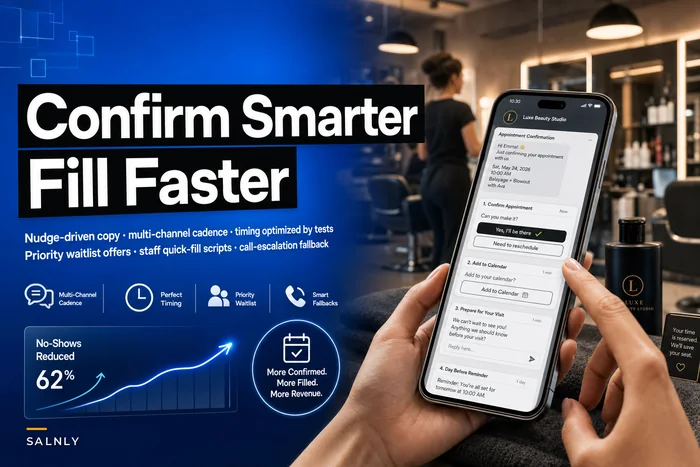
The confirmation: Send a text within 2 hours confirming the appointment details. Include the stylist's name, service booked, and estimated time. This catches any miscommunication before it becomes a problem six weeks later.
Create a one-line rebooking script for stylists and train front-desk staff on a fast handoff so rebooking doesn't slow service flow.
Salons that can't get in-chair rebooking above 40% usually have a handoff problem, not a sales problem. The stylist doesn't want to deal with scheduling, and the front desk doesn't know what the client needs. Building a clean handoff process fixes both issues.
The 30-60-90 day recall sequence
After that second visit, most salons go silent until the client decides to book again. This is where you lose the middle — clients who liked you but don't think about hair appointments until their roots are showing.
A systematic recall sequence runs on three triggers:
30 days post-visit: Product check-in. "How's that conditioning treatment holding up? If you're running low, we have 20% off this week." This isn't really about selling product. It's about maintaining the connection. Only about 8-12% will actually buy something, but nearly 40% will book their next appointment within two weeks of this message.
60 days post-visit: Booking reminder based on their service. Don't send the same message to someone who got a trim versus someone who got highlights. "Your highlights are probably growing out a bit — want to book a gloss to extend them?" Include available appointment times in the next two weeks.
90 days post-visit: The urgency trigger. "We haven't seen you in three months! Here's 15% off if you book this week." This is your last shot before they potentially find another salon. Make it worth their while to come back now versus later.
The critical part: these messages need to reference their actual service history. Generic "we miss you" emails get ignored. "It's been 12 weeks since your balayage with Sarah" gets bookings. This means your confirmation and communication system needs to track what was actually done, not just that they came in.
Year two-plus loyalty mechanics
Clients who've been coming for over a year need completely different treatment than new clients, but most salons treat everyone the same. Long-term clients don't want discounts — they want recognition and consistency.
Consistency protection: Guarantee their preferred appointment slots. After 12 visits, they should get first dibs on their favorite time slot. One salon reserves Tuesday 5pm for clients with 2+ years of history. Those spots don't go to new clients even if they're empty. This sounds like lost revenue but it's actually insurance — those long-term clients are worth 3-4x a new client.
Access perks: Early booking for holidays. First chance at new stylists' schedules. Priority waitlist for cancellations. These cost nothing but matter enormously to regulars. Create a simple tag in your booking system for 12+ visit clients and train your team to check it.
Surprise recognition: Not a points program — those are everywhere. Unexpected perks based on their history. After their 20th visit, comp their blowdry. On their three-year anniversary, upgrade their service without telling them beforehand. These surprises generate more word-of-mouth than any referral program.
The mistake salons make is trying to build complex membership programs when simple recognition systems work better for loyal clients. They don't want to think about points or tiers. They want to feel like VIPs without having to ask for it.
Measurement checkpoints that actually predict retention
You can't fix what you don't measure, but most salons track the wrong metrics. They watch monthly revenue and new client counts while missing the early warning signals that actually predict retention issues.
Acquisition Quality Score
| Metric | Target | Warning Sign |
|---|---|---|
| Channel ROI | 3:1 minimum | Under 2:1 |
| First-visit no-show rate | Under 15% | Over 25% |
| Average first ticket | 80% of overall average | Under 60% |
| Pre-booking rate | Over 40% | Under 25% |
Onboarding Completion
-
Digital intake form completed
Target 70%
-
Before photo taken
Target 100% for color
-
48-hour follow-up sent
Target 95%
-
14-day booking reminder sent
Target 90%
Momentum Metrics (Months 1-6)
-
Visit 1 to 2 conversion
Target 45-55%
-
Visit 2 to 3 conversion
Target 65-75%
-
Average weeks between visits
Track by service type
-
Service upgrade rate
Target 20% by visit 3
Loyalty Indicators (6+ months)
-
Visits per year
Target 6+ for color, 8+ for cuts
-
Pre-book rate
Target 70%+
-
Referral generation
1 per 10 visits
-
Service consistency
Same stylist 80%+ of visits
Businesses that actually improve retention review these numbers weekly, not monthly. They spot problems while they're still fixable — like when new client quality drops or onboarding completion slips.
The decision tree for fixing your weakest link
Every salon has a different breaking point in their client lifecycle. Identify yours:
If new client volume is fine but revenue is flat: Your problem is in onboarding or early retention. Focus on the first 90 days. Build the post-visit sequences. Fix your in-chair rebooking process.
If you're getting second visits but losing people after: Your recall sequence is broken. You're not staying connected between visits. Build the 30-60-90 day touchpoints.
If long-term clients are leaving: Your loyalty mechanics need work. They're feeling taken for granted. Start with consistency protection and surprise recognition.
If everything seems fine but growth is slow: Your acquisition is bringing the wrong clients. Tighten your channel-to-service matching. Add pre-qualification friction. Stop taking everyone who walks in.
Start with whatever's bleeding the most money. Fix that one system completely before moving to the next. Most salons try to fix everything at once and end up fixing nothing.
Building it all on systems, not heroics
The biggest shift successful salons make? They stop depending on amazing stylists to save their retention and start building operational systems that work regardless of who's working that day.
This means documenting every touchpoint. Creating templates for every message. Building checklists for every process. Training everyone on the same system. It's not creative or exciting work, but it's what creates predictable retention versus hoping this month is better than last month.
Here's a simple workflow to visualize how those systems connect.
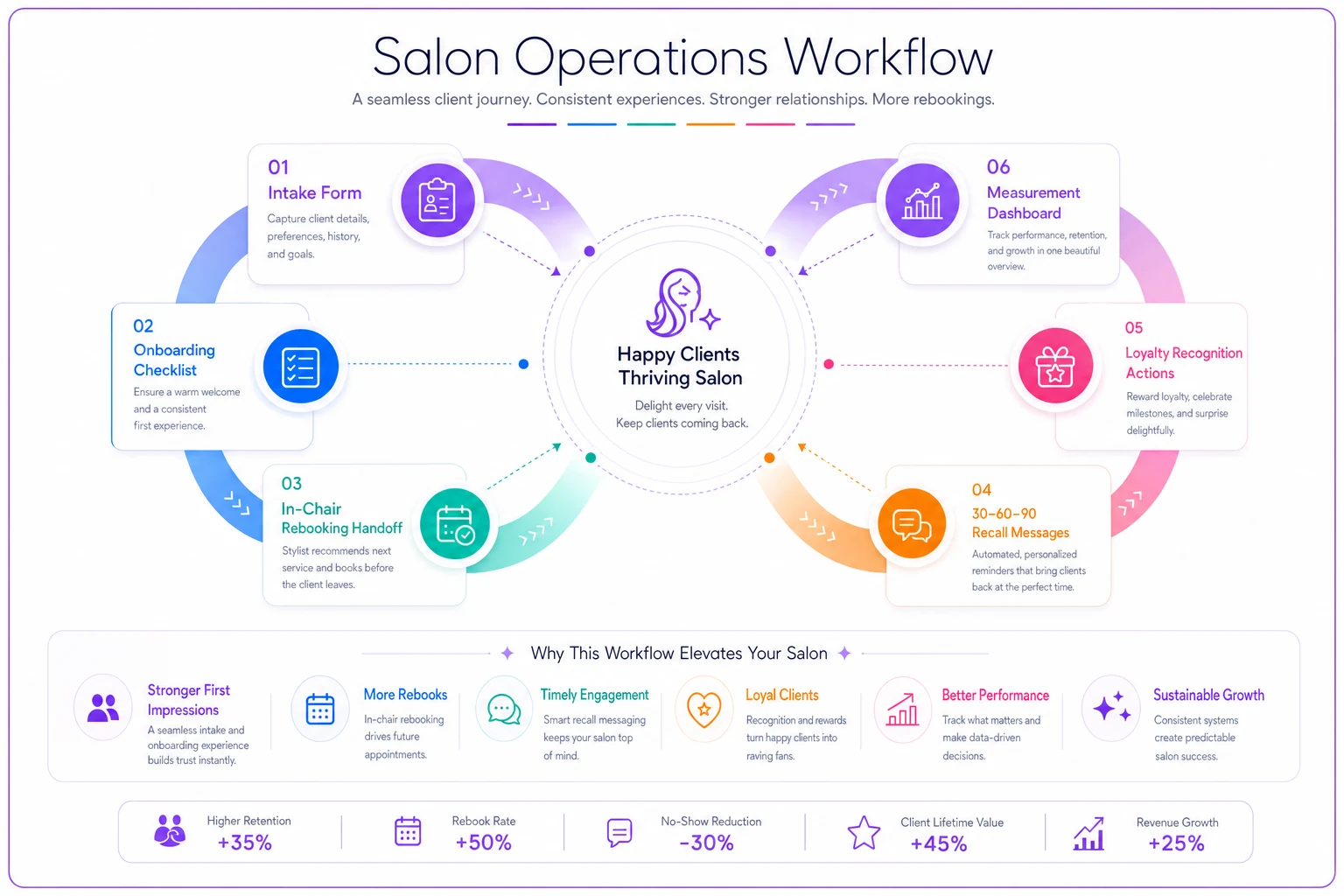
Salons crushing retention aren't necessarily better at hair. They're better at operations. They've mapped every step of the salon client lifecycle, identified where it breaks, and built systems to prevent those breaks.
When retention becomes systematic instead of accidental, that's when you stop chasing new clients and start building a business that actually compounds. Every client you keep is one you don't have to replace. Every system you build is one less thing to worry about tomorrow.
The question isn't whether you need these six systems. It's which one you're going to fix first. Because somewhere in your salon client lifecycle, money is walking out the door. The only question is whether you're going to build the system to stop it.
Ready to simplify your salon operations?
Join 1,000+ salons using Salnly to save time, reduce scheduling chaos, and deliver better client experiences.