


Your membership program launches with 50 sign-ups in the first month. Everyone's excited. Three months later, you're watching members book all your prime Saturday slots while walk-ins can't get appointments for two weeks. Your revenue looks stable on paper, but something feels wrong.
Then you run the numbers. Those $89 monthly members are getting $180 worth of services. Your best stylists are booked solid with discounted appointments. Meanwhile, full-price clients who used to spend $150 per visit are booking elsewhere because they can't get convenient times.
This is how most salon memberships fail — not dramatically, but through slow profit erosion that looks like growth.
Why standard membership models destroy salon economics
The typical salon membership follows a simple formula: pay monthly, get services at a discount. Maybe throw in a free add-on. Set it and forget it.
But salons aren't gyms. When someone pays for gym membership and doesn't show up, you make pure profit. When a salon member books their discounted service, you have real costs — product, labor, utilities, and most importantly, you've given away a chair that could have sold at full price.
Take a standard color membership. You charge $89 monthly for a service that normally costs $140. The member feels great about saving $51. But during a Saturday afternoon, that chair could have generated $140 from a walk-in, plus potentially another $60 in add-on services. Your actual opportunity cost isn't $51 — it's closer to $110 when you factor in lost upsell potential.
The math gets worse with usage patterns. Members who pay monthly feel entitled to book whenever they want. They'll grab your best slots because they're paying members. They'll book farther out because they know they're coming back. They're less likely to add services because they've already allocated their beauty budget to the membership.
Building salon membership mechanics that protect profitability
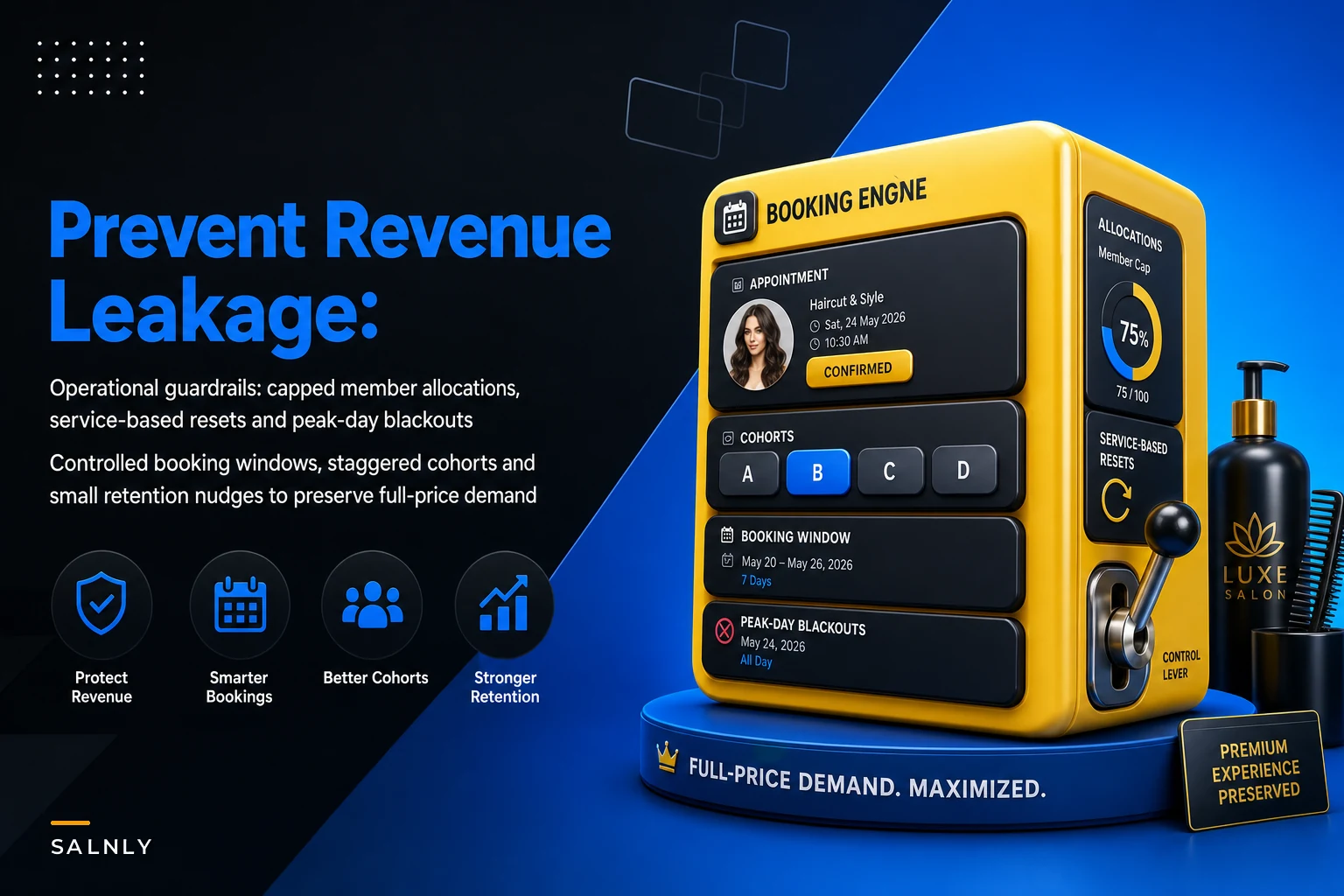
You need to design memberships with operational guardrails that protect your high-value capacity while still delivering member value.
Stop losing appointments in the chaos.
Salnly helps you book, confirm & manage every appointment—efficiently.
- Centralized appointment management
- Client notifications
- Calendar & staff scheduling
No credit card required
Schedule caps that preserve prime time
Most salons treat all appointment slots equally. Tuesday at 2pm costs the same as Saturday at 11am. But operationally, these slots have completely different values.
A Saturday morning slot during wedding season might generate $200+ between service and retail. That same service on a Wednesday afternoon might barely break $100. Yet standard memberships let members book either slot at the same discounted rate.
Smart membership programs use dynamic scheduling caps. During peak hours (typically Friday evening through Sunday afternoon), you might limit membership bookings to 30% of available chairs. During slower periods, that cap might increase to 70%.
This looks like: You have six stylists working Saturday morning. Under the 30% cap, only two chairs can be booked by members during any given hour. The other four remain available for full-price services. Members can still book Saturday if they plan ahead, but you're not giving away your entire prime capacity at discount rates.
Some salons use graduated caps. The first 20% of peak slots are available to all members. The next 10% are only available to members who've been active for six+ months. This rewards loyalty while protecting capacity.
Use graduated caps to reward long-term members while protecting your highest-value hours.
Fulfillment cadence that smooths demand
The worst membership mistake is letting members book whenever they want without any structure. You get clustering — five members all wanting appointments the same Saturday, then nothing for two weeks.
Effective memberships build in fulfillment cadence. Instead of "one service per month," you create windows. A color membership might specify service must be booked between the 15th and the 30th of each month. A treatment membership might require booking in the first two weeks.
This sounds restrictive, but it actually helps members. They develop a routine. They know when to book. Most importantly, you spread demand across your calendar instead of everyone competing for the same peak slots.
One approach that works: assign members to cohorts based on their join date.
-
Members who join 1-10 of the month are "early month" members who book in the first half.
-
Members who join 11-20 are "mid month" members.
-
Those who join 21-31 are "late month" members.
This natural segmentation happens automatically and prevents clustering.
Blackout rules that actually make sense
Every salon knows they should have blackout dates for memberships. Few implement them effectively. The typical approach — blocking December entirely — just annoys members who've been paying all year.
Better blackout rules work surgically. Instead of blocking entire months, block specific high-demand periods: the three days before major holidays, prom weekend, the local festival that brings tourists to town. These targeted blackouts preserve your highest-value capacity while still giving members plenty of booking options.
Even more effective: graduated blackouts based on membership tier. Your basic membership might have 15 blackout days annually. Your premium membership might have only 5. This creates a natural upgrade path while protecting revenue.
The key is communication. Members need to know blackout dates when they sign up, not when they try to book. Include them in your membership agreement. Post them in your booking system. Send quarterly reminders.
Booking windows that create urgency without frustration
How far ahead can members book? Too far, and they lock up your calendar months in advance. Too short, and they can't plan their lives.
The sweet spot for most salons is a 3-4 week booking window for standard memberships. Members can book their next appointment up to 28 days out, but no further. This gives them reasonable planning ability while preserving your flexibility for full-price bookings.
| Membership Tier | Booking Window |
|---|---|
| standard memberships | 3-4 week booking window (up to 28 days) |
| Premium memberships | 6 weeks |
| VIP memberships | 8 weeks |
But here's the operational detail that matters: the booking window should reset based on service completion, not calendar date. If a member gets their color on the 5th, their next booking window opens immediately for 28 days from the 5th. If they wait until the 20th to book, they've lost 15 days of their window. This creates natural urgency without being punitive.
Simple retention levers beyond discounts
Most memberships rely entirely on discounts for retention. Member pays $89, gets $140 service, saves money, stays subscribed. But this single-lever approach means you're always competing on price.
Smarter memberships layer in operational benefits that cost you nothing but create real member value. Priority waitlist access when cancellations happen. The ability to request specific stylists without upcharge. Extended booking hours — members can book online until 10pm while non-members cut off at 8pm.
Product perks work especially well. Members get 15% off retail, but more importantly, they can reserve new products before they hit the floor. They get first access to limited edition holiday sets. They can pre-order their regular products for guaranteed availability.
The technical touches matter too. Members might get booking confirmations via text while non-members only get email. They might see their stylist's real-time availability while non-members see generic "request appointment" buttons.
When memberships enhance vs. erode salon profitability
Not every salon should offer memberships. The model works when specific conditions exist in your operation and market.
Memberships make sense when you have consistent valleys in your schedule. If Tuesday through Thursday afternoons are consistently below 60% utilization, memberships can fill that capacity at contribution margin instead of sitting empty. The key is ensuring your membership mechanics push fulfillment toward these valleys, not your peaks.
They also work when you have a clear service progression path. Color members who eventually need treatments. Treatment members who add styling services. Extension members who need regular maintenance. The membership becomes an entry point to higher lifetime value, not a discount trap.
High fixed cost services benefit most from membership models. A color service might have $20 in product costs against an $140 price. Even at membership rates, you're covering variable costs and contributing to overhead. But a $40 express service with $8 in product costs leaves little margin for discounting.
Memberships fail when your schedule is already near capacity. If you're consistently above 85% utilization, adding discounted demand just displaces full-price revenue. They also fail when your clientele is purely transactional — tourists, event-driven bookings, one-time visits. These clients won't sustain monthly payments.
The geographic test matters too. Suburban salons with consistent clientele often see better membership performance than downtown locations with transient populations. College towns need to account for summer exodus. Resort areas must handle seasonal swings.
The operational blueprint for sustainable membership programs
After watching hundreds of membership programs launch and fail, clear patterns emerge around what separates sustainable programs from margin eroders.
Start small and test mechanics. Launch with 20-30 members max, even if demand is higher. You need to see how real members behave — when they book, what they request, how they respond to limits. It's much easier to adjust rules with 30 members than 300.
Track the right metrics from day one. Not just membership count and monthly recurring revenue, but utilization patterns, displacement rates, and lifetime value changes. What percentage of peak slots go to members? How many full-price bookings are you turning away? Are members adding fewer services than before they joined?
Build the operational infrastructure before you scale. Your booking system needs to enforce caps automatically. Your team needs to understand the rules and why they exist. Your confirmation sequences need to remind members of their windows and restrictions. Manual enforcement doesn't scale and creates inconsistency.
Price based on true economics, not competitive pressure. Calculate your real cost per service including labor, product, utilities, and overhead allocation. Add your minimum acceptable margin. That's your floor. If the membership price doesn't clear that hurdle, you're subsidizing clients at your own expense.
The technology layer that makes complex memberships manageable
Managing sophisticated salon membership mechanics manually is nearly impossible. You're tracking different caps for different time periods, enforcing blackout dates, managing booking windows, monitoring utilization rates. One person trying to juggle this in spreadsheets will make mistakes that cost money and frustrate members.
Operational software becomes essential here. Modern platforms can enforce schedule caps automatically — members simply don't see slots that exceed capacity limits. Booking windows open and close based on individual member timelines. Blackout dates apply system-wide without front desk intervention.
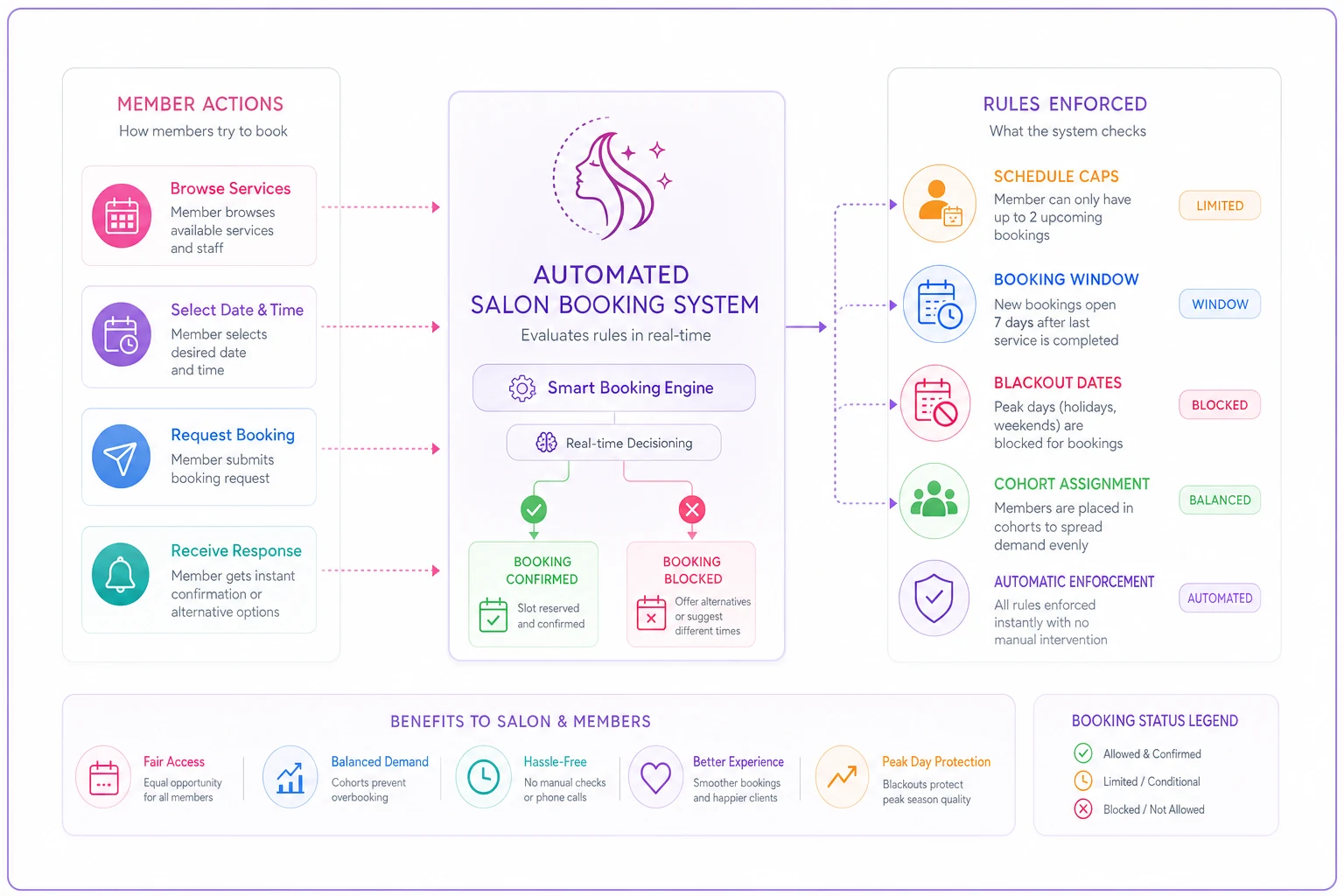
The AI automation layer helps predict patterns and adjust rules. If the system notices members consistently cluster bookings around certain dates, it can suggest cadence adjustments. If utilization in certain periods stays too low, it can recommend cap modifications. These insights surface patterns humans might miss in daily operations.
More importantly, automated systems eliminate the awkwardness of enforcement. Your front desk doesn't have to tell a longtime member they can't book Saturday because of capacity caps. The system simply shows available options within their membership parameters. Rules apply consistently without confrontation.
The reporting component reveals what's actually happening versus what you think is happening. You might believe members are spreading their bookings evenly, but data might show 70% clustering in the same week. You might think your blackout dates are protecting peak revenue, but analysis might reveal you're blocking periods that aren't actually peak demand.
Making the membership transition without disrupting current operations
The biggest risk in launching sophisticated membership mechanics isn't the program itself — it's the transition. You have existing clients with expectations. Your team has established workflows. Your schedule has natural rhythms.
Start with a pilot program positioned as "founding member" benefits. Limit it to 20-30 spots. Make it clear this is a test program that will evolve. This framing gives you flexibility to adjust rules based on what you learn without seeming inconsistent.
Communicate the why behind the rules, not just the what. Don't just tell members they can't book more than 4 weeks out — explain that this ensures all members get fair access to appointments. Don't just announce blackout dates — clarify that this helps the salon maintain sustainable pricing the rest of the year.
Phase in restrictions gradually. If you're implementing schedule caps, start at 50% for the first month, then tighten to 30% based on utilization patterns. If you're adding booking windows, begin with 6 weeks and shorten as members adjust. Sudden strict limits create rebellion; gradual adjustment feels natural.
Train your team on the economics, not just the rules. When they understand that unrestricted membership bookings could cost everyone hours or commissions, they become advocates for the program structure. When they see how proper mechanics protect the salon's ability to pay competitive wages, they enforce guidelines enthusiastically.
The real numbers behind properly structured memberships
A salon with six stylists and roughly $45,000 in monthly service revenue launches a membership program. Without proper mechanics, they sign up 100 members at $89/month for color services. Sounds like $8,900 in guaranteed monthly revenue.
But those 100 members start booking. They take prime Saturday slots. They cluster around paydays and holidays. Full-price clients can't get appointments. The salon's still doing $45,000 in monthly revenue, but now $8,900 is at membership rates for services that should generate $14,000. They've effectively given away $5,100 in margin.
Same salon, but with proper membership mechanics. They cap membership bookings at 30% during peak hours and 60% during valleys. They implement 4-week booking windows. They create "early month" and "late month" cohorts to spread demand. They blackout the three days before major holidays.
Now those 100 members naturally distribute across the schedule. Maybe 30% of their bookings hit peak times (where caps limit damage), while 70% fill previously empty weekday slots. The salon maintains their $45,000 monthly revenue, adds $8,900 in membership fees, but only sacrifices about $2,000 in margin from peak-time displacement. Net gain: $6,900 monthly in mostly incremental revenue.
The difference between breaking even and adding $80,000 annually to your bottom line comes down to operational discipline in your membership design.
Moving forward with sustainable membership mechanics
The temptation with memberships is to launch simple and hope for the best. Flat monthly rate, discount on services, see what happens. But hope isn't an operational strategy, especially when you're essentially selling future capacity at a discount.
Sustainable salon membership mechanics require thinking like an airline, not a gym. Every seat (or chair) has different value at different times. Your job is to maximize revenue per available hour while still delivering member value. This means rules, restrictions, and technology to manage complexity.
But don't let complexity paralyze you. Start with one or two key mechanics — maybe schedule caps and booking windows. Test with a small group. Gather data. Adjust based on reality, not theory. Build from what works, abandon what doesn't.
The salons thriving with memberships aren't the ones offering the deepest discounts or the simplest terms. They're the ones who've figured out how to align member behavior with operational reality. They've built programs that fill valleys without destroying peaks, create predictability without sacrificing flexibility, and generate recurring revenue without eroding margins.
Your membership program should make your operation stronger, not subsidize services at your own expense. With the right mechanics in place, it becomes a profit center that also deepens client relationships. Without them, it's just a very expensive loyalty program that slowly bleeds your business dry.
The path forward is clear: design with operations first, add technology to manage complexity, and never forget that every discounted service has an opportunity cost. Get these fundamentals right, and memberships become a growth lever. Get them wrong, and you're just training your best clients to pay you less.
Ready to simplify your salon operations?
Join 1,000+ salons using Salnly to save time, reduce scheduling chaos, and deliver better client experiences.