



You check your booking software, your POS reports, maybe that spreadsheet you update when you remember. Revenue looks decent. Client count seems stable. But profit? That's where things get fuzzy.
Most salon owners track vanity metrics while the real profit drivers slip through the cracks. Not because they're lazy or don't care — but because the connection between daily actions and monthly profit isn't obvious until you map it out.
After working with hundreds of salons, this pattern keeps showing up: profitable salons don't just track different numbers, they understand which operational levers actually move those numbers. They know retail sales per client jumps when stylists mention products during specific moments in the service. They recognize that rebook rates climb when the front desk follows a particular sequence at checkout.
The difference between a salon scraping by at 8% profit margins and one cruising at 22% usually comes down to about six key metrics and the daily habits that influence them.
The profit equation hiding in plain sight
Walk into any moderately successful salon around 2 PM on a Thursday. You'll see stylists working, clients waiting, products selling. Looks productive. But profitability lives in the gaps between what looks busy and what actually generates margin.
Take service efficiency. One salon with four chairs might push through 280 clients monthly while another handles 340. Same hours, same staff levels. The difference? The second salon reduced their average service time by twelve minutes through better prep workflows and eliminated those awkward gaps between appointments.
Those twelve minutes compound. At $65 average ticket, that efficiency gap translates to roughly $3,900 monthly revenue difference. Factor in that the efficient salon has the same fixed costs — rent, utilities, base wages — and suddenly we're talking about most of that $3,900 dropping straight to profit.
You can't just tell stylists to work faster. Speed without system creates mistakes, unhappy clients, and burnout. The operational levers that actually work are surprisingly mundane. Color mixing happens during processing time for the previous client. Consultation forms get filled out digitally before arrival. Cleaning protocols overlap instead of creating dead time.
The same dynamic plays out across every profit driver in the salon. Retail sales, membership conversions, service upgrades — each has specific operational triggers that either happen consistently or get forgotten in the daily chaos.
Why traditional KPI tracking fails salons
Pull up any salon management article and you'll find the same metrics: revenue per square foot, utilization rate, average ticket price. Useful for comparing yourself to industry benchmarks, nearly worthless for actually improving operations.
Stop losing appointments in the chaos.
Salnly helps you book, confirm & manage every appointment—efficiently.
- Centralized appointment management
- Client notifications
- Calendar & staff scheduling
No credit card required
The breakdown happens because these high-level metrics are outcomes, not drivers. Knowing your utilization sits at 67% doesn't tell you whether the problem stems from scheduling gaps, slow service delivery, or too many no-shows. It's like knowing you're overweight but not understanding whether the issue is portion sizes, snacking habits, or metabolism.
Real salon profitability metrics need three things most KPI frameworks miss. First, they must connect directly to specific daily actions. Second, they need to be measurable without complex calculations. Third, they must account for the interdependencies that define salon operations.
Consider chemical costs. The traditional metric tracks cost as a percentage of service revenue, usually targeting 5-8%. But that aggregate number obscures the real profit leaks. One colorist might use 20% more product achieving the same result. Another might recommend treatments that boost ticket price but actually reduce margin because of product cost. A third might nail the technical efficiency but forget to recommend the take-home treatment that would triple the profit on that service.
The metrics that actually drive profitability live one level deeper. Instead of "chemical cost percentage," you track "product used per service type" and "retail attachment rate by stylist." Instead of "client retention," you measure "rebook rate at checkout" and "return rate for new clients within 60 days."
The six KPIs that actually predict salon profit
Looking at operational data from salons ranging from single-chair studios to 15-station operations, six metrics consistently separate the profitable from the struggling:
| KPI | Details |
|---|---|
| 1. Pre-book rate at checkout | Not overall rebooking percentage, but specifically the percentage of clients who schedule their next appointment before leaving. Top performers hit 75-80%, average salons hover around 40%. Every 10% improvement here typically adds 2-3% to profit margins through reduced marketing costs and more predictable scheduling. |
| 2. Service time variance | The gap between scheduled service time and actual completion. Profitable salons keep this under 8 minutes average variance. When it creeps above 15 minutes, cascade failures multiply — rushed services, skipped upsells, stressed staff, declining retail attachment. |
| 3. New client return rate (first 60 days) | Forget lifetime value calculations. The single best predictor of long-term profitability is what percentage of new clients come back within two months. Strong salons see 65% or higher. Below 45% signals fundamental service or pricing problems. |
| 4. Revenue per labor hour | Not revenue per stylist or per day, but per actual worked hour including assistants and front desk. Target varies by market, but profitable salons consistently generate $90-120 per labor hour. This metric immediately reveals overstaffing, inefficient service mix, or pricing problems. |
| 5. Daily chemical waste rate | Measured in dollars, not percentages. Track actual product disposed of each day — excess color, opened but unused treatments, expired inventory. Profitable salons waste less than $40 daily. Struggling ones often hit $100+ without realizing it. |
| 6. Membership/package active rate | Of clients who purchased a membership or package, what percentage actively use it? High-profit salons maintain 70%+ active rates. Low rates signal poor package design or weak follow-up systems, leading to refund requests and lost recurring revenue. |
These aren't the only metrics that matter, but they're the ones that directly connect to daily operational decisions. More importantly, they're leading indicators — they predict next month's profit, not just report last month's results.
Connecting metrics to daily operational levers
A metric without an operational lever is just trivia. The breakthrough comes from mapping each KPI to the specific daily actions that move it.
Pre-book rate at checkout sounds like a front desk metric, but the operational levers stretch throughout the service. Top-performing salons embed rebooking into the service conversation. While processing color, stylists casually mention seasonal changes that'll affect the client's next service. During blowdry, they reference the maintenance schedule. By checkout, the next appointment feels inevitable, not optional.
The daily checklist looks deceptively simple:
-
Stylists mention next appointment timing during service
-
Front desk offers appointment before running payment
-
Confirmation text includes next appointment date if booked
-
Weekly review of who didn't pre-book and why
But the consistency of execution determines whether pre-book rates hit 40% or 75%. One salon increased their rate from 45% to 72% over three months just by having stylists write the recommended return date on a card during service — a 10-second action that transformed their booking predictability.
One salon increased their rate from 45% to 72% over three months just by having stylists write the recommended return date on a card during service — a 10-second action that transformed their booking predictability.
Service time variance requires different levers entirely. The intuitive approach — rushing through services — backfires immediately. Instead, profitable salons focus on preparation and transition efficiency.
Their daily operational rhythm includes:
-
Morning huddle reviews each stylist's day with potential bottlenecks flagged
-
Assistants prep next client's station during current service processing time
-
Color formulas get pre-mixed during previous client's rinse
-
Check-in happens via text before arrival to handle consultations
The variance shrinks not through speed but through eliminated friction. One salon reduced average variance from 18 minutes to 7 minutes primarily by moving consultation questions to their online booking form. Clients answered while booking, stylists reviewed before arrival, service started immediately upon seating.
New client return rate depends heavily on first-visit experience design. But the operational levers aren't what most assume. Welcome tours and fancy refreshments matter less than three specific touchpoints:
First, the 24-hour follow-up. Not a generic "thanks for visiting" but a specific text asking about their styling experience at home. "How did your blowout hold up this morning?" opens a conversation that generic messages don't.
Second, the two-week check-in. This timing catches color services right when grow-out becomes noticeable, cuts when they start losing shape. The message references their specific service and suggests booking their maintenance appointment.
Third, the new client offer for visit two. But here's the operational key — the offer gets mentioned during the first service, not pitched afterward. "I'm going to send you our new client package that includes a complimentary treatment with your next color" plants the seed without feeling salesy.
Salons executing these three touches see return rates above 65%. Miss any of them and the rate drops below 50%.
Building your daily profit dashboard
The most sophisticated tracking system means nothing if nobody looks at it. Profitable salons build simple, visual dashboards that take under two minutes to update daily.
Here's the framework that actually gets used:
Morning Metrics (tracked at opening):
-
Yesterday's pre-book rate (simple percentage)
-
Today's expected revenue per labor hour (scheduled services divided by scheduled hours)
-
Open chair time (any gaps over 30 minutes)
Afternoon Checkpoint (2 PM):
-
Actual vs scheduled timeline (are we running behind?)
-
Retail units sold so far
-
Walk-in or same-day booking conversions
Evening Wrap-up (closing):
-
Actual revenue per labor hour
-
Chemical waste in dollars
-
Tomorrow's problem spots (double-bookings, complex services, new staff)
The physical format matters more than the technology. One highly profitable salon uses a simple whiteboard with pre-drawn columns. Another built a Google Sheet that takes 30 seconds to update from their phone. The fancy dashboard software they bought three years ago sits unused because it required too many clicks.
A simple daily update and trigger workflow looks like this.
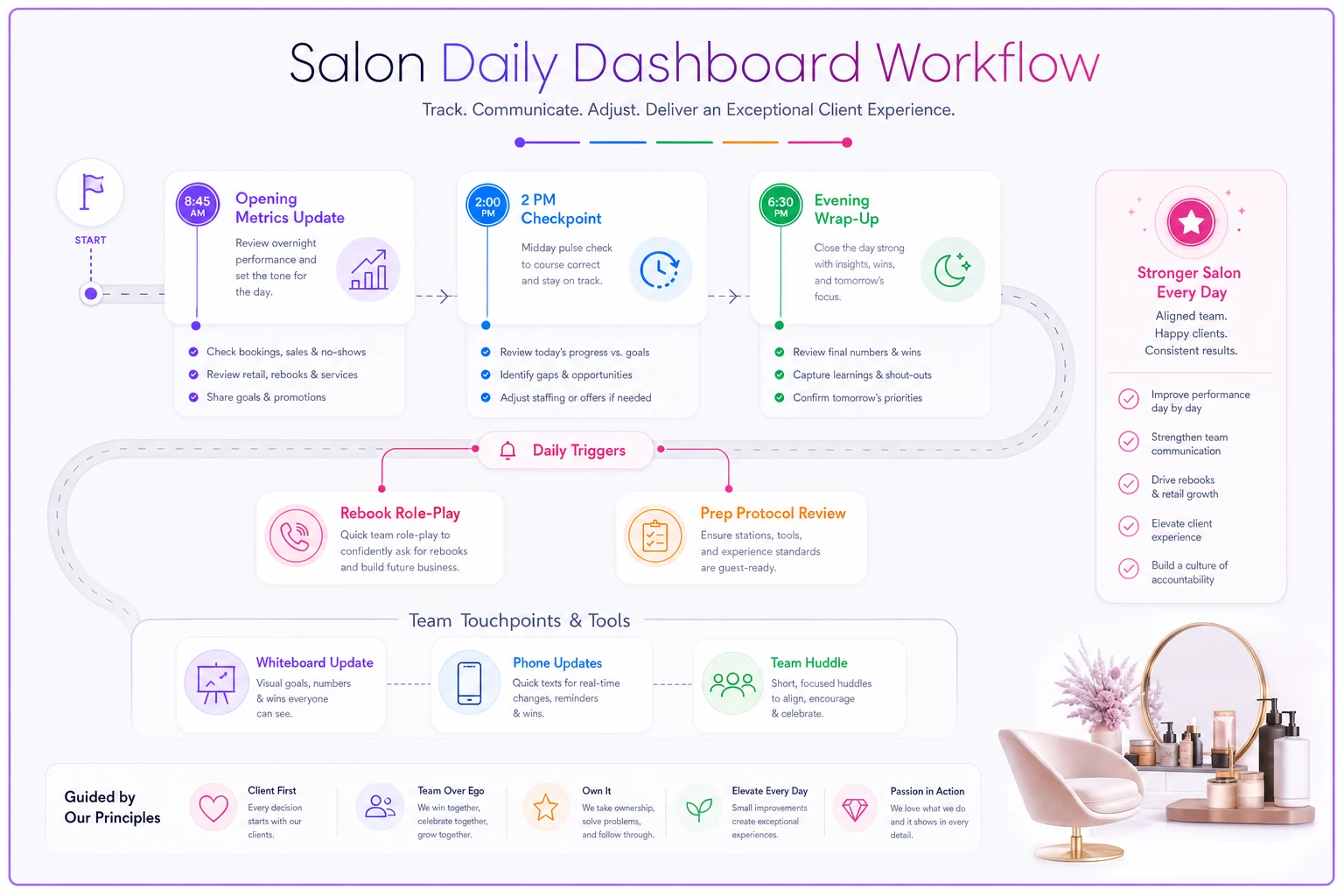
The dashboard becomes powerful when paired with clear response triggers. When pre-book drops below 60%, tomorrow's morning huddle includes a role-play session on rebooking conversations. When service variance exceeds 10 minutes average, the team reviews prep protocols that afternoon.
This responsive adjustment — metric drops, specific action follows — separates profitable salons from those that track numbers without improving them.
The owner's weekly profitability checklist
Daily dashboards tell you what's happening. Weekly reviews reveal patterns and drive systematic improvements. Most effective owners follow a structured weekly review that takes about 45 minutes every Monday morning.
Week-over-week comparison:
-
Did each of our six key metrics improve or decline?
-
What specific events or decisions correlated with changes?
-
Which stylist or shift showed the biggest variation?
Operational lever audit:
-
Which daily actions from our checklist got skipped?
-
What prevented consistent execution?
-
Where did the system break down versus people not following it?
Profit impact calculation:
Take your worst-performing metric and calculate the monthly profit impact if it matched your best week's performance. This creates urgency and clarity around which improvement would matter most.
System adjustment decision:
Based on the patterns, pick ONE operational change for the coming week. Not three improvements, not a complete overhaul. One specific adjustment to one operational lever. Maybe it's adding a timer to chemical mixing to reduce waste. Perhaps it's having the front desk stand up during checkout to improve pre-booking conversations.
The constraint of one change per week prevents overwhelming the team while ensuring continuous improvement. Over a quarter, that's twelve operational improvements. Most salons attempt three massive changes per year that never quite stick.
Team communication plan:
Decide how you'll explain this week's focus to the team. Which metric are we improving? What specific actions are we taking? How will we know if it's working?
One salon owner turned this into a game, posting the weekly focus metric on a visible board with a target line. Hit the target three days in a row and everyone gets a small bonus. Simple, clear, and surprisingly effective at driving behavioral change.
When metrics become overwhelming (and what to do about it)
Around month two of serious metric tracking, most salon owners hit a wall. The dashboards multiply. The spreadsheets grow complex. The team starts rolling their eyes at another number to track. This is exactly when most salons abandon measurement and slip back into flying blind.
The overwhelm happens because of metric creep — the gradual addition of "interesting" numbers that don't drive specific actions. You start tracking average ticket price by day of week. Then by stylist. Then by service type. Suddenly you're drowning in data that reveals patterns but doesn't suggest solutions.
The solution is quarterly metric pruning. Every three months, review everything you track and ask: "Did we make a specific operational change based on this number in the past quarter?" If not, stop tracking it.
This feels wasteful if you've built elaborate tracking systems. But profitable salons understand that focus beats completeness. Six metrics with clear action triggers outperform thirty metrics that create analysis paralysis.
The other overwhelm trigger is perfectionism around data accuracy. One missed day of tracking and owners abandon the entire system. But 80% accuracy with consistent action beats 100% accuracy with no follow-through. If you miss capturing Tuesday's waste number, estimate it and move forward.
The AI-powered tracking advantage
Manual tracking works until it doesn't. Usually around 150 monthly clients, the time required to calculate these metrics starts eating into actual operational improvements. You spend Sunday nights with calculators instead of planning Monday's improvements.
This is where AI-powered operational software starts making sense — not as a magic solution but as a tool that automates the tedious parts of performance tracking. Modern platforms can pull data from your booking system, POS, and even time tracking tools to calculate your key metrics automatically.
The real advantage isn't just time savings. It's pattern recognition. AI automation can spot correlations humans miss — like how pre-book rates drop specifically on Thursdays when a certain combination of stylists work together, or how chemical waste spikes whenever specific service combinations get scheduled back-to-back.
Some salons now use AI agents to send those critical follow-up texts automatically, personalizing them based on service type and stylist notes. The 24-hour check-in that drives new client returns happens without anyone remembering to send it. The pre-appointment reminder includes specific preparation instructions based on the scheduled service.
The technology only amplifies good operational practices though. A salon with unclear metrics and inconsistent execution won't suddenly become profitable because they bought software. The foundations — understanding which metrics matter, connecting them to operational levers, and maintaining daily disciplines — have to exist first.
Making this work in your salon
You could implement everything mentioned here tomorrow. You'd probably last about a week before the complexity crushed your enthusiasm. Instead, profitable salons phase their implementation over roughly six weeks.
Weeks 1-2: Baseline measurement
Pick just three of the six metrics. Track them daily without trying to improve them. You're establishing baselines and building the tracking habit. Most salons start with pre-book rate, service time variance, and revenue per labor hour since these require no new tools to measure.
Weeks 3-4: Single lever focus
Choose the worst-performing metric from your baseline. Implement daily operational levers for just that one metric. If pre-book rate is lowest, focus entirely on checkout conversations and follow-up systems. Ignore the temptation to fix everything simultaneously.
Weeks 5-6: Expand and systematize
Add the remaining three metrics to your tracking. Start the weekly review process. Build your simple dashboard in whatever format your team will actually use. The habit patterns from the first month make this expansion manageable.
After six weeks, you'll have a functioning profitability management system. Not perfect, not comprehensive, but infinitely better than flying blind.
The compound effect of operational discipline
A salon implementing this framework rarely sees dramatic overnight changes. Pre-book rates might climb 5% monthly. Service variance might shrink by two minutes every few weeks. Chemical waste might drop by $5 daily.
Individually, these improvements feel minor. But operational improvements compound in ways that surprise even experienced owners. That 5% monthly improvement in pre-booking becomes a 20% improvement over a quarter. The scheduling becomes predictable enough to optimize staff scheduling. Marketing costs drop because you're filling fewer emergency gaps.
The two-minute service variance improvement means fitting in one extra client daily. At $75 average ticket, that's roughly $1,650 additional monthly revenue with zero additional cost. The $5 daily waste reduction saves $150 monthly that drops straight to profit.
Stack these improvements and a salon generating $40,000 monthly revenue might add $4,000 to $6,000 in profit within four months. Not through any dramatic changes or expensive investments, but through consistently executing mundane operational improvements guided by clear metrics.
The salons that thrive long-term aren't necessarily the ones with the best stylists or prime locations. They're the ones that treat profitability as an operational discipline, not a hopeful outcome. They measure what matters, connect metrics to daily actions, and improve systematically rather than sporadically.
Your salon already contains the profit you're seeking. It's hiding in the twelve minutes between services, the forgotten follow-up text, the chemical mixed but not used. The question isn't whether these improvements would help your salon — it's whether you'll maintain the operational discipline to capture them.
Start with one metric. Track it tomorrow morning. By next month, you'll wonder how you ever ran your salon without knowing these numbers.
Ready to simplify your salon operations?
Join 1,000+ salons using Salnly to save time, reduce scheduling chaos, and deliver better client experiences.