

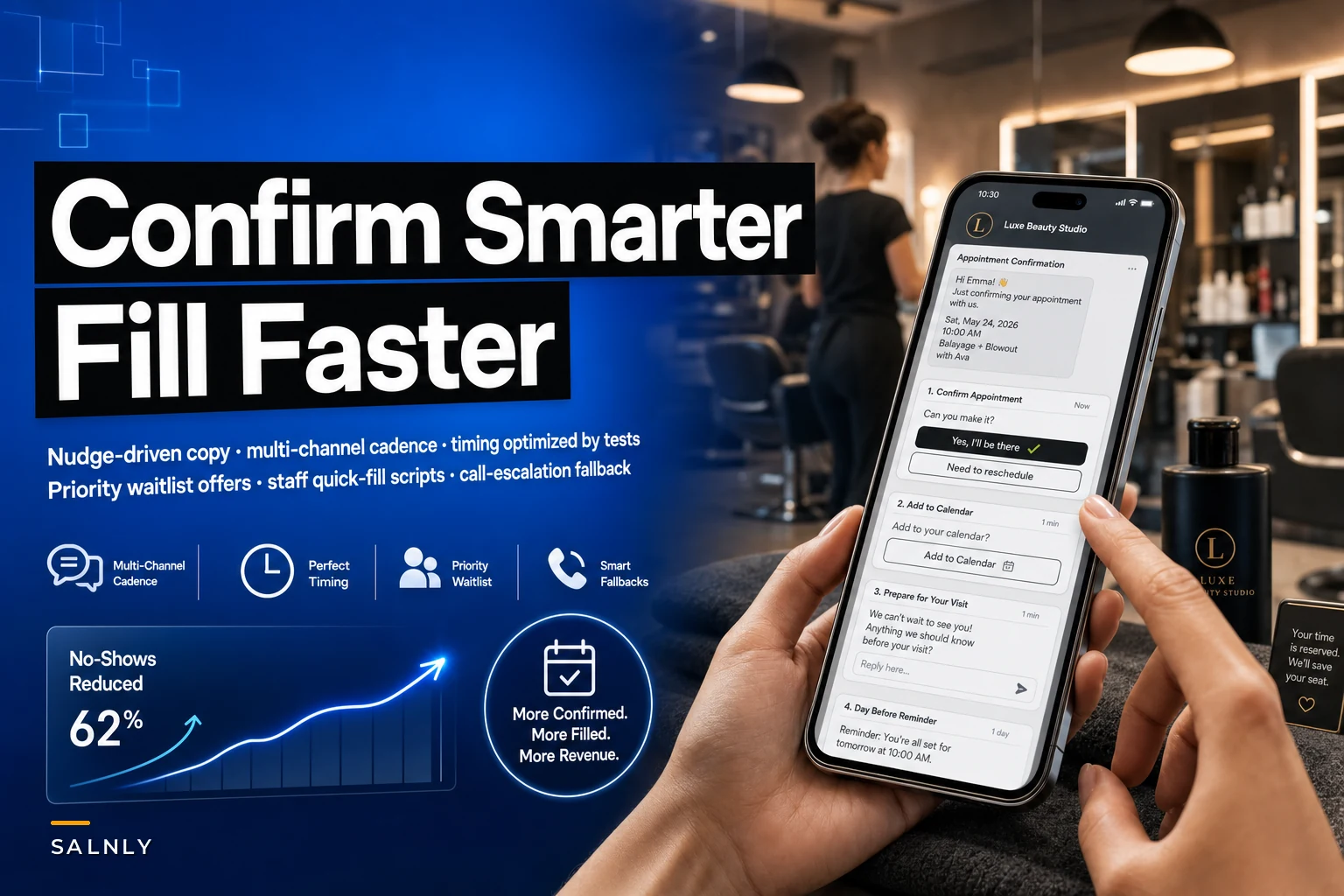

Last Tuesday, a salon owner messaged me about losing $1,800 in a single week from no-shows. Not cancellations — those you can fill. Just empty chairs where clients should've been sitting. Her confirmation texts went out 24 hours before, standard stuff: "See you tomorrow at 2pm!" But that's exactly why they weren't working.
Most salon no-show reminder sequences fail because they treat confirmations like announcements instead of conversations. After looking at appointment data from dozens of salons, the pattern becomes obvious: clients who don't respond to confirmations are 4x more likely to no-show. Yet most salons send passive reminders that don't require any action.
The real issue? Your confirmation sequence probably makes it easier to ignore the message than to engage with it.
Why standard reminder timing creates decision paralysis
A 24-hour reminder hits at the worst psychological moment. Close enough that rescheduling feels awkward, far enough that showing up tomorrow feels abstract. Clients get the text while juggling dinner prep or commute stress, think "I'll deal with this later," then never do.
The behavioral psychology here is straightforward. When you give someone a binary choice (confirm or cancel) at an inconvenient moment, their brain defaults to a third option: delay. And delayed decisions in appointment booking almost always become no-shows.
What actually works is a three-touch sequence that guides different client mindsets:
-
5 days out
The planning reminder
-
48 hours out
The preparation reminder
-
Morning of
The commitment reminder
Each touchpoint serves a different psychological function. The 5-day gives permission to reschedule without guilt. The 48-hour creates anticipation. The morning-of locks in commitment. Skip any of these and you lose a specific type of client.
But timing alone won't fix your no-show rate. The copy matters just as much.
Copy that creates micro-commitments (not just confirmations)
Consider this confirmation text that looks professional but generates no-shows:
Stop losing appointments in the chaos.
Salnly helps you book, confirm & manage every appointment—efficiently.
- Centralized appointment management
- Client notifications
- Calendar & staff scheduling
No credit card required
"Hi Sarah! This is a reminder that you have an appointment tomorrow at 2pm for highlights with Jessica. Please let us know if you need to cancel."
Now here's one that reduces no-shows by roughly 40%:
"Hey Sarah! Getting everything ready for your highlights tomorrow at 2pm with Jessica (blocking 3 hours). Quick question - still planning for the same look we discussed, or want to try something different? Reply YES to confirm or CHANGE if you need a different time 💕"
The difference isn't friendliness. It's creating a reason to respond beyond just confirming. The first message is a statement. The second starts a conversation. When clients engage with any part of your message, they're psychologically more committed to showing up.
Your 5-day message should feel casual and offer an easy out:
"Hi Sarah! Just organizing Jessica's schedule for Thursday - you're booked for highlights at 2pm. Perfect timing still work? If not, I have 10am or 4pm available same day 😊"
Notice how this reframes rescheduling as helping you organize, not them being flaky. You're offering specific alternatives, making it easier to reschedule than to no-show later.
The 48-hour message should build anticipation:
"Sarah! Jessica mentioned she found that inspiration pic you sent - she's excited to try that dimensional blonde technique Thursday at 2pm. Anything special you want her to prep? Reply YES if we're good to go!"
This isn't asking if they're coming. You're assuming they are and getting them mentally invested in the outcome.
The morning-of message needs urgency without panic:
"Morning Sarah! Jessica's getting your color mixed for 2pm today. Running on time? If you're running late, let me know so we can adjust her next client 💕 See you soon!"
This frames punctuality as courtesy to other clients, not rule-following. Small distinction, huge behavioral difference.
The reschedule-first fallback system
Even great copy won't save you from life happening. Kids get sick, meetings run over, cars break down. The difference between a successful salon and a chaotic one is having operational fallbacks ready before you need them.
Same-day cancellation protocol:
When someone cancels day-of, your immediate response shouldn't be "OK, thanks for letting us know." It should be: "No problem! I can move you to tomorrow at 2pm or Friday at 10am - which works better?"
The 2-hour no-show window:
If someone doesn't show by 15 minutes past their appointment time, don't wait until end of day to follow up. Send this immediately:
"Hey Sarah! Looks like 2pm might not have worked out today. Jessica has an opening at 4:30 if you can still make it, otherwise I'll hold your spot for Thursday at 2pm. Which works?"
Again, you're not scolding or questioning. You're solving. About 1 in 4 no-shows will take that same-day rescue slot. Another 40% will confirm the future booking.
The habitual no-show escalation:
After two no-shows, change your entire confirmation approach. These clients need different handling:
-
Require credit card for booking
-
Send confirmations 7 days out, 3 days out, 1 day out, morning of
-
Call instead of text for final confirmation
-
Book them only during slow periods initially
Some salons worry this feels punitive. But behavioral patterns are predictive. A client who no-shows twice will likely do it again unless you change the dynamic.
Staff protocols that actually get followed
Writing perfect confirmation sequences means nothing if your front desk sends them randomly. The gap between intended process and actual execution kills most salon operational improvements.
Your team needs a simple protocol they can follow even during Saturday afternoon chaos:
The confirmation checklist:
-
Every booking triggers automated 5-day reminder
-
Tuesday/Thursday
send all 48-hour confirmations for Thursday/Saturday
-
Daily at 9am
send all same-day confirmations
-
Daily at 2pm
check for tomorrow's unconfirmed appointments, call them
-
Every no-show
immediate follow-up using the rescue script
That's it. Not "send confirmations when you have time" or "check the book throughout the day." Specific times, specific actions.
When to break protocol:
-
New clients
Add a welcome text immediately after booking
-
High-value services ($200+)
Add phone call to text sequence
-
Habitual reschedulers
Confirm at booking, then follow standard sequence
-
VIP clients
Personalized messages only, no templates
The automation component matters here. Manually sending three reminders for every appointment while juggling walk-ins, phone calls, and checkout? Not happening. Your team will default to crisis management every time.
The short-notice fill system
Empty chairs from day-of cancellations are pure profit loss. Most salons handle them reactively - posting on social media hoping someone sees it in time. That's not a system, it's desperation.
The quick-fill list:
Clients who explicitly want last-minute appointments. Build this by asking during checkout: "Want me to text you when we have same-day openings for cuts?" About 15% will say yes. That's your speed dial list.
The smart matching protocol:
-
Cancellation for color? Text other color clients first
-
Senior stylist opening? Contact clients who usually book with them
-
Friday afternoon slot? Target clients who've previously booked similar times
Prioritize clients by service and stylist when texting same-day openings to maximize pickup rates.
The incentive structure:
"Hey Maria! Just had a 2pm color spot open up today with Jessica - usually $120, can do $95 if you can make it. Interested?"
The discount isn't desperation, it's opportunity. You're not begging, you're offering value. Different energy entirely.
One salon filled 72% of same-day cancellations using this exact system. They stopped seeing cancellations as disasters and started treating them as spontaneous promotion opportunities.
Building your complete sequence
Here's what a full salon no-show reminder sequence looks like in practice:
| Timing | Message Type | Primary Goal | Fallback If No Response |
|---|---|---|---|
| At booking | Confirmation request | Lock in commitment | Call within 24 hours |
| 5 days out | Friendly check-in | Allow guilt-free rescheduling | No action needed |
| 48 hours out | Anticipation builder | Create emotional investment | Add to "confirm call" list |
| Morning of | Final reminder | Ensure punctuality | Prepare quick-fill protocol |
| 15 min after no-show | Rescue attempt | Recover same-day | Trigger rebooking sequence |
Visual workflow of the sequence:
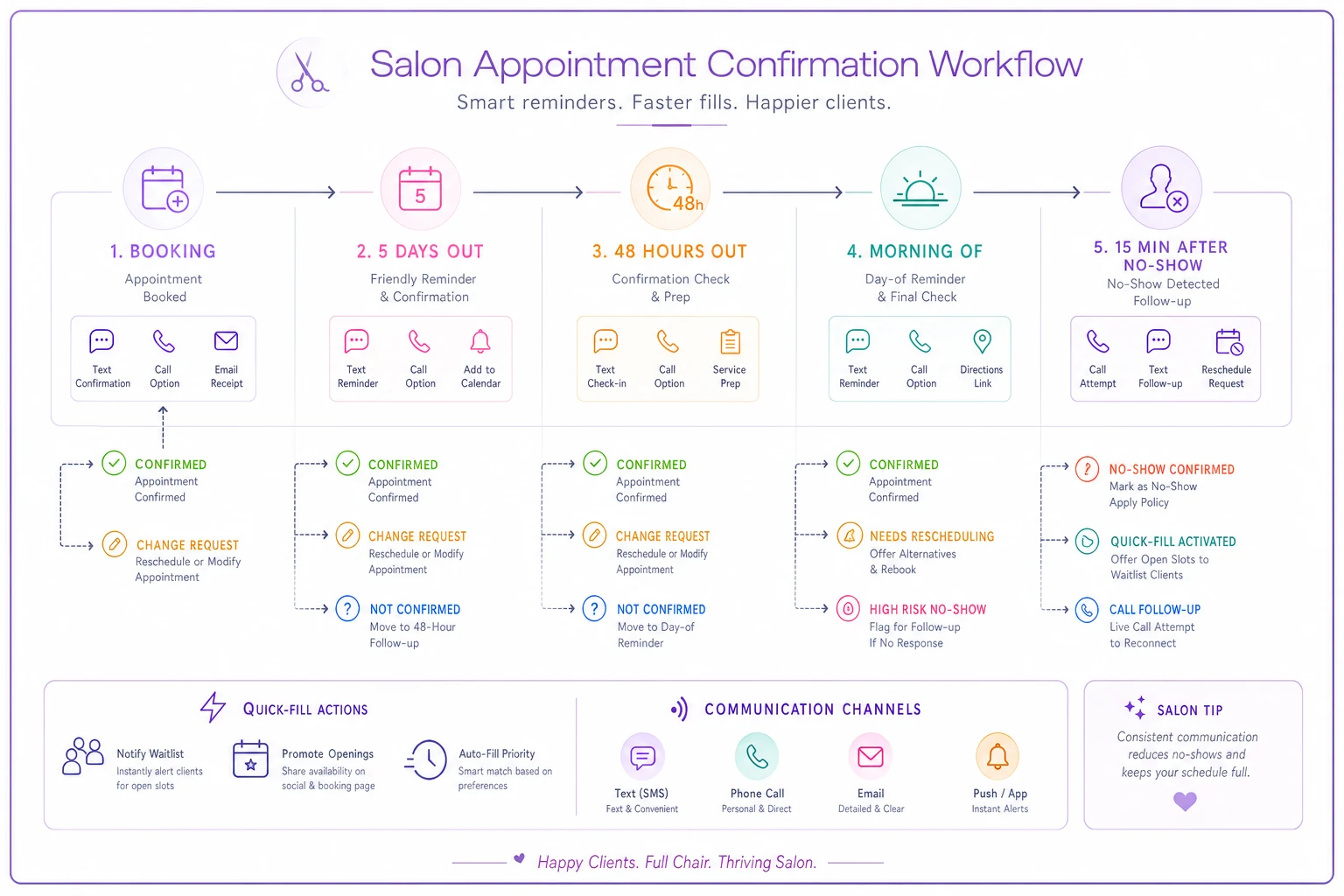
The sequence adapts based on response patterns. Client confirms at 5 days? Great, continue normally. No response to any message? Phone call on morning-of. Previous no-show history? Add deposit requirement.
Client confirms at 5 days? Great, continue normally. No response to any message? Phone call on morning-of. Previous no-show history? Add deposit requirement.
Real numbers from an actual implementation
A 4-chair salon in Denver was losing around $3,400 monthly to no-shows. Not huge numbers, but enough to hurt. They implemented this exact sequence last spring.
Month one: No-shows dropped from about 35 per month to 22. Not dramatic, but noticeable.
Month two: Down to 18, and they'd filled about half the remaining gaps with their quick-fill list.
Month three: Stabilized around 12-15 no-shows monthly, but now filling 70% of them same-day.
Net result? They recovered roughly $2,100 in monthly revenue. Not from booking more clients or raising prices. Just from getting people to show up or giving enough notice to fill the spot.
The biggest shift wasn't even the revenue. The owner told me her team stopped stressing about confirmations because they had a clear process. Instead of randomly texting clients when they remembered, everything ran automatically with manual touches only for special cases.
Where AI-powered operational software changes the game
Managing this sequence manually is technically possible but practically impossible. You're asking front desk staff to track multiple touchpoints for hundreds of appointments while handling their actual job.
Operational software with built-in automation becomes essential here. Not just for sending texts, but for tracking response patterns, flagging at-risk appointments, and automatically adjusting protocols based on client history.
The right platform handles the mundane parts - timing, sending, tracking - while your team focuses on the human parts - personalizing messages for VIPs, calling uncertain bookings, managing same-day fills. It centralizes your confirmation data so you can spot patterns. Maybe Tuesday afternoons have higher no-show rates, or certain services need different confirmation timing.
Without centralized tracking, you're guessing. With it, you're optimizing based on actual patterns from your actual clients.
Making it work in your salon
Start with the basics: implement the three-touch timing first. Don't worry about perfect copy initially. Just get the rhythm established - 5 days, 48 hours, morning of.
Next, add one behavioral nudge to each message. A question they need to answer, a detail about their service, something that requires engagement beyond "OK."
Then build your fallback protocols. Train your team on the exact response to cancellations and no-shows. Script it out. Practice it. Make it automatic.
Finally, track everything for one month. How many confirmations did you send? How many responses? How many no-shows? How many same-day fills? You need baseline data to improve.
The salons that succeed with this don't implement everything perfectly on day one. They start with timing, add copy improvements gradually, and build fallback systems as needed. What matters is having a system, not having the perfect system.
Your confirmation sequence is either working for you or against you. There's no neutral. Every passive reminder you send, every no-show you don't immediately follow up on, every cancellation you don't try to reschedule - these aren't just missed appointments. They're missed opportunities to build better client relationships through better operational systems.
The chair is already empty. The only question is whether you have a system to fill it.
Ready to simplify your salon operations?
Join 1,000+ salons using Salnly to save time, reduce scheduling chaos, and deliver better client experiences.