


The invoice price is usually the smallest problem in a multi-location salon's supply chain.
Most owners know roughly what they pay for a tube of permanent color or a liter of developer. Far fewer know that the same SKU can cost noticeably different amounts at two of their own locations a few miles apart. Fewer still know what they pay in freight on small orders, how many manager-hours go into ordering each week, or how often someone drives to a beauty supply store and pays retail because the distributor order didn't arrive or never got placed.
None of those costs show up on one report. They're scattered across invoices, petty cash, payroll, and the occasional client whose toner got swapped because the right one was out. So salon supplier management at scale isn't really a purchasing problem. It's a coordination problem that happens to look like one.
This article covers how a centralized supplier program fits together: how to tier suppliers, how to consolidate ordering without starving locations, what to negotiate once you have combined volume, and how to run quarterly reviews that change supplier behavior. One constraint runs through all of it. Cutting cost is easy if you let fill rates drop, and that's a terrible trade when a missing shade cancels a $180 service.
The cost leaks that hide between locations
Before you design anything, look at where the money actually goes. These leaks rarely look dramatic on their own. They add up because nobody owns the total.
| Hidden cost | Where it actually shows up | Who usually notices | Typical size in a 3–6 location group |
|---|---|---|---|
| Same SKU, different price by location | Distributor invoices, different deal structures per account | Usually nobody, unless someone compares invoices side by side | 5–15% variance on core backbar items |
| Small-order freight | Line item on invoices, often waived inconsistently | Bookkeeper, occasionally | A few hundred dollars a month, sometimes more |
| Emergency retail-price buys | Petty cash, manager card, reimbursements | Owner, when reviewing card statements | Often 2–3x distributor cost for those items |
| Volume tiers never reached | Missed rebate or free-goods thresholds because each location has its own account | Nobody, because it's money you never received | Can be the largest single leak |
| Manager time spent ordering | Payroll, hidden inside "admin" hours | Nobody | 2–4 hours per location per week is common |
| Unused education credits and promos | Expire quietly at the end of a program period | Rep, who may or may not remind you | Varies, sometimes thousands per year |
| Off-menu SKUs creeping in | Backbar clutter, expired product, shrink | Whoever does the count | Gradual, and it compounds |
| Service changes due to stockouts | Not tracked at all in most salons | The client | Hard to measure, very real |
The volume-tier row is the one that surprises owners most. Distributors usually build free goods, rebates, or tiered discounts around account volume. If each of your five locations has its own account and its own rep, each one sits in a lower tier. Combined, you might clear the next tier easily. Separately, none of them do.
That one structural fix, getting the distributor to recognize a parent account with child ship-tos, sometimes pays for the whole effort before you've negotiated anything.
Why locations drift apart even when nobody is doing anything wrong
Purchasing drift in salon groups almost never comes from carelessness. It comes from reasonable local decisions that nobody connects.
Stop losing appointments in the chaos.
Salnly helps you book, confirm & manage every appointment—efficiently.
- Centralized appointment management
- Client notifications
- Calendar & staff scheduling
No credit card required
The biggest driver is the rep relationship. Distributor consultants in professional beauty build personal relationships with salon managers. They bring deals, show up for education nights, and sometimes cover a gap from their own trunk stock. A manager who's worked with the same rep for four years will order through that rep, take that rep's "buy 12, get 3" deal, and trust that rep's advice on new launches. Multiply that by five managers and five reps and you get five slightly different purchasing strategies under one brand.
Emergency buying is the second driver, and it slowly becomes normal. A location runs short of lightener once, someone runs to the beauty supply store, problem solved. Six months later they're doing it most weeks, because the habit replaced the order discipline. Nobody decided that. It just happened.
Third, deals are local but costs are global. A manager who grabs a promo on a new styling line is optimizing their own backbar. They're not thinking about whether the group now carries three overlapping products from three vendors, each with its own minimums and its own shelf space.
None of these decisions are bad on their own. The problem is that the information needed to make a better call (what the other locations pay, what the combined volume is, which SKUs actually move) sits in nobody's hands.
What changes as you add locations
At two locations, the owner is usually still close enough to purchasing to catch big problems. Drift exists but it's small. The main win is aligning on one color line and one distributor account structure.
At three to five locations, it gets expensive. Each location has its own manager, often its own rep, and the owner has stepped back from daily ordering. Price variance shows up. Emergency buys climb. Backbar SKU counts start diverging. This is also when owners first notice that supply cost as a percentage of service revenue differs by location in ways the service mix can't explain. If you've already normalized your per-chair numbers using something like the salon P&L playbook with per-station break-even and payroll rules, product cost per service is often the line that stands out once labor is accounted for.
At six or more locations, the problem shifts from cost to control. You can't review every invoice yourself. Suppliers start treating your locations as separate customers, because operationally they are. You have negotiating leverage on paper but can't use it, since you can't commit volume you don't control.
Across all of these sizes, centralization is worth more at each step, but it also gets harder to roll out, because local habits have had longer to harden.
Supplier tiers: deciding who gets your attention
Not every supplier deserves the same level of management. A color line that holds half your backbar spend and a towel vendor are different relationships. Treat them the same and you waste time on one and under-manage the other.
A four-tier structure works for most salon groups:
Tier 1 — Core. Your primary color line and the distributor (or direct brand relationship) that supplies it. Usually one or two relationships that account for most backbar spend. These are hard to switch because formulas, client color histories, and stylist training are built around them. You manage them for service level and terms, not by threatening to leave.
Tier 2 — Preferred. Care, treatment, styling, and retail lines. Switchable with effort. You have real leverage here, especially on retail lines where display space and staff recommendations are worth something to the brand.
Tier 3 — Approved. Commodity and semi-commodity items: foils, gloves, capes, neck strips, towels, disinfectant, paper goods. Multiple vendors can supply these. Compete them on landed cost and reliability, and re-bid once in a while.
Tier 4 — Exception. Local beauty supply stores, online marketplaces, anything bought outside the program. This tier exists so you can track it and cap it, not so you can encourage it.
Scoring weights should change by tier, and using one scorecard for everyone is a common mistake. For a Tier 3 glove supplier, price might reasonably be 40% of the score. For a Tier 1 color supplier, price is probably the least movable part of the relationship, and fill rate, backorder communication, and education support matter much more. A rough starting point for Core suppliers:
-
Fill rate and on-time delivery
around 35%
-
Total landed cost (price, freight, free goods, rebates)
around 25%
-
Backorder communication and substitution handling
around 15%
-
Education and field support
around 15%
-
Terms and admin (invoice accuracy, returns, payment terms)
around 10%
For the SKU-level side, meaning which individual products earn their shelf space and how pars get set, the supplier scorecard and SKU rationalization guide goes deep on vendor KPIs and audits. The tier system here sits a level above that. It decides how much management effort each relationship gets and what kind of leverage you can apply.
Consolidated PO rules and how the ordering workflow runs
Consolidation means one person, or a small central function, places orders for all locations on a fixed cadence. Location managers count and request. They don't order directly, except through a defined exception lane.
That's the principle. The rules matter more than the principle, though, because that's where these programs either work or quietly fall apart.
A workable weekly cycle looks something like this. Each location finishes its backbar count for Core and Preferred items by an internal cut-off, say Wednesday at noon. Counts go into a shared system, not a text message to the buyer. The central buyer reviews counts against par levels and upcoming bookings for heavy color days, then builds one PO per supplier with separate ship-to lines for each location. POs go out Thursday morning, timed to land before the distributor's own cut-off for Friday or Monday delivery. When deliveries arrive, each location receives against its ship-to line and flags shorts or damages the same day. The buyer reconciles shorts against the supplier's fill rate record and decides whether to cover the gap with a transfer from another location or a backorder.
One order guide per tier. Locations can only request SKUs on the approved list. New SKUs get added at the quarterly review, not mid-cycle because a rep dropped off a sample.
Minimums and freight thresholds are met at the group level. You need to agree this with the supplier, and some will resist. The goal is that a PO with five ship-tos counts as one order for freight and minimum purposes. If the supplier won't do that, it becomes a negotiation point (more on that below).
Transfers before emergency buys. If one location is short and another is over par, the transfer happens first. That only works if someone can see stock across locations, which is the main reason this falls apart when counts live in separate spreadsheets.
An exception lane with a cap and a reason code. Managers need a way to handle a real emergency. Give each location a small weekly allowance for Tier 4 buys and require a reason: supplier short, count error, unexpected booking, product damaged. The reason codes become data. If one location keeps logging "count error," that's a training problem, not a supply problem.
Cut-offs are enforced, gently, for a while. The first few weeks will be messy. A location that misses the Wednesday cut-off gets covered by transfer or exception, not left empty, but the miss gets noted.
Track exception reason codes weekly so you can spot training problems before they become recurring costs.
Here's a visual of the weekly consolidated ordering workflow.
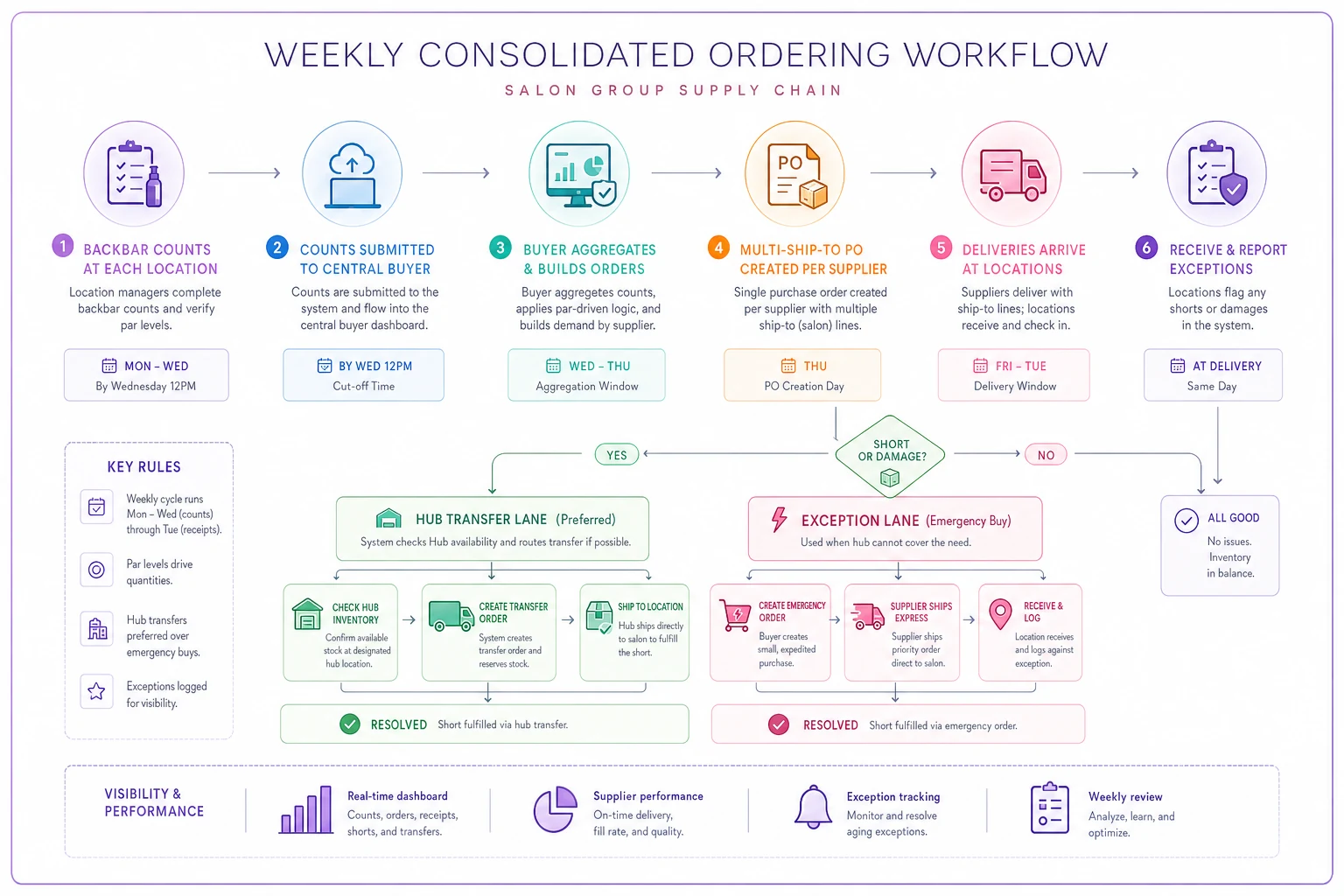
Across rollouts, the friction rarely comes from the ordering itself. It comes from managers feeling like control was taken away. The counts-and-requests model works better when managers can see why the order came out the way it did: par, current stock, upcoming color-heavy bookings. If they can't see that, the PO feels arbitrary and they start working around it.
The negotiation playbook once you actually have leverage
Consolidation gives you leverage, but only if you use it deliberately. Most salon groups walk into supplier conversations asking for a lower price on color. That's usually the hardest thing for a distributor to move, and often not the most valuable thing on the table anyway.
Distributors typically have more flexibility on terms than on price itself. That includes free goods, education funding, freight thresholds, payment terms, rebate tiers, price-change notice, and returns. Added up, those terms are often worth more than a few points off list.
-
Assemble twelve months of spend by SKU, by location, by supplier. Pull it from invoices if you have to. You need to know your actual combined volume, what each location paid, and which SKUs drive most of the spend. Walk in without it and you're negotiating on the supplier's numbers.
-
Restructure the account first. Ask for a parent account with child ship-tos, with volume tiers, rebates, and free goods calculated at the parent level. This often doesn't get framed as a discount at all. It's an admin change that happens to move you up a tier.
-
Normalize pricing across locations. Show the supplier the variance you found and ask for every location to be moved to the best price any location currently gets. Suppliers rarely push back hard on this one, because the alternative is explaining why they were charging you different prices.
-
Trade commitment for terms. This is where consolidation earns its keep. You can now offer things individual locations couldn't: a committed share of backbar volume, a predictable weekly order, a standardized retail wall, a set number of education events. In return, ask for lower freight thresholds at the group level, net-30 or longer payment terms, a written backorder notification window, and an education budget you control instead of one handed out to whoever asks.
-
Ask for price-protection notice. A 60–90 day notice period before price increases gives you time to adjust service pricing or buy ahead. In volatile years this matters more than any one-time discount.
-
Get backorder and substitution rules in writing. When a shade is backordered, who tells you, how fast, and what's the approved substitute? A supplier who quietly ships short and lets you find out on delivery day costs you more than one who charges 3% extra and calls ahead.
-
Set the review date before you sign anything. Tell the supplier the relationship will be reviewed quarterly against specific measures. It changes how they treat the account right away.
Retail lines deserve their own note. Brands value consistent placement and staff recommendations across all your locations, and individual locations never had that leverage. If you've built a disciplined display and recommendation system (the station-level approach to predictable retail is one way to do it), you can put that consistency on the table in exchange for better margin, display support, or demo product. Just don't commit to placement you can't deliver at every location. Brands check.
Keep the rep relationships intact where you can. A centralized program doesn't mean shutting local reps out. The commercial terms get set centrally, and reps keep doing education and support at the location level. Reps who feel cut out sometimes stop going the extra mile on emergencies, and that's a real fill-rate risk.
Quarterly performance gates
A scorecard nobody acts on is just a spreadsheet. Quarterly gates force a decision on every supplier: promote, hold, put on probation, or exit.
The decision logic differs by tier, and Core is where owners tend to overreact. Exiting a color line because of one bad quarter of fill rates is almost always the wrong move. Switching costs are huge: reformulating client histories, retraining stylists, client anxiety about a "different color," old stock stuck on the shelf. For Core suppliers, the gate is about escalation and terms, not switching. A bad quarter means a formal conversation, a written corrective plan with dates, and possibly reduced commitments on secondary lines from the same distributor.
For Preferred and Approved suppliers the gate has real teeth. Two quarters in a row below threshold on fill rate or invoice accuracy should trigger a re-bid. Suppliers in these tiers know they're replaceable, and the gate makes that credible.
Before each quarterly review, work through this:
-
Supplier-level fill rate and on-time delivery, by location, for the quarter
-
Number of backorders and whether each one was communicated before delivery day
-
Invoice accuracy rate and any pricing that didn't match the agreed terms
-
Exception-lane spend by location, grouped by reason code
-
Transfers between locations, and which SKUs keep needing them
-
Rebates and free goods earned versus actually received
-
Education credits used versus expiring
-
SKUs requested by locations that aren't on the order guide
-
Any service changes or reschedules logged because of a missing product
-
Price changes announced and whether notice terms were respected
The "rebates earned versus received" line catches more money than you'd expect. Rebates and free goods often have to be claimed or applied, and they slip through when nobody owns the reconciliation.
"SKUs requested but not on the guide" matters for a different reason. It's how you learn what stylists actually want, and it keeps the order guide from going stale. If three locations keep asking for the same bond-builder, that's a signal, not insubordination.
Protecting fill rates while you centralize
Most programs underestimate this part. Centralization almost always causes a dip in fill rates for the first month or so, and the reason is subtle.
Before centralization, every location had informal backup systems that nobody wrote down. A manager's personal relationship with a rep who'd drop off a tube from trunk stock. A nearby salon they'd swap with. A habit of overordering certain shades "just in case." When you centralize, you remove the visible ordering, and a lot of that invisible backup goes with it.
Before go-live, ask every manager directly: what do you do right now when you're about to run out? Write the answers down. Some of those workarounds should be formalized, like a designated hub location holding extra safety stock for the top-moving shades and developers. Some should be retired. But you have to know they exist first.
Track two different fill rates. The first is supplier fill rate: of what you ordered, what arrived complete and on time. The second is service readiness: how often a service was changed, delayed, or rescheduled because a product wasn't there. Supplier fill rate can look fine while service readiness gets worse, for example when the order guide or pars are wrong. The second number is the one clients feel.
Safety stock should follow service demand, not averages. A location whose Saturday book is mostly balayage and gloss needs deeper buffers on lightener, toners, and developer than its weekly average suggests. Pars set on average weekly usage tend to stock out on exactly the days that matter most.
Real scenario: a five-location group consolidating color and backbar
Business type: Five-location salon group in one metro area, roughly 38 chairs total, mostly color-heavy with a moderate retail program.
The problem: Each location had its own distributor account. Three bought the core color line through the same distributor but under separate accounts with different reps. One bought partly direct from the brand. One had drifted into buying a lot of sundries from a local beauty supply store. Combined backbar and sundries spend ran roughly $19k–$22k a month. Comparing invoices side by side showed the same core color tubes costing about 9–14% more at the highest-priced location than at the lowest. The group was placing around 70 purchase orders a month, many small enough to trigger freight. Emergency retail-price runs happened roughly 20–25 times a month across all locations, mostly undocumented and showing up on manager cards.
What they changed: They restructured the three distributor accounts into one parent account with five ship-tos and moved the direct-buying location onto it. They tiered suppliers, re-bid gloves, foils, and paper goods across two vendors, and moved ordering to a weekly consolidated cycle with a Wednesday count cut-off. Each location got a small weekly exception allowance with reason codes. One central location became the hub, holding extra stock of the top 15 or so color SKUs.
What happened: The third week was rough. Two locations missed the count cut-off, the buyer was still learning the ship-to process, and service readiness dropped. A handful of color services got pushed or adjusted that week, and supplier fill rate dipped to around 91%. After tightening the cut-off reminders and building the hub transfer routine, fill rate settled at around 96–97% by week seven, slightly better than before.
-
POs dropped to roughly 20–24 a month, and most freight charges disappeared because group-level thresholds were met
-
Price variance on core color was essentially gone, since every location sat on the best price
-
The parent account cleared a free-goods tier that no single location had ever reached
-
Emergency buys fell to about 5–8 a month, mostly logged as genuine supplier shorts
-
Net backbar and sundries cost dropped somewhere around 6–8%, roughly $1.3k–$1.6k a month, not counting freight savings or recovered manager time
The bigger change was harder to measure. Managers stopped spending Monday mornings on ordering, and the owner could see supply cost per service by location for the first time without pulling invoices by hand.
Templates worth building before you start
Nothing elaborate.
Just enough that the program doesn't depend on one person's memory.
-
Supplier profile sheet. One page per supplier
tier, account structure, contacts, agreed pricing basis, freight threshold, payment terms, rebate structure, backorder notice terms, price-change notice period, review date. When the buyer is out sick, someone else can pick it up.
-
Location order guide. Approved SKUs by tier, par level per location, count unit (tube, bottle, case), and a "requested additions" column managers can fill in for the quarterly review.
-
Weekly count-and-request form. On hand, par, suggested order, override with reason. The override column matters. It captures local knowledge, like a big bridal party on Saturday, without breaking the system.
-
Exception log. Date, location, item, where it was bought, cost, reason code, who approved it.
-
Quarterly gate summary. One page per supplier with scores by category, the gate decision, any corrective plan with dates, and what changes next quarter.
-
Negotiation prep sheet. Twelve-month spend summary, price variance found, current terms, target terms, what you're willing to commit, and your walk-away position for each ask.
Nothing elaborate. Just enough that the program doesn't depend on one person's memory.
When this actually makes sense
A centralized supplier program pays off most clearly when you have three or more locations using the same core color line, separate supplier accounts, and managers who order independently.
It's also worth doing if you plan to open more locations soon, because building the structure before location six is much easier than retrofitting it after.
It also makes sense when supply cost per service varies across locations by more than the service mix can explain. That gap is usually a purchasing story, not a service story.
When this is a bad idea
Don't launch consolidation in your busiest season. The first month always has friction, and you want it landing in a quieter stretch.
It's also risky without reliable counts. Consolidated ordering built on guessed inventory just centralizes the guessing. If your locations don't count backbar consistently today, fix that first.
And if your locations deliberately use different color lines for positioning, say a premium location carrying a luxury line and a value location on something else, forcing one Core supplier can damage brand differences you built on purpose. You can still consolidate Tier 3 and the tiering, just not the color line.
Who should NOT do this
Single-location salons don't need a centralized program. They need a clean order guide and good pars.
Two locations run by the same hands-on manager usually don't either. That manager is already the central buyer.
Suite and booth-rental models where renters buy their own product don't fit, since there's no shared spend to consolidate. A preferred-vendor arrangement renters can opt into might be worth exploring instead.
Franchise systems need to be careful. Mandating suppliers or centralizing purchasing for franchisee-owned locations raises legal and contractual questions that vary a lot. A preferred-supplier program with negotiated terms that franchisees can choose to use is often the safer structure. Talk to whoever handles your franchise agreements before going further.
Where software helps (and where it doesn't)
Most of what makes this program work is discipline: cut-offs, reason codes, quarterly decisions. Software doesn't replace that. What it can do is remove the manual work that makes discipline hard to maintain.
The time sinks in a consolidated program are predictable. Someone collects counts from five locations and compares them to pars, checks upcoming color-heavy bookings, builds multi-ship-to POs, matches invoices to agreed pricing, tracks fill rate by supplier, and tallies exception spend. Done by hand in spreadsheets, that's easily a part-time job, and it's the first thing to slip when the buyer gets busy.
An AI-assisted operational platform can handle a lot of it. It can pull counts into one place, draft suggested orders from pars and the actual booking calendar, flag invoice lines that don't match contract pricing, and keep a running fill rate and service-readiness record per supplier, so the quarterly review is mostly prepared before anyone sits down. It can also catch patterns people miss, like one location's exception buys creeping up week after week, or a rebate tier you're close to hitting but not tracking.
It can't do the negotiating, the rep relationships, or the judgment call on whether a Core supplier's bad quarter deserves escalation or patience. Those stay human.
Pulling it together
Think of all this as connected parts, not a cost-cutting project. Tiering tells you where to spend management attention. Consolidated ordering gives you volume you can actually commit. Negotiation turns that volume into terms. Quarterly gates make the terms stick. Fill-rate protection keeps the whole thing from saving money at the expense of clients in the chair.
If you do one thing this month, pull three months of invoices for your core color line from every location and put the per-unit prices side by side. Most groups find enough variance in that one comparison to justify the rest of the program. It also gives you the first number you'll need when you sit down with your distributor.
From there, restructure the account before you ask for anything else, set up the weekly count cycle, and schedule your first quarterly review before the first consolidated PO goes out. The review date is what keeps the program running after the setup work is done.
Think of all this as connected parts, not a cost-cutting project. Tiering tells you where to spend management attention. Consolidated ordering gives you volume you can actually commit. Negotiation turns that volume into terms. Quarterly gates make the terms stick. Fill-rate protection keeps the whole thing from saving money at the expense of clients in the chair.
If you do one thing this month, pull three months of invoices for your core color line from every location and put the per-unit prices side by side. Most groups find enough variance in that one comparison to justify the rest of the program. It also gives you the first number you'll need when you sit down with your distributor.
Ready to simplify your salon operations?
Join 1,000+ salons using Salnly to save time, reduce scheduling chaos, and deliver better client experiences.