


Most salons carry between $25k and $50k in retail inventory at any time. That's real cash on shelves, in drawers, under stations, in back rooms. For most salons, retail brings in maybe 8-12% of total revenue when it should be closer to 25-30%.
The problem isn't that stylists don't want to sell. Retail in salons has become this weird mix of guilt-driven recommendations, random product mentions during blowouts, and occasional desperate pushes when you realize you're sitting on three cases of expired treatments nobody knew about.
Last week I watched operations at a high-volume salon in Denver. Beautiful retail displays, premium product lines, everything positioned perfectly. Yet their retail take rate was around 14%. The owner couldn't figure it out — great products, motivated team, decent foot traffic. Watching the actual service flow revealed the real issue: no salon retail system. Just hope that stylists would remember to mention products while juggling color formulas, client conversations, and staying on schedule.
Station-level retail starts with physical product placement
Walk into any salon and you'll see the same retail mistake: all products displayed at the front desk or on a wall somewhere away from service stations. Makes sense from visual merchandising perspective, terrible from operational perspective.
Stylists spend 40-50 hours weekly at their stations. That's where conversations happen, where trust gets built, where recommendations feel natural. Yet most salons keep their retail inventory as far from stations as possible.
Effective salon retail systems start with station-level product placement. Not full inventory — that would be chaos. Specific, rotating product samples and testers based on:
Current service mix at each station If Maria does mostly balayage and treatments, her station needs bond builders and purple shampoos visible and within reach. If James focuses on men's cuts and beard services, different product mix entirely.
Individual stylist success patterns Some stylists naturally sell during shampooing. Others during styling. Your station setup should match when each stylist has their highest engagement moments.
This week's focus products Rotating 2-3 featured products per station weekly prevents displays from becoming invisible background noise. Same products sitting there for months? They become furniture.
One midwest salon chain restructured their stations with small acrylic shelves at eye level — just three products per station, swapped weekly. Retail percentage jumped from 11% to 19% in two months. Not because they pushed harder, but because products became part of the service geography instead of an afterthought.
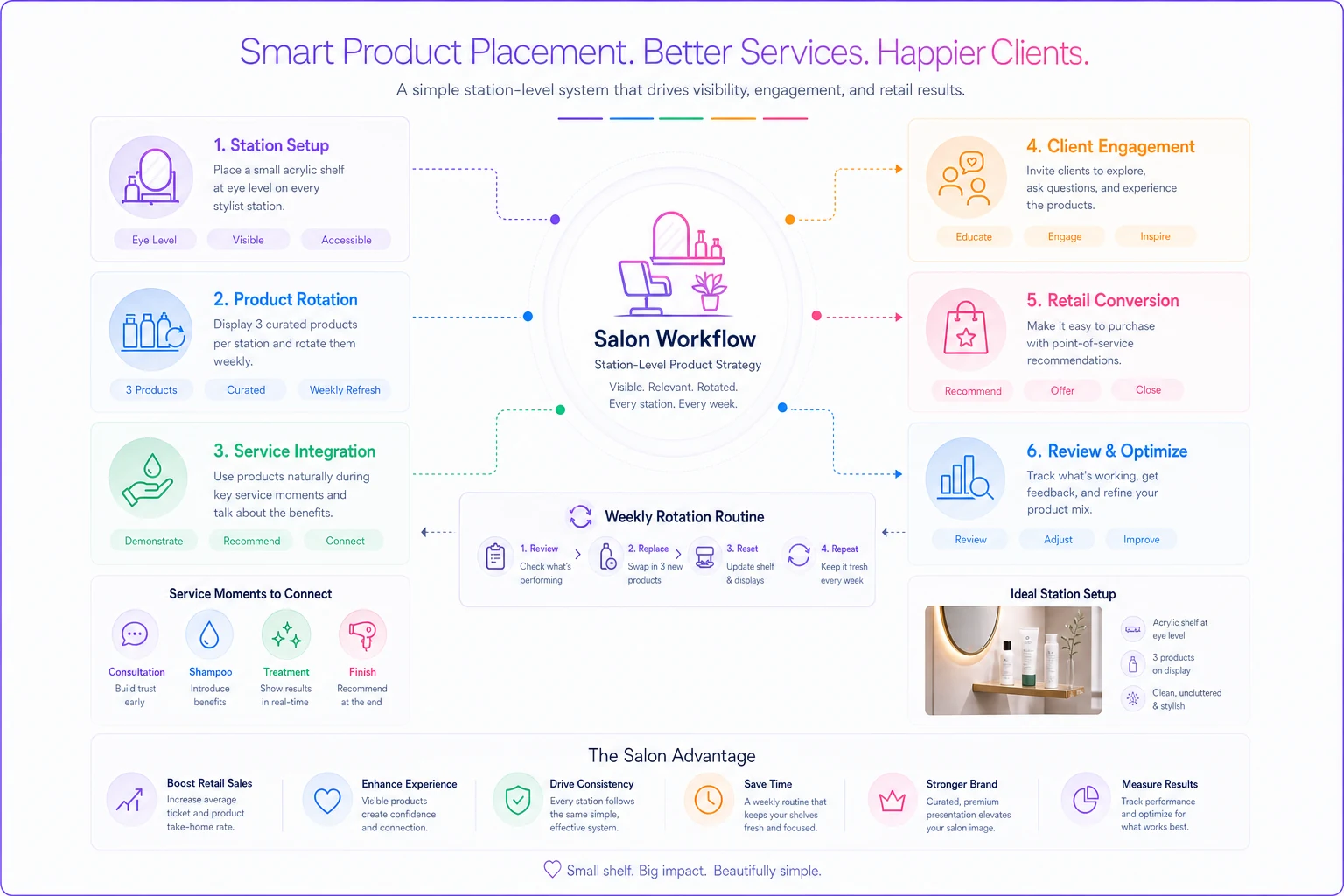
A quick visual to show how station placement and weekly rotation routines should flow.
Micro-offers tied to specific service moments
"Would you like to take home the shampoo we used today?" doesn't work anymore. Clients tune out generic retail pitches the same way they ignore warranty offers at checkout.
Stop losing appointments in the chaos.
Salnly helps you book, confirm & manage every appointment—efficiently.
- Centralized appointment management
- Client notifications
- Calendar & staff scheduling
No credit card required
What actually moves product: micro-offers tied to specific moments in the service when the client experiences the product benefit directly.
During a gloss service, right after rinsing when the client's hair feels incredibly smooth — that's when you mention the gloss treatment for home maintenance. Not at checkout. Not during booking. At the exact moment their hair feels different.
Timing matters more than the script. A decent salon retail system builds these moments into the service choreography:
Color services: Right after the first rinse before toner application
Treatments: During the final rinse when explaining how to maintain results
Cuts: After rough drying but before final styling
Blowouts: Between heat protectant application and actual styling
Each service type has 2-3 natural retail moments. Missing them means waiting until checkout when the experience has faded and price resistance kicks in.
What kills most retail efforts: stylists trying to remember different offers for different services while managing everything else. That's where micro-offer cards come in — small laminated cards at each station with three bullet points:
-
Service moment (when)
-
Specific product (what)
-
Connection phrase (how)
For keratin treatments, the card might say:
-
After final rinse
-
Sulfate-free maintenance kit
-
"To keep this feeling for the full 3 months, you'll need..."
Simple, but it turns retail from memory test to operational checklist.
Inventory rules that prevent the profit-eating cycle of overstock and stockouts
The typical salon inventory cycle goes something like this: owner orders based on gut feeling or wholesale minimums, products arrive, some sell quickly, others sit for months, eventually there's a clearance push to move dead stock, repeat.
Meanwhile, your best sellers run out Thursday afternoon and you're out of stock all weekend when foot traffic peaks.
Functional salon retail systems tie inventory directly to service demand, not sales rep suggestions or bulk discounts. The math is straightforward but almost nobody does it:
Calculate service-to-retail attachment rate by category If you do 300 color services monthly and 22% of color clients buy color-safe shampoo, you need roughly 66 units in that category monthly, plus buffer.
| Category | Min | Max |
|---|---|---|
| Fast movers (selling 10+ units weekly) | min 2 weeks supply | max 4 weeks |
| Steady sellers (3-9 weekly) | min 3 weeks | max 6 weeks |
| Slow movers (under 3 weekly) | min 2 weeks | max 3 weeks |
Create reorder triggers tied to service bookings When next month's color bookings hit 250, that triggers color-care product orders. Not calendar-based, demand-based.
One salon group in Phoenix built this into a simple spreadsheet — service counts in one column, historical attachment rates in another, automated reorder quantities in the third. Dropped their inventory carrying cost by roughly 35% while actually reducing stockouts.
The expensive mistake most salons make: ordering inventory based on what sold last month instead of what's booked next month. Your appointment book is your demand forecast, but only if you track which services actually drive which product sales.
Commission structure that rewards the right retail behavior
Standard retail commission — 10% of product sales — creates wrong incentives. Stylists push expensive items regardless of fit, or worse, they don't bother because the few dollars aren't worth the effort during a packed day.
Salons seeing 25%+ retail rates structure commissions to reward behavior, not just sales:
Attachment rate bonuses over volume bonuses Instead of paying more for selling more, pay more for consistent attachment. Stylist who adds retail to 40% of services gets 15% commission. Stylist who adds retail to 60% gets 20%. This rewards the behavior you want — consistent recommendations — not just occasional big sales.
Service-specific retail targets Different services have different natural retail attachment rates. Keratin treatments should have 90%+ attachment (maintenance products required). Basic cuts might be 20%. Commission tiers should reflect realistic targets by service type.
Team pools for slow-moving inventory Create a separate commission pool (maybe 25%) for moving aging inventory. Prevents the situation where nobody wants to sell the products about to expire because they'd rather push newer items.
Retail-first appointments Some salons now offer 15-minute "product consultation" appointments where stylists earn 30-40% commission. Clients book these between services for personalized product recommendations. Turns retail into a service, not an add-on.
A salon retail system that works long-term aligns stylist incentives with salon profitability. That means rewarding consistent behavior over sporadic big wins.
Manager checkpoints that catch problems before retail flatlines
Retail performance doesn't suddenly collapse — it slowly erodes through tiny operational failures that compound over weeks.
The consultation gets rushed so product recommendations get skipped. New stylists don't know the product line so they avoid retail conversations. The inventory system shows items in stock but they're actually buried in the back room. Death by a thousand small cuts.
Effective retail systems build in manager checkpoints that catch these issues early:
-
Daily
2-minute retail check during morning huddle
- Yesterday's retail percentage - Today's focus product - Any inventory gaps -
Weekly
Station audit walkthrough
Manager spends 10 minutes checking: - Product placement at each station - Tester availability and condition - Micro-offer cards present and current - Any expired/damaged products -
Monthly
Individual retail reviews
Five-minute sessions with each stylist reviewing: - Their retail attachment rate - Which products they're most comfortable with - Any knowledge gaps or training needs - Commission earned vs potential -
Quarterly
Full retail system review
- Product mix vs service mix analysis - Inventory turn rates by category - Commission structure effectiveness - Physical retail space optimization
This isn't about catching people doing wrong — it's about catching system breakdowns before they impact sales.
Most salons only look at retail when it's already broken. These checkpoints catch the drift before it becomes a crisis.
The three-station test that reveals if your retail system actually works
Want to know if your salon retail system functions or just exists? Run this three-station diagnostic:
-
How many times the stylist physically touches a retail product during service
-
How many product conversations happen before checkout
-
Whether the recommended products are actually available for purchase
In most salons, the numbers are brutal. Zero product touches during service. Maybe one conversation if lucky. And half the time, the product mentioned isn't even in stock.
A functioning retail system shows different patterns:
-
Stylists naturally reach for products during service because they're positioned correctly
-
Conversations happen at multiple points, not just checkout
-
Recommended products have 95%+ availability because inventory matches service demand
This diagnostic takes maybe two hours of observation but reveals more than months of sales reports.
When retail systems break at different revenue levels
At $30k monthly revenue, retail is simple — owner knows every product, tracks inventory manually, personally coaches the 3-4 stylists. The salon retail system is really just consistent habits.
At $75k monthly, the cracks show. Too many SKUs to track mentally. Stylists have different selling styles. Inventory orders become reactive. That beautiful retail wall becomes a museum of slow-moving products while fast sellers hide in the back room.
At $150k+ monthly, without proper systems, retail becomes a profit leak. Product expires. Commission calculations take hours. Nobody knows what's actually in stock. The retail percentage drops even as absolute dollars increase, masking the problem.
The operational complexity that kills retail at scale:
Inventory span exceeds management attention You can mentally track 20-30 SKUs. Beyond that, you need systems or things disappear into inventory purgatory.
Stylist specialization fragments product knowledge Your color specialist knows everything about color lines, nothing about styling products. Clients get incomplete recommendations.
Physical space constraints force trade-offs More stations mean less retail display space. More products mean harder navigation. The physical puzzle gets harder as you grow.
Commission complexity creates conflicts Different rates for different products, team vs individual goals, service packages vs retail — the math becomes contentious.
This is exactly where proper KPI tracking becomes critical — you need to see retail performance by stylist, by service type, by product category, in real-time, not monthly.
Building service-retail bundles that feel like value, not upselling
Clients resist retail when it feels like an add-on tax. But they happily buy "service completion kits" or "maintenance systems" that feel like part of their treatment investment.
The difference comes down to positioning and timing.
Instead of: "Would you like the shampoo?" at checkout Try: "Your keratin treatment includes a 6-week maintenance system" during consultation
Color maintenance kits: 6-week supply of color-safe shampoo, conditioner, and gloss treatment. Priced at roughly 20% less than individual items but still maintaining margin.
Treatment extension systems: Products that "extend" a professional treatment between visits. Position as protecting their service investment, not buying additional products.
Seasonal prep packages: Spring repair kit, summer protection bundle, winter hydration system. Creates urgency and reason to buy beyond immediate need.
The operational key — these bundles must be pre-built and ready to grab. Not "let me go find those products" which kills momentum. Physical bundles, pre-packaged, with clear pricing, sitting where stylists can reach them during service.
The technology layer that makes retail systematic, not sporadic
Manual retail tracking means retail failure. Too much to remember, too many moving parts, too easy to let slide when you're busy.
Automated reorder points based on service forecasting When next month's Brazilian blowout bookings exceed 15, system triggers keratin aftercare order. No manual checking, no stockouts.
Service-to-retail recommendation prompts During checkout for specific services, system prompts specific product recommendations based on what that service type typically needs.
Individual stylist retail scorecards pushed daily Not public shaming, but private awareness. Each stylist sees their yesterday's attachment rate and MTD performance each morning.
Inventory aging alerts before problems compound Products approaching 60 days in inventory get flagged. At 90 days, they're featured for promotional push. No more finding expired products during annual inventory.
Commission calculation without the spreadsheet nightmare Different rates, different products, team vs individual goals — AI-powered operational software handles the complexity automatically.
Use booking thresholds to trigger reorders — your appointment book is the most reliable demand signal.
This isn't about replacing human judgment with algorithms. It's about creating systematic triggers that make retail execution consistent regardless of how busy or distracted everyone gets.
Measuring what matters: beyond basic retail percentage
Most salons track retail as percentage of total revenue and call it done. But that single metric hides the operational patterns that actually drive retail success.
Retail attachment rate by service type Shows which services naturally drive product sales and which need better integration.
Average retail transaction value Reveals whether you're selling single items (bad) or systems (good).
Product velocity by station placement Proves which physical positioning actually drives sales.
Stylist retail consistency score Standard deviation of daily attachment rates — lower is better. Consistent modest performance beats sporadic high performance.
Inventory turn rate by category Shows which product categories actually move vs collect dust.
Retail conversation rate Percentage of services where retail gets discussed (not sold, just discussed). This leading indicator predicts future retail growth.
A proper salon retail system tracks these operational metrics weekly, not monthly. By the time monthly reports show problems, you've already lost thousands in potential retail revenue.
Retail success is systematic, not motivational
Every salon owner has tried the retail push — the morning meeting pep talk, the sales contest, the "we really need to focus on retail this month" speech. It works for about a week, maybe two if you're lucky, then everyone slides back to old patterns.
Real retail performance comes from systematic execution, not motivation. When products are positioned correctly, conversations happen at natural moments, inventory matches demand, commissions reward the right behavior, and managers catch drift early — that's when retail grows from afterthought to profit center.
Your $40k in inventory is either dead money or a profit engine. The difference isn't in the products themselves — it's in the systematic execution that turns product displays into predictable revenue. Build the system, and retail becomes as natural as the service itself.
Ready to simplify your salon operations?
Join 1,000+ salons using Salnly to save time, reduce scheduling chaos, and deliver better client experiences.