



Your salon P&L template probably has fifty line items. Revenue categories, product costs, rent, utilities, insurance, marketing spend. But there are really only three numbers that predict whether you'll still be open in six months: per-station revenue, payroll ratio, and days of cash on hand.
Most salon owners track revenue. Some track expenses. Almost nobody tracks per-station economics until they're already losing money.
Why traditional salon P&Ls hide the real problems
The standard salon P&L shows total revenue at the top, total expenses at the bottom, and hopefully some profit in between. Looks fine on paper. But this view completely misses what's happening on the floor.
A salon with eight stations showing $40,000 monthly revenue looks healthy — until you realize three of those stations sit empty most days, two stylists work part-time schedules that create coverage gaps, and your highest producer threatens to leave every other month because their commission structure doesn't match their book.
Aggregated numbers tell you nothing about station-level performance. They don't show that Station 3 generates $8,400 monthly while Station 6 barely clears $2,100. They don't reveal that your Tuesday–Thursday schedule has four stylists competing for the same clients while Mondays run skeleton crew.
Traditional P&Ls also bury the payroll reality. You see total payroll as a percentage of revenue — maybe 45%, maybe 55%. But that single number combines your productive senior stylists earning their keep with junior staff still building books, front desk staff who may or may not be driving bookings, and a manager whose actual contribution is unclear.
Per-station math: the foundation of salon economics
Each styling station is a revenue-generating asset. Think of it like a rental property — fixed costs to keep it operational, and it needs to generate enough to cover those costs plus contribute to overhead and profit.
Stop losing appointments in the chaos.
Salnly helps you book, confirm & manage every appointment—efficiently.
- Centralized appointment management
- Client notifications
- Calendar & staff scheduling
No credit card required
Here's the basic per-station calculation most owners never actually run:
Fixed costs per station per month:
-
Rent allocation (total rent ÷ number of stations)
-
Insurance allocation
-
Utilities allocation
-
Basic supplies/backbar
-
Software/booking system allocation
-
Equipment depreciation
For a typical 1,800 square foot salon with 8 stations paying $4,500 monthly rent, each station carries roughly $560 in rent burden. Add utilities, insurance, and other fixed allocations and you're looking at $750–900 per station in fixed monthly costs before you pay a single stylist.
Variable costs per station:
-
Stylist wages/commission
-
Payroll taxes and benefits
-
Product costs for services
-
Processing fees on payments
-
Marketing cost to fill the chair
The variable side depends entirely on your comp structure. A 50% commission stylist generating $6,000 monthly costs you $3,000 in commission plus another $450–600 in payroll taxes and related expenses. An hourly stylist at $18/hour working full-time runs about $3,400 monthly including taxes — regardless of what they produce.
This is where the math gets interesting. And painful.
Break-even by comp structure: commission vs hourly vs hybrid
Here's the break-even reality for different pay structures using actual operational numbers:
| Comp Structure | Monthly Station Revenue Needed | Services Required (avg $85) | Daily Services Needed |
|---|---|---|---|
| 50% Commission | $1,800 | 21 | 1.0 |
| $18/hr Hourly | $4,300 | 51 | 2.4 |
| $15/hr + 15% Comm | $3,600 | 42 | 2.0 |
| 45% Comm + Tips | $2,000 | 24 | 1.1 |
| Booth Rental ($800) | $800 | N/A | N/A |
These numbers assume $750 in fixed costs per station and standard payroll burden. Notice how dramatically break-even shifts based on structure.
That hourly stylist needs to complete 2.4 services daily just to break even — not to generate profit, just to cover their cost. The commission stylist breaks even at one service per day because they only get paid when they produce.
But the simple math misses a few things. Commission stylists with weak books don't stick around. Hourly stylists with strong books eventually demand commission. And booth renters who build loyal clientele sometimes walk away with half your customers.
Payroll-to-margin decision rules
After reviewing hundreds of salon P&Ls, clear patterns emerge around sustainable payroll ratios. Not the generic "keep payroll under 50%" advice you read everywhere — actual decision rules based on your business model.
For commission-based salons:
-
Total payroll should run 42–48% of service revenue
-
Above 50% usually signals structural problems
rates too low, commissions too high, or both
-
Below 40%, you're probably understaffed and leaving revenue on the table
For hourly/salary salons:
-
Payroll typically runs 48–55% of revenue
-
Needs 75%+ productivity to stay profitable
-
Relies more heavily on retail and add-on sales to offset higher fixed costs
For hybrid models:
-
Target 44–52% depending on your mix
-
Track productivity per pay type separately
-
Watch for cannibalization between pay structures
It gets more nuanced when you factor in experience levels. A salon heavy on junior stylists might run 38% payroll but struggle with retention and quality. A senior-heavy team might push 52% but generate higher average tickets and stronger client retention.
Here's a practical decision framework when payroll runs over target by 5% or more:
-
Check productivity reports — are chairs actually full?
-
Analyze service mix — too many low-ticket services?
-
Review pricing — when did you last raise rates?
-
Examine staffing levels by day and hour
-
Adjust comp structure only as a last resort
Most owners jump straight to cutting commissions or hours. That usually backfires. The real issue is almost always underutilized capacity or underpriced services.
Weekly cashflow reality check
Your P&L might show profit, but profit doesn't pay rent. Cash does. And salon cashflow has its own patterns that monthly P&Ls completely obscure.
Salons typically see cash crunches around:
-
The 1st–3rd (rent due, usually the largest single expense)
-
The 10th–15th (hourly payroll and supplier payments)
-
The 20th–25th (credit card processing settlements that lag behind actual sales)
A simple weekly cashflow tracker beats any complex financial model.
Monday Morning Cash Check:
-
Bank balance today
-
Expected deposits this week (based on last week's bookings)
-
Required payments this week
-
Minimum cash cushion needed
-
Go/no-go on discretionary spending
Track this every Monday for 8 weeks and patterns become obvious. You'll spot that your second week always runs tight because retail orders hit at the same time. Or that months with three payroll periods eat through your cushion faster than expected.
Most salons need 12–15 days of operating expenses in cash reserves at minimum — roughly $8,000–12,000 for a typical 6-station salon. Below that, one slow week puts you at risk of missing payroll.
Building your own tracking template
Forget complex spreadsheets with hundreds of formulas. You need five numbers updated weekly:
-
Revenue per station — Total service revenue ÷ number of active stations
-
Payroll percentage — Total payroll ÷ total revenue
-
Per-service profit — (Service revenue - direct costs) ÷ number of services
-
Days cash on hand — Current bank balance ÷ daily operating costs
-
Productivity rate — Booked hours ÷ available hours
Here's a dead-simple template structure:
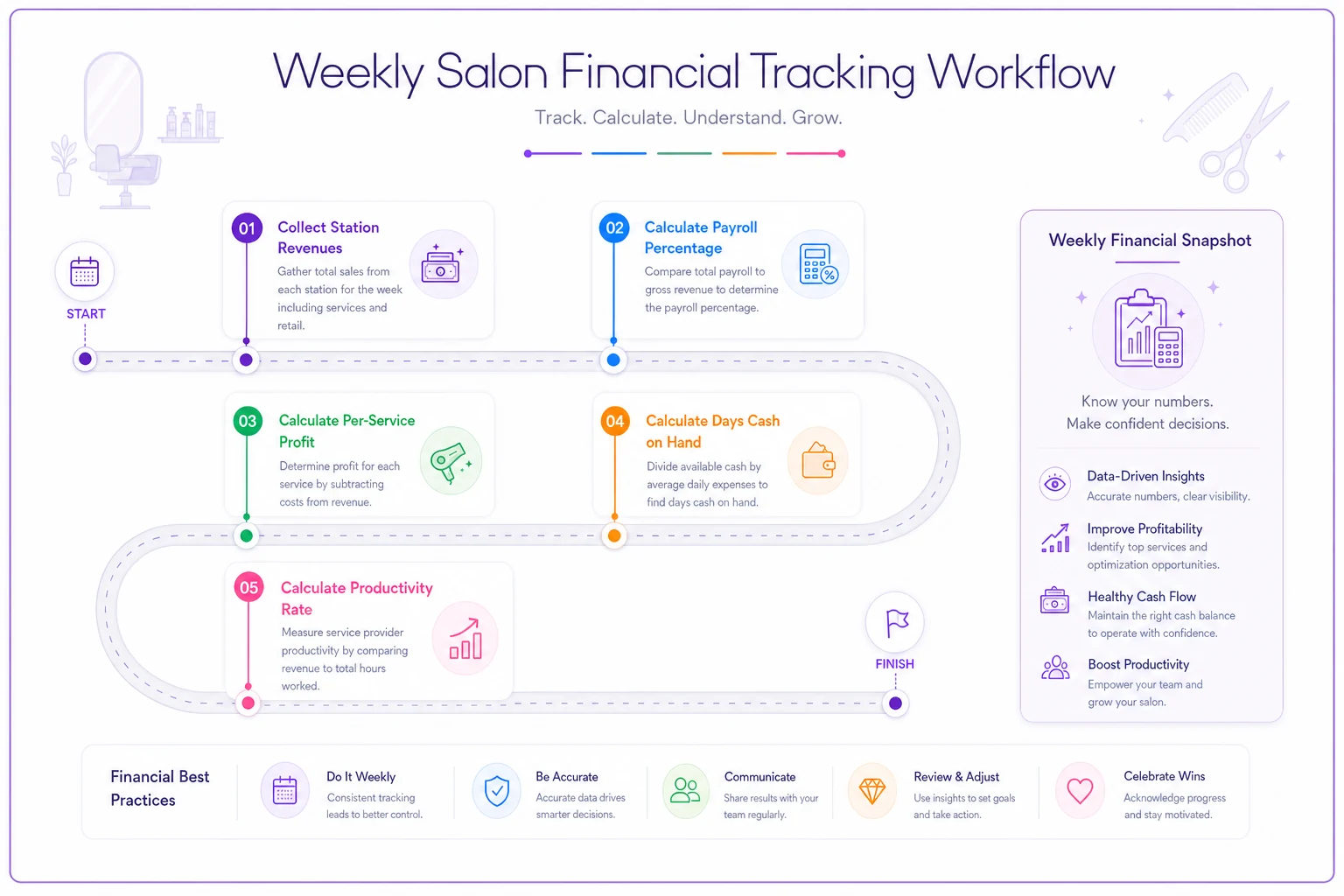
Use this flow to collect numbers, compute the five KPIs, and highlight any metric outside your target ranges.
Update the five numbers every Monday to spot issues before they compound.
Weekly Station Tracker: Week of: Station 1: $ revenue / services Station 2: $ revenue / services Station 3: $ revenue / services [Continue for all stations] Total Revenue: $ Total Services: Revenue per Station: $ Revenue per Service: $_
Payroll Quick Check: Service Revenue: $ Retail Revenue: $ Total Revenue: $ Stylist Payroll: $ Support Payroll: $ Payroll Taxes: $ Total Payroll: $ Payroll %: % Target %: % Variance: %
Track these weekly, not monthly. By the time monthly numbers are ready, you've already lost three weeks to course-correct.
Real experiment: testing price sensitivity
Most salons guess at pricing. They look at competitors, add 10%, and hope for the best. Here's a testing framework that actually works:
30-Day Price Sensitivity Test:
Week 1–2: Baseline measurement. Track exact service count by type, note any complaints about current pricing, and document lost sales — clients who inquired but didn't book.
Week 3–4: Test price increase. Raise prices on your top 3 services by 8–12%, but only for new bookings (honor existing appointments at old rates). Track the same metrics from the baseline period.
Compare booking rate change, service volume change, total revenue impact, and client feedback patterns. If revenue goes up or stays flat with the increase, make it permanent. If bookings drop more than 15%, roll back and try smaller increments.
One salon tested this with color services — raised single-process color from $75 to $85. Bookings dropped from 47 monthly to 43, but total revenue increased by $250. More importantly, the slightly lower volume meant better service quality and less stylist stress. That's a win by any measure.
When to adjust your model
The numbers tell you when your model is breaking, but most owners ignore the signals until things get bad. Which salon KPIs actually move profitability — and the daily actions behind them goes deeper on early warning metrics, but here are the critical triggers worth watching.
Time to restructure compensation:
-
New hires can't break even within 90 days
-
Senior stylists consistently earn above industry norms while salon margins shrink
-
Annual turnover exceeds 40%
-
Pay structure is creating internal competition instead of collaboration
Time to adjust service menu:
-
Break-even requires 3+ services per day per station
-
Express services dominate bookings but tank margins
-
Service times consistently run over, destroying your capacity planning
-
Add-on attachment rates sit below 20%
Time to reconsider location or size:
-
Rent consistently exceeds 12% of revenue
-
Station utilization stays below 60% despite marketing efforts
-
Neighborhood demographics make price increases impossible
-
Parking or access issues show up in every third review
These aren't hypothetical scenarios — they're patterns that show up across salons of all sizes once you start looking at the right numbers.
Seasonal adjustments that actually work
Salon revenue swings hard by season. December might hit $65,000 while February limps along at $38,000. Your P&L template needs seasonal adjustment built in, not treated as an afterthought.
Seasonal forecasting for salons: a 12-week toolkit to staff, promo and stock for peaks covers the full methodology, but for basic P&L planning:
High season (Nov–Dec, May–June):
-
Budget for 25–35% above average months
-
Temporarily adjust commission caps if you have them
-
Pre-order retail inventory by September/March
-
Lock in temporary help by October/April
Slow season (Jan–Feb, Aug–Sept):
-
Plan for 20–30% below average
-
Reduce hourly staff schedules proactively
-
Push memberships and packages harder
-
Focus on retention over acquisition
Build these swings into your cash reserves. That December surplus needs to carry you through February's shortfall — and it disappears faster than you'd expect if you're not watching.
The limits of manual tracking
Manual per-station P&L tracking works fine for a few weeks. Then someone forgets to update the spreadsheet. Or updates it wrong. Or you realize you're burning three hours every week just moving numbers between systems.
This is where AI-powered operational software makes a genuine difference — not by replacing your financial thinking, but by automatically pulling transaction data, calculating per-station metrics, and flagging when numbers drift outside normal ranges. The same platform can monitor booking patterns, track service capacity, and project next week's cash position based on current appointments.
The automation doesn't make decisions for you. It gives you accurate, timely numbers so you can make better decisions faster. Instead of discovering your payroll ratio crept to 58% at month-end, you get an alert when it crosses 52% and still have time to do something about it.
Making P&L reviews actually useful
Most salon P&L reviews happen monthly, last ten minutes, and change nothing. The owner glances at total revenue, checks if there's profit, and files it away.
Effective P&L review happens weekly and focuses on trends, not snapshots.
Every Monday morning (15 minutes):
-
Compare last week's per-station revenue to the 4-week average
-
Check payroll percentage trend — getting better or worse?
-
Review cash position for the week ahead
-
Identify one specific action based on the numbers
Monthly deep dive (45 minutes):
-
Compare station-by-station performance
-
Analyze service mix changes
-
Review payroll by employee, not just total
-
Adjust forward-looking budgets based on actual trends
-
Document three specific operational changes to make
The difference between salons that survive and salons that actually grow isn't complex financial modeling. It's consistently looking at the right numbers and making operational adjustments based on what they show.
Your salon might have beautiful stations, talented staff, and loyal clients. But if Station 3 loses $500 monthly, your payroll ratio sits at 59%, and you have four days of cash on hand, none of that matters. The math determines survival. Everything else determines success.
Ready to simplify your salon operations?
Join 1,000+ salons using Salnly to save time, reduce scheduling chaos, and deliver better client experiences.