



Last week, a salon owner showed me her appointment book. Three colorists were running 90 minutes behind. The receptionist was turning away walk-ins. Two junior stylists sat idle between appointments. Classic Thursday afternoon chaos, right?
Wrong. This wasn't a scheduling problem. It was a capacity planning problem that started months earlier when she set her service durations based on... well, nothing really. Just copied times from her old salon and adjusted when stylists complained. Most salons operate this way. They guess at service times, ignore complexity variations, price services randomly, then wonder why some days feel impossible while others drag. The real issue? Your entire operational foundation — service durations, pricing, chair allocation — is built on assumptions instead of data.
The hidden math destroying your daily operations
Think about what happens when a "45-minute" highlight actually takes 70 minutes. That delay cascades through the entire day. Your 2pm becomes a 2:25pm. The 3pm turns into a 3:50pm. By closing, you're running an hour late and everyone's frustrated.
But what most owners miss: that same miscalculation affects everything. Your pricing assumes 45 minutes of chair time. Your daily capacity assumes you can fit 10 highlights. Your staffing assumes certain productivity levels. When the foundation is wrong, the entire structure collapses.
A salon with 6 chairs theoretically has about 60 chair-hours daily (assuming 10-hour days). Sounds like plenty, right? But actual productive capacity is usually around 65-70% of that. Between transitions, consultations, cleanups, and breaks, you're looking at roughly 40 productive hours. Now factor in service time variations, and that number becomes even murkier.
The complexity multiplies when you add different stylist skill levels. A senior colorist might complete a full balayage in 2.5 hours. A mid-level stylist needs 3.5 hours for the same service. A junior? Could be 4+ hours. Yet most salons price and schedule these identically, creating constant operational friction.
Why your current "system" breaks at scale
Small salons can survive on intuition. When you have 2-3 stylists, you know Sarah runs slow on color corrections and Mike speeds through men's cuts. You adjust mentally, shuffle the book, make it work.
Stop losing appointments in the chaos.
Salnly helps you book, confirm & manage every appointment—efficiently.
- Centralized appointment management
- Client notifications
- Calendar & staff scheduling
No credit card required
But watch what happens around 5-6 stylists. Suddenly you can't track everyone's pace. The variations compound. One stylist running 20 minutes behind affects three others. The receptionist can't juggle the mental math anymore. Clients notice the chaos.
This is where most salons get stuck — too big for manual adjustments, too small to invest in serious operational infrastructure. So they muddle through, losing money to inefficiency while burning out their team.
Owners usually blame the wrong things. They think they need better stylists, more training, stricter policies. They implement penalties for running late. They create elaborate scheduling rules. Meanwhile, the core problem — inaccurate service durations and misaligned capacity planning — remains untouched.
The audit method that changed everything
Instead of guessing, start measuring. Not casually noting times, but systematically tracking every service for at least two weeks. The framework that actually works:
Week 1-2: Raw data collection Track start time, end time, service type, stylist, and any complications. Don't announce you're doing this — you want natural behavior. Use a simple spreadsheet or even paper forms at each station.
You'll quickly see patterns. Those "30-minute" root touch-ups? They average 42 minutes. The "2-hour" highlights? Range from 1:45 to 3:15 depending on hair length and desired result. Men's cuts that should take 30 minutes often stretch to 45 with consultation and styling.
Week 3: Complexity categorization Now segment services by complexity. A root touch-up on short hair is fundamentally different from one on long, thick hair. Create tiers:
-
Simple
Single process, short hair, minimal styling
-
Standard
typical length/thickness, moderate technique
-
Complex
Long/thick hair, multiple processes, corrective work
Each tier needs its own duration. That root touch-up might be 35 minutes (simple), 45 minutes (standard), or 60 minutes (complex).
Week 4: Stylist tier mapping Layer in stylist skill levels. Track how long each tier takes for each service complexity:
| Service Type | Junior | Mid-Level | Senior |
|---|---|---|---|
| Highlights (Simple) | 120 min | 90 min | 75 min |
| Highlights (Standard) | 150 min | 120 min | 100 min |
| Highlights (Complex) | 200 min | 165 min | 140 min |
A quick visual of the audit workflow:
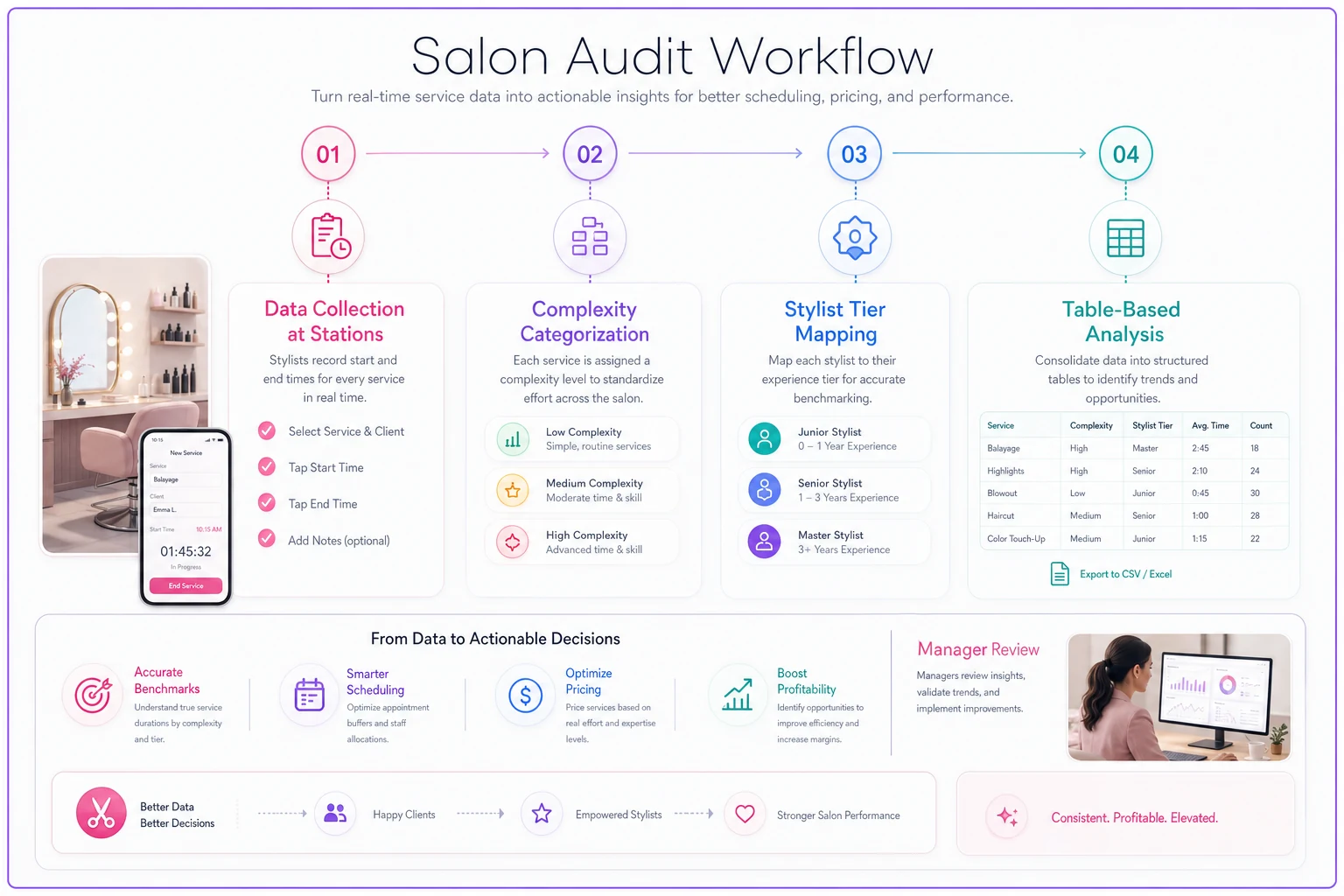
Start with a single station for your first week to iron out data collection issues before rolling it salon-wide.
These aren't aspirational times — they're what actually happens in your salon.
Building your capacity-aligned pricing model
Once you know real service durations, pricing becomes mathematical rather than emotional. Calculate your true chair-hour cost first. Include rent, utilities, product costs, and assistant wages, then divide by productive chair-hours monthly.
Let's say your 6-chair salon costs $24,000 monthly to operate (rent, utilities, products, support staff). With roughly 40 productive hours daily, 26 days monthly, that's about 1,040 productive chair-hours. Your base chair-hour cost is around $23.
Now add stylist costs. If you're paying 40% commission, a $100 service costs you $40 in stylist pay plus $23 in chair time (assuming 1 hour). Your true cost is $63 before any profit.
But duration accuracy matters. If that "$100 service" actually takes 1.5 hours, your chair cost jumps to $34.50. Total cost becomes $74.50. Your margin just dropped from 37% to 25.5%.
This is why accurate service times matter more than pricing strategy. You can't price profitably if you don't know your true costs.
The recovery system for daily variability
Even with perfect measurements, reality varies. Clients arrive late. Stylists have off days. Unexpected corrections pop up. You need buffer rules that protect profitability without destroying flexibility.
The 15-minute rule Build 15-minute buffers between appointments for senior stylists, 20 minutes for mid-level, 25 minutes for juniors. This isn't downtime — it's transition, consultation, and catch-up space. When everything runs smoothly, stylists can prep, grab water, or pull in waiting clients early.
Late client protocol If a client is 10+ minutes late, the service automatically shifts to "express" mode. Skip the massage, simplify the style, focus on the core service. Make this policy clear during booking. Late arrivals can't expect full service and delay everyone else.
Complexity upgrade triggers When a "standard" service becomes "complex" mid-appointment (happens constantly with color corrections), have a clear process:
-
Stylist signals complexity upgrade
-
Reception checks downstream impacts
-
Client gets informed of time/cost adjustment
-
Next appointments get proactively managed
The floater position Once you hit 5+ stylists, designate one as daily "floater" on rotation. They handle walk-ins, cover delays, and jump in when someone hits complexity surprises. Yes, this reduces total bookings, but it prevents cascade failures that cost way more.
When precision planning meets real operations
A salon I worked with recently ran this entire audit process. They discovered their average color service ran 35 minutes longer than scheduled. Multiply that by 8 color services daily, and they were losing 4.5 hours of capacity — basically an entire stylist's production.
After implementing accurate durations and complexity tiers, something interesting happened. Revenue actually dropped for two weeks. They were booking fewer services with proper spacing. But then profits jumped. No more overtime. Less product waste from rushed applications. Fewer refunds from botched services. Happier stylists meant lower turnover.
Within two months, they'd raised prices 15% on complex services (now that they knew the true time investment), added a junior stylist to handle simple services efficiently, and their Saturday chaos transformed into smooth operations. Same chair count, 30% more profit.
Your implementation roadmap
Start with the audit. Don't skip this or use industry averages. Your salon, your stylists, your clients are unique. Measure what actually happens.
Then categorize by complexity. Keep it simple — three tiers maximum. More than that and your front desk can't manage it effectively.
Map your stylist levels honestly. Just because someone has 10 years experience doesn't make them "senior" for all services. Maybe they're senior for cuts but mid-level for color.
Build your buffer system before you need it. Train everyone on late policies, complexity upgrades, and recovery protocols while things are calm.
Price according to true capacity costs, not competitor comparison. If complex highlights consume 3 chair-hours plus products and stylist time, price them accordingly. Clients who value quality will pay for proper service time.
The technology leverage point
This is where AI-powered operational software transforms everything. Instead of manually tracking service times, modern salon platforms automatically capture duration data from your booking system. AI agents can identify patterns — like how humidity affects processing time or which stylists consistently run over on specific services.
The real power comes from dynamic adjustment. AI automation can suggest optimal booking patterns based on stylist performance, automatically space appointments based on complexity, and even predict when you'll need that floater coverage. It's like having an operations manager who never sleeps and processes thousands of scheduling variables simultaneously.
But even basic automation helps. Digital intake forms that capture hair history and desired outcomes let you pre-categorize complexity. Automated reminders that include service-specific prep instructions reduce consultation time. Central dashboards showing real-time chair utilization help managers spot and prevent bottlenecks before they cascade.
The combination of accurate baseline data and intelligent automation means you stop fighting daily fires and start optimizing actual capacity. Your software handles the complexity while your team focuses on what they do best — making clients look amazing.
Moving from chaos to capacity
Salon capacity planning isn't about squeezing in more appointments. It's about understanding the true economics of your chair time and aligning every operational decision to that reality.
Most owners avoid this because it feels complex. They'd rather deal with daily chaos than confront foundational problems. But you're already dealing with the complexity. You're just doing it reactively, at the worst possible moments, with imperfect information.
The audit-first approach takes maybe 20 hours total to implement properly. Compare that to the hundreds of hours you waste annually on scheduling chaos, overtime costs, and staff frustration. Compare it to the thousands in lost revenue from underpriced complex services or idle chairs from overestimated capacity.
More importantly, accurate capacity planning changes how you grow. Instead of adding chairs and hoping for the best, you know exactly when you need another senior colorist versus a junior stylist. You can predict which service categories to expand and which to phase out. You make decisions based on data, not desperation.
The salons that thrive over the next few years won't be the ones with the best stylists or fanciest spaces. They'll be the ones that treat operations as seriously as they treat creativity. The ones that measure, adjust, and optimize continuously. The ones that recognize their service menu isn't just a price list — it's the foundation of their entire business model.
Stop guessing at service times. Stop hoping the schedule works out. Stop treating capacity like it's infinite. Start measuring what really happens in your chairs, price according to reality, and build the operational buffer systems that turn chaos into consistency.
Your stylists will thank you. Your clients will notice the difference. Your bank account definitely will.
Ready to simplify your salon operations?
Join 1,000+ salons using Salnly to save time, reduce scheduling chaos, and deliver better client experiences.