

Last December, I watched a salon owner lose $18,000 in a single week. Not from a disaster or major failure—just from misjudging holiday demand and having three stylists on vacation during what turned out to be their busiest stretch of the year.
Most salon owners treat seasonal forecasting like weather prediction—checking last year's books maybe a week before a holiday and hoping for the best. But seasonal patterns in beauty services aren't just about holidays. They're about prom season overlapping with wedding season, back-to-school rushes colliding with end-of-summer color corrections, and those weird dead zones in March that nobody talks about.
Owners who nail their forecasting capture an extra 15-30% revenue during peak periods, while everyone else scrambles with emergency hiring, stockouts, and burnt-out staff. The difference isn't magic—it's having a systematic way to see what's coming and prepare for it.
The key isn't predicting the future perfectly. It's having enough visibility to make good decisions before problems hit. That's what separates salons that grow consistently from those that lurch between crisis and recovery.
Why traditional salon forecasting breaks down
Most salon forecasting looks something like checking last December's numbers in late November, maybe glancing at the appointment book two weeks out, and ordering extra color based on gut feeling. This worked fine when salons were smaller and seasons were more predictable.
Modern salon operations face a different reality. Your clients book differently now—some schedule months ahead for weddings while others expect same-day availability. Local events you've never tracked suddenly drive massive demand spikes. A high school moves prom from May to April and your entire spring schedule shifts.
The traditional approach assumes patterns repeat cleanly year to year. But salons today deal with shifting demographics, changing booking behaviors, social media-driven trend spikes, and competition that wasn't there twelve months ago. A forecasting system built on "what happened last year" misses all of this.
What actually works is cohort-based demand tracking—understanding not just that you did 450 services last May, but which client segments drove that demand, what they booked, and why. Combined with local event calendars and actual lead-time requirements, this gives you something you can actually use to make decisions.
The 12-week rolling forecast framework
Instead of annual planning or monthly scrambling, you maintain a rolling 12-week operational forecast that updates weekly.
Stop losing appointments in the chaos.
Salnly helps you book, confirm & manage every appointment—efficiently.
- Centralized appointment management
- Client notifications
- Calendar & staff scheduling
No credit card required
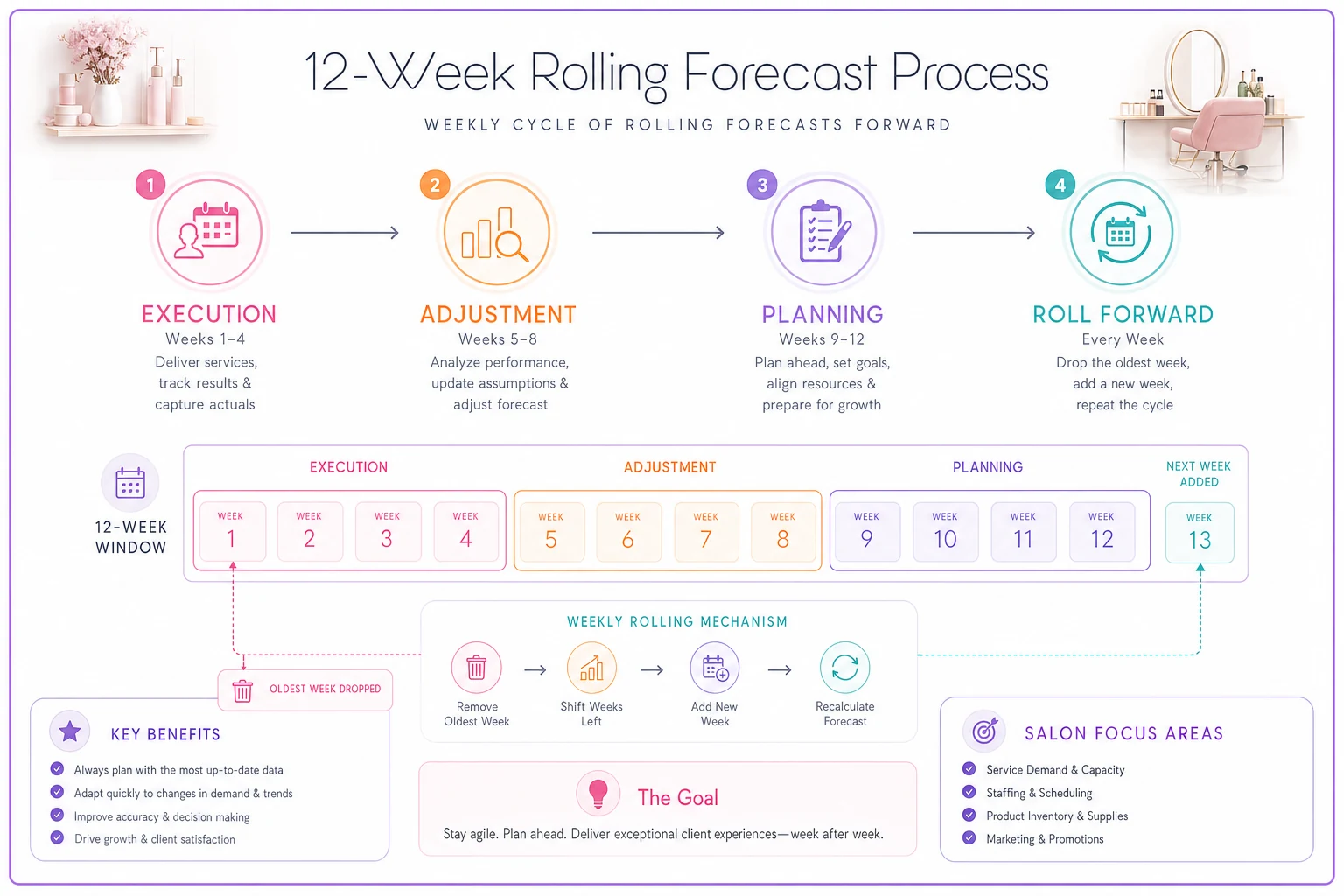
Week 1-4 is your execution zone. These weeks are largely locked—staff is scheduled, inventory is on hand, promotions are running. Your focus here is on filling gaps and optimizing what you've already planned.
Week 5-8 becomes your adjustment zone. You can still affect staffing through shift swaps and overtime, rush order critical inventory, and launch short-notice promotions. This is where you catch problems before they hurt you.
Week 9-12 is your planning zone. You're making staffing decisions, placing standard inventory orders, and designing promotional calendars.
Every Monday, you roll everything forward one week. Week 2 becomes Week 1, Week 13 enters your planning zone. This constant forward motion keeps you from getting surprised by predictable events. This system matches your actual operational constraints. You can't hire a new colorist tomorrow for next week's rush, but you can absolutely plan for one three months out. You can't get a bulk color order delivered in three days, but eight weeks gives you options.
[WORKFLOW GRAPH: 12-Week Rolling Forecast Process - Shows the weekly cycle of rolling forecasts forward with execution, adjustment, and planning zones]
This system matches your actual operational constraints. You can't hire a new colorist tomorrow for next week's rush, but you can absolutely plan for one three months out.
Building your demand cohorts
The biggest mistake in forecasting is treating all appointments the same. A color correction client who books quarterly has completely different seasonal patterns than someone who gets monthly blowouts.
Start by segmenting your client base into behavioral groups. High-frequency clients (weekly to monthly visits) respond to different seasonal triggers than low-frequency clients (quarterly or less). Your color clients peak at different times than your treatment clients. Bridal parties book differently than regular appointments.
| Client Cohort | Booking Pattern | Peak Periods | Lead Time |
|---|---|---|---|
| Weekly regulars | Steady, habit-driven | Slight lifts before holidays | 1-2 weeks |
| Monthly maintenance | Predictable intervals | Before major events | 2-3 weeks |
| Quarterly color | Seasonal refresh | Spring, fall, holidays | 3-4 weeks |
| Special occasion | Event-driven | Proms, weddings, holidays | 4-8 weeks |
| Walk-ins/fills | Opportunistic | Random gaps | 0-3 days |
Track each cohort's historical demand separately, then combine them for your total forecast. This reveals patterns you'd never see in aggregate data. Maybe your April surge isn't general demand—it's prom season for special occasion clients while your regulars maintain normal patterns.
The cohort approach also helps with capacity planning. Your regulars rarely deviate from their patterns, so their demand is easy to predict. Special occasion clients create the wild swings that destroy your staffing plans if you're not ready.
The local event calendar overlay
Every salon operates in a local ecosystem of events that drive demand in predictable but often untracked ways. A high school prom, a major conference at the convention center, even the local marathon—these all create demand spikes that destroy your staffing plans if you don't see them coming.
Build a comprehensive local event calendar that goes beyond major holidays. School events matter more than you think. Proms, graduations, homecomings, parent-teacher conferences, school photos—each drives specific service demand. A single high school prom can mean 40-60 updos in one weekend.
Convention and conference schedules affect business travel patterns and special event bookings. That dental conference bringing 3,000 people to town? They're booking blowouts. Sports and entertainment events create ripple effects. Home games, concerts, festivals—people want to look good for these.
Community traditions unique to your area matter. The annual charity gala, the country club's member-guest tournament, that weird local festival that brings in thousands—these create predictable demand. Wedding venue schedules tell you when bridal party demand peaks. If the three major venues in your area are booked solid certain weekends, you need extra staff those Fridays and Saturdays.
Map these events to your 12-week forecast and watch patterns emerge. That dead week in March? It's spring break and half your regulars are traveling. That crazy Saturday in October? It's homecoming at three local high schools.
Staffing model based on forecasted demand
Once you understand what's coming, you need to translate that into actual staffing decisions. But salon staffing isn't like retail—you can't just add bodies. Each stylist has different capabilities, client relationships, and availability.
Create a tiered staffing model that matches forecasted demand to actual capability. Start with your baseline—the minimum staff needed to serve your regular clients without anyone feeling rushed or neglected. This is your foundation.
Add capacity layers based on demand forecasts. When you see a 20% demand spike coming in week 7, you don't need 20% more stylists—you need the right mix of skills available at the right times. Maybe that means bringing in your part-time colorist for extra days, not hiring someone new.
Build flexibility into your model. Cross-trained staff who can handle both color and cuts give you options. Junior stylists who can take overflow basic services free up seniors for complex work. Assistants who can handle blowouts create surge capacity without adding full stylists.
The key is matching staff skills to forecasted service mix, not just total appointments. If your forecast shows heavy color demand, adding cut-only stylists won't help. If you're seeing lots of simple blowouts, you don't need your master colorist working overtime.
Plan recovery time too. After big weeks, your team needs to recharge. Factor this into your model—a slow Tuesday after a brutal weekend isn't waste, it's necessary maintenance.
Promotional timing and service mix optimization
Your forecast doesn't just tell you when to staff up—it tells you when to promote what. The worst promotional timing is pushing services when demand already exceeds capacity. Yet salons do this constantly, promoting holiday packages in December when they're already slammed.
Use your 12-week forecast to identify promotional opportunities in valleys, not peaks. That dead week in March? Perfect for a color refresh promotion. The slow Tuesday afternoons in September? Ideal for treatment packages.
Design promotions that smooth demand rather than spike it. Instead of "December holiday glamour packages," try "November pre-holiday prep" promotions. Get clients in before the rush, when you have capacity and they have time.
Service mix optimization means steering clients toward what you can actually deliver. When your forecast shows color capacity but cut constraints, promote color services. When you have junior stylist availability but senior stylists are booked, promote services juniors can handle.
This isn't about tricking clients—it's about aligning what you promote with what you can excellently deliver. Nothing hurts your reputation faster than promoting services you can't properly provide. Smart promotional timing also helps train your clients. They start to understand when you have availability and when you don't. Regular clients learn to book early for peak times and take advantage of slower periods.
Inventory planning with actual lead times
Product stockouts during peak season are profit killers, but so is carrying excessive inventory through slow periods. Your 12-week forecast, combined with real lead times, prevents both problems.
Map every product category to its actual replenishment timeline. That premium color line might take three weeks from order to delivery. Your retail products might arrive in five days. Some items have minimum orders that affect your planning.
Order color supplies by the lead time deadline rather than waiting until you notice shortages to avoid rush shipping.
Create inventory triggers based on forecasted usage, not historical averages. If your forecast shows heavy balayage demand in week 8, you need those lighteners ordered by week 5, not when you notice you're running low.
Build buffer stock strategically. High-margin, slow-spoiling products can carry more buffer. Fast-moving commodities need tighter control. Seasonal items should never carry over—plan to sell through.
Link inventory to service forecasts, not general seasonality. If you're forecasting 80 full color services in week 6, you know exactly how much color to have on hand. This is far more accurate than "order extra for spring."
The math isn't complicated once you know your usage rates. Track how much product each service type consumes, multiply by forecasted services, add your safety buffer. Order by the lead time deadline. Simple, but most salons never do this systematically.
Reading the signals: early indicators that adjust your forecast
The best forecasting systems aren't static—theyadjust based on early signals. Your 12-week forecast is a living document that gets smarter each week.
Booking velocity tells you if your forecast is on track. If you typically book 60% of next week's appointments by Tuesday and you're only at 40%, something's off. Maybe there's a competitor promotion, maybe weather's keeping people home. Either way, you can adjust.
Consultation patterns predict future demand. A surge in color consultations this week means color demand in 2-3 weeks. Bridal consultations predict wedding season demand months out.
Retail sales patterns often preview service demand. Clients buying damage repair products will book treatments soon. Color maintenance product sales predict rebooking timelines. Watch what clients buy to predict what they'll book.
Social media engagement around certain styles or trends gives you weeks of warning before demand hits. That balayage video that went viral? You'll see appointment requests within days.
Local economic indicators matter too. Major layoffs suppress discretionary spending on beauty services. A new corporate campus brings hundreds of potential clients to your area. Track what affects your local market.
Scheduling chaos already costs salons thousands monthly. Adding seasonal forecasting to broken scheduling just multiplies the problems. Get your base operations solid first.
The difference between planning and panicking
When you implement proper seasonal forecasting, you stop reacting and start anticipating. That holiday rush isn't a surprise anymore—it's a planned peak with appropriate staffing, stocked inventory, and realistic scheduling.
Your staff stops burning out during peaks because you've planned coverage and recovery time. They're not working emergency overtime; they're working planned schedules with proper support. This alone reduces turnover and improves service quality.
Clients get better service because you have capacity when they need it. Instead of cramming them in or turning them away, you've built appropriate availability. They can book the services they want when they want them.
Your inventory turns faster and wastes less. Products arrive when needed, sell during peak demand, and don't sit aging on shelves. Your cash isn't tied up in excessive stock or lost to emergency shipping charges.
Stress levels drop across the board. When everyone knows what's coming, they can prepare for it. Problems become manageable challenges instead of existential crises.
When forecasting makes sense (and when it doesn't)
This level of forecasting makes sense once you're past about 200 appointments monthly. Below that, seasonal patterns aren't stable enough to forecast reliably, and the effort exceeds the benefit.
You need at least one full year of data to build meaningful forecasts. Without historical patterns, you're guessing. New salons should focus on capturing clean data first, then build forecasting systems in year two.
Team size matters too. Solo operators or two-person salons can adjust quickly enough that detailed forecasting adds little value. Once you're coordinating four or more service providers, forecasting becomes critical.
If your business is heavily walk-in based, traditional forecasting won't work. You need different tools—perhaps real-time utilization tracking rather than advance forecasting.
Don't build a forecasting system if your basic operations aren't solid. Fix scheduling, standardize pricing, get inventory control working first. Forecasting amplifies whatever system you have—good or bad.
A real 12-week transformation
A 6-chair salon I worked with last year was consistently slammed during the holidays, dead in January, and could never predict their spring season. Staff were frustrated, clients couldn't book appointments, and the owner was ordering inventory based purely on gut feeling.
We implemented the 12-week rolling forecast in September, just as they were heading into their traditionally chaotic Q4. The first month was just observation—tracking booking patterns, identifying client cohorts, mapping local events.
By October, patterns emerged. Their "holiday rush" actually started in early November with corporate holiday parties. The dead zone in January wasn't uniform—color services dropped 40% but treatments stayed steady. Spring volatility was tied to three local high schools with staggered prom dates.
November's forecast called for adding 32 hours of stylist capacity spread across two weeks. Instead of panic hiring, they brought in a traveling stylist for specific days and shifted their part-timer to full-time temporarily. Inventory orders placed in early October arrived exactly when needed.
December ran smoothly for the first time in years. Revenue hit $47,000 versus $39,000 the previous December, but more importantly, overtime costs dropped and no one worked past 7 PM on weekdays. Client complaints about availability disappeared.
January's "dead zone" became an opportunity. With proper forecasting, they ran targeted treatment promotions that filled gaps without discounting core services. Revenue only dropped 12% versus the usual 30% decline.
By March, they were forecasting with confidence. Prom season staffing was arranged months in advance. Summer inventory was ordered with volume discounts instead of rush premiums. The owner spent less time fighting fires and more time growing the business. The transformation wasn't magic—it was systematic preparation.
The compound effect of better forecasting
Good forecasting creates compound improvements across your salon operations. When you can see 12 weeks ahead clearly, every other decision gets better.
Staffing becomes strategic rather than reactive. You're developing talent for future needs, not just filling today's gaps. Training happens during planned slow periods. Vacations get approved without panicking about coverage.
Marketing aligns with operational reality. Promotions fill valleys rather than amplifying peaks. New service launches happen when you have capacity to deliver them well. Your marketing spend generates better returns because timing improves.
Financial management improves dramatically. Cash flow becomes predictable when you know what's coming. You can negotiate better terms with suppliers based on predictable volume. Labor costs align with revenue instead of surprising you.
The entire operation runs with less friction. There's less stress, less waste, fewer emergencies. Problems get solved before they become crises. Everyone from stylists to clients experiences a better-run business.
Quality goes up because you're not constantly in crisis mode. When stylists aren't rushing through overbooked days, they do better work. When inventory is available, services get delivered properly. When clients can book when they want, they're happier.
Building your toolkit week by week
Implementation doesn't happen overnight. Start with observation and data gathering. Week 1, just track daily appointments by type and stylist. Week 2, add client categorization. Week 3, start mapping local events.
By week 4, you'll see patterns emerging. Build your first rough forecast for weeks 5-16. Don't aim for perfection—even being directionally correct helps.
-
Start tracking current appointments by service type and stylist
-
Categorize clients into behavioral cohorts
-
Map local events that affect demand
-
Create baseline forecast for next 12 weeks
-
Update weekly and track accuracy
-
Refine categories based on what you observe
-
Add inventory planning to the forecast
-
Link staffing decisions to forecasted demand
-
Adjust promotional timing based on capacity
-
Optimize the system based on actual results
Week
Quality goes up because you're not constantly in crisis mode. When stylists aren't rushing through overbooked days, they do better work. When inventory is available, services get delivered properly. When clients can book when they want, they're happier.
Ready to simplify your salon operations?
Join 1,000+ salons using Salnly to save time, reduce scheduling chaos, and deliver better client experiences.