



Most salon owners think their biggest problem is getting more clients through the door. But you're already losing $42,000 a year through scheduling gaps, service mismatches, and staffing inefficiencies—before a single client cancels or complains.
The real killer? These losses compound. A scheduling gap creates a staffing problem. The staffing problem creates a service bottleneck. The service bottleneck creates unhappy clients. And suddenly you're working 60-hour weeks wondering why revenue stays flat despite being "busy."
I learned this watching salon after salon hit the same operational wall around $35k monthly revenue. They'd push harder, extend hours, add services—but profits actually dropped. The businesses that broke through didn't work harder. They built interconnected systems that turned chaos into predictable operations.
Why traditional salon management creates expensive chaos
Walk into any salon doing $20k–40k monthly and you'll see the same pattern. The owner bounces between cutting hair, managing the schedule, handling walk-ins, and fixing whatever crisis just erupted. They're using three different systems that don't talk to each other—appointment book here, staff schedule there, client notes somewhere else.
This fragmentation creates what I call "operational leak points." Every handoff between systems, every manual update, every piece of information stored in someone's head instead of a central system—these are all spots where money disappears.
Typical Tuesday: Your 2pm appointment texts to reschedule. You check the book, find an opening Thursday. But wait—that's when Maria requested off. You forgot because it's written on a sticky note. Now you're texting staff to see who can cover. Meanwhile, your 2:30 arrives early and sees an empty chair. They wonder why they couldn't book that earlier slot.
Each of these moments seems minor. String them together across a month and you're looking at 40–60 hours of administrative friction that produces zero revenue. Worse, each friction point increases the chance of errors that upset clients or staff.
The breaking point usually hits around 25–30 weekly appointments per stylist. Below that threshold, informal systems work fine. Above it, the wheels start coming off. Double-bookings increase. Staff confusion grows. Client wait times extend. And the owner gets trapped in daily firefighting mode instead of actually growing the business.
The four pillars that actually determine salon profitability
After mapping operations across dozens of salons, the same four areas determine whether a salon thrives or merely survives. Most owners focus on one or two. The profitable ones systematically connect all four.
Stop losing appointments in the chaos.
Salnly helps you book, confirm & manage every appointment—efficiently.
- Centralized appointment management
- Client notifications
- Calendar & staff scheduling
No credit card required
Scheduling architecture
This isn't just about booking appointments. It's understanding capacity math—how many services you can deliver per hour across your team, accounting for prep time, clean-up, and realistic transition windows. A 30-minute haircut actually consumes 42 minutes of chair time when you factor in real operations.
Staff deployment patterns
Your team's productivity varies predictably throughout the week. Tracking actual performance patterns (not what you hope happens) reveals that Tuesday mornings run at 45% capacity while Saturday afternoons hit 95%. Most salons staff these periods identically, burning labor costs or leaving money on the table.
Service profitability mapping
That $120 color service might seem like your moneymaker until you calculate the true cost: 2.5 hours of chair time, $28 in product, 30 minutes of processing where the stylist can't take other clients. Meanwhile, the $35 men's cut takes 25 minutes total and requires $2 in product. One generates $17 per chair-hour. The other generates $78.
Revenue optimization rules
This connects everything above into decision frameworks. When should you accept a walk-in? When does discounting make sense? How do you handle late arrivals? Without clear rules, every decision becomes a negotiation that disrupts operations.
Building your modular salon operations playbook
The solution isn't another scheduling app or hiring an assistant manager. You need interconnected systems that handle decisions automatically while adapting to your specific business model.
Start with your scheduling foundation. Map every service you offer with realistic time requirements:
| Service Type | Book Time | Actual Time | Setup/Cleanup | True Capacity Cost |
|---|---|---|---|---|
| Women's cut | 45 min | 52 min | 8 min | 60 minutes |
| Men's cut | 30 min | 25 min | 5 min | 30 minutes |
| Full color | 120 min | 135 min | 15 min | 150 minutes |
| Highlights | 90 min | 105 min | 15 min | 120 minutes |
| Blowout | 30 min | 35 min | 5 min | 40 minutes |
Notice how the "book time" rarely matches operational reality? This gap creates most scheduling problems. Your system needs to account for actual time, not wishful thinking.
Next, create staff deployment templates based on demand patterns. Don't guess—pull your actual appointment history. You'll likely find patterns like:
-
Monday
60% capacity, primarily existing clients
-
Tuesday-Wednesday
70% capacity, mix of services
-
Thursday-Friday
85% capacity, heavy color services
-
Saturday
95% capacity, everything
Build staffing templates for each pattern. A Tuesday might need 2 stylists and 1 assistant. Saturday needs 4 stylists, 2 assistants, and someone dedicated to managing walk-ins.
For service design, calculate true profitability per chair-hour:
Revenue per service ÷ Total time invested = Actual hourly value
This reveals surprising truths. That premium service package might generate less per hour than basic cuts. Use this data to guide booking priorities and promotional decisions.
Finally, establish clear decision rules:
-
Walk-ins accepted only when next 90 minutes have 40%+ open capacity
-
Late arrivals over 10 minutes automatically rescheduled unless same-day availability exists
-
Discounts only offered for services with sub-$50 hourly value during off-peak times
-
New stylists book maximum 70% capacity for first 60 days
These rules eliminate decision fatigue and ensure consistent operations regardless of who's managing the front desk.
Here's a simple workflow showing how these pieces connect.
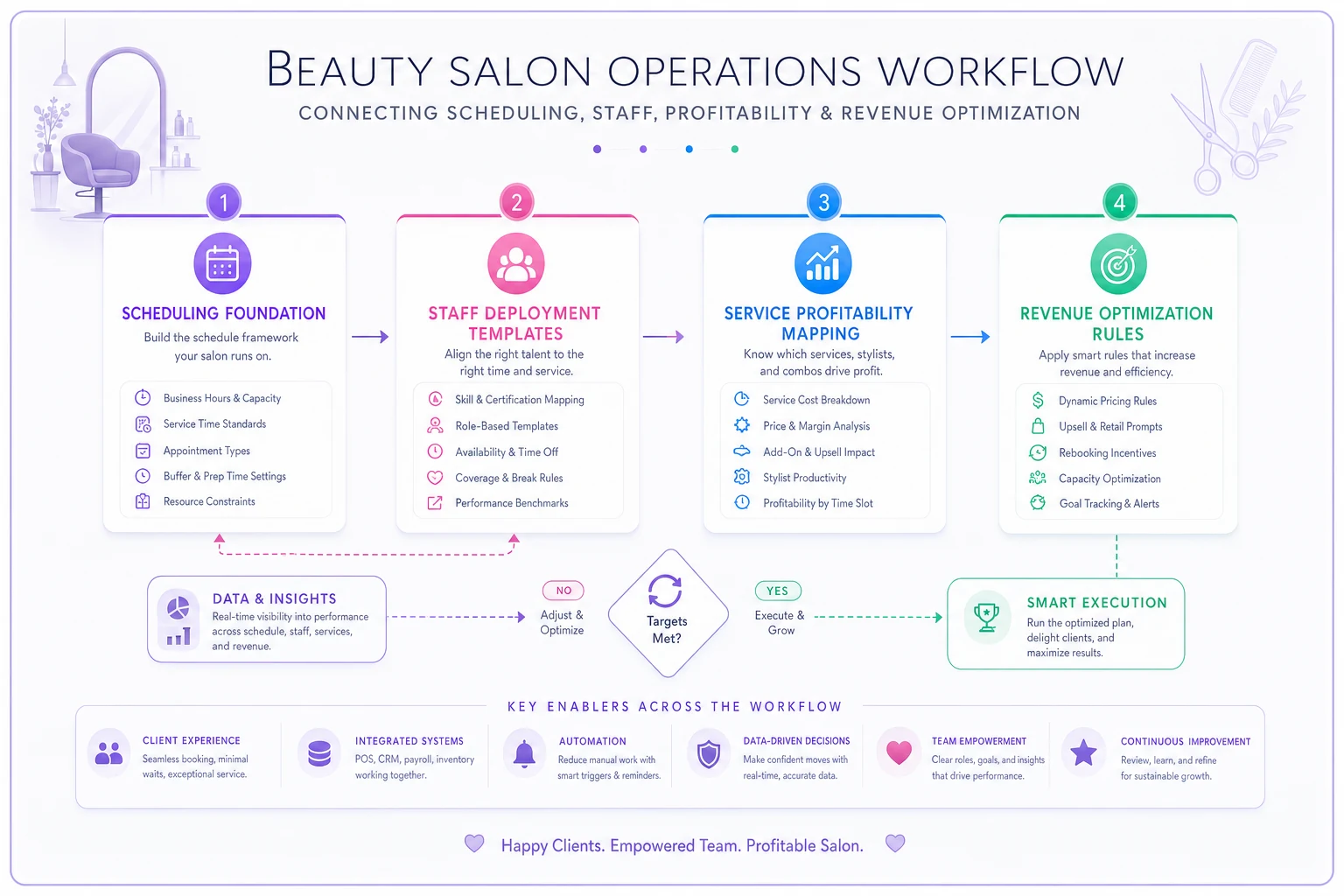
Use this workflow to visualize how scheduling, staffing, service mapping, and rules interact.
Implementation checkpoints that prevent system failure
The best playbook fails without proper implementation. Most salons try changing everything at once, creating chaos instead of clarity. Smart implementation happens in phases with clear checkpoints.
Phase 1: Data capture (Weeks 1–2)
Document your current state without changing anything. Track actual appointment times, not scheduled times. Note when staff actually arrive versus scheduled shifts. Record every scheduling conflict, client complaint, and operational hiccup. This baseline tells you what's really broken versus what feels broken.
Phase 2: Template testing (Weeks 3–4)
Implement scheduling templates for just two days per week. Choose your busiest and slowest days. Run the templates alongside your current system, comparing outcomes. You'll quickly see which assumptions were wrong.
A salon in Denver discovered their Saturday "rush" actually happened Friday evening—they'd been overstaffing the wrong day for years. Simple observation saved them $1,400 monthly in unnecessary labor costs.
Phase 3: Rule rollout (Weeks 5–6)
Add one decision rule at a time. Start with walk-in policies since they're easiest to track. Once that's smooth, add late arrival rules. Then booking priorities. Each rule needs a full week of testing before adding the next.
Phase 4: Full integration (Weeks 7–8)
Connect all systems. Your scheduling feeds staffing. Staffing determines service availability. Service mix drives revenue optimization. Every piece reinforces the others.
The checkpoint that matters most: weekly variance tracking. Compare planned versus actual for:
-
Services delivered per stylist
-
Revenue per chair-hour
-
Staff utilization rate
-
Schedule accuracy (how often you stick to the plan)
Track weekly variance in a simple spreadsheet to spot template drift before it becomes a systemic issue.
When variance exceeds 15% for two consecutive weeks, something's broken. Either your templates need adjustment or staff isn't following the system.
Common failure points and system adjustments
Even solid systems hit predictable failure points. Knowing these ahead of time lets you adjust before things spiral.
The senior stylist rebellion
Around week three, your most experienced stylists will resist the system. They've operated their own way for years and don't appreciate "rules." The fix: give them input on their personal templates while maintaining overall structure. Let them own their micro-schedule within the macro-system.
The new client bottleneck
Structured scheduling often reveals you can't accommodate new clients without disrupting existing ones. This is actually good—it shows your true capacity. The adjustment: designate specific "new client slots" that can't be filled by existing clients until 48 hours before.
The product stockout spiral
Better scheduling means more predictable service delivery, which reveals inventory problems you didn't know existed. Suddenly you're out of specific color on your busiest day. Build 20% buffer stock for your top 10 products and create reorder triggers based on appointment forecasts, not current inventory.
The reception desk revolt
If your front desk handles scheduling, they'll struggle initially with the new rules and templates. They're used to making judgment calls, not following decision trees. Invest extra training time here. Create a physical checklist they can reference until the rules become automatic.
You'll also hit what I call "system fatigue" around week four. Staff get tired of the new process and start reverting to old habits. Push through this phase. By week six, the new system becomes natural, but only if you maintain consistency during the difficult middle weeks.
Measuring what matters: KPIs that track system health
Forget vanity metrics like total appointments or gross revenue. Your salon operations playbook needs measurements that reveal system performance.
Chair utilization rate
(Actual service hours ÷ Available chair hours) × 100 Target: 75–85% during peak periods, 50–60% during standard periods Below 50% means scheduling problems. Above 85% means you're hitting capacity limits.
Revenue per available hour
Total service revenue ÷ Total salon operating hours This shows whether you're maximizing your fixed costs (rent, utilities, insurance).
Service mix efficiency
Track the percentage of high-value services (over $60/hour) versus low-value services. If low-value services exceed 40% of your mix, your booking priorities need adjustment.
Staff productivity variance
Compare each stylist's actual revenue per hour against their target. Variance over 20% indicates either scheduling problems or performance issues.
System adherence rate
What percentage of decisions follow your established rules? Track weekly. Below 80% adherence means your system is too complex or staff needs retraining.
These metrics tell you more about salon health than client count or monthly revenue. A salon with 80% chair utilization and high system adherence will outperform one with more clients but chaotic operations.
Scaling beyond the chair: when systems enable growth
Most salon owners don't realize: operational systems don't just fix current problems—they unlock growth opportunities you couldn't see before.
Once your foundational systems run smoothly, patterns emerge. Maybe Wednesday afternoons consistently show 40% utilization. That's not a problem to fix; it's an opportunity to explore. Could you offer specialized services then? Training for junior stylists? VIP appointment blocks at premium prices?
A salon running systematic operations can actually predict when they'll need to expand. When chair utilization maintains 80%+ for six consecutive weeks, you've hit true capacity. That's expansion signal based on data, not feeling overwhelmed.
The same systems that organize a 4-chair salon scale to 12 chairs with minimal adjustment. The decision rules remain identical. The templates simply replicate across more stylists. The KPIs track the same way.
This scalability transforms how you think about growth. Instead of "we need more stylists," you think "we need Tuesday afternoon capacity for color services." Instead of "we're too busy," you identify "Thursday evening hits 95% utilization—time for surge pricing or expansion."
Three months of systematic operations gives you clarity on expansion timing, staffing needs, and service mix optimization that would take years to figure out through trial and error.
The technology integration question
Eventually, manual systems hit their limit. Tracking everything in spreadsheets, coordinating via group texts, and managing paper schedules becomes its own bottleneck around $60k monthly revenue.
Modern salon operations benefit from AI-powered operational software that connects scheduling, staff management, and service optimization in one platform. But the playbook comes first. Establish your templates, rules, and checkpoints manually. Prove they work. Then technology makes them automatic.
AI automation can predict scheduling conflicts before they happen, automatically adjust staff schedules based on booking patterns, and identify optimization opportunities humans might miss.
The salons that successfully integrate operational software already have clear systems. They use technology to reduce the manual work of system management, not to avoid creating systems entirely. When a platform can automatically enforce your booking rules, suggest optimal service mix, and flag capacity issues, you free up 10–15 hours weekly for actual business growth.
But here's the mistake most owners make: they think software will solve their operational problems. It won't. Software amplifies your existing systems—good or bad. If your manual systems are chaotic, digital systems will be chaotic faster.
Your implementation roadmap
Week 1: Document everything for three days. Every appointment, every conflict, every deviation from plan.
Week 2: Build your first template—just for your busiest day. Include realistic time blocks and clear staff assignments.
Week 3: Test one decision rule. Pick something simple like walk-in acceptance criteria.
Week 4: Review and adjust. What worked? What didn't? Refine before expanding.
Stop treating symptoms. Build systems that prevent problems from occurring. Start this week:
The salons that thrive don't have more talented stylists or better locations. They have better systems that turn daily chaos into predictable operations. Every scheduling decision follows a rule. Every service has a profitability calculation. Every staff member knows their role in the bigger picture.
Your salon operations playbook isn't about perfection—it's about progress. Each systematic improvement compounds. Fix scheduling, and staffing gets easier. Fix staffing, and service delivery improves. Fix service delivery, and revenue becomes predictable.
The choice is simple: continue fighting daily fires, or build systems that prevent fires from starting. The playbook exists. The templates are proven. The only question is whether you'll implement them before hitting your breaking point or after.
Most salon owners wait too long, implementing systems only after losing key staff, major clients, or hitting personal burnout. The smart ones build systems while things are manageable, using structure to accelerate growth rather than just survive it.
Start with one template. Follow one rule. Track one metric. Build from there. Within 90 days, you'll wonder how you ever operated without clear systems. More importantly, you'll finally have the mental space to think about growth instead of just getting through today.
Ready to simplify your salon operations?
Join 1,000+ salons using Salnly to save time, reduce scheduling chaos, and deliver better client experiences.