



Last Tuesday, a salon owner in Phoenix showed me her booking screen. Six stylists working, appointments scattered throughout the day, but something was off. Between 2 PM and 5 PM, she had seventeen 30-minute gaps. Dead time. Stylists scrolling Instagram. Rent still ticking.
She'd already tried the usual fixes. Better booking software. Color-coded calendars. Even hired a receptionist specifically to manage appointments. Nothing worked because the problem wasn't the tools—it was how appointments naturally fell into place.
Most salons lose 15-25% of potential revenue to these micro-gaps. Not from no-shows or cancellations (those are different problems), but from the natural way appointments stack against each other. A highlight ending at 2:35. Next client at 3:00. Twenty-five minutes of nothing.
Why traditional scheduling creates expensive gaps
Standard appointment booking follows a simple rule: client picks service, software finds opening, booking confirmed. Makes sense on paper. Falls apart in practice.
Your first client books a cut and color at 10 AM. Takes two hours. Next client wants just a cut, books at noon. Third client needs highlights, grabs the 1 PM slot. By 11:30, you've got a stylist finishing early with nobody scheduled until noon. Then another gap from 12:45 to 1:00.
These gaps compound. A 90-minute color service followed by a 45-minute cut creates a 15-minute dead zone if the next appointment is on the hour. Stack enough of these throughout the day, and you're looking at two to three hours of lost productivity per stylist.
The math hurts. Say your average service brings in $85. A stylist with three hours of gaps daily could theoretically handle two more appointments. That's $170 per day, roughly $850 weekly, or around $3,400 monthly per stylist. For a six-chair salon, we're talking about $20,000 in monthly revenue sitting in those gaps.
But you can't just cram appointments together and hope it works. Processing times vary. Some clients run late. Colors need to set. The solution isn't tighter scheduling; it's smarter scheduling.
Staggered starts: the 15-minute offset that changes everything
Instead of starting everyone on the hour or half-hour, offset your stylists by 15 minutes. Sounds simple. The impact surprised me.
Stop losing appointments in the chaos.
Salnly helps you book, confirm & manage every appointment—efficiently.
- Centralized appointment management
- Client notifications
- Calendar & staff scheduling
No credit card required
Here's the setup: Stylist A starts appointments at :00 and :30. Stylist B starts at :15 and :45. Stylist C starts at :10 and :40. Stylist D starts at :20 and :50.
When Stylist A finishes a 90-minute service at 11:30, Stylist B is wrapping up at 11:45, and Stylist C at 11:40. Suddenly, you've got coverage for walk-ins and early arrivals throughout that 11:30-12:00 window instead of everyone being between clients at once.
A salon in Denver implemented this exact system last year. Before staggering, they averaged 31 appointments daily across four stylists. After three months with staggered starts, they hit 37-39 daily appointments without adding hours or staff. The gaps didn't disappear—they just stopped aligning.
Setting this up requires planning:
-
Map current appointment patterns for two weeks
-
Identify your peak gap times (usually 11
30-12:30 and 2:30-4:00)
-
Assign offset times to each stylist
-
Train reception to book within these windows
-
Adjust for special cases (long services, specific client preferences)
Some stylists resist at first. They're used to their rhythm. But once they see fewer dead periods and more consistent workflow, most come around. The key is showing them the numbers—more appointments means more tips, more commission, less standing around.
Dynamic buffer zones: building flexibility without chaos
Static buffers kill profits. You know the type—automatic 15-minute gaps after every color service "just in case." Multiply that across six stylists doing four colors daily, and you've just thrown away six hours of bookable time.
Dynamic buffers work differently. They adjust based on three factors: service type, client history, and daily load.
For service type, quick cuts get 5-minute buffers. Complex colors get 10-15 minutes, but only for new clients or tricky formulations. Regular root touch-ups for established clients might get zero buffer.
Client history matters more than most owners realize. That client who's always 20 minutes late? Build it in. The one who shows up early and tips well? Tighten the schedule. Track this stuff—it's not discrimination, it's operations.
Daily load shifts everything. Tuesdays are slow? Run tighter buffers to maximize the clients you do get. Saturday mornings are slammed? Add breathing room to prevent pile-ups.
Dynamic buffer matrix from a salon doing $65k monthly:
| Service Type | New Client | Regular (on-time) | Regular (often late) | Saturday | Weekday |
|---|---|---|---|---|---|
| Cut only | 10 min | 5 min | 15 min | +5 min | baseline |
| Single color | 15 min | 10 min | 20 min | +10 min | baseline |
| Highlights | 20 min | 10 min | 25 min | +10 min | baseline |
| Color + cut | 15 min | 5 min | 20 min | +5 min | baseline |
The results? They went from 78% chair utilization to 87% in four months. Not by booking more appointments, but by using time more intelligently.
Partial-slot booking: the money hiding in 'unusable' time
Most salons treat a 35-minute gap as unusable. Can't fit a color, barely fits a cut, so it stays empty. But those gaps add up to serious money.
Enter partial-slot services—quick wins designed specifically for these windows. Bang trims take 15 minutes at $20. Beard shaping runs 20 minutes for $35. Gloss refresh takes 25 minutes but brings $45. Brow tint and shape: 20 minutes, $30. Quick blowouts: 25 minutes, $40.
The economics work because the service-to-time ratio beats traditional appointments. A $100 cut and style takes 45-60 minutes. A $45 gloss refresh takes 25 minutes. The hourly rate is actually higher on the partial service.
But you need rules, or it becomes chaos. Partial slots can only be booked within 24 hours. Never bump a full appointment for a partial. Stylists can decline if they need the break. Price these services at premium rates—they're convenience offerings. Market them as "express services" to set expectations.
Price these services at premium rates—they're convenience offerings.
A Chicago salon introduced express services specifically for their dead zones. First month: 47 express bookings generating $1,645. By month six: 180+ monthly express bookings adding $7,200 to revenue. No extra hours. No extra stylists. Just better use of existing gaps.
Express services can't require extensive setup or special products. They need to flow into whatever the stylist is already doing. That gloss refresh uses products already at the station. The bang trim happens with tools already out.
Sample shift templates that actually work
Theory is nice. Let me show you exactly what this looks like on an actual schedule.
Traditional Tuesday (Before)
``
Stylist A:
9:00-10:30 - Color & cut ($120)
[30 min gap]
11:00-11:45 - Cut ($65)
[45 min gap]
12:30-2:00 - Highlights ($140)
[30 min gap]
2:30-3:15 - Cut ($65)
[45 min gap]
4:00-5:30 - Color & cut ($120)

Daily total: $510
Gaps: 2 hours 30 minutes
``
Micro-scheduled Tuesday (After)
``
Stylist A:
9:00-10:30 - Color & cut ($120)
10:40-11:00 - Bang trim ($20)
11:00-11:45 - Cut ($65)
11:50-12:15 - Gloss refresh ($45)
12:30-2:00 - Highlights ($140)
2:10-2:30 - Brow tint ($30)
2:30-3:15 - Cut ($65)
3:25-3:50 - Blowout ($40)
4:00-5:30 - Color & cut ($120)

Daily total: $645
Gaps: 35 minutes
``
That's $135 extra per stylist per day from the same hours. Scale that across four stylists, five days a week, and you're looking at $10,800 monthly.
Express services fill specific gaps, they don't create new ones. The original appointments stay intact. We're just monetizing what was already dead time.
Capacity checks that prevent operational meltdown
Aggressive micro-scheduling without capacity checks is asking for disaster. I watched a salon try to maximize every minute without considering processing stations, shampoo bowls, or colorist availability. Week two was chaos.
Run these checks before implementing any micro-scheduling system:
Physical capacity audit: How many simultaneous rinses can your shampoo bowls handle? Where do clients sit during color development? Enough dryer stations for your partial-slot blowouts? Can your color mixing station handle rapid-fire touch-ups?
Staff capability matrix: Not every stylist can handle express services. Some need those gaps to reset. Map out who's fast enough for quick services, who needs longer transition times, who handles pressure well, who's good with walk-ins.
Peak time stress test: Take your busiest Saturday and add 20% more appointments on paper. Where does it break? That's your ceiling. Your micro-scheduling should stay 10-15% below that breaking point.
One salon found their constraint was shampoo bowls. Three bowls, six stylists. During peak times, stylists were waiting to rinse. They adjusted their micro-scheduling to stagger chemical services, ensuring no more than two needed rinsing simultaneously. Small change, huge impact on flow.
Before and after: real revenue impact from three salons
Salon 1: Urban location, 4 chairs
Before: $47k monthly revenue, 68% utilization Changes: Staggered starts + express services menu Month 3: $54k revenue, 79% utilization Month 6: $58k revenue, 82% utilization Additional monthly revenue: $11k Investment: Two days of staff training, new service menu printing
Salon 2: Suburban strip mall, 6 chairs
Before: $72k monthly, appointments clustered around school hours Changes: Dynamic buffers + partial-slot booking system Month 3: $79k revenue Month 6: $86k revenue, same staff, same hours Additional monthly revenue: $14k Biggest win: 2-3 PM slots now profitable instead of dead
Salon 3: Small town, 3 chairs
Before: $31k monthly, lots of walk-in attempts turned away Changes: 15-minute staggered starts only (simplest implementation) Month 3: $34.5k revenue Month 6: $36k revenue Additional monthly revenue: $5k Note: Smallest change, still meaningful impact
None of these salons added hours. None hired additional staff. They just got better at using the time they already had.
The implementation sequence that minimizes disruption
Don't flip everything at once. Week 1-2: Track every gap for two weeks. Note the size, time, and which stylist. You need this baseline or you're flying blind.
Week 3-4: Pick your two most flexible stylists. Offset them by 15 minutes. Watch what happens. Adjust if needed.
Week 5-6: Add remaining stylists to the staggered system. Keep some flexibility—not everyone needs to be offset if it doesn't make sense for their booking patterns.
Week 7-8: Start simple. Bang trims, brow tints, maybe gloss refresh. Price them high enough that they're profitable even with setup time.
Week 9-10: Implement buffers for just your highest-variance services first. Usually highlights and color corrections. See how it affects flow.
Week 11-12: Everything running together. Track daily metrics. Adjust what's not working.
Here's a quick visual of the rollout.
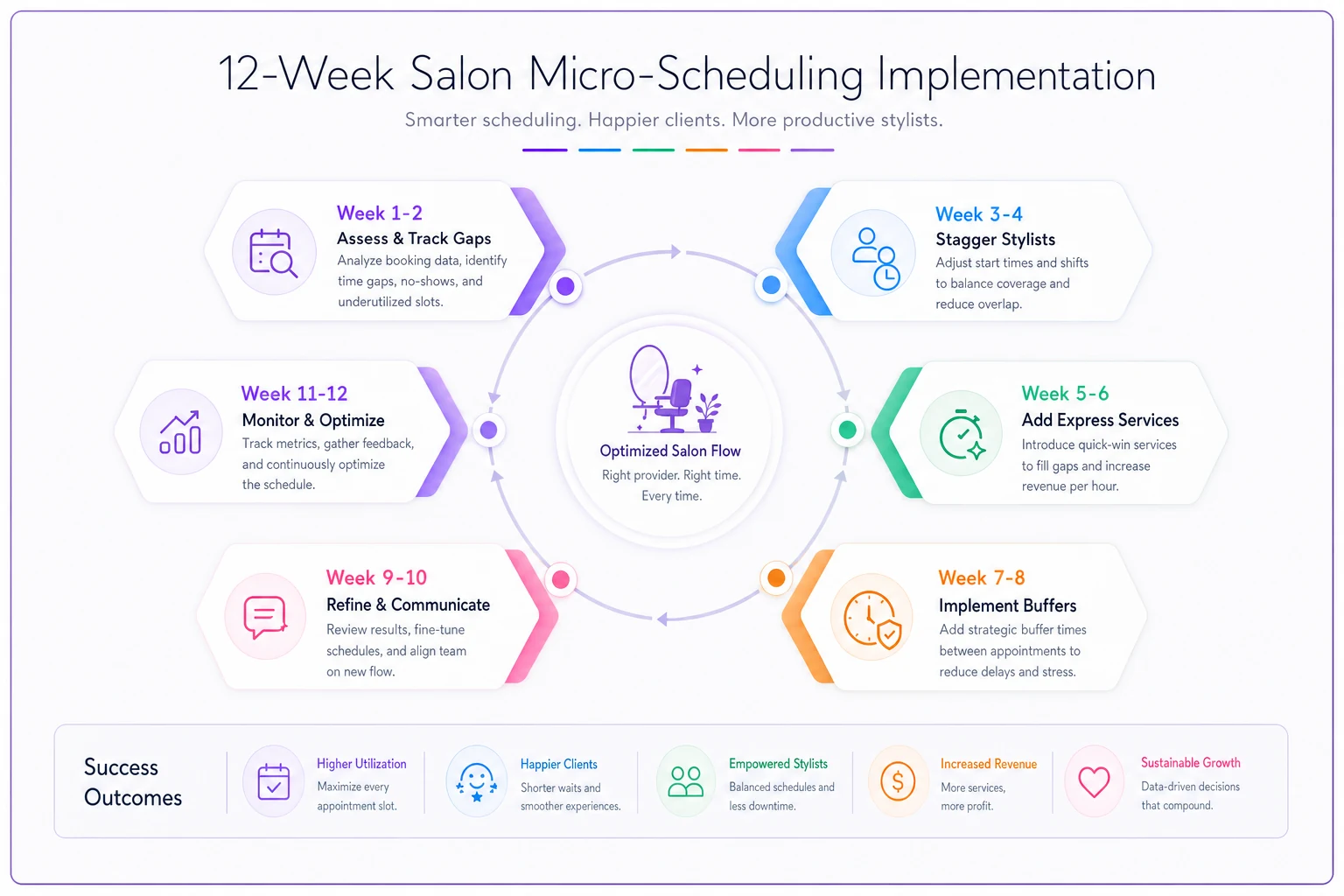
Most salons see revenue impact by week 6. Full optimization takes about three months.
When micro-scheduling backfires (and how to prevent it)
This system isn't magic. Force it into the wrong environment and it'll hurt more than help.
Micro-scheduling fails when your team is already at capacity (fix staffing first), your salon layout can't handle the flow (one shampoo bowl for six stylists won't work), stylists aren't trained for speed on express services, reception can't handle the complexity, or you don't have the tools to track it properly.
The worst case I saw was a salon that went from relaxed to frantic overnight. They added express services without training, implemented all changes simultaneously, and didn't account for their senior clientele who needed more time. Revenue actually dropped as stressed stylists made mistakes and clients felt rushed.
Prevention comes down to gradual implementation and constant adjustment. If stylists seem stressed, slow down. If clients complain about feeling rushed, add back some buffer. The goal is sustainable optimization, not short-term gains that burn everyone out.
Making this sustainable with the right operational setup
Manual micro-scheduling is exhausting. Keeping track of staggered starts, dynamic buffers, and partial slots in your head or on paper will drive your receptionist crazy within a week.
This is where operational software becomes essential. Not just any booking system, but one that can handle complex rules without constant human intervention. AI-powered scheduling can automatically identify gaps, suggest appropriate express services, and maintain your buffer rules without someone manually checking every booking.
The best platforms now use pattern recognition to optimize schedules in real-time. They learn that Tuesday afternoons always have gaps and automatically market express services to fill them. They track client punctuality and adjust buffers accordingly. They prevent double-booking of processing stations without requiring manual checks.
A well-configured system also handles the client communication side. Automated reminders for express services need different messaging than full appointments. Staggered starts mean customized timing for each stylist's reminder sequence. Dynamic buffers require smart waitlist management to fill last-minute openings.
The investment in proper operational software pays for itself quickly when you're capturing an extra $10k+ monthly from better scheduling. But even with great tools, the strategy comes first. Understand your gaps, design your rules, then let technology handle the execution.
The bottom line on micro-scheduling
Every salon has hidden capacity. It's sitting in those 20-minute gaps between appointments, those 35-minute windows too small for regular services, those moments when one stylist is swamped while another waits for their next client.
Micro-scheduling isn't about working harder or longer. It's about using time more intelligently. Staggered starts prevent everyone from having gaps simultaneously. Dynamic buffers eliminate waste without creating chaos. Partial-slot services turn "unusable" time into profitable time.
The salons seeing the biggest wins aren't implementing complex systems. They're starting simple—offsetting two stylists by 15 minutes, adding three express services, tracking what happens. Then they build from there.
Most salons can add $5k-$15k monthly revenue without adding a single hour of operation or hiring anyone new. It just requires looking at your schedule differently. Those gaps aren't inevitable. They're opportunities.
The choice is straightforward: keep losing money to scheduling inefficiency, or implement systems that capture it. Your stylists are already there. Your chairs are already paid for. Your overhead is already covered.
Time to stop leaving money in those gaps.
The choice is straightforward: keep losing money to scheduling inefficiency, or implement systems that capture it. Your stylists are already there. Your chairs are already paid for. Your overhead is already covered.
Time to stop leaving money in those gaps.
Ready to simplify your salon operations?
Join 1,000+ salons using Salnly to save time, reduce scheduling chaos, and deliver better client experiences.