



Your backbar cabinet probably looks familiar. Fifteen different shampoo lines, half-empty developer bottles from vendors you stopped ordering from six months ago, and that "revolutionary" treatment system the rep swore would fly off the shelves. Still sitting there, untouched since March.
The real problem isn't just dead inventory. Without tracking vendor performance and SKU movement properly, you end up reordering on gut feel. You stock up from the pushy rep who visits monthly while missing reorders from the vendor whose products actually sell. Stylists grab whatever's closest when they run low mid-service, throwing off product costs completely.
Walk into enough salons and you see the same situation play out: a manager doing a quarterly count, finding six unopened cases of a keratin treatment they'd already mentally written off, and realizing the vendor who sold it to them hasn't delivered a complete order in four months. No one flagged it because no one was tracking it. Salons that tighten up vendor scorecards and run honest SKU reviews tend to cut inventory holding costs significantly — somewhere in the range of 25-35% based on what I've seen — while actually reducing stockouts at the same time. The difference is having real data on what moves, what doesn't, and which vendors deliver value versus which ones just deliver lunch.
Why vendor relationships in beauty are uniquely complex
Beauty suppliers operate differently from other industries. They push seasonal collections, exclusive "salon-only" lines, and education programs that blur the line between training and sales. A color line vendor might offer free education worth $2,000 but require minimum orders of $5,000 quarterly. Another might have genuinely great products but terrible fill rates, leaving you scrambling when your top colorist needs specific tones for a standing client.
The complexity piles up when you factor in a few things that don't show up in standard procurement thinking:
Professional versus retail inventory. That keratin treatment might carry 40% margins but sit for months, while the take-home serum has 25% margins but turns weekly. Standard inventory metrics miss this completely.
Stylist preferences tied to specific clients. Your senior colorist might insist on one vendor's toners because three high-ticket clients specifically request them. You can't exactly discontinue those, even if the numbers would otherwise say to.
Minimum order requirements that force overbuying. To hit the $500 minimum for free shipping, you order six months of a slow-moving product. Cash-poor and cabinet-rich.
Without a structured way to evaluate vendors beyond "the products seem good," decisions get made based on relationships rather than results. The friendly rep gets the orders while the vendor with better margins and reliability gets overlooked.
Building your salon supplier scorecard
A functional vendor scorecard needs to track metrics that actually matter for how a salon operates, not generic procurement KPIs pulled from a supply chain textbook.
Stop losing appointments in the chaos.
Salnly helps you book, confirm & manage every appointment—efficiently.
- Centralized appointment management
- Client notifications
- Calendar & staff scheduling
No credit card required
Core vendor KPIs to track quarterly
Fill rate accuracy — Not just whether they shipped, but whether they shipped what you ordered. Beauty vendors love substitutions. "Oh, we're out of 7N but sent 7NN instead." That's not helpful when a client books specifically for her signature shade.
Track this as: (Items received as ordered / Total items ordered) × 100
Anything below 85% creates operational chaos. Your team wastes time managing substitutions instead of serving clients.
Lead time consistency — Average days from order to delivery matters less than variance. A vendor who always takes 7 days beats one who averages 5 but randomly takes 14. Track the range, not just the average. If a vendor's delivery window swings by more than 3 days, you're forced to overstock as insurance.
Margin contribution — Not just product margin, but true margin after factoring in shipping costs, minimum orders, and payment terms.
Calculate as: ((Revenue from vendor products - Total vendor costs) / Revenue) × 100
Include shipping fees, finance charges for Net 30 terms, and the cost of capital tied up in slow-moving minimums.
SKU velocity by vendor — What percentage of each vendor's products actually move? If you stock 20 SKUs from a vendor but only 5 sell regularly, that vendor is inflating your inventory. Track active SKUs as a percentage of total, where "active" means at least one sale per month.
Support response time — When there's an issue, how fast do they fix it? Beauty products have batch variations, shipping damage, and formula changes that affect results. A vendor who takes a week to respond to a damaged shipment costs you more than slightly higher prices from someone who picks up the phone.
The quarterly review scorecard template
| Vendor | Fill Rate | Lead Time Range | Avg Margin | Active SKU % | Support Score | Quarterly Spend | Action |
|---|---|---|---|---|---|---|---|
| ColorCo Pro | 92% | 5-7 days | 38% | 75% (15/20) | A | $4,200 | Maintain |
| StyleLine Plus | 78% | 4-11 days | 42% | 45% (9/20) | C | $3,100 | Reduce SKUs |
| Treatment Systems | 95% | 3-4 days | 31% | 90% (18/20) | A | $2,800 | Expand |
| Luxury Retail Co | 88% | 6-9 days | 45% | 35% (7/20) | B | $1,900 | Rationalize |
Track fill rates at the SKU level for your top sellers to catch substitution patterns early.
The "Action" column is what drives decisions. "Reduce SKUs" means cutting their slow movers. "Rationalize" means keeping only top sellers. "Expand" means testing more products from high-performing vendors. StyleLine Plus has decent margins but a 78% fill rate and products sitting on the shelf — that's a vendor you start pulling back from, not doubling down on.
SKU rationalization without disrupting service
The scariest part of cutting SKUs is telling stylists their favorite product is gone. There's a systematic way to do it without causing a revolt, but it does require some uncomfortable conversations upfront.
Start with movement data. Pull three months of product usage and categorize every SKU:
A items (top 20%) — These drive 60-70% of product revenue. Never stock out.
B items (middle 30%) — Steady movers that justify shelf space. Standard stocking.
C items (bottom 50%) — The problem children. Some might be new, some dying, some are vanity SKUs someone insisted on ordering after a trade show.
Within C items, you need to separate three groups:
-
Products tied to specific high-value clients
-
Products required for services you're actively promoting
-
Products that are genuinely dead (zero movement in 60+ days)
Genuinely dead items get discontinued. For client-specific products, have the conversation with the stylist about special ordering versus stocking. A lot of clients are fine waiting a few days for a product if you frame it as "we ordered this specifically for you." Works better than you'd think.
The consolidation happens in the middle ground. That wall of 12 different purple shampoos? Pick the top three sellers and position them as your curated selection. Stylists adapt faster than expected when you explain you're freeing up budget for products that actually move.
Par-level rules tied to actual service demand
Generic par levels are one of the quieter ways salons leak money. Setting every product to "minimum 2, maximum 6" ignores the reality that you might use a bottle of developer daily but a specialty treatment twice a month.
High-frequency service products (used in 20+ services weekly): Minimum = 1 week supply, Maximum = 2 weeks
Medium-frequency products (5-20 weekly uses): Minimum = 2 weeks, Maximum = 4 weeks
Low-frequency products (under 5 weekly uses): Minimum = 1 unit, Maximum = 2 units
This seems obvious, but salons consistently overstock low-frequency products because vendors push volume discounts. That case discount on keratin treatments sounds great until you realize you'll use four bottles this year and just bought twelve.
For color lines specifically, map your pars to your actual color service mix. If 40% of your color services use levels 7-9, your inventory should reflect that — not the "complete spectrum" the vendor insists you need to carry.
Dynamic reorder timing based on service patterns
| Month | Service Index | Reorder Multiplier |
|---|---|---|
| January | 0.85 | 0.85 |
| February | 0.90 | 0.90 |
| March | 1.00 | 1.00 |
| April | 1.05 | 1.05 |
| May | 1.10 | 1.10 |
| June | 1.00 | 1.00 |
| July | 0.95 | 0.95 |
| August | 0.90 | 0.90 |
| September | 1.05 | 1.05 |
| October | 1.10 | 1.10 |
| November | 1.15 | 1.15 |
| December | 1.20 | 1.20 |
Multiply your base reorder point by the upcoming month's multiplier. If you normally reorder developer at 10 bottles remaining, your November trigger becomes 12. This prevents the December stockouts that force overnight shipping fees and the kind of scrambling that stresses everyone out heading into your busiest stretch.
Creating accountability without overwhelming staff
The biggest failure point in vendor management isn't the system — it's getting anyone to maintain it when the salon is busy. Your team is cutting hair and managing clients, not analyzing spreadsheets.
Lead stylist or color specialist: Weekly count of top 20 SKUs only. Takes about 10 minutes on Friday afternoon. They know these products intimately and catch problems immediately.
Receptionist or assistant: Monthly check of vendor invoices against scorecard metrics. Did ColorCo actually maintain their fill rate this month?
Owner or manager: Quarterly SKU review and vendor decisions. This is the only time you look at the full picture.
The key is making routine checks genuinely simple. Not "analyze inventory variance" — just "count the developers and write the number here." When the task is that clear, it gets done.
The quarterly audit process
Most audit processes fail because they're overwhelming. Three hours counting every single product? Not happening consistently.
First 30 minutes: Count and evaluate C-category SKUs only. These are your problem products. Everything else you can track through normal ordering patterns.
Next 30 minutes: Review vendor scorecards with actual data. Fill rates, margins, SKU performance. Make discontinue/reduce/maintain/expand decisions.
Final 30 minutes: Set next quarter's par levels based on service projections. If you're launching a new treatment service or pushing a specific service package, adjust accordingly.
Here's a quick visual of the audit workflow.
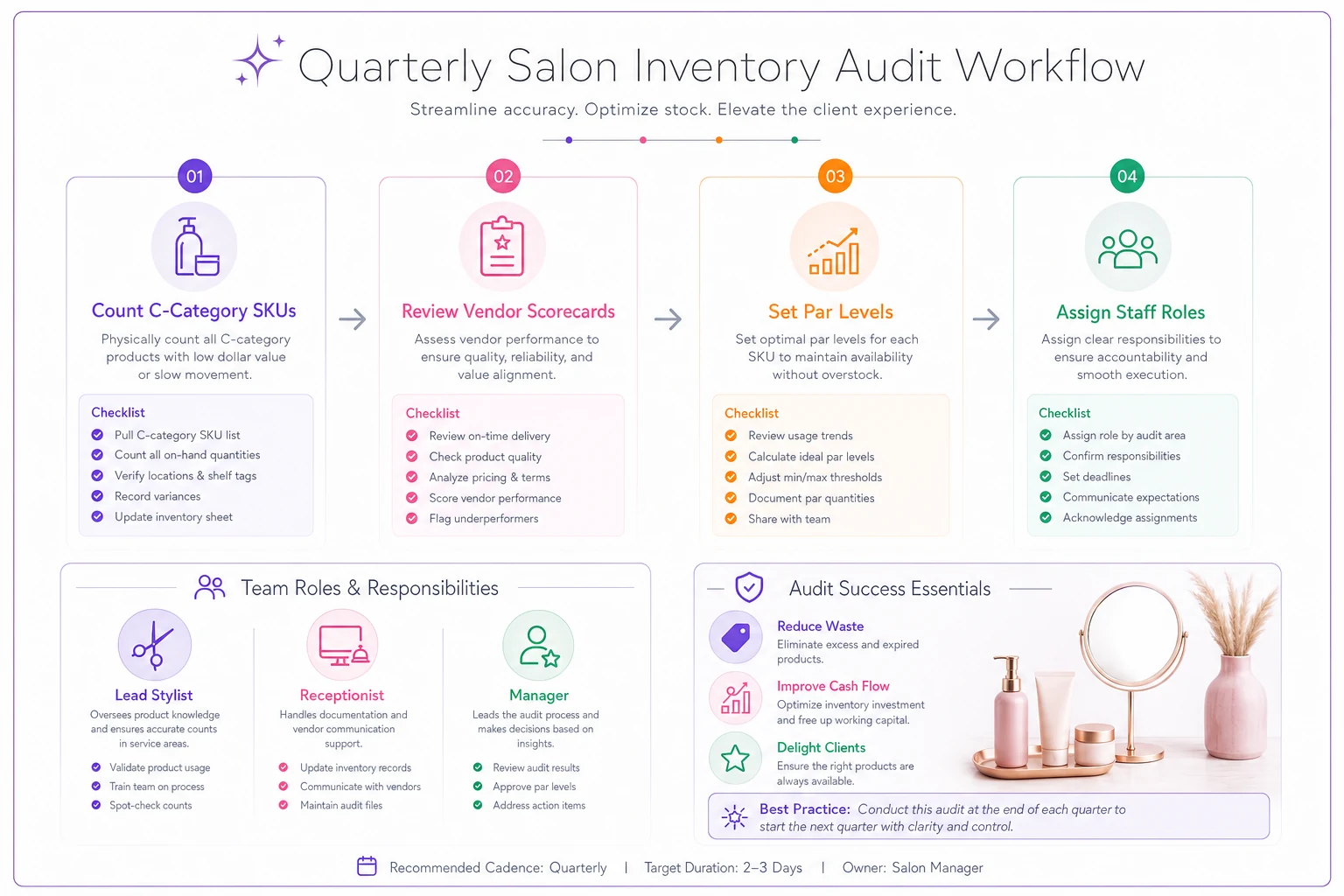
Use this visual when training staff on the quarterly audit steps.
Your seasonal forecasting system can feed directly into this process — if you're projecting increased color services for fall, color inventory pars should reflect that before you're in the thick of it.
Document decisions simply:
-
Discontinued
8 SKUs from StyleLine (no movement in 60+ days)
-
Reduced
Luxury Retail Co from 20 to 12 SKUs
-
Expanded
Treatment Systems adding 3 new masks
-
Par adjustments
Increased developer max from 20 to 25 for Q4
This becomes your reference when a sales rep asks why you're not ordering their new revolutionary system. "We reviewed in July and decided to focus on proven sellers." Hard to argue with documented decisions.
What this changes day-to-day
A working vendor scorecard and SKU system shifts daily operations in ways that compound over time, but not always in the ways you'd expect.
Stylists stop hoarding products because they trust the reorder system. That hidden stash of favorite lightener in the back room becomes unnecessary when pars are properly set and orders arrive reliably. This alone can reduce apparent inventory needs by 15-20%, sometimes more.
The front desk can answer retail questions confidently. When retail SKUs are rationalized down to proven sellers, your team actually knows what they're selling instead of fumbling through 40 different options. Your retail systems work better when the inventory is focused.
Cash flow improves in a tangible way. Instead of $8,000 tied up in slow-moving product, you might have $5,000 in inventory and $3,000 available — for marketing, equipment, or just breathing room. The monthly scramble to cover vendor minimums disappears when you're ordering from fewer, better suppliers.
Making technology work for inventory tracking
The right operational software changes vendor management from a quarterly scramble into something you're actually on top of. AI-powered platforms can automatically track fill rates by comparing purchase orders to receipts, calculate true margins including shipping and payment terms, and flag SKUs that haven't moved in 30 days before they become a write-off problem.
More usefully, these systems can adjust reorder points based on actual service trends rather than static numbers. If color bookings are trending up month-over-month, the system adjusts developer orders automatically — no more emergency supply runs because someone forgot to check levels during a busy week.
The same logic applies to vendor scoring. Instead of manually pulling metrics quarterly, the platform tracks performance continuously and surfaces issues when they happen. When a normally reliable vendor's fill rate drops, you know within weeks, not at the next quarterly review.
This isn't about replacing judgment. It's about having accurate data when you actually need to make a call — whether that's dropping an underperforming vendor or negotiating better terms with your best one.
The payoff: predictable inventory, better margins, less chaos
Salons that get structured vendor scorecards and SKU rationalization actually working tend to see inventory turn faster — more like 8-10 times annually versus the 4-6 times that's common before any of this is in place. Less cash tied up, less obsolete product written off at the end of the year, less physical space eaten up by dusty bottles you're not sure what to do with.
Margin improvement varies depending on how much dead inventory you're starting with. A salon carrying a lot of stale product might see 5-7 percentage points improvement just from rationalization. Even well-run operations usually find 2-3 points through better vendor selection and smarter par levels.
But the real value is operational calm. Stylists stop scrambling for products mid-service. Vendor relationships become professional rather than personal — decisions based on actual performance, not who brought the best snacks to the last sales visit. The quarterly review becomes a quick confirmation that things are working, not a crisis discovery session.
This framework scales whether you're managing 100 SKUs or 500, two vendors or twenty. Build it once, maintain it quarterly, and your product operations start functioning like an actual profit center instead of a recurring headache.
Ready to simplify your salon operations?
Join 1,000+ salons using Salnly to save time, reduce scheduling chaos, and deliver better client experiences.