

Last Thursday, I watched a salon owner named Michelle dump half a box of expired keratin treatments into the trash. Twenty-four hundred dollars worth of product, gone. The frustrating part? She had three stylists asking for that exact treatment two months ago when they couldn't find any. This happens in salons everywhere. Not because owners are careless, but because traditional inventory systems are designed for retail stores, not service businesses where product sits in backbar stations, disappears into mixing bowls, and gets used in wildly different amounts depending on hair length and texture. The salons that actually control inventory costs don't rely on fancy scanning systems or complex spreadsheets. They use something much simpler: par-level templates tied directly to their service menu, combined with a weekly 15-minute check that actually gets done.
Why traditional inventory fails at the backbar
Walk into any salon on a Tuesday afternoon and check the color room. You'll find partial tubes everywhere, duplicates of the same shade opened at different stations, and products that expired because nobody knew they existed. The backbar becomes this weird black hole where inventory goes to die.
Most salons think about inventory like retail — count everything, track everything, monitor everything. But salon inventory behaves differently. A single highlight service might use anywhere from 40g to 120g of lightener depending on the client. A root touch-up could need one tube of color or three. Traditional retail inventory systems can't handle this variability.
Then there's the multiple-location problem. Product lives at stations, in the backbar, in storage, at the wash basins. By the time you count everything, half of it has moved.
The worst part is small-loss bleeding. A stylist grabs an extra tube "just in case." Someone opens a new bottle because they can't find the open one. Products get mixed but not used. These tiny losses compound into massive waste that nobody notices until the P&L comes out.
Building par levels that match service patterns
Forget counting every tube and bottle. Build simple par levels based on your actual service mix. If you're doing 80 highlights a month, you know roughly how much lightener you need. The math becomes straightforward.
Stop losing appointments in the chaos.
Salnly helps you book, confirm & manage every appointment—efficiently.
- Centralized appointment management
- Client notifications
- Calendar & staff scheduling
No credit card required
Start with your top five services. Pull your booking data for the last three months — not to get fancy, just to see the pattern. A typical neighborhood salon might see:
-
Single process color
65-75 per month
-
Highlights (partial/full)
30-35 per month
-
Root touch-up
40-45 per month
-
Gloss/toner
50-60 per month
-
Keratin/smoothing
8-12 per month
| Service | Typical monthly |
|---|---|
| Single process color | 65-75 per month |
| Highlights (partial/full) | 30-35 per month |
| Root touch-up | 40-45 per month |
| Gloss/toner | 50-60 per month |
| Keratin/smoothing | 8-12 per month |
Now tie product usage to each service type. Don't overthink this. A full highlight uses roughly 80-100g of lightener on average. A single process needs about 60g of color. These aren't exact — hair varies — but they're close enough to build a working system.
Your par level becomes: (Average monthly services × Average product per service) × 1.3 for buffer. That 1.3 gives you breathing room without creating excess. For that highlight example: 33 services × 90g = 2,970g monthly, so keep around 3,900g on hand.
This system self-adjusts naturally. Busy month coming up? Your service bookings tell you to order more. Slow season? The numbers automatically scale down. No complex formulas, no scanning guns, just simple multiplication tied to what you're actually booking.
The weekly 15-minute check that catches problems early
Most salons wait until month-end, spend hours counting, then scramble to fix problems that have been building for weeks. The smarter approach takes 15 minutes every Monday morning.
Pick one person — usually your lead stylist or assistant manager — to own this check. Same person, same day, same process. Consistency matters more than perfection. They're not counting everything, just checking five things:
The FIFO check: Walk the backbar and flip any products that are backwards. Oldest in front, newest in back. Takes two minutes but prevents those expensive expirations.
The par-level scan: Check your top ten products against their par levels. Don't count exact amounts — just mark if you're clearly under. Binary decision: enough or not enough.
The duplicate hunter: Look for multiple containers of the same product opened. Consolidate them. This alone can save hundreds monthly.
The expiration sweep: Check dates on your five most expensive products. Keratin treatments, bond builders, specialty treatments. If something expires in the next month, flag it for promotion or use it in training.
The mystery product audit: Find three products you don't recognize or haven't seen used recently. Ask your team about them. Either incorporate them back into service or toss them.
Document this on a simple sheet — not a complex spreadsheet, literally a piece of paper on a clipboard. Date, initials, any issues found, orders needed. That's it. The documentation isn't for analysis; it's for accountability and catching patterns.
Keep the clipboard where the opening stylist naturally stands so the 15-minute check happens while other opening tasks are being done.
Here's a quick visual of that 15-minute check workflow.
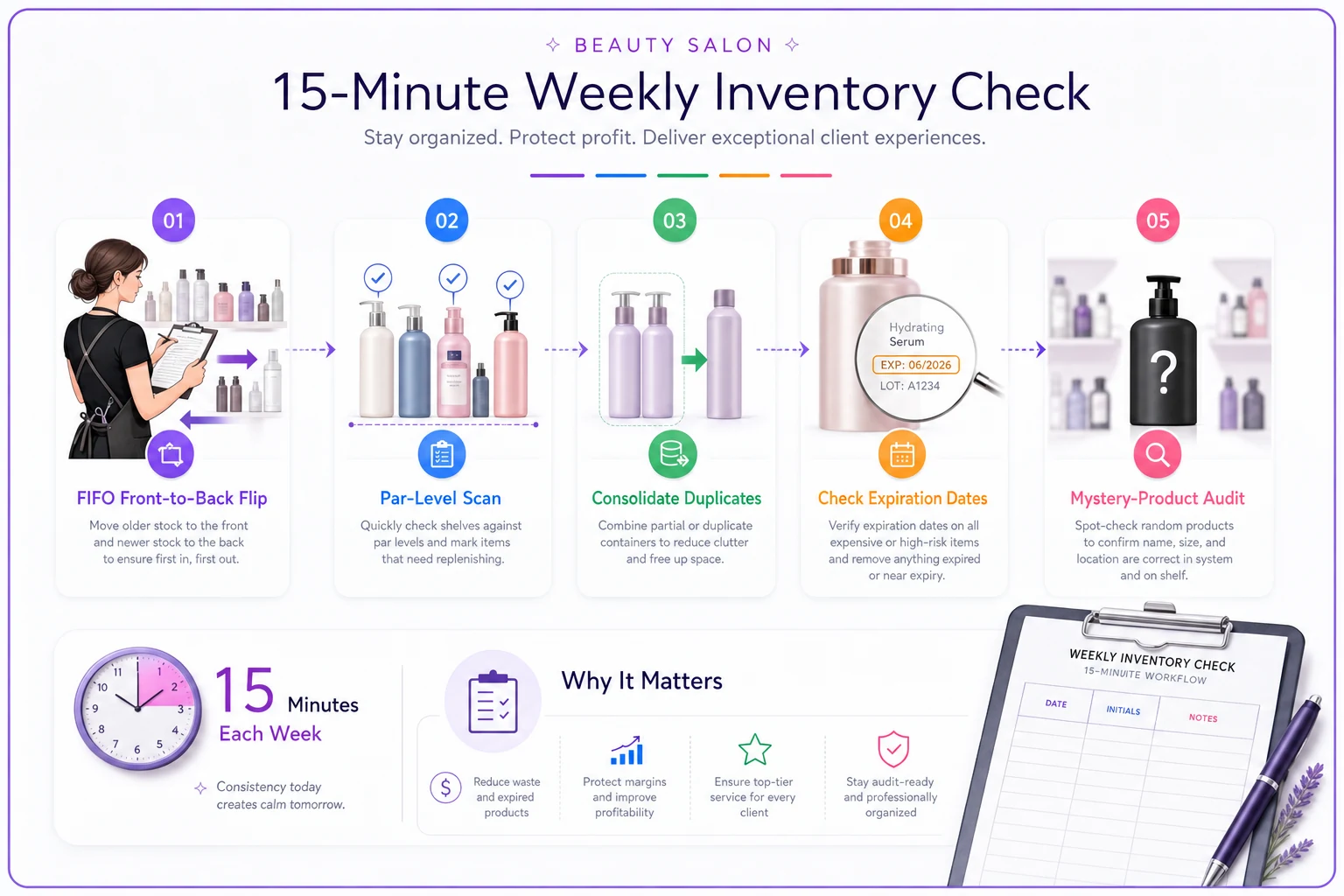
Use this as a quick guide during your Monday check.
Small-loss detection without being the inventory police
Stylists waste product. Not maliciously — they're focused on the client, not the cost per gram of lightener. But those small losses add up to thousands annually.
Making waste visible without creating a police state works better than monitoring every drop. Nobody wants to work where they feel micromanaged. Focus on patterns and systems instead.
Start with mixing stations. Put up a simple chart showing standard mixing ratios for common services. Not rules, just references. "Typical root touch-up: 45-60g color + developer." When stylists see the standard, they naturally adjust without feeling micromanaged.
Track your high-theft items differently. Retail products, especially dry shampoo and travel sizes, walk out constantly. Keep these in a locked retail cabinet, not because you don't trust your team, but because it creates a natural checkpoint. Someone has to ask for the key, which makes them think twice.
Watch for the "backup stash" behavior. Stylists often hoard their favorite products at their stations because they've been burned by running out mid-service. This creates phantom shortages — the salon orders more while product sits hidden in drawers. Monthly station cleanouts solve this. Make it routine, not punitive.
Set up a "leftover color" system where unused mixed product goes into a designated area for the next hour. Another stylist doing a similar service can use it. Some salons resist this, thinking it looks unprofessional, but clients don't care if their color came from a fresh mix or one made 20 minutes ago.
When to break your own rules
Seasonal services throw off normal patterns. December means more blowouts and updos, which means more finishing products. September brings keratin treatments as clients prep for fall humidity. Don't let your standard pars handcuff you during these predictable surges. Bump inventory 40-50% for your seasonal items about three weeks before the rush.
Vendor deals sometimes justify overbuying, but be careful. That 30% discount on a case of developer sounds great until you realize you now have eight months of inventory taking up space and tying up cash. Only stock up on products you'd use within four months anyway.
Product discontinuations require breaking protocol completely. When a manufacturer announces a discontinuation, your regulars who love that specific product will panic. Order enough to give them a few months to transition, even if it puts you over par.
New service launches need inventory front-loading too. If you're adding Brazilian Blowouts to your menu, don't order based on projected services — you'll run out during the promotional period and kill momentum. Triple your expected needs for the first month, then adjust based on actual uptake.
Creating accountability without adding admin work
The biggest reason inventory systems fail isn't complexity — it's that nobody actually does them. They become another task on an already overwhelming list.
Build inventory checks into existing routines rather than adding new ones. Your Monday morning team meeting? That's when the 15-minute check happens. The person opening on Mondays does it while the coffee brews. It becomes part of the rhythm, not an interruption.
Rotate responsibility quarterly. Not weekly — that's too much transition. Not annually — people get burned out. The handoff meeting between old and new inventory leads should include a walkthrough of current problem areas and any products to watch.
Make the data visible but not overwhelming. A simple whiteboard in the break room showing this month's waste total versus last month. No names, no blame, just awareness. When the team sees waste dropping, they naturally want to keep the trend going. If your KPI tracking shows inventory costs above 8% of service revenue, everyone should know.
The ordering process itself needs one owner. Multiple people ordering creates chaos — duplicates, missed items, confusion. Pick one person who places all orders. Others can request, but only one person clicks "buy."
The tech stack that supports (not replaces) manual checks
You don't need expensive inventory software to run this system, but a few simple tools help. A basic spreadsheet tracking your pars, weekly check results, and monthly waste numbers is enough.
What actually helps is connecting your booking system to your inventory planning. If you can export next week's appointments and see you have 12 highlights booked, you know to check lightener levels. This kind of service capacity planning naturally feeds into inventory management.
Some salons use AI-powered operational software to flag unusual patterns — like color usage spiking without a corresponding increase in color services. These systems can catch theft or waste trends before they become expensive problems. But the weekly manual check catches most issues if someone actually does it.
The most valuable tech addition might be a simple shared note system where stylists can flag low products in real-time. A WhatsApp group, a notebook at the desk, even sticky notes on a designated board. The medium doesn't matter — the habit of communication does.
What this system catches that others miss
Three months after implementing this approach, most salons discover problems they never knew existed. The most common surprise? Product migration. Expensive treatments walking from the backbar to personal kits without anyone realizing it.
Another hidden issue: the favorite child syndrome. One or two stylists consuming 60% of certain products because they use heavier amounts than necessary. Not malicious, just habit. Once visible, it's easily coached.
Service creep becomes obvious too. Stylists adding extra steps or products to standard services without adjusting pricing. That "quick gloss" added to every highlight adds up to hundreds in product cost monthly. The par system catches this because product usage outpaces service counts.
The real win is catching expiration patterns before they hurt. If the same products expire repeatedly, you're ordering too much or they're not moving from backbar to chair.
Making it stick when everything else hasn't
Every salon owner has tried inventory systems that failed. The elaborate spreadsheet that lasted two weeks. The expensive software nobody used. The manager who swore they were tracking everything but wasn't.
This system works because it respects reality. Stylists are artists focused on hair, not accountants counting tubes. Managers juggle dozens of priorities. A lightweight approach that takes minutes, not hours, actually gets done.
Start with just the weekly check. Don't even implement pars initially — just get someone doing that Monday morning walk-through consistently for a month. Once that habit exists, add the par levels for your top five products only. Build slowly.
Frame this as profit protection, not penny-pinching. Show your team how every dollar saved on waste can go toward equipment upgrades, education, or bonuses. When they see direct benefit from reduced waste, they'll naturally become more conscious about product use.
When waste drops 20%, make it known. When you avoid a stockout because the system caught it early, point it out. Success builds momentum.
The monthly reality check
Even the best system needs regular calibration. Monthly, pull three numbers: total product cost, total service revenue, and product cost percentage. If you're above 8% consistently, something's off. Below 5% might mean you're running too lean and risking stockouts.
Compare actual usage to your pars. If you're constantly over or under, adjust the multipliers. Maybe highlights in your salon average 110g, not 90g. The numbers should reflect your reality, not industry averages.
Look for seasonal patterns emerging. August might need different pars than February. Your system should breathe with your business cycle, not fight against it.
Check if your service mix is shifting. More younger clients might mean more fashion colors and unconventional techniques that use product differently. An aging clientele might shift toward coverage and treatments. Let your inventory system evolve with your salon.
Beyond products: applying this thinking everywhere
Once this inventory approach clicks, you'll see applications everywhere. The same par-level thinking works for retail accessories, cleaning supplies, even front desk materials. The principle remains: tie inventory to actual activity, check regularly but quickly, and make waste visible without being punitive.
Some salons extend this to equipment maintenance. Par levels for capes, towels, and foils based on service volume. Weekly checks for equipment issues before they become emergencies.
Stop thinking of inventory as counting things and start thinking of it as flow management. Products should flow from storage to backbar to chair to client at a predictable rate. When flow breaks, waste or stockouts happen. Your job is maintaining flow, not perfecting counts.
This approach fundamentally changes how teams view products. Instead of mysterious supplies that magically appear, they see direct connections between services, products, and profit. That visibility alone often reduces waste by 15-20% without any other changes.
The salon backbar inventory system doesn't need to be complicated. It needs to be consistent, visible, and tied to what actually drives your business — services and clients. Build from that foundation and you'll find inventory becomes less of a burden and more of a competitive advantage.
Ready to simplify your salon operations?
Join 1,000+ salons using Salnly to save time, reduce scheduling chaos, and deliver better client experiences.