

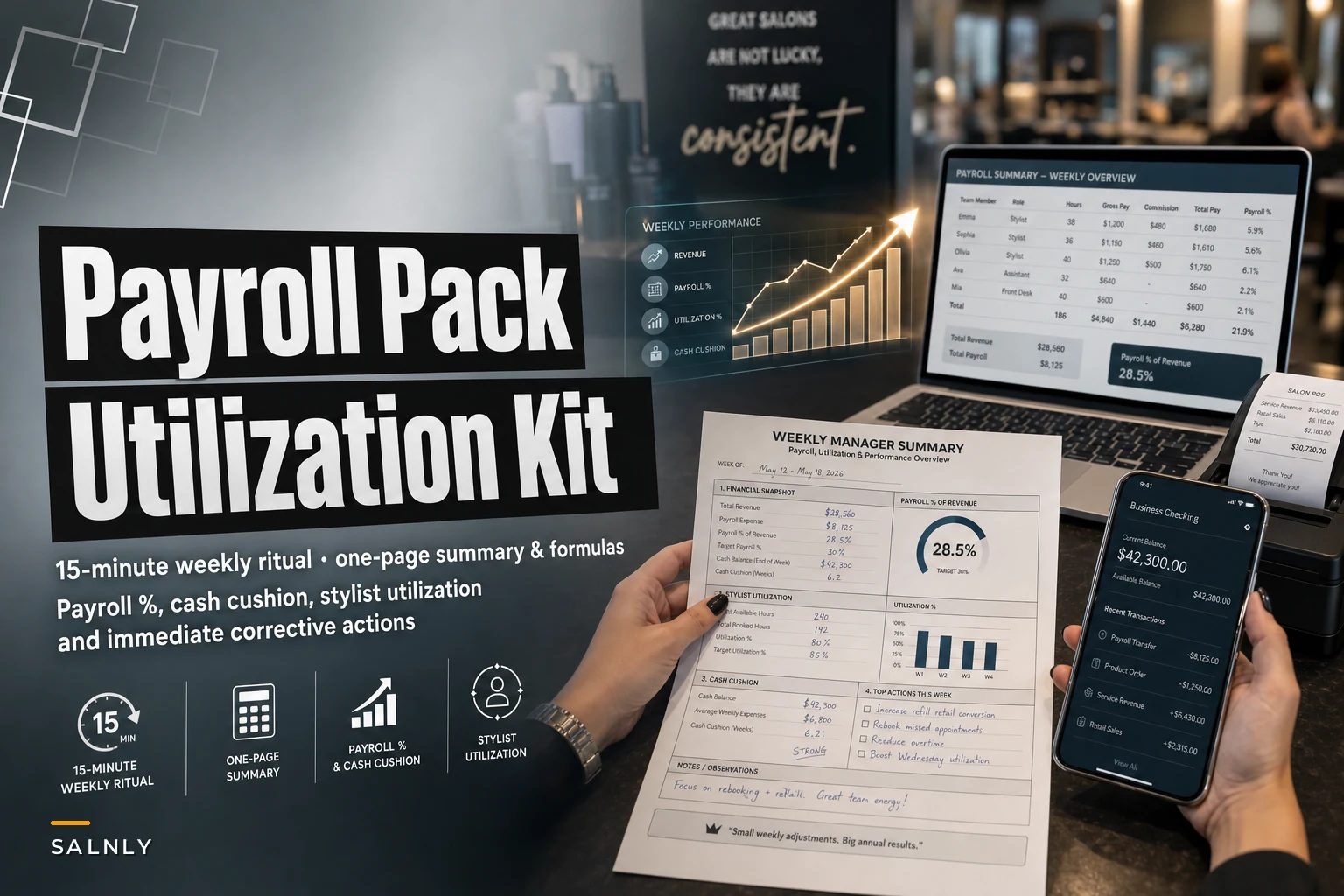

Most salon managers don't struggle with the math of running a tight shop. They struggle with the fact that the numbers live in six different places — the payroll portal, the POS, the booking calendar, a bank app, maybe a spreadsheet someone built two years ago and nobody fully trusts anymore. By the time you've pulled everything together, the week's already gone and whatever you could've fixed on Tuesday is now baked into Sunday's totals.
This isn't a guide to financial analysis. It's a guide to a 15-minute Monday-morning ritual that connects three metrics — payroll as a percentage of revenue, cash position, and stylist utilization — to specific corrective actions you can take that same week. Speed matters more than precision here. You're not closing the books. You're catching drift before it compounds.
Why the weekly window is the one that actually matters
Monthly reviews are too late. By the time your accountant sends the P&L for March, April is nearly over and you can't un-pay anyone or un-book an empty Tuesday. Daily reviews are too noisy — one slow morning doesn't mean anything, and reacting to individual days makes staff crazy.
The week is the natural unit for salon operations. Long enough to smooth out a dead Monday against a packed Saturday, short enough that you can still adjust next week's roster, shift a promo, or have a quiet word with a stylist whose column is half empty.
A lot of salon owners know their payroll feels high but can't say whether it was 38% or 51% last week. That gap — between a vague sense that something's off and an actual number you check every Monday — is where most of the margin quietly disappears.
The three numbers, and nothing else
The temptation is to track fifteen things. Don't. A weekly pack with fifteen metrics gets abandoned by week three. Three numbers, each tied to a clear action, is something a manager will actually follow through on.
Stop losing appointments in the chaos.
Salnly helps you book, confirm & manage every appointment—efficiently.
- Centralized appointment management
- Client notifications
- Calendar & staff scheduling
No credit card required
1. Payroll as a percentage of service revenue
Take last week's total payroll cost for service staff — wages, commission, plus payroll taxes if you can grab them quickly — and divide by service revenue (not retail, keep that separate for now).
Most salons land somewhere in the 45%–55% range depending on pay model, though commission-heavy shops run higher and booth-rental setups run much lower. The exact "right" number matters less than the trend. If you were at 48% three weeks running and suddenly you're at 57%, something changed: a slow week where you didn't adjust hours, a new hire ramping up, or someone clocking in early and leaving late without the bookings to justify it.
The corrective action isn't "cut hours" reflexively. Ask one question first: was revenue down, or was labor up? Those are two completely different problems. Revenue down means a demand or booking issue. Labor up with flat revenue means a scheduling issue. For the deeper logic on where the payroll line should actually sit per station, the per-station break-even and payroll decision rules are worth keeping next to this pack.
2. Cash on hand (and what's due before next Friday)
This one takes 90 seconds and saves more sleep than anything else on the list. Write down your current operating account balance, then subtract the known outflows hitting before your next check-in: rent, payroll run, a supplier invoice, card processor fees.
The number you care about is the cushion — what's left after the obvious bills. New or stretched salons sometimes discover their "cash" is really next week's payroll sitting in the account for a few days. That's not cushion. That's a trap.
A simple rule that works in practice: if the cushion drops below one full payroll run, that's your yellow flag — tighten discretionary spend (hold the backbar reorder, pause the ad boost) until it recovers. Below half a payroll run is a red flag and should change decisions immediately.
3. Stylist utilization
Utilization is straightforward: booked service hours ÷ available scheduled hours, per stylist. If someone's scheduled 32 hours and booked 20, they're at roughly 63%.
This is the number that quietly explains your payroll percentage. High payroll with low utilization isn't a pay problem — it's an empty-chair problem. A stylist at 55% utilization is being paid to stand around for nearly half their shift, and no commission structure fixes that.
Most profitable columns sit around 70%–85%. Push consistently past 85% and you've got the opposite problem — overbooked chairs, rushed services, no slack for a late client. Utilization ties directly into the daily behaviors covered in which salon KPIs actually move profitability, and it's the metric most managers under-watch.
The one-page weekly summary template
Here's the whole thing on a single page. A manager fills it in from four sources — payroll portal, POS, booking calendar, bank app — in under 15 minutes once they know where to look.
| Metric | Last week | This week | Trend | Flag | Action taken |
|---|---|---|---|---|---|
| Service revenue | $19,400 | $17,900 | ↓ | Yellow | Added two reactivation texts to slow stylists |
| Payroll % of service rev | 49% | 55% | ↑ | Yellow | Trimmed 6 low-demand hours next week |
| Retail revenue | $2,100 | $2,350 | ↑ | Green | — |
| Cash cushion (after bills) | $11,200 | $8,600 | ↓ | Yellow | Held backbar reorder 1 week |
| Avg utilization (team) | 74% | 68% | ↓ | Yellow | Shifted Maria to 4-day week |
| Lowest utilization (name) | Maria 61% | Maria 58% | ↓ | Red | Rebooking script review scheduled |
The numbers above are illustrative, but notice the shape of the week: revenue dipped, so payroll percentage climbed even though nobody got a raise, utilization slipped, and the cash cushion followed. One cause, four symptoms. The template makes that visible in a glance instead of across four apps.
The final column — Action taken — is the part that matters most. A metric without an action next to it is just anxiety. Every yellow or red flag gets one concrete move written down, and next Monday you check whether it worked.
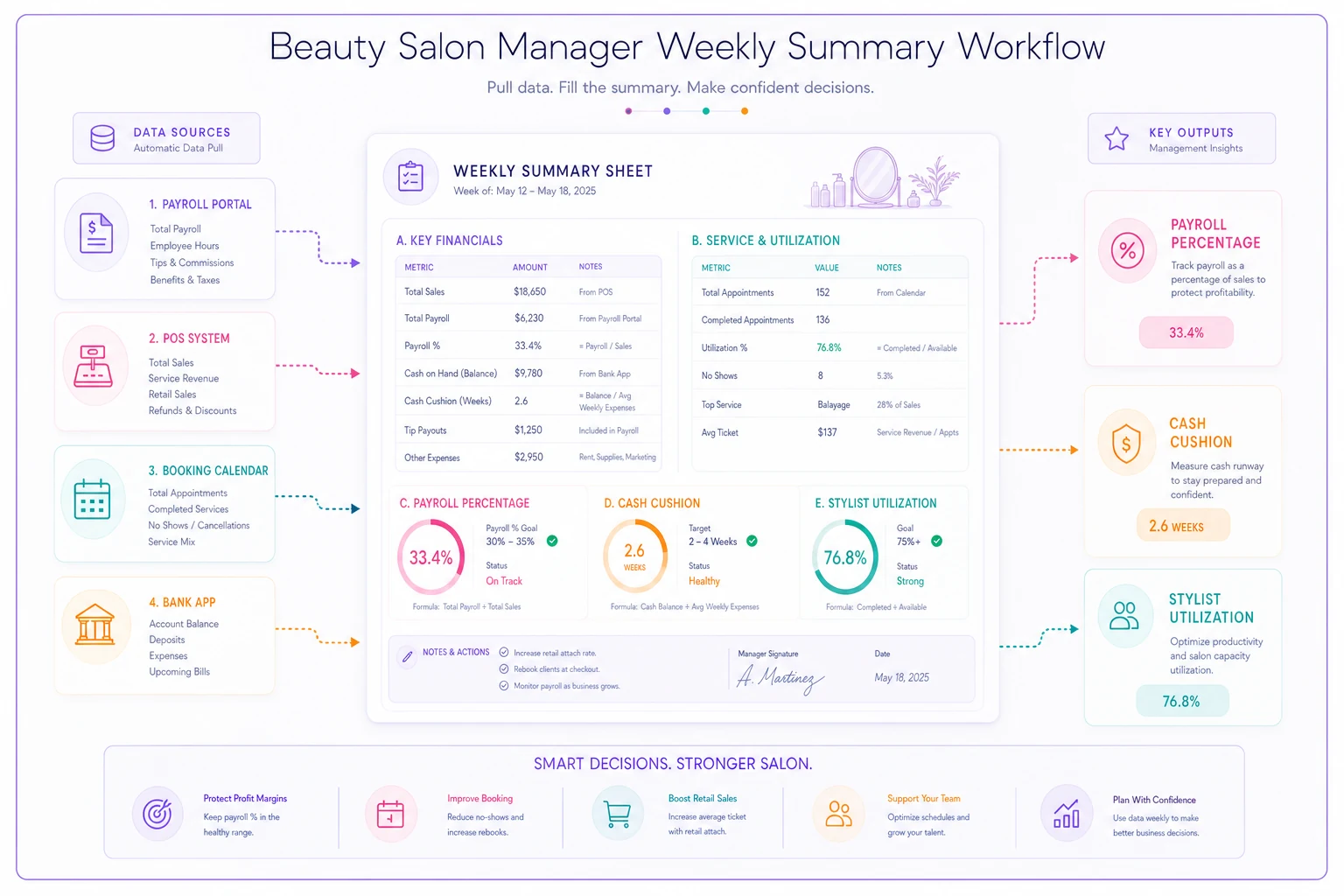
A quick visual of the fill-from-four-sources workflow.
A flag-to-action map, so you're not deciding from scratch
The whole reason this works without accounting skills is that the decisions are largely pre-made. You're not analyzing — you're matching a flag to a response.
-
Payroll % up + revenue down → Demand problem. Push short-notice fills, reactivation texts, and rebooking before touching hours.
-
Payroll % up + revenue flat → Scheduling problem. Trim the lowest-demand hours next week; don't cut your busy stylists.
-
Cash cushion yellow → Pause discretionary spend (reorders, ads, non-urgent repairs) for one week and recheck.
-
Cash cushion red → Escalate to the owner same day; delay any non-payroll, non-rent outflow you legally can.
-
One stylist's utilization red → Coaching conversation, not a schedule cut yet. Check their rebook rate first — the hole is usually there.
-
Whole team's utilization red → Marketing or capacity problem, not individual performance. Look at your slow blocks.
The pattern in #5 is the one managers get wrong most often. When a single stylist is underbooked, the instinct is to cut their hours. But if their rebook rate is weak, cutting hours just hides the real issue and loses you a column that could fill. Fix the behavior first, then the structure if needed.
A quick real scenario
A two-location salon with around nine chairs had a manager doing a loose monthly review and a gut feeling that "payroll's been rough lately." When they started the weekly pack, the first few weeks surfaced something the monthly view had smeared over: payroll % was fine on Saturdays but running near 60% Monday through Wednesday, driven by two stylists scheduled full days with utilization in the low 50s.
The correction wasn't dramatic. They moved both stylists to four shorter early-week days, opened one of them to handle walk-ins and color prep, and added a mid-week reactivation text to the slow columns. Over the next six weeks payroll % on those weak days drifted back toward the high-40s, and the cash cushion stopped dipping below a payroll run every month. Nothing fancy — just three numbers, checked every Monday, each one tied to a move.
Where this fits — and where it doesn't
When this makes sense: any salon past the point where the owner can hold every number in their head. Usually that's four-plus chairs or a second location, or any time you've handed daily operations to a manager who needs to make decisions without calling you constantly.
When it's not worth over-engineering: a single-chair or two-person shop doesn't need a formal pack — you already see everything. Forcing the template there just adds busywork.
Who should NOT run this as-is: booth-rental-heavy salons, where you don't carry the stylists' payroll at all. Your version should swap payroll % for rent-collection status and chair occupancy. The utilization logic still holds; the payroll line doesn't.
One honest caution: the pack only works if the numbers are trustworthy. If your POS and your calendar disagree about what actually got booked and paid, fix that reconciliation first — a clean weekly pack built on dirty data just gives you confident wrong answers.
Making it stick
The failure mode isn't building the template. It's abandoning it by week four.
Attach the pack to your team huddle so it's part of an existing routine rather than a standalone task.
Two things keep it alive. First, attach it to something that already happens every week — ideally right before or after your team huddle, so it's part of an existing routine rather than a standalone task. The 15-minute huddle and scorecard toolkit pairs naturally with this; the pack feeds the manager, the huddle feeds the team.
Second, keep last week's sheet visible when you fill out this week's. The entire value is in the trend, not the snapshot. A payroll % of 52% means nothing on its own. A payroll % that's climbed from 47% to 52% over three weeks means you have something specific to fix, and fifteen minutes on Monday to decide how.
Modern salon and booking platforms can pull most of these numbers automatically — utilization straight off the calendar, revenue off the POS — which cuts the pull time significantly and removes the "I trust my gut more than this spreadsheet" problem. But don't wait for perfect tooling. A manager with a printed one-pager and four browser tabs can run this starting next Monday, and that beats a flawless dashboard you set up three months from now.
Ready to simplify your salon operations?
Join 1,000+ salons using Salnly to save time, reduce scheduling chaos, and deliver better client experiences.