
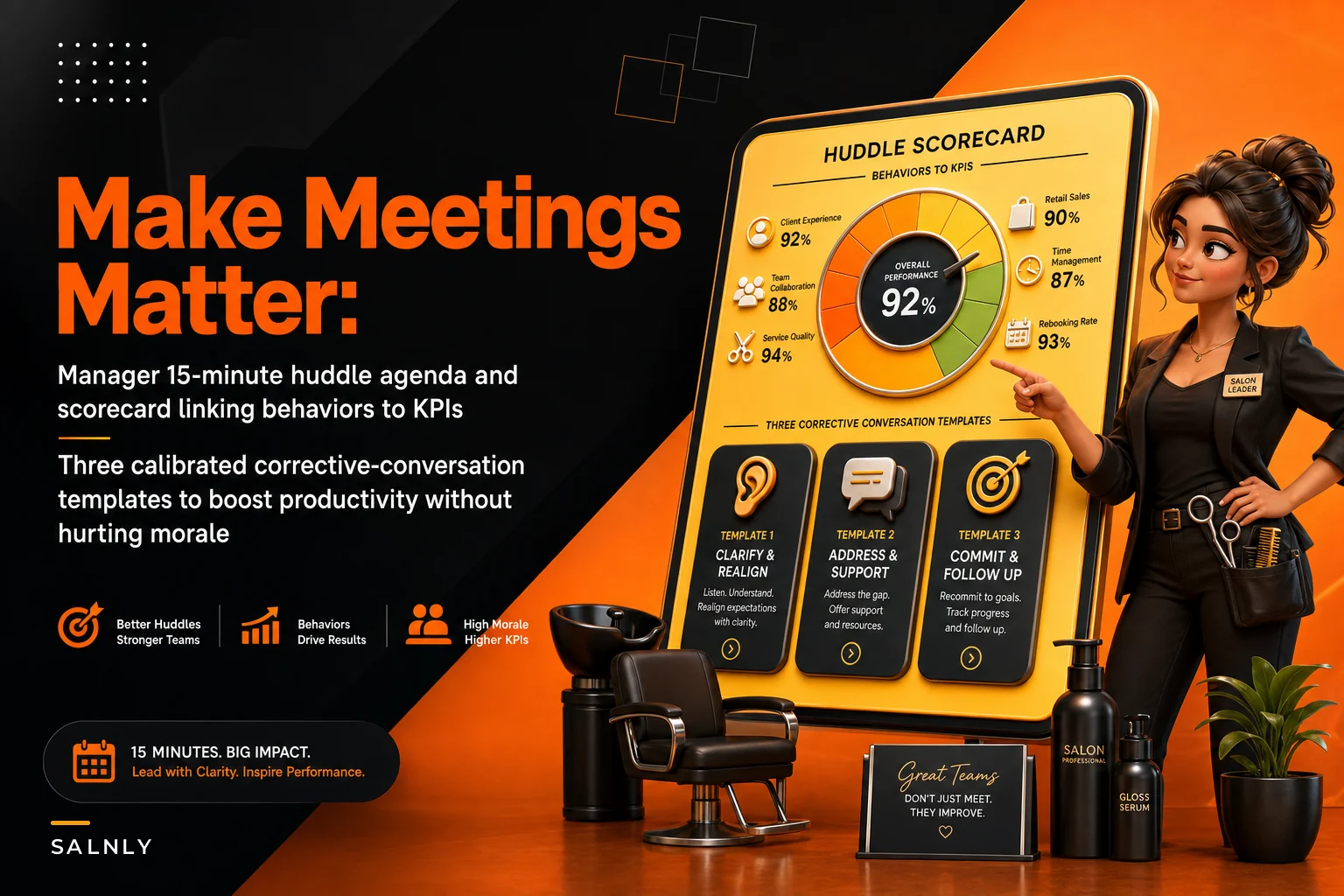

This toolkit gives you a printer‑friendly one‑page huddle checklist, a minute‑by‑minute facilitator script, a simple 1‑page scorecard (table + CSV), a worked example with formulas, copy‑ready micro‑scripts for rebook and retail closes, corrective‑conversation templates, an observer rubric, decision rules and an 8‑week rollout plan.
Use the materials as-is or adapt targets from your own baseline week 0. Sample targets in this document are labelled “sample target” and derived from the worked example baseline.
At the end: choose whether you want the scorecard exported as CSV text or a one‑page printable single‑column HTML ready for your CMS.
Quick links (snippetable)
-
Huddle checklist (printable HTML one‑pager) — print this page
-
Scorecard (table + CSV) — paste into a spreadsheet
-
Worked example (formulas shown)
-
Coaching scripts & role‑play prompts
-
Corrective conversation templates and escalation timeline
-
Observer rubric, measurement controls and FAQ
One‑page printable huddle checklist (HTML / print‑friendly)
This single page is designed to print and laminate. Left column = facilitator script; right column = quick checkboxes to tick. Rotate facilitator, timekeeper and scribe weekly.
Stop losing appointments in the chaos.
Salnly helps you book, confirm & manage every appointment—efficiently.
- Centralized appointment management
- Client notifications
- Calendar & staff scheduling
No credit card required
| Time | Facilitator one‑line prompt (read aloud) | Quick checklist (tick) |
|---|---|---|
| 0:00–0:45 | "Good morning. Two housekeeping items; keep updates under 30s." | [ ] Opened on time |
| 0:45–2:00 | "Shout out 1–2 wins from yesterday — name the behavior." | [ ] 1–2 wins called |
| 2:00–6:00 | "Scorecard snapshot: read top 3 metrics — team actual vs target." | [ ] Top 3 metrics read |
| 6:00–9:00 | "Today's schedule heads‑up: risks, fills, product needs." | [ ] Schedule risks noted |
| 9:00–12:00 | "Skill focus: one phrase to practice (30–45s demo)." | [ ] Skill demo done |
| 12:00–13:30 | "Commitments: each person says one micro‑commitment (15s each)." | [ ] Commitments recorded |
| 13:30–14:30 | "Support ask: any blockers? assign owner for each." | [ ] Blockers assigned |
| 14:30–15:00 | "Close: confirm actions, quick energy reset." | [ ] Close & energy reset |
Use the one‑line prompts as the facilitator script. Keep laminated and keep a digital copy in the team folder for substitutes.
Minute‑by‑minute facilitator script (copy‑ready, one‑line prompts)
-
0
00–0:45 — "Good morning — two housekeeping items, 1 ask: keep updates under 30s."
-
0
45–2:00 — "Quick wins: name 1–2 behaviors from yesterday (rebook, retail, teamwork)."
-
2
00–6:00 — "Scorecard snap: Top 3 metrics — Team actual / Target / Trend — any red flags?"
-
6
00–9:00 — "Schedule heads‑up: notable clients, processing heavy services, equipment or product needs."
-
9
00–12:00 — "Skill focus: demo a 30s rebook or retail phrase. Who shows it? One quick role‑play."
-
12
00–13:30 — "Commitments: go rapid‑fire — each person one micro‑commitment for today."
-
13
30–14:30 — "Blockers: any blockers? Assign owner & 'by when' for each; park complex items."
-
14
30–15:00 — "Close: confirm owners, state one line of encouragement, quick energy reset."
If short on time, run a mini huddle: skip skill focus and compress commitments to 30s.
Printable 2‑column huddle checklist (HTML/Text version)
Left column = steps; Right column = 2‑line facilitator cue + checkbox. Use for printing two‑column cards; fold A4/Letter in half for index‑card size.
-
Header
15‑Minute Huddle — Today: [date] — Facilitator: [name]
-
0
00–2:00 — Wins & housekeeping — Right cue: "Name 1 behavior"
-
2
00–6:00 — Scorecard snapshot — Right cue: "Read top 3"
-
6
00–9:00 — Schedule heads‑up — Right cue: "Note risks/needs"
-
9
00–12:00 — Skill focus — Right cue: "Demo (30s)"
-
12
00–13:30 — Commitments — Right cue: "1 micro‑commit each"
-
13
30–14:30 — Blockers & assignment — Right cue: "Owner & by when"
-
14
30–15:00 — Close & energy reset — Right cue: "Confirm & hype"
Simple daily scorecard (copy‑ready table + CSV)
Post a single team scoreboard on a screen or board. Limit to three tracked behaviors per run (recommended). Use color coding: Green = on/above, Yellow = <10% off, Red = >10% off.
| Metric | Today (Actual) | Target | Trend (7‑day) | Owner | Immediate Action |
|---|---|---|---|---|---|
| Prebook Attempt % | 72% | 80% (sample target) | ▼ | Team | 1 coach today on rebook close |
| Rebook Rate % | 48% | 55% (sample target) | ▲ | Team | Ask 3 x targeted clients today |
| Add‑on Conversion % | 18% | 25% (sample target) | → | Sasha | 2 product demos by 1pm |
CSV header + sample row you can paste into a spreadsheet:
Metric,Today (Actual),Target,Trend (7-day),Owner,Immediate Action
Prebook Attempt %,72%,80%,-10%,Team,"Coach: 3 rebook asks today"
-
Week 1
choose 1 behavior (prebook attempts)
-
When target met 4 of 5 weeks, rotate the 3rd behavior
-
Keep only 3 visible behaviors at once
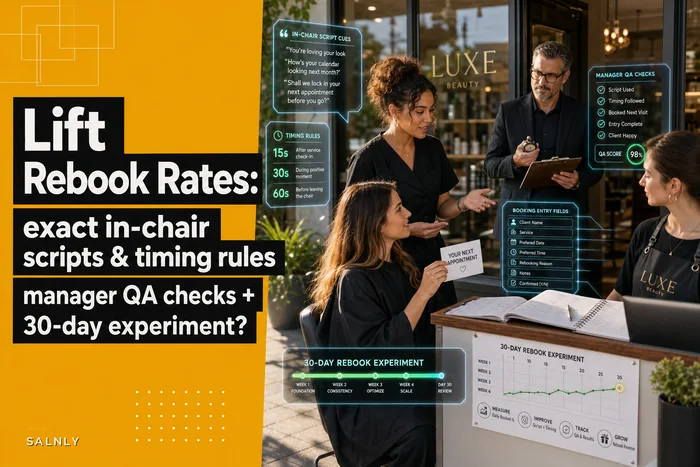
Pair tracked behaviors with the matching micro‑process scripts: e.g., for Prebook Attempt use the in‑chair rebook micro‑process: in‑chair rebook micro‑process.
For add‑on language and bundling use: add‑on upsell matrix and scripts.
Worked example (team of 6 — one week) with formulas
Sample raw weekly numbers (team totals): clients served, offers, sales and retail totals are below.
Total clients served (week): 360
Prebook offers made (logged at checkout): 280
Rebooks secured at checkout: 172
Add‑on offers: 90; Add‑ons sold: 18; Total retail $ (week): $1,080
-
Prebook Attempt % = (prebook offers ÷ clients served) × 100 = (280 ÷ 360) × 100 = 77.8% (sample target: 80%) — Yellow
-
Rebook Rate % = (rebooks ÷ clients served) × 100 = (172 ÷ 360) × 100 = 47.8% (sample target: 55%) — Red
-
Add‑on Conversion % = (add‑ons sold ÷ add‑on offers) × 100 = (18 ÷ 90) × 100 = 20% (sample target: 25%) — Yellow
-
Retail $ per Client = total retail $ ÷ clients served = 1,080 ÷ 360 = $3.00 per client
Interpretation & immediate actions (examples):
-
Prebook Attempt 77.8% — Yellow
coach front desk to ensure every checkout logs the offer; audit today
-
Rebook Rate 47.8% — Red
coach top 3 stylists privately using micro‑scripts
-
Add‑on Conversion 20% — Yellow
run role‑play in today's huddle (skill focus)
Note: numeric targets above are samples. Set your salon targets from a baseline week 0.
Copy‑ready micro‑scripts — rebook closes (4 variants)
-
Standard rebook close — "To keep this looking fresh, I recommend we see you in about 6 weeks. I have Tuesday at 10:00 or Thursday at 4:00 — which works better?"
-
Hesitant client (soft) — "Totally fine if you want to wait — can I tentatively hold a time for you and send a reminder a week before?"
-
Price/time resistance — "What if we lock a short 30‑minute check‑in or book a morning slot to save time? Which helps more?"
-
Receptionist follow‑up — "Can I have permission to call/text with two options? We'll only reach out once."
Role‑play prompt: partner plays client with objections. Format: 30s demo, 60s practice pair, 30s peer feedback.
Copy‑ready micro‑scripts — retail recommendations (4 variants)
-
Standard product prescription — "I recommend this color‑safe shampoo — I use a pea‑sized amount; want me to set one aside?"
-
Hesitant about buying — "No pressure — I can give you a sample to try at home; if you love it we’ll ring it when you’re ready."
-
Price resistance (value) — "This replaces three cheaper products and saves styling time; you should see a difference in two weeks."
-
Receptionist follow‑up — "Can we message you tomorrow with a short how‑to and price? No pressure."
Guidance: recommend at most 1–2 products tied to the service and describe usage in one sentence.
Role‑play micro‑exercises for the huddle (30–90s each)
-
Pair A
Rebook standard close vs hesitant client (60s)
-
Pair B
Retail prescription demo + 30s coach feedback
-
Quick rotation
2 demo, 1 coach, 1 timer
Keep role‑plays fast, supportive and data‑informed. Rotate who coaches.
Three corrective‑conversation templates (light → formal → escalation)
Use private, behavior‑focused conversations. Each template includes an opener, a data snippet, an SBI statement, co‑creation prompts, SMART actions, a follow‑up date and HR documentation wording.
Template 1 — Light coaching (first signs / minor miss)
Opener: "Do you have 10 minutes now? I'd like to review yesterday's numbers and get your view."
Data snippet: "Yesterday you had 10 clients; the scorecard shows 3 prebook offers logged and 0 rebooks."
SBI: "When you miss offering a next appointment during checkout (behavior) our clients leave without a next visit confirmed and we lose predictable future bookings (impact)."
Co‑creation: "What do you think was different yesterday? What would make asking for the next visit feel natural?"
SMART action: "Try the 30‑second rebook close for your next 8 clients today. I'll shadow one interaction at 11:00. We'll meet 10 minutes in tomorrow's huddle to review."
Documentation (HR paragraph): "Light coaching with [Name]. Reviewed scorecard: 3 prebook offers; 0 rebooks on 10/05/20XX. Agreed actions: use 30‑second rebook close for next 8 clients; manager to shadow on 10/07/20XX. Review scheduled 10/07/20XX."
Template 2 — Formal documented coaching (repeated misses or larger gap)
Opener: "Can we schedule 20 minutes now? I want to review a pattern the scorecard has surfaced and co‑create a plan."
Data snippet: "Over the last two weeks you made prebook offers for 50% of clients; team average 82%; rebook conversion 30% vs team 55%."
SBI: "When offers are not made consistently at checkout across multiple days, it reduces your opportunity pipeline and affects schedule stability."
Co‑creation: "What support or changes would help you consistently offer at checkout? Shadowing, shift change or habit prompts?"
SMART actions: "1) Practice script A for every checkout for two weeks; 2) Manager shadow one session weekly; 3) Front desk log offers. Meet in 14 days to review."
Documentation (HR paragraph): "Formal coaching with [Name]. Data: prebook offer rate 50% last 2 weeks vs team 82%; rebook conversion 30% vs team 55%. Agreed actions: practice script A at every checkout (2 weeks), manager shadow weekly, front desk log offers. Follow‑up 10/20/20XX."
Template 3 — Escalation documentation & next steps (no improvement after coaching)
Opener: "I want to share the formal review of progress and agree next steps with you and HR as needed. Are you okay to continue?"
Data snippet: "Since formal coaching on 10/06/20XX, offer rate remains at 52% and rebook conversion at 32% (no sustained improvement). Two coaching meetings occurred (10/06, 10/20)."
SBI: "Because agreed actions were not consistently completed and conversion hasn't improved, we need a documented performance plan to support required improvement."
Co‑creation: "What obstacles prevented completing the agreed actions? What reasonable accommodations would help you meet expectations?"
SMART actions (PIP): "90‑day performance plan with weekly check‑ins: target prebook offer ≥ 90% daily; rebook conversion ≥ 50% by week 6; manager shadow twice weekly; documented training hours."
Documentation (HR paragraph): "Escalation meeting with [Name], manager and HR. Reviewed prior coaching. No sustained improvement. Agreed 90‑day Performance Improvement Plan: targets, weekly check‑ins, manager support and training hours logged. Review at 30/60/90 days."
Guidance: Keep corrective conversations private, behavior‑focused and documented. For booth renters/independent contractors consult local labor counsel before imposing mandatory requirements.
Objective observer scoring rubric (one page)
Score only observable behaviors. Use the 3‑point scale: 2 = >80% observed, 1 = 20–80% observed, 0 = <20% observed. Attach a timestamp and 1–2 sentences of evidence with each score.
| Behavior (observable) | 2 (evidence language) | 1 (evidence) | 0 (evidence) |
|---|---|---|---|
| Offers next appointment at checkout | "Asked and offered 2 date options on each of 8 checkouts" | "Asked 3 of 8 checkouts" | "No offer made during observed checkouts" |
| Demonstrates product & one‑sentence use | "Showed product, explained one use case and amount" | "Mentioned product once without demo" | "No product recommendation observed" |
| Station reset (clean & restock) | "Station cleared and restocked within 3 min between clients" | "Reset took 4–6 min once" | "Station left dirty or not restocked" |
| Uses client name during service | "Client name used 3+ times during service" | "Name used once during service" | "Name not used" |
Calibration note: managers should jointly observe two interactions and compare evidence language before first use.
Decision rules & escalation timeline (example sequence)
-
Informal check — trigger
2 consecutive weeks below threshold on one behavior; action: Light coaching (Template 1) and 1‑week follow‑up
-
Formal coaching — trigger
4 weeks below threshold or 2 coaching conversations with no sustained improvement; action: Formal coaching (Template 2) and 14‑day review
-
Performance Improvement Plan / Escalation — trigger
no improvement after formal coaching; action: Escalation meeting with HR as appropriate and 30/60/90 day plan
Decision rules must be transparent. Communicate the timeline to staff during rollout and use private, documented steps for individuals.
Guardrail: avoid public punitive leaderboards. Prefer positive recognition and non‑punitive skill rewards.
Measurement controls & audit notes (data integrity)
Define what counts and how to record it; audit raw sources and rotate signers to prevent gaming.
-
Prebook attempt
counts only when two specific date/time options were presented at checkout
-
Rebook success
counts when appointment is entered before client leaves or booked via documented follow‑up within 48 hours
-
Add‑on offer
counts when an explicit in‑chair offer is made; sale counts when charged or scanned
-
Who signs
manager verifies weekly totals; second manager or owner spot‑checks one random day weekly
-
One‑line audit
pick two stylists; verify receipts against recorded offer counts; if mismatch >10% run integrity review
-
Controls
audit receipts/POS timestamps, random shadowing 2–3 transactions weekly, rotate who signs numbers
-
Technical
many POS systems auto‑track bookings; use a POS checkbox or code for 'offer made' to low‑friction track offers
Short FAQ (snippet‑ready answers)
What counts as a rebook attempt? A rebook attempt is counted only when a stylist or receptionist presents at least two specific date/time options during checkout, or when client agrees to a tentative hold with permission for receptionist follow‑up within 48 hours.
How do we measure retail attach? Retail attach = (clients who purchased retail ÷ total clients served) × 100. Alternative: retail $ per client = retail $ ÷ clients served.
What if staff are booth renters / independent contractors? Make huddles optional but incentivized; treat scorecards as opt‑in development tools and consult local labor counsel before imposing mandatory operational requirements.
How do we protect psychological safety during coaching? Ask before giving feedback, use data and SBI, correct privately, praise publicly and document agreed actions. See Amy Edmondson's work for research on psychological safety.
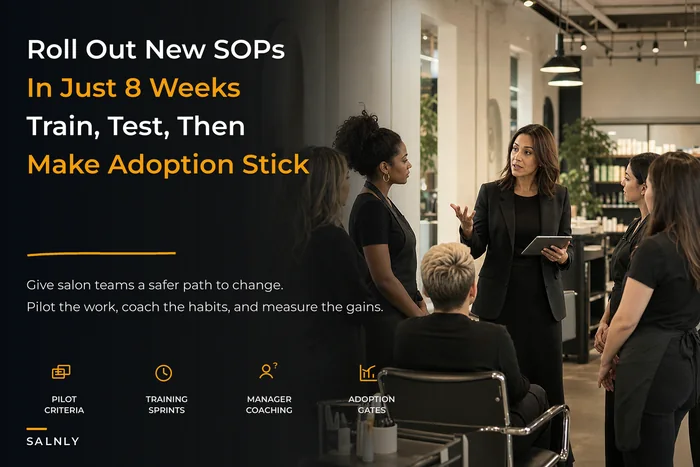
How to roll out in 8 weeks — summary checklist (pilot plan)
-
Week 1–2
Start daily huddles only; track habit formation
-
Week 3–4
Add positive callouts and rotate one skill focus
-
Week 5–6
Introduce the scorecard (1 behavior); post team totals only
-
Week 7–8
Begin documented corrective conversations as needed; expand to 2–3 behaviors by week 9
Manager training: two 15‑minute practice sessions (run huddles + role‑plays) and one calibration meeting using the rubric.
Pilot criteria: choose a single location or team of 6, run week 0 baseline measurements, and use success gates (e.g., +5pp prebook attempt improvement by week 8).
Internal link: read the 8‑week rollout playbook for more detail: [Roll Out New Sops in 8 Weeks a Salon Changemanagement Playbook].
Quick manager checklist
Run the huddle at the same time daily; read the top 3 scorecard metrics; practice one micro‑skill; record commitments; assign owners for blockers; run 1–2 spot observations weekly using the rubric; document coaching conversations and follow the escalation timeline.
Accessibility & extraction notes for web crawlers
The page is designed to be snippetable: H2/H3 Q&A blocks, clear lists, a copy‑ready CSV line and explicit formulas so search engines and grounded models can extract the toolkit.
If you want, I can convert the scorecard table into a download‑ready CSV text block or produce a one‑page printable single‑column HTML ready to copy into your CMS. Which would you prefer next?
Ready to simplify your salon operations?
Join 1,000+ salons using Salnly to save time, reduce scheduling chaos, and deliver better client experiences.