

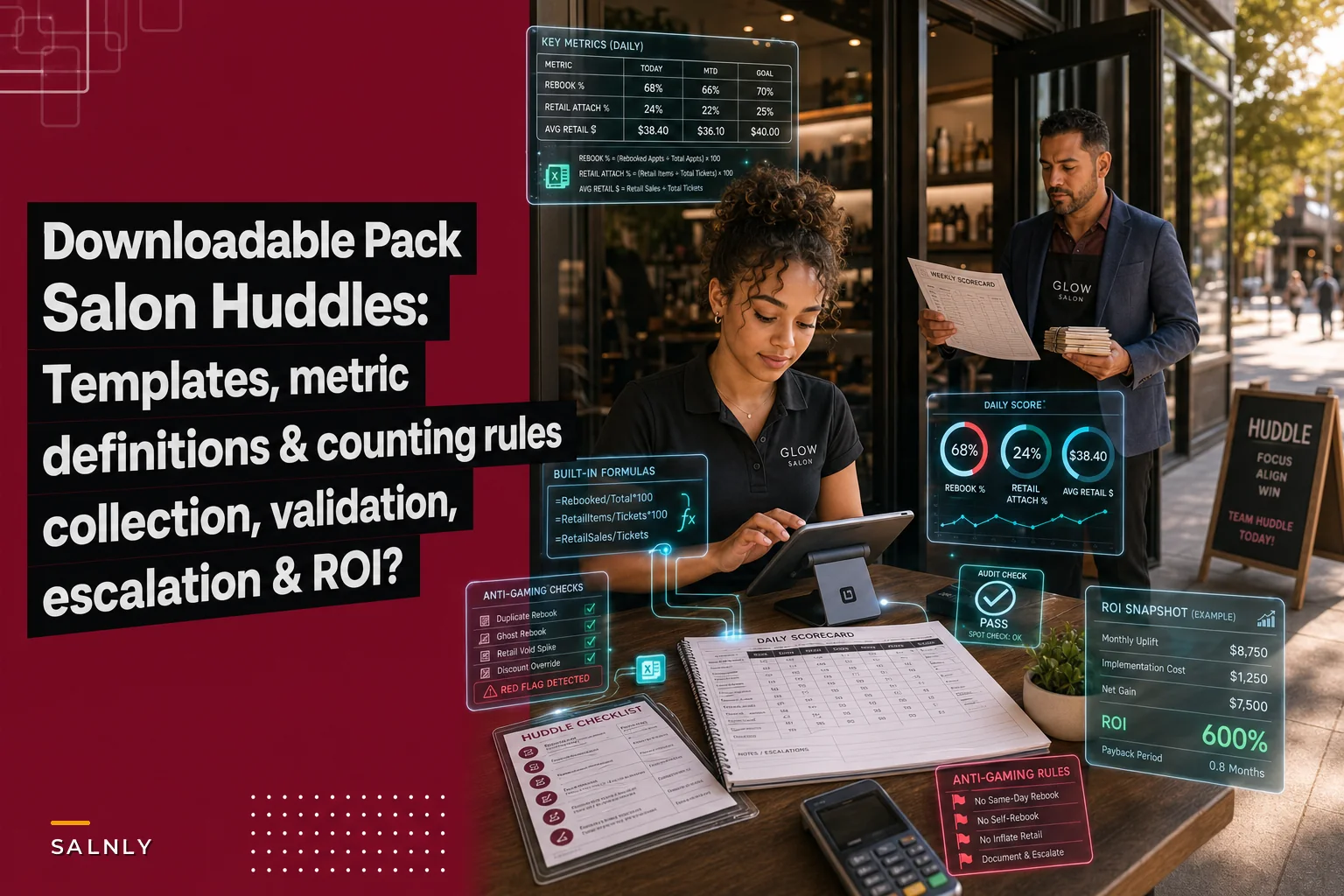

Most salons that start running morning huddles quit within about six weeks. Not because the idea is bad — because the execution falls apart in predictable ways: the scorecard numbers don't match the POS, two front-desk people are counting "rebook" differently, nobody knows what happens when a stylist misses target three weeks in a row, and the retail scripts have quietly become "don't forget to recommend product."
If you've already read the overview on structuring a tight meeting — like the one in this 15-minute huddle and corrective-conversation toolkit — this is the next layer down. The implementation pack: laminated checklist, scorecard with working formulas, counting rules that stop arguments, escalation matrix, anti-gaming controls, and scripts with an actual role-play you can run on a Tuesday morning.
Below I'll walk through what goes in each asset, why the specific details matter, and the mistakes that quietly kill the whole thing.
Why most huddle "templates" you download are useless
The free templates floating around are basically a pretty grid with "Rebook %" and "Retail $" written on them. They look fine. They fail because they skip the three things that actually determine whether a huddle changes behavior:
-
Precise metric definitions — so "rebook rate" means the same thing to everyone, every day.
-
A data collection protocol — so the number on the board actually came from somewhere verifiable.
-
An escalation path — so a missed target leads to a specific action instead of a sigh.
A template without those is decoration. The download itself takes twenty minutes to make. The definitions and rules are where owners spend zero time, then wonder why the board stops getting filled in after a month.
This pack is built around closing those execution gaps.
What's actually in the pack
Here's the full contents, then I'll break down the ones that matter most.
Stop losing appointments in the chaos.
Salnly helps you book, confirm & manage every appointment—efficiently.
- Centralized appointment management
- Client notifications
- Calendar & staff scheduling
No credit card required
| Asset | Format | What it solves |
|---|---|---|
| One-page huddle checklist | Printable PDF, laminate it | Keeps the meeting to 15 min, same order daily |
| Daily scorecard | PDF + PNG | Visible target vs. actual for 3 core metrics |
| Editable metrics workbook | Spreadsheet with built formulas | Auto-calcs rebook %, retail attach %, avg retail $ |
| Metric definitions + counting rules | 1-page reference | Stops the "what counts as a rebook" arguments |
| Baseline + target method | Short guide | Sets realistic targets instead of made-up ones |
| Data collection + validation protocol | Checklist | Makes the numbers match the POS |
| Escalation / timeline matrix | 1-page grid | Turns a missed target into a defined action |
| Anti-gaming controls + audit steps | Checklist | Prevents padded numbers |
| 3–5 retail recommendation scripts | Scripts + role-play | Gives staff exact words, not "sell more" |
| Observed-behavior checklist | Printable | Manager QA of what actually happens on the floor |
| Manager micro-training plan | 5–10 min modules | Trains managers without pulling them off the floor |
| KPI/huddle variants by model | Reference | Adjusts the pack for booth-rent, commission, etc. |
| ROI worked example | 1 page | Makes the business case before you commit |
The rest of this article explains the parts people consistently get wrong.
The metric definitions that stop arguments (read this before anything else)
This is the single highest-leverage page in the pack. If two people count differently, your scorecard is fiction and every decision downstream is built on that fiction.
Rebook %
-
Definition
Of all completed service clients today, the percentage who left with their next appointment booked.
-
Counting rule
Count the client, not the service. A client who books two future visits still counts as one rebook.
-
Edge cases that must be written down
- A client who "will call to book" = not a rebook. No exceptions. This one loophole alone can inflate the number by 10–15 points. - A client pre-booked by the salon (standing appointment) still counts. - Walk-ins who complete service count in the denominator.
Retail attach %
-
Definition
Of all completed service tickets today, the percentage that included at least one retail product.
-
Counting rule
Ticket-based, not client-based. One product on the ticket = attached.
-
Edge case
Backbar usage, tools the stylist buys, and staff purchases are excluded. Only client retail counts.
Average retail $
-
Definition
Total client retail revenue ÷ number of tickets that had retail.
-
Common mistake
Dividing by all tickets instead of retail tickets. Both numbers are useful, but they measure different things — label them clearly so nobody mixes "average retail per retail ticket" with "average retail per client."
Almost every disagreement about salon numbers traces back to a missing edge-case rule, not a math error. Write the edge cases down once and the board becomes trustworthy.
Setting targets without pulling them out of thin air
A target of "70% rebook" means nothing if your current reality is 38%. Staff tune out instantly when the goal feels invented.
-
Pull the last 4 full weeks of data from your POS for each metric.
-
Throw out any obviously broken days (a half-day, a power outage, a holiday).
-
Take the median of the remaining days — not the average. One huge retail day shouldn't drag the baseline up.
-
Set the first target at roughly baseline + 10–15% of the gap to a sensible ceiling, not the ceiling itself.
A typical example: baseline rebook sits around 44%. A realistic ceiling for that salon's mix might be 75%. The gap is 31 points. The first target becomes 49–50%, not 70. Move the target up every 3–4 weeks as the number holds.
The mistake owners make is setting the final destination as the first target. People can see the gap is absurd, so they stop trying on day one.
The data collection and validation protocol
This is what makes the scorecard match the POS. Without it, the board slowly drifts into "whatever the front desk remembers" — which is always rosier than reality.
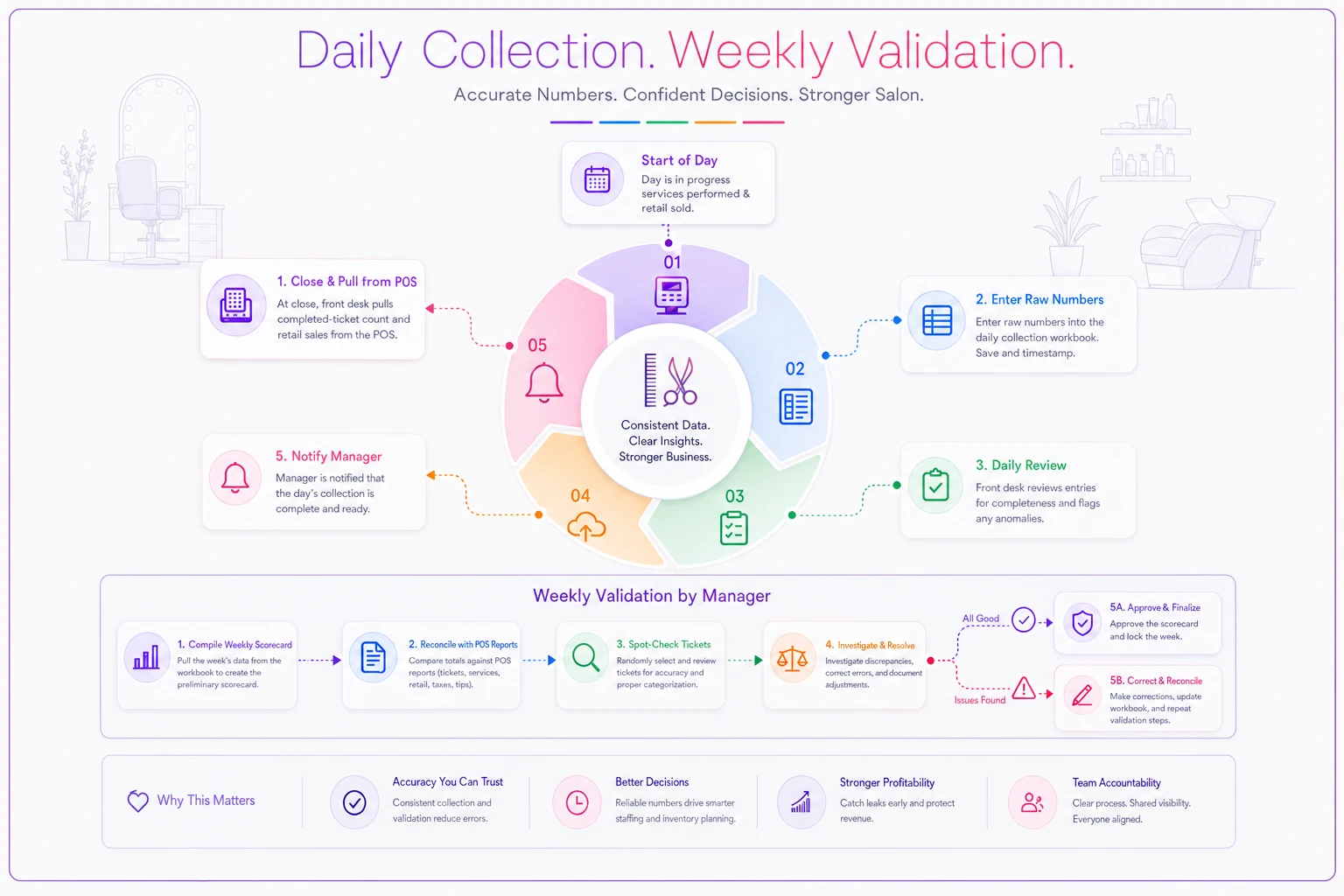
Quick visual of the daily close pull and the weekly manager validation.
Pull numbers at the same clock time each day so "close" means the same thing every day.
Daily collection (front desk, ~5 min at close):
-
Pull the day's completed-ticket count from the POS.
-
Pull retail revenue and retail-ticket count.
-
Count rebooks from the appointment book (next appointments created today for clients seen today).
-
Enter all four raw numbers into the workbook — let the formulas calculate the percentages. Never let staff type in a percentage by hand.
Weekly validation (manager, ~10 min):
-
Reconcile the week's scorecard retail total against the POS retail report. They should match within a rounding margin. If they don't, something's being counted wrong.
-
Spot-check 5 random tickets marked "rebooked" against the actual appointment calendar.
That weekly spot-check is the quiet backbone of the whole system. It's the difference between a number people respect and a number people quietly inflate.
Anti-gaming controls (because people optimize what you measure)
The second you put rebook % on a board and tie praise to it, some people will find the shortcut. This isn't cynicism — it's just how measured systems work. Build the controls in from the start.
Common gaming patterns and the control for each:
-
"Book now, they'll probably cancel" — stylist books a loose future appointment just to count the rebook, knowing it won't hold. Control: Track rebook retention monthly — what % of rebooked appointments actually show. A stylist with 80% rebook but 50% show is gaming.
-
Counting "will call" as a rebook. Control
The definition above plus the weekly calendar spot-check.
-
Ringing retail on the stylist's own account to pad attach %. Control: Exclude staff purchases by rule, and audit any ticket where the retail buyer matches a staff name.
-
Splitting one product across two tickets to boost attach rate. Control: Audit same-client same-day ticket splits monthly.
Audit steps (monthly, ~20 min):
-
Compare each stylist's rebook rate to their rebook retention rate.
-
Pull the 10 highest retail-attach tickets and confirm they're legitimate client sales.
-
Review any metric that jumped more than ~15 points week-over-week. Big sudden jumps are either a real breakthrough or a counting change — find out which.
Build the controls in from the start.
The escalation and timeline matrix
A missed target should trigger a defined response, not a vibe. This grid removes the awkwardness and the inconsistency.
| Situation | Timeframe | Action |
|---|---|---|
| Individual misses target | 1 week | Noted on scorecard, quick floor coaching, no formal conversation |
| Individual misses target | 2–3 weeks | 10-min structured corrective conversation + one specific behavior to change |
| Individual misses target | 4+ weeks | Written plan with a check-in date and a specific skill module assigned |
| Whole-team miss | 1 week | Huddle discussion — is it the target, the process, or the week? |
| Whole-team miss | 2+ weeks | Re-examine the target itself; the baseline may be wrong, or something changed |
The insight most owners miss: a team-wide miss is almost never a people problem. It's a target problem, a scheduling problem, or a seasonality problem. Escalating individuals when the whole team missed is how you lose good staff. The matrix forces you to ask "did everyone miss?" before you single anyone out.
Retail scripts and the role-play that makes them stick
Handing someone a script doesn't change behavior. Running the script out loud twice, badly, in front of a peer — that changes behavior. The pack includes 3–5 scripts tuned to the actual moment, not generic "would you like product today."
Script 1 — The in-service recommendation (highest conversion):
> "The reason your color's fading faster than you want is the sulfate in your current shampoo. This one here is what I use on you at the backbar — it's the difference between six weeks and nine between visits."
Why it works: it's tied to a problem the client already feels, and it references something they just experienced in the chair.
Script 2 — The checkout attach:
> "I set aside the [product] we used on you today — want me to add it so you can get the same result at home?"
Script 3 — The rebook + retail combo:
> "Let's lock in your next color for [date] so you keep the chair you like, and grab the [product] so it looks this good until then."
The role-play (run it in a huddle, ~4 min):
-
Stylist A plays the client, picks a mild objection ("I already have shampoo at home").
-
Stylist B runs the script and handles the objection once.
-
The manager uses the observed-behavior checklist to note what actually happened.
Observed-behavior checklist (what the manager watches for):
-
Did they tie the recommendation to a specific client problem? ✅ / ❌
-
Did they name the exact product used in service? ✅ / ❌
-
Did they make it easy to say yes (product already in hand)? ✅ / ❌
-
Did they handle one objection without getting pushy? ✅ / ❌
-
Did they stop after one ask? ✅ / ❌
That last one matters more than people think. The over-asking stylist annoys clients and tanks the experience. One clean ask beats three desperate ones every time.
Manager micro-training plan (5–10 minute modules)
Managers don't have an afternoon for training. They have the ten minutes before doors open. The plan is modular — one skill per session, delivered standing up.
Module sequence:
-
How to read the scorecard in 60 seconds
-
Running the daily huddle in order, on time
-
Giving a corrective conversation without it getting emotional
-
Running a retail role-play
-
The weekly validation check
-
Spotting gaming patterns
Each module is a half-page: the objective, one thing to practice, one thing to avoid. The whole plan runs over about two weeks of mornings. Train one thing, let the manager use it for a few days, then add the next. Dumping all six modules in one meeting guarantees none of them stick.
KPI and huddle variants by salon model
A commission salon and a booth-rent salon cannot run the same scorecard, because the owner doesn't control the same levers.
-
Commission salon Full pack applies. Rebook, attach, and avg retail are all fair game because the salon owns the client relationship and the retail margin.
-
Booth rent / chair rent Retail is often the renter's business, so the owner's huddle shifts toward shared metrics — front-desk rebook capture, waitlist fill, review requests. Don't try to enforce retail attach on independent renters; it creates conflict and legal gray areas.
-
Hybrid salon Run the full pack for commission staff, the lighter version for renters, and keep separate baselines. Mixing them produces a meaningless blended number.
-
Small 2–4 chair salon Skip the escalation matrix formality. With that few people, the "conversation" is just a quiet word. Keep the scorecard and definitions; drop the bureaucracy.
The mistake here is forcing one scorecard across every model in the name of consistency. Consistency in definitions matters. Consistency in which metrics apply does not.
A short ROI worked example
Say a mid-size salon runs roughly 330 service tickets a month.
-
Current retail attach
~22%. Avg retail per retail ticket: ~$31.
-
Current rebook
~44%.
After running the pack consistently for a quarter, suppose attach moves to ~30% and rebook to ~52%. Not dramatic — just the kind of lift a trustworthy scorecard and real scripts tend to produce.
Retail math:
-
Before
330 × 22% = ~73 retail tickets × $31 ≈ $2,260/mo.
-
After
330 × 30% = ~99 retail tickets × $31 ≈ $3,070/mo.
-
Monthly retail lift
roughly $800, call it $9k–$10k/year on retail alone.
Rebook math: an 8-point rebook lift on a base of hundreds of monthly clients shows up as a handful more pre-booked visits per stylist per month. Even at a conservative count, that's typically several thousand dollars of protected future service revenue per year — revenue you didn't have to pay to re-acquire.
Honest caveat: these numbers only materialize if the data is clean and the conversations actually happen. A padded scorecard produces fake lift and real disappointment.
When this pack is worth it — and when it isn't
Worth it when:
-
You already run some form of huddle but the numbers feel squishy.
-
You've got at least 4–5 staff where consistency actually matters.
-
You have POS data you can pull reports from.
Not worth it when:
-
You're a solo operator — you don't need a scorecard to talk to yourself.
-
You're not willing to do the weekly 10-minute validation. Without that, the whole thing rots within a month.
-
Your team is in the middle of a bigger crisis (turnover, a bad move, a software migration). Fix the fire first.
Fix the fire first.
Where the software layer fits
None of this requires software — the pack is deliberately paper-and-spreadsheet friendly so you can start Monday. That said, the two chores most likely to kill a huddle long-term are the daily data pull and the weekly reconciliation. Operational platforms with built-in reporting can auto-populate the raw numbers straight from the POS and appointment calendar, so the front desk isn't hand-counting at close and the manager isn't cross-checking tickets manually.
The point isn't to add tech for its own sake — it's that automating the collection removes the exact friction that makes people abandon the board after a few weeks. Keep the judgment, the conversations, and the scripts human. Let the system handle the counting.
Bottom line
A huddle only works when the numbers behind it are trustworthy and a missed target actually leads somewhere. The pack exists to close those gaps: shared definitions so nobody argues, a validation routine so the board matches reality, anti-gaming audits so the numbers stay honest, scripts and role-plays so retail stops being vague, and an escalation grid so coaching is consistent instead of mood-dependent.
Download it, laminate the one-pager, set your baseline from your own four weeks of data, and run it for a full quarter before you judge it. The salons that make it past the six-week wall are almost always the ones who did the unglamorous part first — the definitions and the weekly check.
Ready to simplify your salon operations?
Join 1,000+ salons using Salnly to save time, reduce scheduling chaos, and deliver better client experiences.