


Most salon owners don't think about the ports until a shipment doesn't show up. Then suddenly your 7N is on backorder, your favorite bond builder is "temporarily unavailable," and your distributor rep is giving you that vague "we're expecting it next week" answer that everyone knows means nothing.
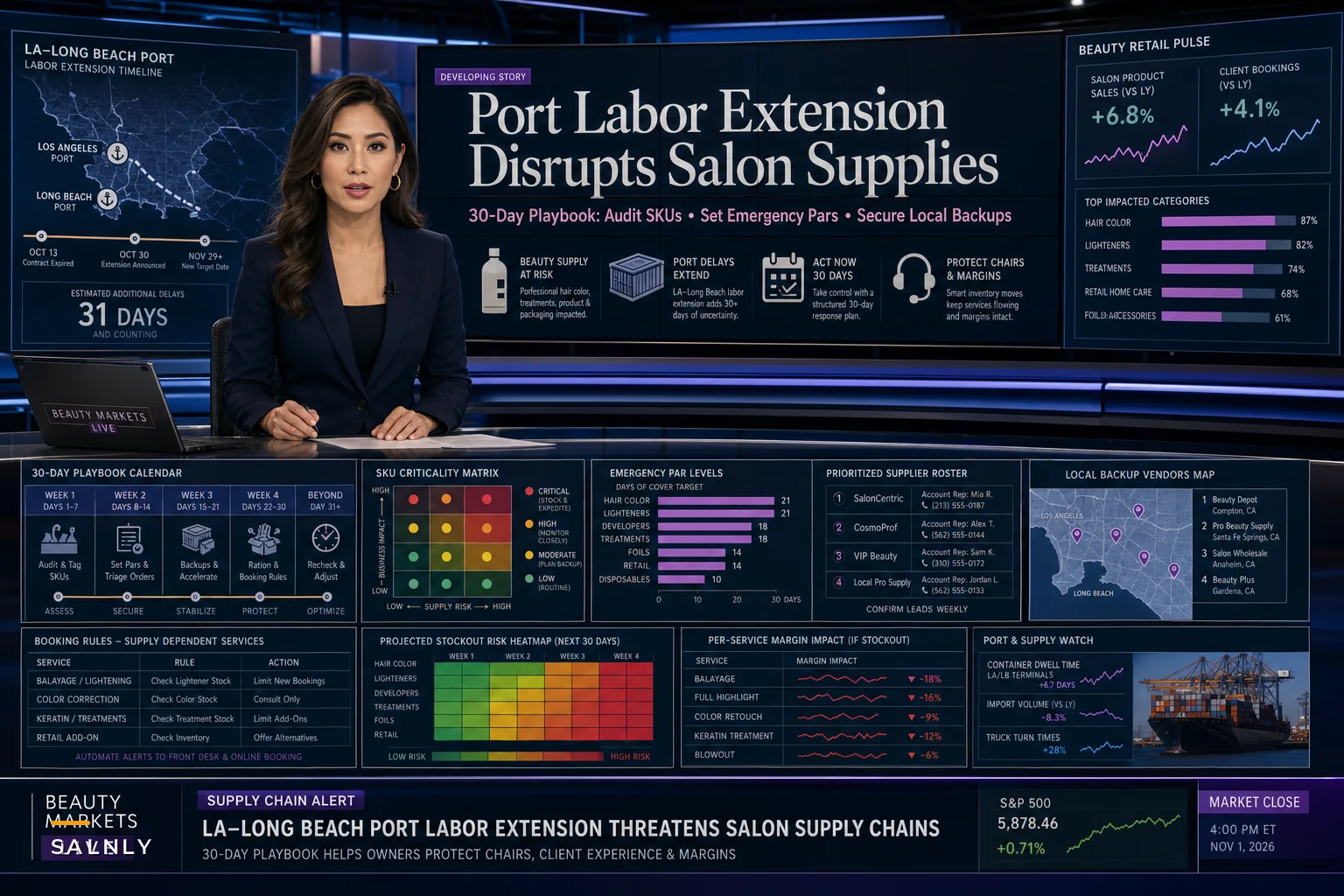
That's roughly where things stand right now. On October 30, 2026, negotiations between employers and the maritime watchmen union at the Los Angeles and Long Beach seaports were extended, pushing the deadline into early November — delaying, but not eliminating, the risk of a work stoppage. Reuters reported the two sides agreed to extend talks through Nov. 5, while Bloomberg framed it as a strike threat pushed to early November. The ports at LA/Long Beach handle a massive share of imported goods coming into the country, and a lot of professional beauty product — color, treatments, disposables, tools — moves through that complex at some point.
The timing is what makes it ugly. This is happening right as holiday booking demand ramps up and retail starts moving. Even a short slowdown at the gates doesn't just delay containers — it backs up the whole chain, raises freight costs, and creates spot shortages that hit specialty SKUs first. Your toner, your developer, the specific shade your color-correction clients can't go without.
This post isn't about predicting whether a strike happens. Nobody knows that. It's about what you do in the next 30 days so your service schedule and your margins don't depend on the outcome.
The real problem isn't the port — it's how thin most salon inventory actually runs
Port risk exposes something that was already there: most salons run with almost no buffer. The "reorder when we're low" model works fine when distribution is smooth. It falls apart the moment lead times stretch.
In normal weeks, a lot of salons carry maybe one to two weeks of color on hand and reorder on a loose rhythm — usually when a stylist notices a tube is almost gone. No real par level, just a vibe. Retail is often worse: shelves get restocked when someone remembers, or when a rep swings by.
That setup has a hidden fragility. When a supplier's lead time jumps from 3 days to 10–14 days because of port congestion, your one-week buffer isn't a buffer anymore. You're already underwater before the reorder even ships.
And shortages don't hit evenly. The first things to go dark are almost always:
-
Specialty and low-volume color shades — the ones only a few clients need, which means you never stock deep
-
Bond builders and treatment add-ons tied to premium services
-
Disposables that quietly run your day
foils, gloves, capes, towels
-
Anything single-sourced from one distributor with no local backup
The painful irony is that the SKUs most likely to disappear are often your highest-margin service drivers. A color correction or bond-heavy blonde service can run $250–$400 in the chair. Losing the ability to book those because you're out of one $18 product is a brutal trade.
Triage your SKUs before you touch a single order
Before you start panic-ordering everything, separate what actually matters. Dumping cash into a blanket "buy more of everything" move is how salons end up with $6k of slow-moving product and expired color six months later.
Stop losing appointments in the chaos.
Salnly helps you book, confirm & manage every appointment—efficiently.
- Centralized appointment management
- Client notifications
- Calendar & staff scheduling
No credit card required
The cleaner approach is sorting every SKU into three buckets based on two questions: how much revenue depends on it and how replaceable is it.
| Tier | What it is | Action in next 30 days |
|---|---|---|
| Critical / single-sourced | High-revenue services depend on it, hard to substitute (specialty color, specific bond builder) | Raise par to 4–6 weeks, order now, line up a backup supplier |
| Important / substitutable | Used often but an alternative exists (common developer, standard foils) | Raise par to 2–3 weeks, confirm a second source |
| Low-risk / flexible | Easy to swap, low service impact, or slow-moving retail | Keep normal cadence, don't overbuy |
The point isn't to hoard — it's to spend your extra inventory budget where a stockout actually cancels appointments. A color-heavy salon might find that only 12–15 SKUs genuinely fall into the critical tier. That's a very manageable number to protect.
Protect the 12–15 SKUs that actually fall into the critical tier first.
This kind of tiering is basically a fast, emergency version of the discipline covered in the supplier scorecard and SKU rationalization approach — except right now you're doing it under time pressure instead of as a quarterly habit. Salons that already run par levels and vendor scoring are barely sweating this news. They bump their critical pars and move on.
The 30-day ordering playbook
Work through this sequence over the next few weeks, not all in one frantic afternoon.
-
Pull your last 60–90 days of product usage. You need real consumption numbers, not guesses. If your POS or inventory system tracks product depletion per service, use it. If not, look at what you've reordered recently.
-
Tag your critical-tier SKUs. Use the table above. Be honest about what's single-sourced — a lot of owners assume they have alternatives they've never actually tested.
-
Raise par levels on critical SKUs to 4–6 weeks. This is the one place you spend ahead. Place these orders first, before everyone else in your region has the same idea. Early movers get product; late movers get waitlisted.
-
Line up a second source for every critical SKU. Call a different distributor, a regional supply house, even a nearby salon you trust. You don't have to buy from them yet — you just need to know the door is open and the price.
-
Accelerate reorder cadence on important-tier items. Shift from "reorder when low" to a fixed weekly check. Tighter cadence beats bigger single orders when lead times are unpredictable.
-
Set ration rules for scarce products. If a specialty color is at risk, cap how it gets used — reserve it for pre-booked appointments, not walk-in experimentation.
-
Update booking rules for supply-dependent services. This is the step most salons skip, and it's the one that actually protects the schedule. More on this below.
-
Recheck in week three. Negotiations may resolve or they may stretch. Adjust pars back down if the risk clears so you're not sitting on dead stock.
The steps above map to a simple 30-day sequence you can follow visually.
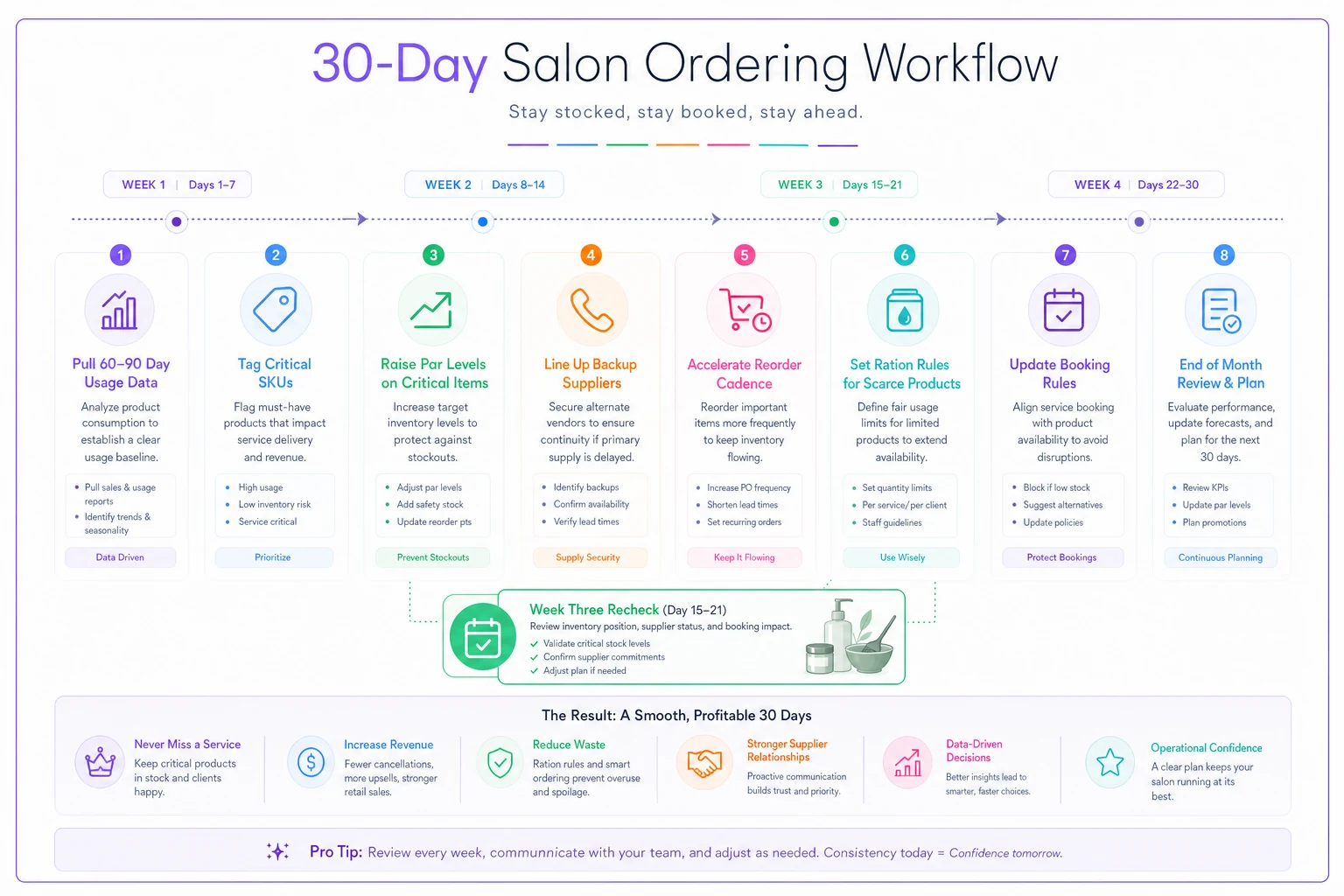
Use the visual to keep orders prioritized day-by-day so you place the highest-impact buys first.
Protect the schedule, not just the stockroom
The inventory side gets all the attention, but the bigger operational miss is letting clients book services you might not be able to perform. Taking a deposit for a full balayage and then calling two days before to cancel because your lightener didn't arrive — that's the kind of thing that costs you the client, not just the appointment.
A smarter move during a supply-risk window is tying your booking rules to your stock reality. A simple workflow:
Front desk — or your online booking system — flags any service that depends on a critical-tier SKU. Before confirming those bookings more than a week out, someone checks current stock against expected usage. If things are tight, you either shorten the booking window for that service or hold a few confirmed slots until product lands. Clients booking supply-heavy services get a soft heads-up that there's a small chance of rescheduling — which lands a lot better upfront than as a last-minute cancellation.
This is where inventory and scheduling have to actually talk to each other. In a lot of salons they live in totally separate worlds — product tracked in a spreadsheet or on a rep's clipboard, bookings in the calendar, nobody connecting the two until something breaks. Salons that handle supply shocks well are usually the ones running an operational platform where product usage per service and booking demand sit in the same system, so a low-stock SKU can surface before someone books three color corrections that'll drain it. You don't need anything fancy to start — even a shared view that shows "this service uses this product, here's what's left" prevents most of the painful cancellations.
A quick real scenario
A mid-size color-focused salon — three stylists, somewhere around 330–360 appointments a month — got caught during a previous shipping slowdown. They were running their usual loose reorder system and ended up out of two specialty toners for about nine days. During that stretch they had to reschedule roughly 11 color appointments and partially substitute on a handful more, which left two clients unhappy and one who didn't rebook.
The rough math: those canceled and downgraded services added up to somewhere in the $2,800–$3,400 range in lost or delayed revenue over a week and a half — plus the harder-to-measure cost of losing a regular.
After that, they did the boring thing. Identified their 14 critical SKUs, set 5-week pars, added one backup distributor. The next time a disruption came along, they bumped orders early and barely noticed it operationally. The extra carrying cost of holding deeper stock on those 14 items was minor compared to a single canceled high-ticket appointment.
When stocking up is the wrong call
Raising pars isn't free, and it's not always the right move. A few situations where you should not go deep:
-
Products with short shelf life. Some developers and mixed treatments don't hold well. Overbuying just creates waste.
-
SKUs you're already phasing out. If you're switching color lines or dropping a slow retail brand, don't stockpile the thing you're trying to get rid of.
-
Tight cash position going into a slow stretch. If your January is historically soft, tying up $4k–$5k in inventory can hurt more than an occasional stockout. Protect only the true critical tier and keep the rest lean.
-
Easily substitutable items. If three distributors carry it and it ships from everywhere, you don't need a six-week pile. A second source is enough.
Spend where a stockout cancels revenue, stay lean everywhere else.
The part that actually sticks after this blows over
Whether the LA/Long Beach situation resolves quietly or drags on, the useful outcome isn't just surviving this specific window. It's realizing how little buffer most salons carry and how disconnected inventory is from the booking calendar.
The salons that get rattled by supply news are the ones running on memory and instinct — reorder when low, hope the shade shows up, find out about shortages when a stylist opens an empty drawer. The ones that shrug it off have par levels, a second source for anything critical, and a way to see product and demand in the same place.
You don't need the threat of a strike to justify that kind of setup. But if the current headlines are what finally gets you to set real pars on your critical SKUs, that's not a bad trade. Do the triage this week, protect the 12–15 things that actually drive revenue, and give your front desk a way to see supply risk before it books into a wall. That's most of the battle.
Do the triage this week, protect the 12–15 things that actually drive revenue, and give your front desk a way to see supply risk before it books into a wall. That's most of the battle.
Ready to simplify your salon operations?
Join 1,000+ salons using Salnly to save time, reduce scheduling chaos, and deliver better client experiences.