

Most salons don't fail an incident because nobody cared. They fail because the response lives in one person's head, and that person happened to be off that day. The color line went down, the card reader stopped talking to the booking system, a client had a scalp reaction mid-service — and the three people on the floor each did something slightly different, slightly too late.
That's not a training problem. It's a governance problem. And governance that only exists as a binder nobody opens is the same as no governance at all.
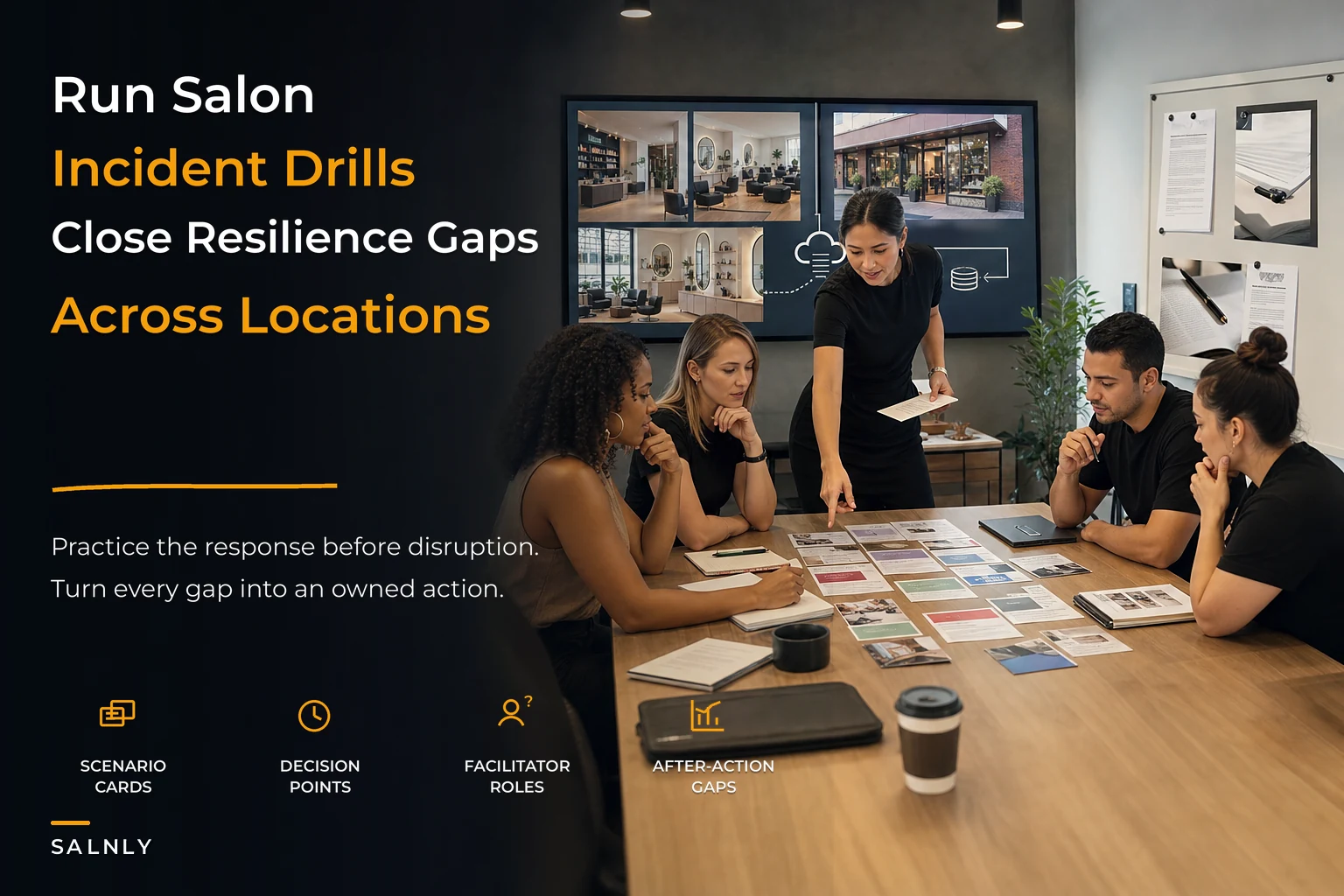
What separates salons that absorb a bad day from ones that lose a weekend of revenue over it isn't luck. It's that they've rehearsed the ugly stuff on a schedule, written down who decides what, and pushed their vendor contracts to carry real obligations instead of hoping for goodwill. That's what a recurring governance pack is for — and tabletop exercises are the engine that keeps it honest.
Why incident response quietly rots between locations
A single-chair operation can run on instinct. The owner is there, she sees the problem, she fixes it. The moment you add a second and third location, that instinct doesn't scale — but owners usually assume it does. They write one SOP, email it out, and consider the matter closed.
-
Location A interprets "notify the owner immediately" as a text. Location B interprets it as "tell the manager, who'll tell the owner tomorrow."
-
A new front-desk hire at Location C never saw the original SOP because it lived in an email thread from before she started.
-
The chemical-reaction protocol got updated after one scary incident, but only the location where it happened got the memo.
By month ten you don't have one incident process. You have three or four slightly mutated versions, and none of them have been tested against a real scenario since the day they were written. The gap doesn't announce itself. It sits quietly until something goes wrong at the worst location, on the worst shift, and the response is whatever the least-experienced person on the floor improvises.
Across a lot of multi-location operators, resilience isn't evenly distributed. One location is sharp because the manager drills her team. The others coast. Governance exists to close that gap deliberately, not leave it to whoever happens to manage where.
The governance pack, piece by piece
A governance pack isn't a policy document. It's a small, reusable kit that makes rehearsal cheap and repeatable. Five pieces do the heavy lifting.
Stop losing appointments in the chaos.
Salnly helps you book, confirm & manage every appointment—efficiently.
- Centralized appointment management
- Client notifications
- Calendar & staff scheduling
No credit card required
Scenario cards
Each card describes one incident in a few lines: what's happening, what's known, what's unknown, and what's at stake. You want 15–20 of these covering the realistic range — not disaster-movie stuff, but the Tuesday-afternoon problems that actually hit salons.
> A client 20 minutes into a lightening service reports burning and visible redness at the hairline. The stylist is mid-foil. Front desk is slammed with two checkouts. The manager is at lunch off-site. What happens in the next five minutes, and who does what?
-
They include a complication (manager off-site, phones down, a full waiting room).
-
They force a decision with imperfect information.
-
They map to a real category
client safety, data/platform outage, supplier failure, staffing collapse, physical/facility.
Facilitator scripts
The person running the tabletop needs a script so the exercise doesn't drift into a venting session. The script keeps time, injects complications, and asks the uncomfortable follow-ups.
-
Read the scenario card aloud (1 min). No extra context.
-
Silent think (2 min). Everyone writes their first move.
-
Walk the response (10 min). Go person by person
"You're front desk — what do you do first?"
-
Inject a complication (mid-way)
"The owner isn't answering. Now what?"
-
Hit the decision points (5 min)
Who had authority to comp the service? Who logs it? Who calls the client back?
-
Score against the gate (5 min)
pass or fail, and why.
-
Capture the gap (2 min)
one sentence into the after-action repository.
A simple workflow for running a tabletop:
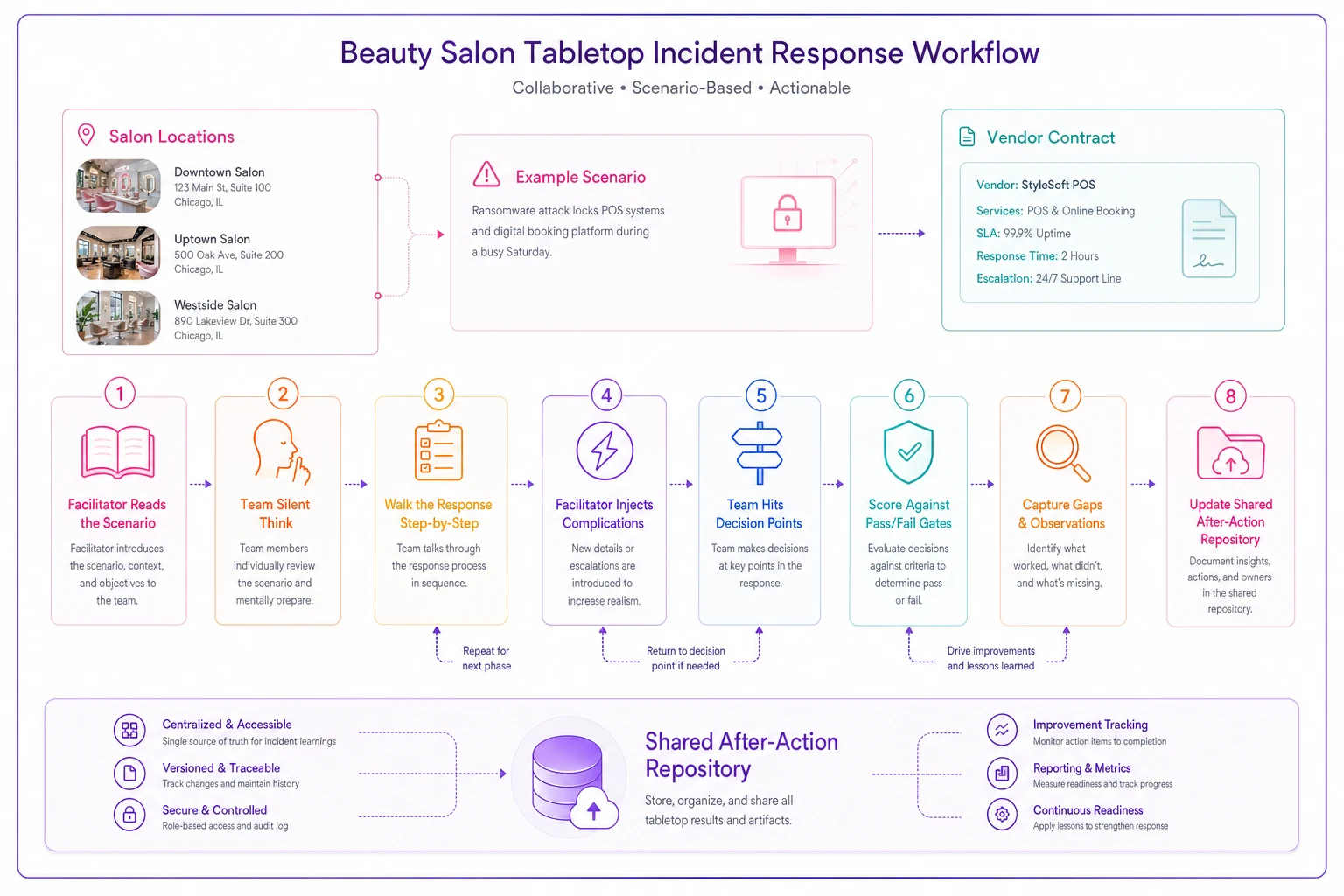
The facilitator's real job is to resist solving the problem for the team. The silence when nobody knows who's allowed to refund $240 on the spot — that silence is the finding.
Pass/fail gates
This is the part most salons skip, and it's the part that makes the whole thing worth doing. A tabletop without a clear pass/fail is just a conversation. A gate turns it into a check you either clear or you don't.
-
Did someone own the client's safety within 60 seconds? Pass/Fail
-
Was the incident logged with time, people involved, and actions taken? Pass/Fail
-
Did the person on the floor know their decision authority without calling up the chain? Pass/Fail
-
Was the client contacted for follow-up within the window the SOP requires? Pass/Fail
If a location fails a gate, that's not a punishment — it's a scheduled re-drill. You run that scenario again in two weeks. The gate is what stops "we talked about it" from being mistaken for "we fixed it."
Vendor continuity clause snippets
Half of a salon's worst days aren't caused inside the salon. The booking platform goes dark on a Saturday. The color distributor misses a delivery during peak. The payment processor freezes payouts. You can drill your team all you want, but if your vendor has no obligation to respond, you're drilling around a hole.
This is where you push continuity language into the contracts before you need it. We'll go deeper on this below, because it's the piece owners most often leave to chance.
The after-action repository
Every tabletop and every real incident produces findings. Those findings have to land somewhere permanent, searchable, and shared across locations — not in a manager's notebook. The repository is how Location A's painful lesson becomes Location C's standard operating procedure before Location C has to learn it the hard way.
A clean after-action entry has:
-
Date, location, scenario or real incident
-
What the gate result was
-
The single biggest gap exposed
-
The specific change made (SOP edit, training, authority change)
-
A re-check date
The repository is how Location A's painful lesson becomes Location C's standard operating procedure before Location C has to learn it the hard way.
Where tabletops expose the real failure points
When salons run their first honest salon incident governance tabletop, the same categories of breakdown surface repeatedly. Not the dramatic ones — the mundane coordination failures.
-
Decision authority is fuzzy. Nobody on the floor is sure whether they can comp a service, send a client home, or shut down a station without calling the owner. In a real incident, that uncertainty costs minutes you don't have.
-
Logging happens last, or never. The team handles the immediate problem, the client leaves, and the incident never gets written down. Three weeks later there's a complaint or a chargeback and there's no record of what happened. For the legal and documentation side of this, it ties directly to having proper incident logs and consent trails already in place.
-
Handoffs drop. The opening manager knows about the simmering issue. The closing manager doesn't. The night team walks into a situation blind.
-
Vendor dependency is invisible until it isn't. The team has no idea what to do when the platform is down because they've never operated without it. This connects straight into broader operational resilience and 48-hour contingency playbooks for supplier, power and platform outages — the governance pack is the rehearsal layer that keeps those contingency plans from going stale.
The pattern underneath all of these: the salon has a plan, but the plan has never met a real decision under pressure. Tabletops are cheap pressure. Better to fail a scenario card on a quiet Monday than fail the real thing on a packed Saturday.
Standardizing vendor continuity obligations
Worth spending real time here, because this is where owners leave the most money on the table.
When you sign with a booking platform, a payment processor, or a product distributor, the default contract protects them. It covers their rights, their fees, their limitation of liability. It rarely says what they owe you when their service fails during your peak hours. Most owners never read that far, and then act surprised when a Saturday outage comes with a shrug and a "we're working on it."
The fix is to carry standard continuity language into every vendor relationship so the obligations are consistent across your whole portfolio. You don't need a lawyer to draft 40 custom contracts — you need a short set of reusable clause snippets you insert or negotiate at every renewal. The categories worth standardizing:
| Obligation area | What to require | Why it matters at scale |
|---|---|---|
| Response time | Defined response window for critical outages (e.g., acknowledgment within a set number of hours) | Without it, "urgent" means whatever they decide |
| Status communication | Proactive notification of outages and maintenance windows | You find out before your clients do |
| Data portability | Your data exportable in a usable format on demand | Protects you if you ever switch providers |
| Uptime / credits | Service credits tied to downtime thresholds | Puts a real cost on their failures |
| Supply continuity | Backorder notice periods and substitute options for product vendors | Lets you reorder before you stock out |
| Exit terms | Clear offboarding process and timeline | Prevents being held hostage by your own data |
The data portability and exit points matter more than most owners expect. If you ever have to move platforms — and most multi-location salons eventually do — a vendor with no portability obligation can turn a routine switch into a nightmare. We've written separately about managing that transition in the booking-system migration playbook with phased mapping and parallel runs, and the single biggest predictor of a smooth migration is whether the original contract gave you a right to your own data in a clean, usable format.
The scale benefit is subtle but real: when every vendor carries the same baseline obligations, your managers across locations respond to vendor failures the same way, because the contracts behave the same way. You stop having one location that "has a good relationship with the distributor" and another that gets ignored. The relationship stops mattering as much as the written obligation.
A real scenario
A three-location salon group — roughly 22 chairs total, somewhere around 1,400–1,600 appointments a month across all sites — had never run a formal incident drill. Each location had its own loose way of handling problems. The owner assumed they were basically consistent.
Their first tabletop cycle used four scenario cards: a chemical reaction, a full booking-platform outage on a Saturday, a missed color delivery during a holiday week, and a front-desk staffer walking off shift mid-day.
The results were uncomfortable in a useful way. All three locations failed the decision-authority gate on the chemical-reaction card — no one on the floor was confident they could send a client to urgent care and comp the full service without the owner's sign-off. Two of three failed the logging gate on every scenario. And nobody at any location knew what the booking vendor was actually obligated to do during an outage, because no one had ever read that section of the contract.
Over the next quarter they fixed the cheap stuff first: written decision authority posted at each front desk, a one-page incident log any staffer could complete in under two minutes, and a shared after-action repository all three managers could see. They renegotiated the payment and booking contracts to add a defined outage-response window and data export rights at the next renewal.
The payoff wasn't a dramatic revenue number. It was quieter. When the booking platform went down for about three hours on a Saturday a few months later, the team ran their offline flow, kept serving clients from printed schedules, logged the disruption, and filed it into the repository the same day. The owner found out from a status notification, not from an angry client. A day that would have cost them a chunk of the afternoon cost them almost nothing.
Keeping it recurring without it becoming a chore
The reason most governance efforts die is that they're treated as a one-time project. You write the SOPs, run one big drill, feel good about it, and never touch it again. Six months later the whole thing is stale and half your staff has turned over.
A workable cadence:
-
Monthly one scenario card per location, run inside an existing huddle, 20 minutes max.
-
Quarterly a full cycle of four cards plus a review of the after-action repository to confirm last quarter's gaps actually got closed.
-
Annually a vendor-obligation review timed to renewals, pulling your standard continuity snippets into any contract that's up.
The repository is what ties the cadence together. Each drill writes into it. Each quarter you check whether the gaps you found last time have a closed-out fix. A gap that keeps reappearing is telling you the fix didn't stick — maybe the authority change was posted but never trained, or the new manager never saw it. That recurrence is the signal governance is supposed to surface.
Post the decision-authority chart at each front desk so new hires see the authority structure during their first shift.
Who should NOT over-invest in this yet
If you're running a single location with three or four chairs and you're on the floor every day, you do not need 20 scenario cards and a quarterly vendor review. A short written incident process and knowing your own vendor contracts is plenty. The full recurring pack earns its keep once you have multiple locations, managers running shifts you're not present for, and enough staff turnover that tribal knowledge stops being reliable.
The honest line: governance overhead should match coordination complexity. One location, one owner-operator — you are the governance. Three or four locations — the governance has to live outside your head, or it doesn't exist.
Pulling it together
Incident governance isn't about preparing for catastrophe. It's about making sure a normal bad day stays normal. The salons that handle the color-line failure, the platform outage, and the scalp reaction without losing a shift aren't tougher or luckier — they've rehearsed the decisions and pushed their vendors to carry real obligations.
Start smaller than you think. A handful of scenario cards, a facilitator script, clear pass/fail gates, a shared repository, and a standard set of continuity clauses you insert at every renewal. Run it on a cadence light enough that it survives contact with a busy month. Do that, and the gap between your best location and your worst one starts closing on purpose — which is the entire point of governance in the first place.
Ready to simplify your salon operations?
Join 1,000+ salons using Salnly to save time, reduce scheduling chaos, and deliver better client experiences.