


Most salons are one bad Tuesday away from losing a full day of revenue and half their goodwill. Not because owners are careless, but because the whole operation quietly depends on things outside your control: your booking platform staying up, your color supplier shipping on time, the power staying on, the card reader talking to the bank. When one of those fails, it doesn't stay contained. It spreads through your schedule, your team, and your client relationships within hours.
Building salon operational resilience isn't about predicting every disaster. You can't. It's about making sure that when something specific breaks, you already know the next three moves, who makes them, and what you tell clients — so the outage costs you two hours of scrambling instead of two days of chaos.
This is a systems article, not a tips list. We'll cover how outages actually cascade through a salon, how to build a risk register, how to write 48-hour playbooks for the failures that actually happen, how to handle client communication, and how to run a quarterly testing rhythm so none of this rots in a drawer.
How one failure becomes five
Nobody tells you when you open a salon that your operation is a chain of dependencies, and clients only ever see the last link. They don't care that your booking software went down — they care that they showed up for a 10am appointment nobody has a record of.
Walk through a realistic Saturday. Your online booking platform has an outage at 8:40am. On the surface, that's an IT problem. But look at what follows.
The front desk can't pull the day's schedule, so they're rebuilding it from memory and text confirmations. Two double-bookings appear because two stylists both think they have the 11:00 slot. A walk-in gets turned away because nobody can see the gap that actually exists at 1:15. Your color specialist starts a process on the wrong client because the notes about a previous reaction were locked inside the platform. By noon you've got a service issue, a scheduling collision, and a client composing a review in her head.
One technical failure turned into a scheduling failure, a service-quality failure, and a reputation failure. That's the pattern across almost every outage — the initial break is rarely the expensive part. The cascade is.
Understanding that changes how you plan. You're not protecting against "the platform going down." You're protecting the downstream functions the platform was quietly holding together: schedule visibility, client history, payment, and communication. Frame it that way and the playbooks almost write themselves.
Build the risk register first
A risk register is just a plain list of what can break, how likely it is, how badly it hurts, and who owns the response. Salons overcomplicate this or skip it entirely. You don't need a spreadsheet with 40 rows — you need the 8–10 failures that would actually ruin a day, ranked honestly.
Stop losing appointments in the chaos.
Salnly helps you book, confirm & manage every appointment—efficiently.
- Centralized appointment management
- Client notifications
- Calendar & staff scheduling
No credit card required
Rank each on two axes: how often it's likely to happen, and how much a single occurrence costs you in lost revenue plus recovery time. That second number matters more than owners expect. A rare failure that wipes a full Saturday deserves more prep than a frequent annoyance that costs twenty minutes.
Here's a starting register that fits most salons. Adjust the ratings to your own reality.
| Failure | Likelihood | Impact per event | Primary owner | First backup |
|---|---|---|---|---|
| Booking platform outage | Medium | High | Front desk lead | Offline schedule sheet |
| Power outage | Low–Medium | High | Owner/manager | Battery pack + candles-not-required plan |
| Card/payment processor down | Medium | Medium–High | Front desk | Backup reader + manual capture |
| Key supplier stockout (color/backbar) | Medium–High | Medium | Inventory owner | Secondary vendor + par buffer |
| Water heater / plumbing failure | Low | High | Owner | Nearby partner salon agreement |
| Internet outage | Medium | Medium | Front desk | Phone hotspot |
| Sudden staff shortage | High | Medium–High | Manager | Triage flow |
| Data loss / client records inaccessible | Low | Very High | Owner | Recent export/backup |
The uncomfortable thing you notice building this: most salons have all their eggs in one vendor for the highest-impact rows. One booking system, one processor, one color distributor, one place client data lives. Resilience usually comes down to a single question repeated eight times — "if this one thing disappears at 9am Saturday, what's our second option?" If the honest answer is "we don't have one," that row is your priority.
A note on the supplier row specifically: your risk register and your vendor management overlap here. If you've already built a proper supplier scorecard and par-level system, you're halfway to resilience on the supply side — you already know which SKUs are single-source and which vendors are unreliable, which is exactly the data a contingency plan needs.
What a 48‑hour playbook actually contains
A playbook is not a policy document. It's a short, ugly, one-page set of instructions for a specific failure, written so a stressed 22-year-old at the front desk can execute it without calling you. The 48-hour window matters because that's roughly how long most salon-level disruptions last before the underlying issue resolves or a workaround becomes routine. You're bridging a gap, not rebuilding civilization.
Each playbook should answer five things:
-
Trigger — how we know this is happening (e.g., "booking site won't load for 10+ minutes on two devices").
-
Immediate stabilize (first 30 min) — the actions that stop the bleeding.
-
Client-facing move — what we tell people, and who sends it.
-
Workaround for the next 48 hours — how we keep running without the broken thing.
-
Recovery + reconcile — what we do once it's back to catch anything we missed.
Here's what that looks like for a booking platform outage, which hits hardest and most often.
Playbook example: booking platform down
Trigger: Platform unreachable on two devices for 10+ minutes, or clients report they can't book.
First 30 minutes: Front desk prints or opens the last exported schedule (more on why you need this below). Post the day's confirmed appointments on the offline sheet by stylist and time. Assign one person to answer the phone and text confirmations — no one else touches the phone. Freeze online booking mentally: assume anything not on your offline sheet doesn't exist yet.
Client-facing move: Send the pre-written "we're confirming appointments manually today" message to anyone with an appointment in the next four hours. Don't announce the outage broadly — it invites panic bookings and cancellations. Handle it quietly, client by client.
Next 48 hours: Run the schedule off the offline sheet. Take new bookings by phone into a paper or notes-app grid built around your standard service durations. Capture name, service, stylist, phone. When the platform returns, one person re-enters everything and checks for collisions.
Recovery: Cross-check the offline sheet against the restored platform. Confirm no double-bookings survived. Text anyone whose appointment can't be honored before they arrive, not after.
Visual: 48-hour playbook workflow.
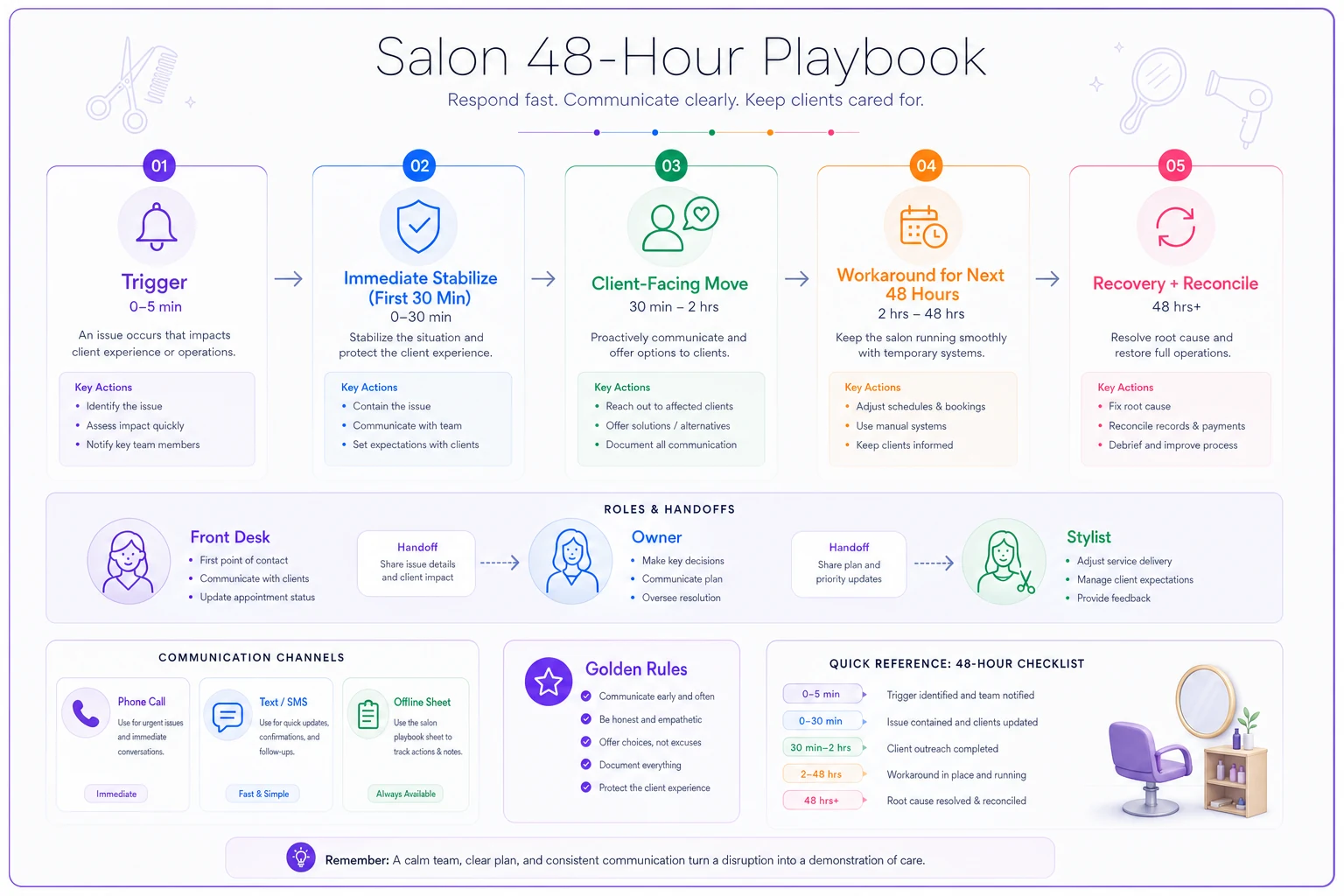
The whole thing fits on one laminated page. The magic isn't sophistication — it's that nobody has to invent this at 8:45am with a lobby full of clients.
The backup layer: what you actually need saved and where
Playbooks assume you have something to fall back on. This is where most salons are quietly exposed.
Rank your backups by how badly you'd hurt without them:
-
Tier 1 — must have offline access, always current today's and tomorrow's confirmed schedule, client contact numbers, and any critical service notes (allergies, prior reactions, formulas). A weekly export saved somewhere you can reach on a phone covers most of this.
-
Tier 2 — need within a day full client history, product formulas, and appointments for the coming week.
-
Tier 3 — need eventually reporting, marketing lists, historical financials.
The practical move: set a recurring weekly export of your schedule and client contacts, saved somewhere that doesn't depend on the same system going down. A cloud drive plus one local copy. Sounds paranoid until the one Saturday you need it.
Payments deserve their own backup. A second card reader from a different processor, kept charged in a drawer, has saved more salon Saturdays than any fancy tech. If your primary processor goes down, you switch readers and keep charging. Without it, you're either doing manual card capture on paper or turning away revenue at the register.
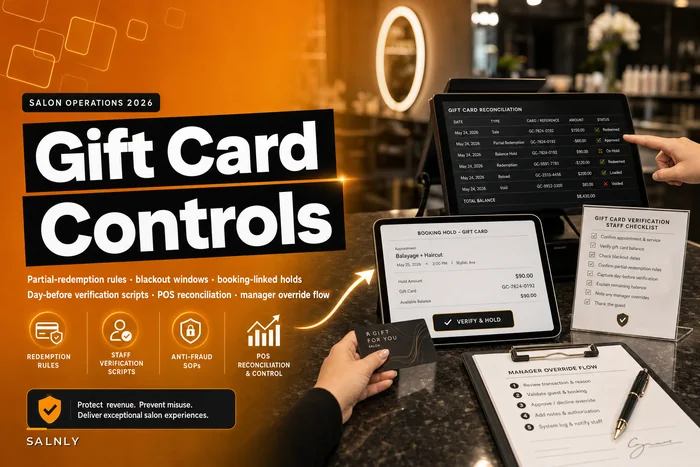
One pattern worth flagging: salons that sell gift cards get burned during outages when they can't verify balances or redemptions. If your gift card records live only in the down system, you're exposed to both lost sales and fraud. Tightening your gift card verification and redemption controls so balances are checkable through a second channel closes a gap most owners never think about until a client tries to redeem $200 during an outage and nobody can confirm it's real.
Client communication: the part that decides your reputation
Clients rarely punish you for the failure itself. They punish you for the silence and the surprise. A client who gets a calm, proactive text saying "our system's having issues this morning, but your 11am with Dana is confirmed and we're on track" walks in relaxed. The same client who shows up to confusion and a front desk staring at a frozen screen leaves with a story to tell.
Write the messages before you need them. Templates should be plain, short, and honest without oversharing the technical mess. A few you'll want ready:
-
Appointment confirmed despite outage "Hi [name] — our booking system is having a brief hiccup, but your appointment today at [time] with [stylist] is confirmed. See you soon."
-
Need to reschedule due to failure (power/plumbing) "Hi [name] — we've had an unexpected [issue] and have to move today's appointment. We're so sorry. Can we get you in [option 1] or [option 2]? First choice is on us with [small make-good]."
-
Payment system down "Quick heads up — our card system is temporarily offline, so we're taking [alternative] today. Everything else is running normally."
Two rules that matter more than the wording. First, one person owns outbound communication during an outage — otherwise clients get three conflicting messages. Second, communicate before the client is inconvenienced, not after. The difference between a proactive text at 9am and an apology at 11:15 when they're standing in your lobby is the difference between loyalty and a one-star review.
One person owns outbound communication during an outage — otherwise clients get three conflicting messages.
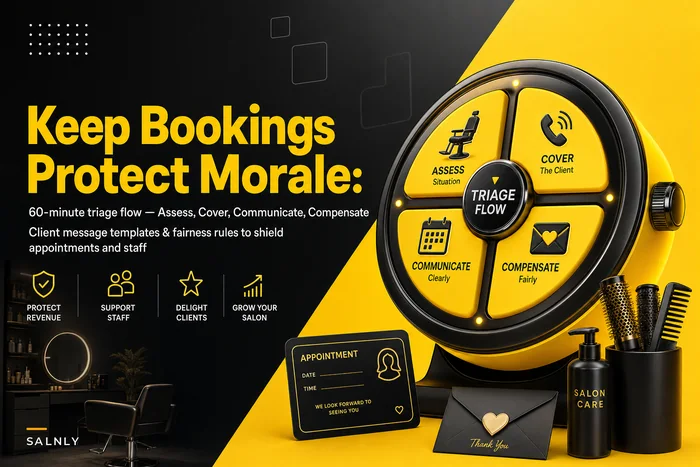
Staff-driven disruptions follow the same logic. When a stylist calls out sick and you're rebooking around it, the communication discipline is identical to a system outage — proactive, single-owner, options-first. If you don't already have a fast triage flow for that, the 60-minute emergency staffing SOP plugs directly into this framework as the "sudden staff shortage" row of your risk register.
Quarterly resilience tests: because a plan you never rehearse is fiction
This is the step everyone skips, and it's the one that matters most. A playbook that's never been tested will fail exactly when you need it — because the front desk person who was there when you wrote it left eight months ago, or the offline export stopped running and nobody noticed.
Run a light drill once a quarter during a slower stretch. Pick one row from your register and simulate it for 30–60 minutes.
-
Q1 — Booking outage drill. Close the laptop, run the front desk off the offline sheet for an hour. Did the export exist? Was it current? Could staff actually use it?
-
Q2 — Payment failure drill. Switch to the backup reader. Confirm it's charged, set up, and staff know the flow.
-
Q3 — Supplier stockout drill. Walk through your par levels and place a mock order with your secondary vendor. Confirm the account still works and pricing is known.
-
Q4 — Data recovery drill. Try to actually open your most recent backup. This is where most salons discover their "backup" was never really backing up.
After each drill, spend ten minutes on what broke. The offline sheet was missing three walk-in slots. The backup reader battery was dead. The secondary vendor's minimum order changed. These small findings are the entire value of the exercise — you're finding the cracks on a quiet Tuesday instead of a packed Saturday.
Where software genuinely helps — and where it doesn't
Resilience is mostly discipline, not tools. But some operational realities are much easier to hold together when your booking and client systems are built to support them. Automatic recurring exports of your schedule and client contacts mean your Tier 1 backup is always current without anyone remembering to run it. Systems that let front-desk staff pull client notes and formulas quickly — and ideally access a read-only view during partial outages — shrink the cascade when something breaks. Automated confirmation flows mean your client messaging doesn't fall apart the moment one person is overwhelmed.
The honest caveat: no platform removes the need for playbooks and drills. Software that stores everything in one place can actually increase your exposure if that one place goes down and you've never planned around it. The goal isn't more technology — it's making sure your core information is accessible, current, and not trapped behind a single point of failure. Good operational software should make your backups easier and your workarounds faster, not become another thing you can't function without.
A real scenario
A three-stylist salon in a mid-size town lost power for most of a Saturday after a storm — roughly six hours during their busiest block. Before doing any of this work, a similar outage a year earlier had cost them close to a full day: around 14 appointments lost, several angry clients, two who never returned, and a scramble that ate the following week's morale.
The second time, they had a one-page power playbook and a partner agreement with a salon two blocks over that kept power. Front desk had the day's schedule on a phone export. Within about 40 minutes, they'd texted every client in the next four hours, moved four color clients to the partner salon's open stations, rebooked the rest across the following two days with a small make-good, and kept the walk-in crowd informed.
They still lost some revenue — maybe a third of the day rather than all of it — and, more importantly, kept the clients. No one-star reviews. A couple of clients actually mentioned being impressed by how it was handled. That's the real return on resilience: not zero loss, but a bad day that stays a bad day instead of becoming a bad month.
When this is worth it — and when it's overkill
All of this makes sense once you're consistently booked, running multiple stylists, and a lost day represents real money and real reputation risk. If you're a solo operator with a light book and a loyal handful of clients you can text personally in ten minutes, a full risk register is overkill — you are the playbook. Build the offline schedule export and a backup payment method, and stop there.
The middle case is where most owners get caught: two to five stylists, mostly booked, no plan, and a quiet assumption that "we'd figure it out." You'd figure it out slowly and expensively, in front of clients. That's exactly the size where an afternoon spent building the register and three or four playbooks pays for itself the first time anything breaks.
Resilience work is unglamorous. It produces nothing you can point to on a good day. But the salons that handle their worst days well are almost never the ones with the best luck — they're the ones who decided, in advance, what the next three moves would be. Sit down before your next slow week, list the eight things that could ruin a Saturday, and answer the only question that matters for each one: what's our second option?
Ready to simplify your salon operations?
Join 1,000+ salons using Salnly to save time, reduce scheduling chaos, and deliver better client experiences.