

The morning scramble hits different when you're staring at a fully booked Saturday with a key stylist down. Your receptionist is already fielding calls, other stylists are setting up stations, and you've got maybe 75 minutes to sort coverage for $1,400 worth of appointments — without burning out your remaining team or damaging client relationships you've spent years building.
Most salon emergency staffing SOPs fail because they treat every absence the same way. A junior stylist calling out on a slow Tuesday needs completely different handling than your extension specialist getting into a car accident the morning of three installation appointments. The difference between chaos and a controlled response comes down to having a clear triage system — one that protects both revenue and team morale without making whoever's in charge feel like they're winging it.
The four-phase emergency response that actually works
Salons that keep both bookings and team harmony intact during staffing emergencies tend to follow a pretty consistent sequence. Not a rigid script, but a flexible framework that adjusts based on how bad the situation actually is.
Phase 1: Assess (0–15 minutes) The assessment phase determines everything else. You need three pieces of information fast: who's affected, what services genuinely can't move, and which team members have real capacity. Start with the appointment book. Flag appointments by complexity, not just price. A balayage correction requires specific skills that maybe only two other stylists can handle. Basic root touch-ups have more flexibility. New client consultations can sometimes shift to a phone call if needed. Then check actual team capacity — not just open time slots. If Maria has a 30-minute gap between clients, that doesn't mean she can absorb a complex color correction. Real capacity means matching skills, time, and where someone is energy-wise on that particular day.
Phase 2: Cover (15–35 minutes) Coverage decisions follow a priority ladder that most salons get backwards. They start by trying to squeeze appointments into existing schedules, which just leads to rushed services and exhausted stylists by mid-afternoon.
| Coverage Priority | When to Use | Risk Level |
|---|---|---|
| Same-skill redistribution | Complex color, extensions, specialty services | Low client risk, moderate team stress |
| Shift to off-day staff | High-value clients, multiple bookings | Higher cost, minimal stress |
| Reschedule with incentive | Flexible clients, non-urgent services | Some revenue loss, low stress |
| Manager/owner coverage | VIP clients, zero alternatives | High opportunity cost, emergency only |
Redistribution has to account for realistic service times. If Jennifer usually takes 3 hours for a full highlight, Sandra isn't going to do it in 2.5 hours just because that's the available slot. This is where protecting your existing schedule systems actually matters — accurate time blocks are what make coverage decisions realistic instead of wishful thinking.
Phase 3: Communicate (35–50 minutes) Client communication determines whether this turns into a reputation problem or a demonstration of how well your salon handles adversity. The messaging needs to be fast, clear, and solution-focused.
"Hi Sarah, Amanda had an emergency this morning, but we've arranged for Michelle to take care of your highlights at your scheduled time. Michelle specializes in blonde services and has Amanda's notes. We'll also include a complimentary gloss treatment for any inconvenience."
"Good morning David, Tom had a family emergency and won't be in today. I can offer you his earliest opening Tuesday at 2pm, or Jennifer has availability today at 4pm for the same service. As an apology for the short notice, we'll include a complimentary beard treatment with either appointment."
Notice what's missing from both: long explanations, medical details, defensive language. Clients want solutions, not a story about what went wrong.
Phase 4: Compensate (50–60 minutes) This phase is what protects long-term team morale. Emergency coverage creates hidden costs — stylists working through lunch, taking services outside their comfort zone, fielding irritated clients they didn't create. Document who stepped up and how. If someone took on two extra color services, that's not just noted — it's compensated. Some salons use a point system where emergency coverage earns credits toward days off or education. Others do direct bonuses. The specific method matters less than whether it's applied consistently.
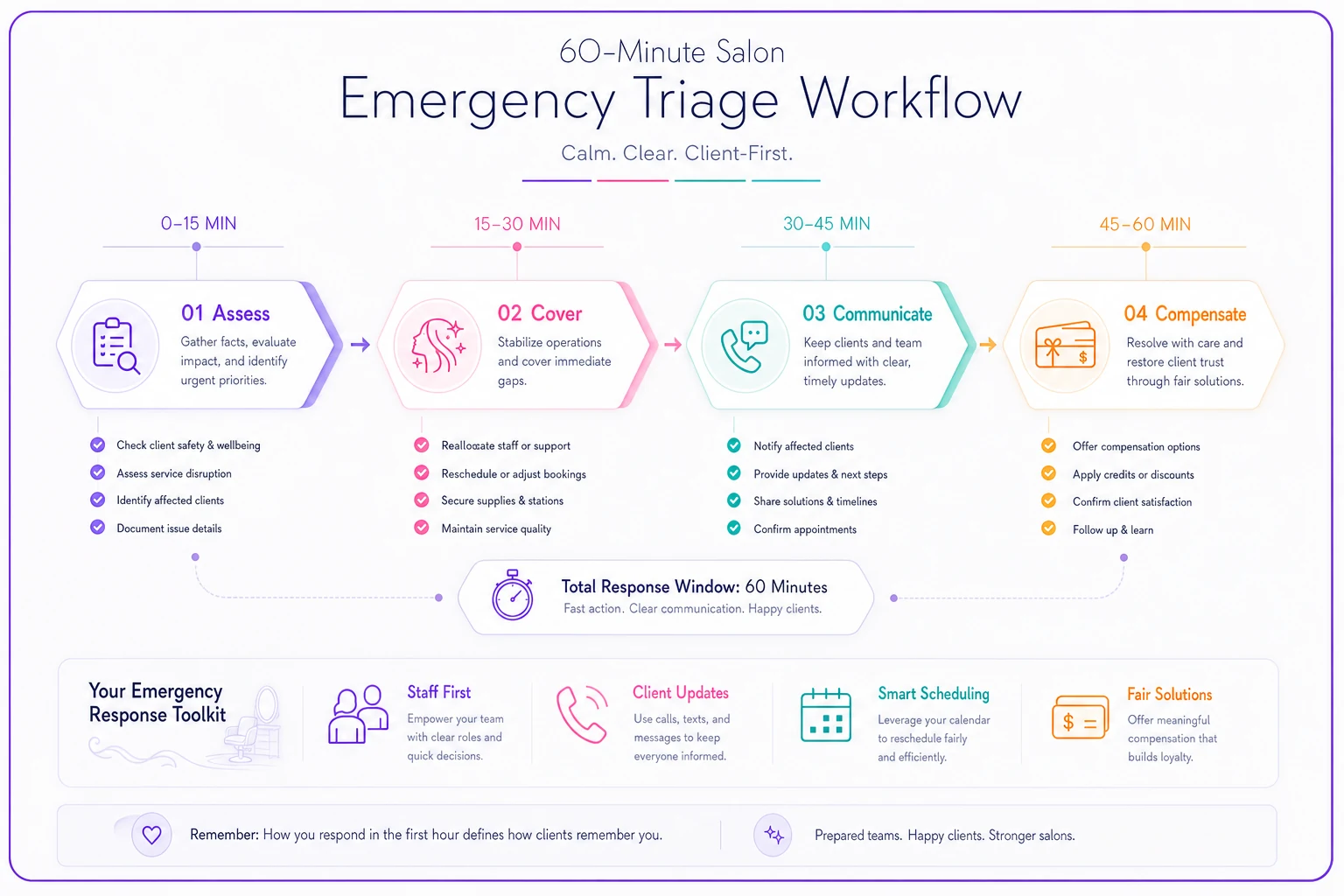
A simple visual of the 60-minute triage flow makes it easier for teams to follow in real time.
Breaking down real compensation scenarios
Say your salon does around $8,000 on a typical Saturday across six stylists. One calls out with the flu, affecting $1,400 in bookings. Here's how compensation might actually play out:
Stop losing appointments in the chaos.
Salnly helps you book, confirm & manage every appointment—efficiently.
- Centralized appointment management
- Client notifications
- Calendar & staff scheduling
No credit card required
Two stylists each take one extra client by working through lunch: $50 bonus each plus a paid lunch credit for another day.
One stylist comes in on their day off for two hours: time-and-a-half pay plus a floating day off within 30 days.
Manager covers one appointment personally: no direct compensation, but the hour gets tracked as "emergency coverage" for monthly operations review.
Receptionist handles three difficult rescheduling calls: $25 gift card or service credit.
Total emergency compensation cost: roughly $275–$350 to protect around $1,100 in bookings (assuming about 20% had to be rescheduled anyway). That math works — but only if you're tracking it consistently instead of just promising to "figure it out later."
Why standard approaches fall apart during real emergencies
Traditional emergency protocols assume every absence is basically the same. They push uniform coverage plans that treat a planned medical procedure identically to a 7 AM text about food poisoning. This creates three specific problems.
First, it burns out the reliable people. When the same two stylists always cover emergencies because they're skilled and actually answer their phones, they eventually stop answering their phones on days off.
Second, it creates resentment. Junior stylists watch seniors get coverage priority while their clients get bumped. Seniors feel like they're constantly cleaning up for less reliable team members. Neither group is wrong.
Third, it ignores the nuances of client relationships. Moving a first-time client might mean losing them permanently. Moving a 10-year regular who genuinely understands your business might actually strengthen the relationship if you handle it right.
Building fairness rules teams actually respect
Fairness doesn't mean identical treatment for everyone. It means transparent, consistent principles that people understand before anything goes wrong.
The rotation principle: Emergency coverage rotates among capable staff. Keep a simple log — who covered last, for whom, what kind of situation. This prevents the "Maria always covers" dynamic that quietly destroys team culture.
The skill-match principle: Complex services get covered by similarly skilled stylists only. Don't put a junior colorist in a position to fail on corrective color just because they have an opening in their schedule.
The reciprocity principle: Coverage creates obligations. If Tom covers for Ashley's emergency today, Ashley moves to the top of the list for Tom's next planned absence. This builds mutual support instead of one-way dependency.
The boundary principle: Define what counts as a genuine emergency versus poor planning. Teams respect systems that make this distinction clearly — and stop respecting systems that don't.
When your messaging templates need authority levels
Not every emergency gets the same communication approach. A receptionist can handle routine sick day rescheduling just fine, but a senior stylist's sudden resignation needs owner-level messaging.
Level 1 (Receptionist handles): Single-day illness, 1–3 affected clients, straightforward rescheduling.
Level 2 (Manager handles): Multi-day absence, 4–8 affected clients, specialty services, or upset high-value clients.
Level 3 (Owner handles): Permanent departure, 10+ affected clients, VIP relationships, or anything with potential legal implications.
Each level needs different templates, different authority to offer compensation, and different escalation triggers. A receptionist shouldn't be making the call on whether to offer 50% off to save a wedding party booking.
The technology gap in emergency management
Manual emergency systems fall apart under real pressure. You're texting stylists, calling clients, updating the schedule, tracking coverage, calculating who's owed what — all while trying to keep the floor running.
Operational software changes how this actually feels in practice. AI-powered platforms can instantly surface affected appointments, match available coverage based on skills and schedule, generate client communications, and track compensation obligations — without someone running three separate spreadsheets. What normally takes 60–90 minutes of frantic coordination gets compressed into 15–20 minutes of actual decision-making.
The best waitlist and cancellation systems already handle similar complexity. Emergency staffing just adds another layer — tracking who's out, who's covering, what's owed, and what worked for next time. When every staffing emergency feeds back into your operations instead of just being survived, things gradually get more manageable.
Testing your system before you need it
Run a mock emergency next Tuesday morning. Have your manager pretend a senior stylist just texted in sick at 8 AM. Time how long it takes to:
-
Identify all affected appointments
-
Find realistic coverage options
-
Contact the necessary clients
-
Document the coverage plan
-
Calculate compensation
If it takes longer than 60 minutes or causes visible stress, your system needs work. Most salons discover their templates are too vague, their coverage rules are informal at best, or their compensation policies don't actually exist beyond "we'll work something out."
The mock drill is uncomfortable, which is exactly the point. Better to find the gaps on a quiet Tuesday than on a $9,000 Saturday.
Protecting team morale through transparent recovery
After every emergency, run a quick debrief within 48 hours. Not a blame session — just a 5-minute check on what worked and what didn't.
Did clients understand what happened? Did covering stylists feel supported? Was the compensation fair? Were there unexpected friction points that need a new protocol?
One salon found their emergency system worked well except for one detail: no protocol for tips when services got reassigned. Clients wanted to tip both the original stylist and whoever covered, which created genuinely awkward situations at checkout. A simple policy addition fixed it.
Another salon noticed their compensation system rewarded coming in on days off but not staying late, which created odd incentive problems over time. Adjusting the point values sorted it out.
Small things, but they compound over time into either a culture people trust or one they quietly resent.
When to skip the triage system entirely
Some situations don't fit the standard framework. Power outages, natural disasters, or anything affecting multiple team members at once need a completely different approach.
In those cases, the goal shifts from maintaining operations to a clean shutdown and orderly restart. That means immediate blanket communication to all affected clients, clear decision criteria for temporary closure, batch rescheduling protocols, and force majeure policies for deposits and penalties.
These scenarios warrant their own SOP. But they're rare enough that your day-to-day emergency system should stay focused on single-staff situations — the ones that happen every few weeks, not once a year.
Making emergency response part of operational culture
The best emergency systems eventually become invisible because they're just how things work. New team members learn the coverage rotation during onboarding. Stylists know their communication responsibilities. Managers track compensation without being reminded.
That shift happens when emergency response moves from reactive scrambling to something people are prepared for. When every team member knows what happens when someone calls in sick, the actual emergency becomes just another operational situation instead of a crisis.
Most salons face two or three staffing emergencies a month. That's 30-plus opportunities a year to either strengthen or damage client relationships, team morale, and operational confidence. A solid emergency staffing SOP turns those situations into demonstrations of professionalism — the kind that builds loyalty from clients who see you handle problems without falling apart, and from team members who feel like someone's actually got their back when life happens.
How you handle the unexpected is often what separates salons that build lasting businesses from the ones that stay stuck in survival mode.
Ready to simplify your salon operations?
Join 1,000+ salons using Salnly to save time, reduce scheduling chaos, and deliver better client experiences.