

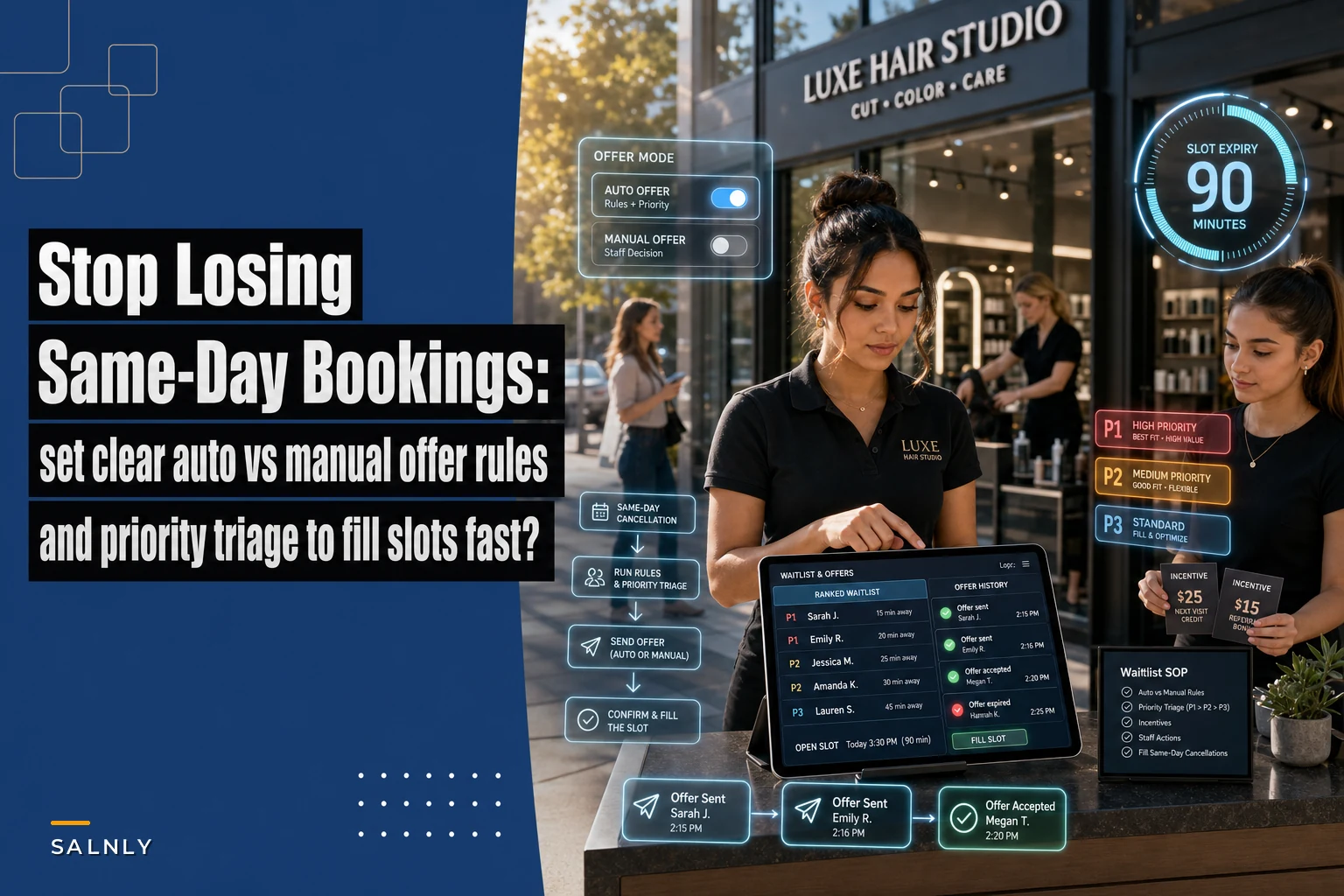

Your stylist just texted. Food poisoning. Three color appointments today, gone. That's $650 in services, and it's already 10:47 AM.
The receptionist starts scrolling through a notebook where she jots down "maybes" from the week. Half the numbers don't answer. The one client who picks up can't make it until 4 PM for a 2 PM slot. By the time anyone fills that first appointment, you've lost the whole morning.
Most salons treat their waitlist like an afterthought. Names scribbled on post-its. Random texts in stylists' phones. A Word document someone updates occasionally. The result? Same-day cancellations become same-day losses, and those losses compound into serious revenue problems.
A prioritized waitlist system with clear rules about who gets called, when they get called, and what you offer them changes everything. Not complicated. Not fancy. Just organized enough that any staff member can execute it without thinking.
Why waitlists fail (hint: it's not about having more names)
The waitlist notebook sitting at your front desk probably has 40+ names in it. But when that 2 PM cancellation hits, nobody can figure out who to call first.
Should you start with the client who's been waiting longest? The one who spends the most? Someone who specifically wanted that stylist? Someone nearby who can arrive in 20 minutes?
Without clear rules, your team defaults to randomness. They call whoever seems easiest. Usually that means calling nobody at all because the decision feels too complicated when there's already a line of clients waiting to check out.
The breakdown happens in three predictable places.
First, collection. Stylists gather waitlist requests their own way. Some use their phones. Some tell the receptionist. Some forget entirely. There's no central place where everyone can see who's waiting for what.
Second, prioritization. When multiple people want the same slot, nobody knows who should get it. The veteran stylist thinks her regular who spends $300 per visit should get priority. The receptionist thinks first-come-first-served is fairest. The owner just wants someone—anyone—in that chair.
Third, execution. Even with names and numbers, the actual outreach falls apart. Staff don't know what to offer (full price? discount? just the opening?). They don't know how long to wait for responses. They don't track what works.
This all happens while your team is trying to handle their regular responsibilities. They're checking clients in, answering phones, mixing color. The waitlist becomes one more thing they don't have time for.
Building rules that your team will actually follow
Your salon waitlist operations need rules simple enough that a brand-new receptionist could execute them perfectly on day one.
Stop losing appointments in the chaos.
Salnly helps you book, confirm & manage every appointment—efficiently.
- Centralized appointment management
- Client notifications
- Calendar & staff scheduling
No credit card required
Start with collection standards. Every waitlist request goes into one place. A simple spreadsheet, a dedicated app, even a specific notebook—doesn't matter what, matters that it's the only place. Include: client name, service requested, stylist preference (if any), flexibility level, contact preference, and date added.
When someone calls asking about openings with Marcus next week, your staff adds them to THE list. Not Marcus's personal list. Not a sticky note. The single, central list everyone checks.
Next, create your priority matrix. This isn't about favoritism—it's about making quick decisions when time matters.
Priority Level 1: Perfect matches
-
Wants the exact service that cancelled
-
Can arrive within 30 minutes
-
Has been waiting less than 2 weeks
Priority Level 2: Flexible matches
-
Wants similar service (cut when color cancelled)
-
Can arrive within 1 hour
-
Regular client with history
Priority Level 3: General interest
-
Wants any appointment
-
Flexible on stylist
-
New client or irregular visitor
The magic happens when you add automatic triggers. Same-day cancellation before noon? Contact Priority 1 people immediately. Cancellation after 3 PM? Only contact people who've specifically said they want last-minute spots.
Some salons get fancy here, tracking client lifetime value and prioritizing their biggest spenders. That works if you can maintain it. Most salons do better with simple rules everyone understands.
Keep the master waitlist in a single, easily accessible place (even a shared note on staff phones) so nobody ever uses a personal list.
Most salons do better with simple rules everyone understands.
The 90-minute rule that saves your afternoon revenue
Any cancellation with more than 90 minutes notice gets the full waitlist treatment. Multiple calls, multiple offers, maximum effort to fill. But cancellations inside 90 minutes trigger a different protocol entirely.
Why 90 minutes? Because that's roughly how long it takes for someone to receive your message, decide, get ready, and travel to your salon. Calling people about a slot that opens in 45 minutes wastes everyone's time.
Inside that 90-minute window, you shift to your "hot list"—clients who've specifically said they can drop everything for a same-day appointment. These might be:
-
Work-from-home professionals
-
Retired clients
-
People who live within 10 minutes
-
Anyone who's explicitly asked for last-minute calls
Keep this list small. Maybe 15-20 people total. They get special treatment: text messages instead of calls, standing discounts for same-day bookings, priority booking for future appointments.
One salon tracked this for three months. They had 67 cancellations inside the 90-minute window. Using their hot list, they filled 34 of them. That's around $4,100 in recovered revenue that would've been lost with traditional waitlist calling.
These clients know they're on the hot list. They've opted in. They're expecting your text. Half the battle is already won.
Incentive structures that actually drive same-day bookings
Offering 10% off a same-day appointment sounds logical. It rarely works.
Clients who can drop everything for a hair appointment usually aren't motivated by small discounts. They're motivated by exclusivity, convenience, or solving an urgent problem.
Instead of blanket discounts, create incentive tiers based on timing and client type:
For the 24-hour window:
-
New clients
First-time service at regular price, get 20% off their next prebooking
-
Regular clients
Take this slot, jump the line for holiday booking
-
VIP clients
No discount, but include a complimentary add-on service
For the 2-hour scramble:
-
Anyone
20% off, but only on the service, not products
-
Hot list members
15% off plus guaranteed next appointment within 2 weeks
-
Staff friends/family
25% off (they're your best last-minute fillers)
The psychology matters more than the math. "Exclusive same-day opportunity" performs better than "discount available." "Skip the holiday waitlist" beats "save $20."
Track what actually drives bookings. One salon discovered their best incentive wasn't monetary at all—it was guaranteed parking. They bought two monthly spots in the garage next door, reserved for same-day bookings. Filled rate jumped from around 30% to almost 55%.
Service-specific triage (because a massage no-show isn't a haircut no-show)
A cancelled Brazilian blowout at 2 PM requires different waitlist operations than a cancelled men's cut at the same time.
Your triage system needs to account for:
-
Service duration
-
Stylist specialization
-
Prep requirements
-
Product availability
Build your response protocols around service categories, not individual services:
Quick services (under 45 minutes):
-
Men's cuts, bang trims, beard shaping
-
Call anyone on today's waitlist first
-
Expand to general waitlist if needed
-
Can often squeeze into unexpected gaps
Standard services (45-90 minutes):
-
Women's cuts, basic color, styling
-
Priority to exact service matches
-
Consider service downgrades (color client takes cut slot)
-
2-hour minimum notice for best fill rate
Complex services (2+ hours):
-
Full color, extensions, treatments
-
Only call pre-qualified waitlist
-
Require confirmation of full time availability
-
Often better to break into multiple smaller services
The mistake salons make: treating all cancellations equally. When your senior colorist has a 3-hour slot open, calling random people off the waitlist wastes time. You need someone who specifically wants color, has the time, and can afford the service.
Create service-specific waitlists when it makes sense. The client waiting for balayage doesn't care about an open slot for a trim. Stop wasting both your time calling them about it.
Staff workflows that eliminate decision paralysis
Your receptionist shouldn't have to think when a cancellation comes in. They should execute a workflow so clear it runs itself.
Immediate cancellation protocol (client just called):
-
Log it
Time, service, stylist, original price
-
Check
Any walking clients who can take it?
-
Text
Hot list members (if within 90 minutes)
-
Call
Priority 1 waitlist (if beyond 90 minutes)
-
Track
Record outcome within 2 hours
The workflow lives on a laminated card at the front desk. Not in a manual. Not in someone's head. Right there where they need it.
But creating the workflow without assigning ownership means "someone" should call the waitlist becomes "nobody" calls the waitlist.
Morning shift (8 AM - 2 PM):
-
Receptionist owns all same-day filling
-
Checks for cancellations every 2 hours
-
Reports fill rate at shift change
Afternoon shift (2 PM - close):
-
Senior stylist on duty owns next-day filling
-
Receptionist handles only same-day
-
Both report to manager end of day
Some salons rotate this responsibility. Tuesday is Emma's day to own the waitlist. Wednesday is Marcus's. This works if you maintain it, but static assignments usually perform better.
The difference between salons that fill cancellations and those that don't isn't the sophistication of their system. It's whether someone specific is responsible for executing it.
Here's a quick visual of the immediate cancellation workflow.
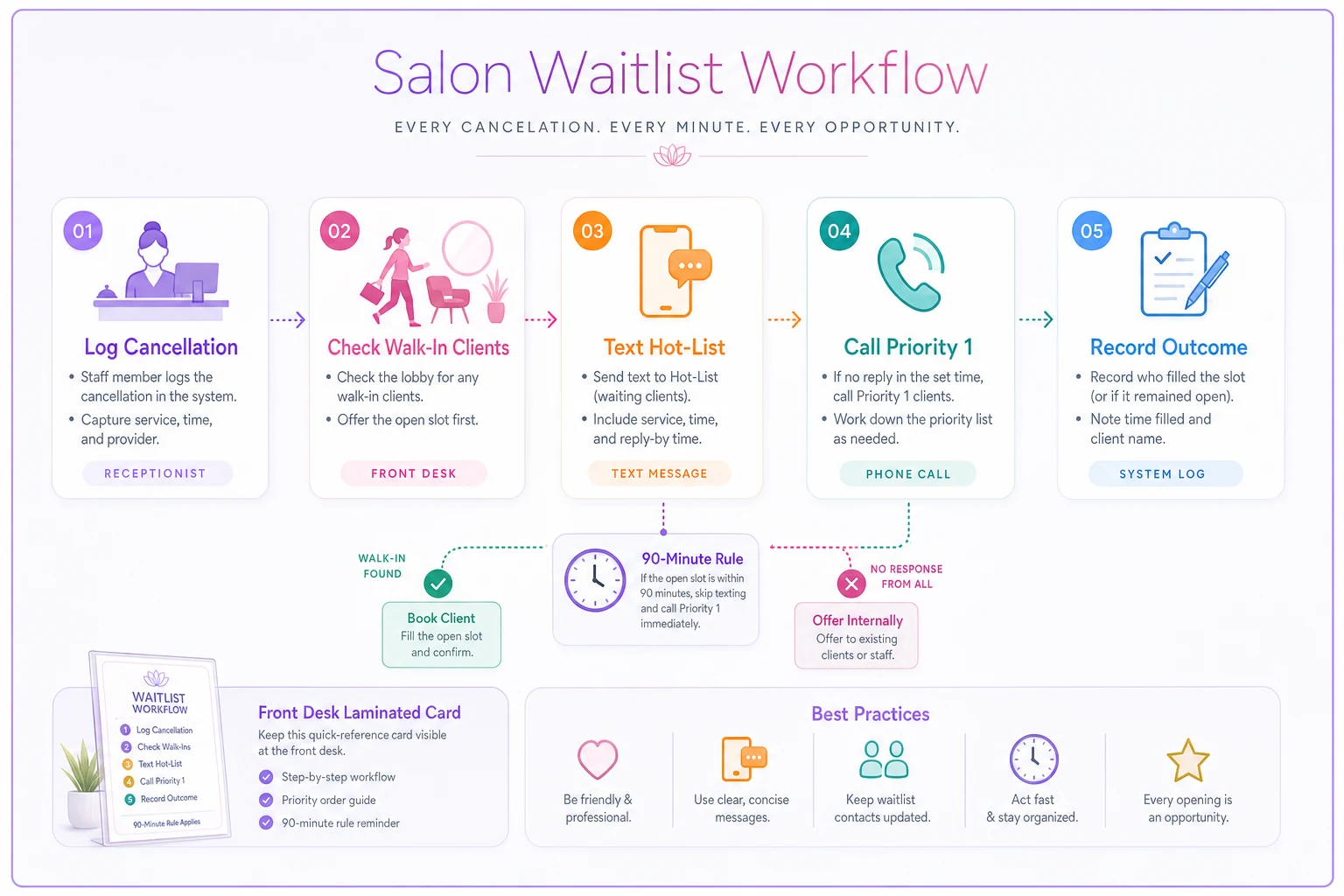
The workflow should be visible, short, and owned by a named person each shift so nobody has to make judgment calls under pressure.
Tracking what works (without drowning in spreadsheets)
Most salon waitlist operations fail because nobody knows if they're working.
You need exactly four metrics:
-
Cancellation rate by day/time
-
Fill rate by notice period
-
Success rate by incentive type
-
Revenue recovered monthly
That's it. Not 20 metrics. Not complex attribution. Just enough to know if your system works.
Track this weekly using a simple table:
| Week of | Cancellations | Filled | Fill Rate | Revenue Recovered |
|---|---|---|---|---|
| Oct 7 | 12 | 7 | 58% | $1,340 |
| Oct 14 | 8 | 6 | 75% | $980 |
| Oct 21 | 15 | 8 | 53% | $1,560 |
| Oct 28 | 11 | 9 | 82% | $1,720 |
Notice patterns. If Tuesday always has high cancellations, build a bigger Tuesday waitlist. If 20% discounts never work but complimentary add-ons do, adjust your incentives.
Track WHO fills the slots. You might discover that five clients account for 40% of your same-day fills. Those people deserve VIP treatment. They're saving your revenue.
When automation beats human judgment
Every part of this system can run manually. But certain pieces work better when automated.
Waitlist notifications? Automation beats human calling every time. Set up simple rules: when a color appointment cancels, automatically text everyone waiting for color with that stylist. They can respond yes/no/maybe without your staff making 15 phone calls.
The automatic part isn't the decision—it's the notification. Your staff still decides who gets the slot if multiple people respond. But you've eliminated the most time-consuming part: initial outreach.
Tracking fills? Let software count it. Whether it's a simple booking system or full salon management platform, automatic tracking beats manual logs. Your receptionist already has enough to handle without maintaining spreadsheets.
Some salons try to automate the whole process. Client cancels, system automatically offers the slot to the next person, they confirm, booking complete. This sounds great until the wrong person gets the wrong slot and everyone's frustrated.
The sweet spot: automate notifications and tracking, keep decisions human. Your staff knows that Mrs. Patterson won't want the 8 AM slot even though she's first on the list. They know the new stylist isn't ready for the complex color correction that just cancelled. These judgment calls matter.
The Tuesday morning scramble (a real scenario)
It's Tuesday, 10:15 AM at a busy salon doing about 340 appointments monthly. Sarah, the receptionist, gets a text from Jamie, one of the senior stylists. Her babysitter just cancelled—she can't make it in until 2 PM. That's three appointments to fill: an 11 AM cut and style ($95), a 12:30 PM partial highlight ($140), and would've been a 2 PM consultation (no charge but leads to bookings).
Before the SOP: Sarah would've panicked, maybe called two or three random clients she remembered wanting appointments, probably filled one slot if lucky.
With the system: Sarah pulls up the waitlist. Two people specifically waiting for Jamie, five wanting color services this week, twelve flexible on stylist. She immediately texts the three hot-list members who live nearby (11 AM is 45 minutes away). One responds YES within 3 minutes.
For the 12:30 highlight, she calls the two Jamie-specific waitlist clients first. Neither can make today. She moves to the five color waitlist clients. Third call succeeds—client was hoping for Thursday but can rearrange for today. Offers her 15% off for the inconvenience. Booked.
The consultation gets pushed to phone call—easier to handle.
Results: Two of three paid services filled. $195 of $235 potential loss recovered. Took Sarah 18 minutes total, mostly waiting for responses. Without the system, she might have saved $95 if lucky. The structured approach doubled her recovery rate.
Making this sustainable for your team
The best salon waitlist operations are boring. They run the same way every time. No creativity required. No decisions to agonize over.
Your team already juggles enough. Between difficult clients, complex services, retail sales, and general chaos, the last thing they need is a complicated waitlist system that requires deep thinking.
Make it systematic:
-
One place for all waitlist names
-
Clear priority rules everyone knows
-
Specific incentives for specific situations
-
Assigned ownership for execution
-
Simple tracking that shows what works
This isn't about perfection. You won't fill every cancellation. Some days, nobody on your waitlist can take that 4:30 slot. That's fine. The goal is turning random success into predictable recovery.
With clear operations, filling 50-60% of same-day cancellations becomes normal. That might mean an extra $3,000-$5,000 monthly that would've been lost. Not through working harder, just through working systematically.
The salons that succeed with waitlists don't have better clients or less cancellations. They just have rules their team can execute without thinking. When the next cancellation hits (and it will), your team knows exactly what to do. That's the difference between scrambling and recovering.
Ready to simplify your salon operations?
Join 1,000+ salons using Salnly to save time, reduce scheduling chaos, and deliver better client experiences.