

That 11am cancellation text just hit. Your stylist Sarah has a gap until 2pm, and your receptionist is already scrolling through the waitlist calling people who won't answer. Meanwhile, three blocks away, someone's desperately googling "hair salon near me today" and your competitor just got the booking.
The waitlist is killing your short-notice fill recovery rate. Not because waitlists don't work — they do, when you have days to work through them. But for same-day cancellations? By the time you've called person number eight who's "actually busy today," you've burned 45 minutes and that chair is staying empty.
Salons that consistently fill same-day gaps don't rely on passive waitlists. They run an active fill system that moves fast, targets the right people, and gets decisions within an hour of the cancellation.
Why traditional waitlists fail for same-day fills
Your waitlist works great for next Tuesday's opening. Give your team a few days and they'll work through the list, find someone who wants that slot, and book it. But same-day cancellations operate on completely different dynamics.
First, availability changes. That client who desperately wanted any Saturday appointment three weeks ago? Today she's at her kid's soccer game. The person who begged for a cancellation slot last month is now on vacation. Your waitlist is full of people who wanted appointments then, not people who can come now.
Second, the contact pattern breaks down. When you call someone for next week's opening, they check their calendar, think about it, maybe text their partner. For same-day fills, you need instant decisions. But most waitlist clients aren't mentally prepared for "can you be here in two hours?" They need to arrange childcare, leave work early, cancel other plans. By the time they figure it out, it's too late.
The math gets worse when you factor in contact rates. Your receptionist might reach 30% of waitlist calls on the first try. Of those, maybe 20% are actually available today. Of those, perhaps half can make the specific time slot. You're down to 3% success rate, and you've spent an hour making calls.
The prioritized outreach template system
Instead of working through a generic waitlist, build targeted fill lists based on actual availability patterns. Start by segmenting your client base into fill probability tiers.
Stop losing appointments in the chaos.
Salnly helps you book, confirm & manage every appointment—efficiently.
- Centralized appointment management
- Client notifications
- Calendar & staff scheduling
No credit card required
Your "Quick Fill Gold" tier includes clients who work from home, have flexible schedules, or live within 10 minutes of your salon. These aren't necessarily your highest-spending clients — they're your most responsive ones. Track who actually books same-day openings and flag them in your system.
Create a separate "Lunch Break Warriors" list for clients who work nearby and can slip out for midday appointments. Another list for "Evening Flexibles" who can pivot their after-work plans. And yes, maintain a "Weekend Warriors" group for Saturday emergency fills.
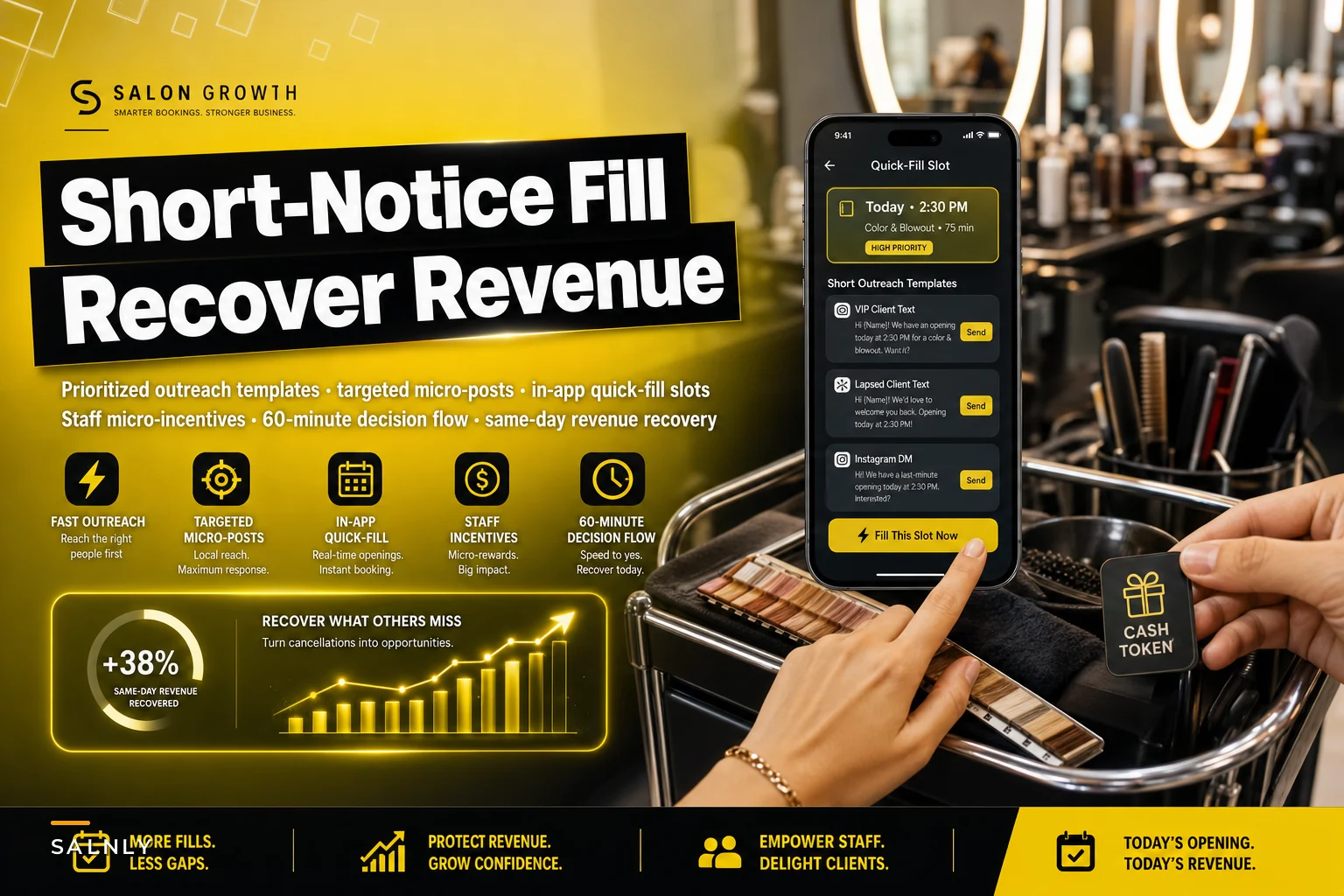
"For each tier, create a specific outreach template that acknowledges their situation: "Hi Emma, Sarah just had a 2pm color slot open up today (usually booked 3 weeks out!). I know you work from home Thursdays — any chance you could swing by? Need to know by 1pm. Text YES or NO to claim."
Notice what that message does: acknowledges the premium nature of the slot, shows you remember their schedule, creates urgency, and makes response simple. Compare that to "Hi, we have an opening today if you're interested" — which message gets the quick response?
Micro-posts and quick-fill slots
While your receptionist works through priority contacts, parallel paths should activate. Your social media doesn't need a polished graphic to fill a same-day slot. A quick Instagram story or Facebook post works better than waiting for perfect creative.
But most salons mess up the messaging. They post "LAST MINUTE OPENING TODAY!" and wonder why response is weak. Instead, frame it as an opportunity with clear parameters:
"Secret same-day slot alert 🎯 2pm color appointment just opened (Sarah's books are usually locked for weeks). First to DM gets it. Must confirm by 1:30pm."
The "secret alert" framing makes followers feel special, not like they're getting leftovers. Mentioning the stylist's typical availability shows value. The hard deadline prevents endless back-and-forth.
Some salons I work with maintain "quick-fill slots" in their booking system — appointments held at popular times that can only be booked same-day. This seems counterintuitive (why hold premium slots?), but it creates a different dynamic. When you release that held 5:30pm Friday slot at 2pm, it feels like a win for the client who grabs it, not a desperation move by the salon.
Staff micro-incentives that actually work
Your team knows who could fill that empty chair. Sarah's 1pm client mentions her friend is looking for an appointment. Your shampoo assistant's sister wants highlights. But without incentive alignment, that knowledge stays silent.
Traditional commission doesn't motivate same-day fills because the effort exceeds the reward. A stylist making 40% commission on a $60 service gets $24 whether booked weeks ahead or filled last-minute. Why hustle for the same pay?
Micro-incentives change the calculation. Add a $10 "quick-fill bonus" for any service booked and completed within 3 hours. Now that stylist makes $34 instead of $24 — suddenly worth a quick text to their regular who lives nearby.
For reception staff, try slot-based bonuses: $5 for filling any same-day cancellation within an hour, $10 if filled within 30 minutes. Sounds small? A receptionist filling 3-4 slots per week adds $60-80 to their monthly pay. That's motivation to move fast.
Post a visible tally of quick-fill bonuses in the staff area to keep the friendly competition real.
Track these bonuses visibly. A simple whiteboard showing "Quick Fills This Week" with names and tallies creates friendly competition. Jessica filled three slots yesterday? Now Michael wants to beat that today.
The 60-minute decision flowchart
Every same-day cancellation should trigger a specific sequence with hard time limits. This isn't about perfection — it's about speed and avoiding analysis paralysis.
Minute 0-5: Assessment Determine the slot value. A senior colorist's 3-hour slot demands different treatment than a junior's 30-minute trim. Flag as "Priority Fill" (high-value, prime time), "Standard Fill" (regular service, decent time), or "Bonus Fill" (hard-to-fill time, lower value).
Minute 5-15: Tier 1 Outreach Priority fills get immediate calls to Quick Fill Gold clients. Standard fills get texts first, then calls. Bonus fills might go straight to social media. Your receptionist shouldn't spend more than 10 minutes on this first wave.
Quick visual below to make the sequence easy to follow under pressure.
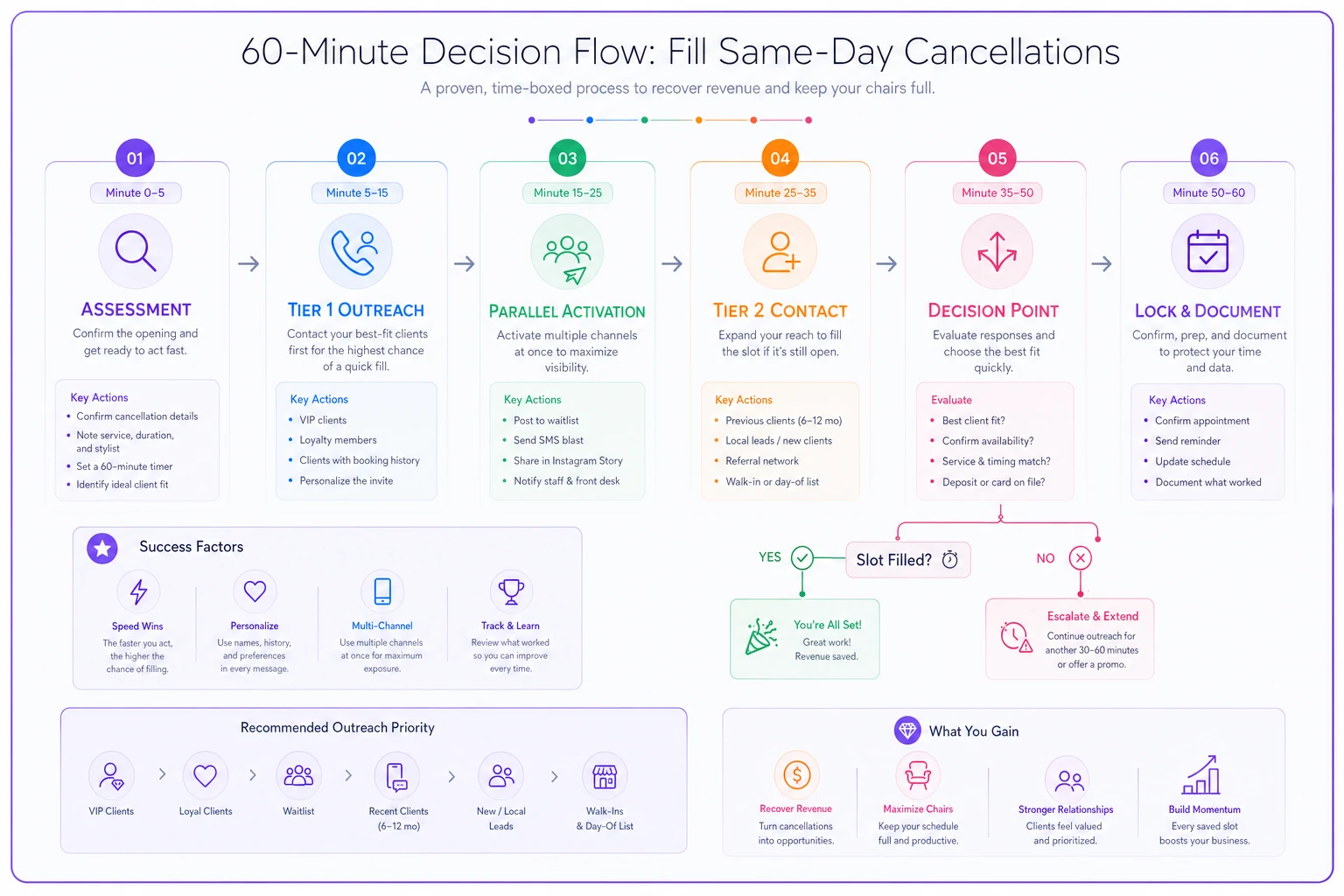
Minute 15-25: Parallel Activation While waiting for Tier 1 responses, activate other channels. Post on social, alert staff about micro-incentives, check if any walk-ins are waiting. This isn't sequential — it's simultaneous.
Minute 25-35: Tier 2 Contact No response from Tier 1? Move to the broader list but with modified offers. Maybe add a 10% same-day discount or throw in a free conditioning treatment. The goal shifts from full-price recovery to avoiding zero revenue.
Minute 35-50: Decision Point Still empty? Make the strategic choice: hold for potential walk-ins, offer to staff at deep discount, or write it off and give your stylist an early break. Don't let this drag past an hour.
Minute 50-60: Lock and Document Whether filled or not, close the loop. Update your tracking, note what worked or didn't, and move on. Spending 90 minutes to maybe fill a slot is worse than accepting the loss at 60 minutes.
Common mistakes that sabotage short-notice fills
The biggest mistake is treating all cancellations equally. A Saturday morning cancellation is not the same as a Tuesday 3pm cancellation. One needs aggressive action; the other might fill itself through walk-ins.
Another killer: overcommunicating the cancellation. "Hey, we just had a cancellation, but if you can't make it no worries, we know it's last minute, totally understand if it doesn't work..." Stop. You're pre-rejecting yourself. State the opportunity clearly and let them decide.
Many salons also fail to set response deadlines. "Let me know if you're interested" leads to three-hour text conversations while the slot sits empty. Always include "Need answer by [specific time]" in your outreach.
The perfectionism trap catches salons too. Waiting for the ideal fill — same service, same price point, same duration — often means no fill at all. A 2-hour color slot filled with two one-hour services still beats an empty chair.
Building your fill rate tracking system
Most salons have no clue what their actual short-notice fill rate is. They know it "feels low" but can't quantify it. Start simple: track three numbers weekly.
First, same-day cancellations by day and time. You might discover 40% happen on Mondays (post-weekend regret) or Thursday afternoons consistently go unfilled. Patterns inform strategy. Second, fill success rate by method. Are Instagram posts filling 15% of slots while calls fill 8%? That data reshapes your minute-by-minute response plan. Third, time-to-fill average. If most successful fills happen within 20 minutes, why spend an hour trying? Alternatively, if your 45-60 minute efforts show surprising success, maybe extend that deadline.
Basic tracking setup:
| Day | Time | Service Cancelled | Fill Method | Minutes to Fill | Revenue Recovered |
|---|---|---|---|---|---|
| Mon | 2pm | Color ($120) | 35 | $120 | |
| Mon | 4pm | Cut ($60) | Priority call | 15 | $60 |
| Tue | 11am | Highlights ($180) | Unfilled | 60 | $0 |
| Wed | 3pm | Cut & Style ($85) | Walk-in | 45 | $85 |
After a month, patterns emerge. Maybe Tuesday mornings never fill — stop burning effort there. Perhaps Instagram consistently outperforms calls for afternoon slots — shift your process. This isn't complex analysis, just basic pattern recognition.
When automation makes the difference
The speed requirement of short-notice fills makes this a perfect case for operational software. Not to replace human judgment, but to eliminate the friction points that slow everything down.
Think about what happens now: receptionist notices cancellation, checks paper waitlist, starts calling, manually texts, posts on social, tracks responses on sticky notes, calculates incentives on paper. Each step adds minutes when you need to move in seconds.
AI-powered operational platforms can trigger the entire fill sequence instantly. Cancellation hits the system, priority clients get automated texts with one-click booking links, social posts go live immediately, staff gets alerts about available incentives. What took 15 minutes of manual work happens in 15 seconds.
The real value isn't just speed — it's consistency. Your best receptionist might nail the process every time. But what about the new hire working Saturday? What about busy Wednesday when three cancellations hit at once? Automated workflows ensure every cancellation gets the same aggressive fill attempt, regardless of who's working or how busy it is.
More importantly, AI automation helps identify patterns humans miss. Maybe clients who book Sunday services are 3x more likely to accept same-day Monday fills. Perhaps people who've previously taken last-minute slots have an 80% response rate versus 20% for general waitlist. These micro-patterns, invisible in daily operations but obvious in data, reshape your fill strategy.
The short-notice fill challenge isn't going away. Clients will keep canceling morning-of, life will keep happening, chairs will threaten to stay empty. But salons running proactive fill systems — whether manual or automated — consistently recover 50-70% of same-day cancelled revenue. Those running traditional waitlists might hit 20% on a good day.
Making it work in your salon
Start with the basics before building the full system. Pick one weekday this week and track every cancellation: time received, efforts made, outcome. That baseline tells you what you're really dealing with.
-
Next week, implement just the tier system.
-
Identify your ten most flexible clients and text them first for any cancellation.
-
See if your fill rate moves.
-
Week three, add the 60-minute timer.
-
Week four, introduce micro-incentives.
Salons that successfully fill same-day gaps don't have better clients or luckier circumstances. They've just accepted that empty chairs require different tactics than advance bookings. While everyone else is leaving voicemails for waitlist position #12, they've already filled the slot and moved on.
Your 11am cancellation doesn't have to mean lost revenue. But it does mean moving faster, targeting smarter, and accepting that perfect fills are less important than actual fills. The chair that generates 70% of expected revenue beats the chair that generates zero every single time.
If you've already tackled your confirmation sequences to prevent no-shows and built a solid waitlist system for advance fills, this short-notice system is your next revenue protection layer. Because at the end of the day, your ability to react to same-day changes determines whether you're running a resilient business or just hoping for the best.
Ready to simplify your salon operations?
Join 1,000+ salons using Salnly to save time, reduce scheduling chaos, and deliver better client experiences.