

Gift cards should be pure profit for salons. Someone pays you $100 today for services they'll redeem months later — basically a free loan at zero percent interest. But what actually tends to happen: duplicate redemptions, partial value confusion, expired cards that get mysteriously "reactivated," and staff who can't explain why the books show $8,000 in outstanding gift card liability but nobody can account for half of it.
The problem isn't the gift cards themselves. It's the complete lack of operational controls around them. Most salons treat gift cards like an afterthought — something the booking system handles automatically. Then they wonder why their gift card revenue looks great on paper but the actual redemption patterns make zero sense.
Why gift card fraud happens in plain sight
Staff aren't usually trying to steal from you. But when there are zero verification procedures and no redemption tracking, you've basically created an honor system with cash. That never ends well.
The typical scenario starts innocently enough. A client says they have a $150 gift card but can't find it. Your receptionist, wanting to keep things moving, manually enters a discount. No verification, no manager approval, no documentation. Just a quick override to keep the client happy. Three months later, that same client produces the "lost" gift card and uses it again. Your booking system has no record of the first redemption because it was processed as a manual discount. You've now given away $150 in free services. Multiply this across dozens of transactions, multiple staff members, and partial redemptions nobody tracked properly — and you're looking at thousands in preventable losses. One salon I worked with discovered they'd "redeemed" $11,000 more in gift cards than they'd actually sold over the previous year. The owner had no idea until their accountant flagged it during year-end reconciliation.
The verification script that stops double-redemption cold
Your front desk needs exact language for gift card transactions. Not suggestions — word-for-word scripts that become muscle memory. Here's what works:
Stop losing appointments in the chaos.
Salnly helps you book, confirm & manage every appointment—efficiently.
- Centralized appointment management
- Client notifications
- Calendar & staff scheduling
No credit card required
Initial verification (every time, no exceptions): "I'll need to verify your gift card balance. Can you provide either the physical card or the gift card number?" If they don't have it: "No problem. Let me look it up by the purchaser's information. Who bought the gift card and roughly when?" If they can't provide any details: "I understand it's frustrating not to have the card handy. To protect against fraud, I need to verify the gift card details before applying it. Would you prefer to pay today and we can apply the gift card credit to your account once you locate it?" This script does three things: it normalizes verification as standard procedure rather than suspicion, it creates a paper trail, and it shifts the burden of proof to the client.
For partial redemptions, the script expands: "Your gift card has a remaining balance of $73. I'm applying it to today's $120 service, leaving $47 to pay. I'll email you a receipt showing the remaining gift card balance as zero. Would you like that sent to [email on file]?" That email receipt becomes your audit trail. No more clients claiming they had value left when they didn't.
Building partial-redemption rules that actually stick
Partial redemptions create more operational headaches than full redemptions because they require tracking a running balance. Most booking systems handle this poorly, and manual tracking is a nightmare. Two things fix this: strict denomination rules and a clear partial-use policy. First, limit gift card denominations to preset amounts — $50, $100, $150, $200. No custom amounts like $73 or $127. This makes tracking easier and reduces confusion about remaining balances. Yes, clients will complain they want to buy exactly $85 for their friend. Operational clarity beats that kind of customer convenience. Second, implement a "use it or lose it" partial redemption policy:
| Remaining Balance | Policy | Action Required |
|---|---|---|
| Under $10 | Forfeit or apply as tip | Staff asks: "You have $7 remaining. Would you like to apply it as gratuity?" |
| $10-$25 | Must use within 30 days | System flags for follow-up email reminder |
| Over $25 | Standard expiration applies | Treated as new gift card with fresh expiration date |
These rules eliminate the dozen $3.50 gift card balances floating around your system that create reconciliation nightmares.
Blackout windows and booking restrictions that protect your peak revenue
Gift cards shouldn't be redeemable during your busiest, highest-margin periods. This isn't anti-customer — it's smart capacity management. A gift card redemption on a dead Tuesday afternoon is great. That same redemption taking a Saturday slot from a full-paying client with add-ons is leaving real money on the table.
Tier 1 - Peak blackout (no gift cards):
-
Saturdays in December
-
Week before Valentine's Day
-
Mother's Day weekend
-
Prom season Fridays/Saturdays
Tier 2 - Partial restriction (gift cards accepted with limitations):
-
Regular Saturdays
Gift cards only cover base service, add-ons must be paid separately
-
Friday evenings
$25 minimum cash co-pay required
-
Holiday weeks
Gift cards cannot exceed 50% of service total
Tier 3 - Incentivized redemption (encourage gift card use during slow periods):
-
Tuesday-Thursday mornings
Extra 10% value when redeeming
-
Slow season weeks
Gift card holders get priority booking
The key is communicating restrictions at point of sale, not point of redemption. Include a small card with every gift card purchase that lists them. Your script: "This gift card is valid for all services with just a few peak-time restrictions listed on this card. It helps us ensure availability for all our clients."
The daily reconciliation process that catches fraud before it spreads
Most salons reconcile gift cards monthly or quarterly, if at all. By then, errors have compounded beyond recognition. You need daily reconciliation — and it takes less than five minutes.
Every night at close, your closing manager runs three reports:
-
Gift cards sold today (amount and card numbers)
-
Gift cards redeemed today (amount and card numbers)
-
Manual discounts applied (any that might be hidden gift card redemptions)
Then they answer three questions:
-
Do redemption amounts match the gift card tracking log?
-
Were all redemptions properly verified?
-
Are there any manual discounts that look like gift card redemptions in disguise?
Automate the three nightly reports to reduce human error and save time.
Discrepancies get flagged for next-day investigation. A real example: a salon implemented daily reconciliation and discovered their newest receptionist had been processing gift card redemptions as "promotional discounts" because she couldn't figure out the correct button in their booking system. Over two weeks, she'd misprocessed around $400 in redemptions. Because they caught it quickly, they could correct the records and retrain her. Without daily reconciliation, that would've been invisible for months.
Manager approval thresholds and override protocols
Not every gift card transaction needs manager approval — that would grind operations to a halt. But certain situations absolutely require a second set of eyes:
Mandatory manager approval triggers:
-
Any redemption without physical or digital card present
-
Redemptions over $150 in a single transaction
-
Multiple gift cards used in one transaction
-
Any manual override of gift card balance
-
Reactivation of expired cards
-
Gift card refunds or transfers
The approval doesn't need to be complicated. Manager reviews the situation, asks a couple of verification questions, and either approves or suggests an alternative. The point isn't to catch criminals — it's to create enough friction that casual fraud becomes impractical.
Override protocol:
-
Staff identifies trigger situation
-
Client waits while manager is called
-
Manager verifies using secondary information (purchase history, ID, etc.)
-
Manager enters override code
-
Transaction logged with manager name and reason
This sounds like overkill until you realize that waitlist management systems follow similarly strict protocols for protecting revenue. Same idea.
Integration with your booking system and POS
The biggest operational failure with gift cards usually happens at the intersection of your booking system and POS. They rarely talk to each other properly, and those gaps are where money disappears.
Most salons use separate systems for booking and payments. A client books online using a gift card code, but that reservation doesn't update the POS gift card balance until day of service. In between, that same card could be used in-store — and your systems won't catch the double redemption.
The fix requires procedural bridges between systems:
At booking (online or phone):
-
Gift card number entered into booking notes
-
Automatic hold placed on gift card value
-
Confirmation email includes gift card balance after planned service
Day before appointment:
-
Staff manually verifies gift card still has sufficient balance
-
Any discrepancies trigger client contact
At checkout:
-
POS redemption must match booking system notes
-
Any variance requires manager override
-
Final balance update pushed to both systems
This feels like a lot of manual work upfront, but it's genuinely less work than reconciling missing money three months later. AI-powered operational software can automate most of these verification steps — flagging discrepancies without needing someone to manually cross-reference reports. The system tracks gift card numbers across both platforms and maintains an audit trail of every redemption.
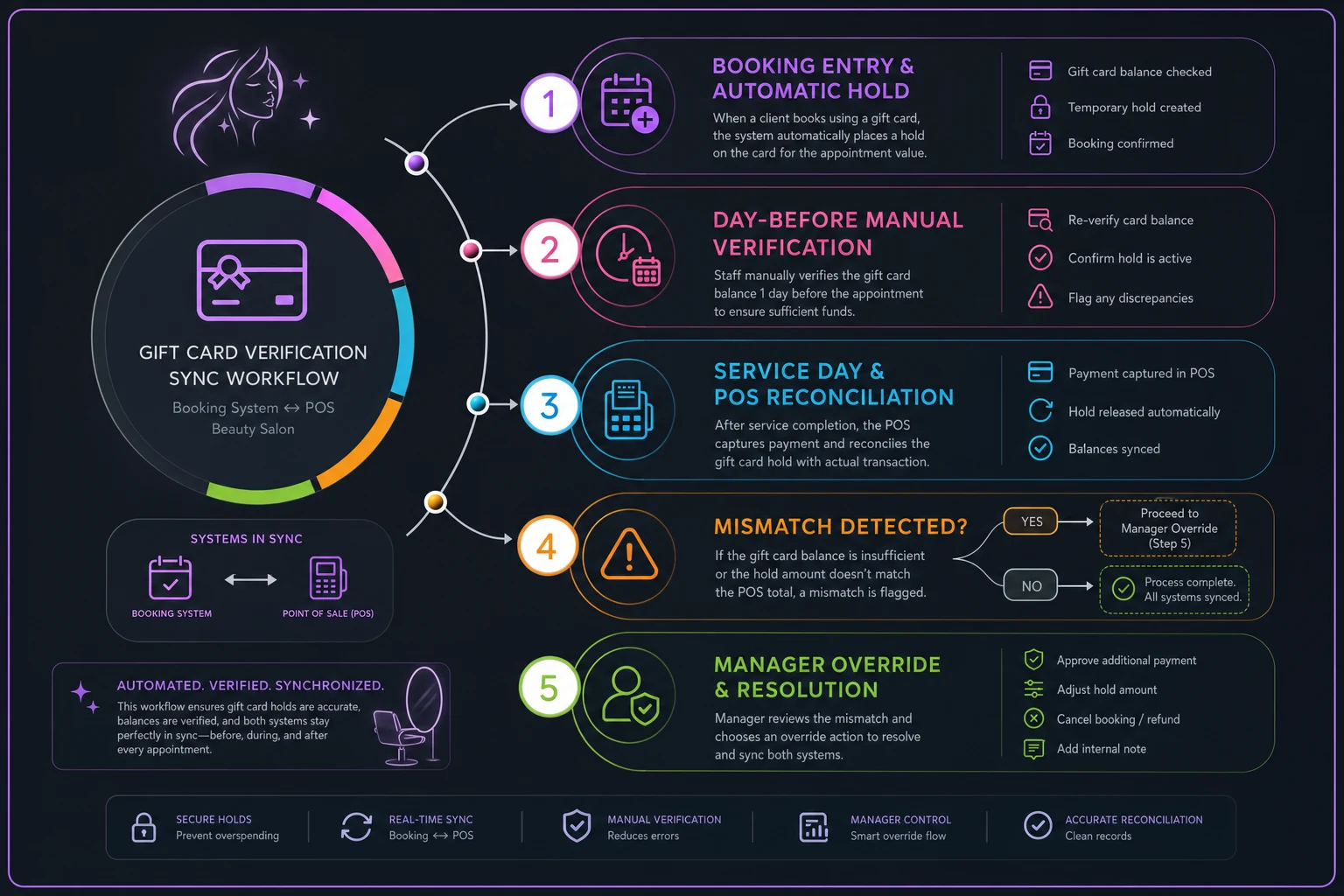
This diagram shows the verification workflow across booking and POS and where overrides can occur.
The "expired but not really" problem
Gift card expiration is a legal minefield that varies by state, but operationally you need clear rules regardless of what the law technically allows. The problem isn't usually whether cards expire — it's how you handle the gray areas.
Common scenarios that create chaos:
-
Client finds a 3-year-old gift card while moving
-
Someone inherits gift cards after a death
-
Corporate gift cards purchased in bulk two years ago
-
Partially used cards with unclear expiration status
Your operational stance: honor the value (fighting customers over gift cards is terrible PR) but control the terms.
For clearly expired cards: "I see this gift card is from 2019. While it's technically expired, we value your business. I can offer you 50% of the original value as a courtesy credit, or full value if you book a premium service package today."
For questionable expiration status: "Let me verify this card in our system. I can absolutely honor this, though I need to note it's only valid for services — not retail products — due to the elapsed time."
For inherited or gifted old cards: "We understand this has sentimental value. We'll honor the full amount — we just need to document it specially in our system."
This approach costs you some margin in edge cases but saves significant headaches and preserves relationships.
Training staff to spot and stop common fraud patterns
Your team needs to recognize gift card fraud patterns without becoming paranoid or accusatory. The most common schemes are surprisingly unsophisticated:
The "I bought multiple cards" shuffle: Client claims they purchased several gift cards but can only produce one. They want you to check your records for the others. When you can't find records (because they don't exist), they pressure staff to "make it right."
The screenshot scam: Client shows a cropped screenshot of a gift card purchase confirmation, but the image conveniently cuts off any identifying information. Often the same screenshot gets used multiple times across different visits.
The corporate gift card story: "My company bought gift cards for the whole team. I don't have mine physically but Jennifer from accounting said it's in the system." There's never a Jennifer, and it's never in the system.
Train your staff to respond with empathy but firmness: "I completely understand the situation. To protect all our clients from fraud, we have strict verification procedures. Let me get my manager who can explore some options with you." The phrase "protect all our clients from fraud" matters — it frames the policy as protective rather than accusatory.
Quality assurance checks and quarterly audits
Even with solid procedures, drift happens. Staff get comfortable, skip steps, create workarounds. Regular quality checks keep things honest.
Monthly spot checks:
-
Pull 10 random gift card transactions
-
Verify each one followed proper procedure
-
Check that balances reconcile correctly
-
Review any override documentation
Quarterly deep audits:
-
Full reconciliation of gift card liability account
-
Analysis of redemption patterns for anomalies
-
Staff quiz on verification procedures
-
Mystery shopper attempting redemption without card
Quarterly audits usually surface surprises. One salon found their gift card liability account showed $15,000 outstanding, but detailed analysis revealed $6,000 was from cards over five years old that would never be redeemed. They'd been carrying dead liability for years without realizing it.
Building gift card tracking into operational software
Manual gift card tracking becomes basically impossible at any real scale. You need systems that flag issues automatically and maintain proper audit trails. This is where AI automation shows its value — not by replacing human judgment, but by catching patterns that humans miss.
A solid tracking setup monitors:
-
Redemption velocity (same card used multiple times in rapid succession)
-
Geographic anomalies (card purchased in-store, redeemed online from a different state)
-
Balance inconsistencies between systems
-
Staff override patterns by employee
-
Client history of gift card disputes
Modern operational platforms can integrate with your existing booking and POS systems, creating a unified view of gift card activity. Instead of manually cross-referencing three reports, you get automated alerts when something looks off. The software doesn't make decisions — it just makes sure nothing slips through. This same principle applies to retail inventory tracking, where AI helps surface discrepancies without replacing the human who decides what to do about them.
When gift card controls actually cost you money
There's a point where gift card security theater hurts more than it helps. If you're losing clients because your verification process feels like airport security, you've gone too far.
Signs your controls are too strict:
-
Regular clients complaining about being treated like suspects
-
Staff spending 5+ minutes on simple redemptions
-
Lost sales because clients leave rather than deal with the friction
-
Negative reviews that specifically mention gift card hassles
The balance: a verified redemption should take maybe 30 seconds longer than cash payment, not five minutes longer. Your controls should be invisible to honest customers and obvious to anyone attempting fraud.
One effective middle ground: implement "trusted customer" status. After three successful verified redemptions, that client gets streamlined processing. They've proven they're legitimate — reduce the friction accordingly. It rewards good customers while maintaining security for unknowns.
The real numbers behind gift card leakage
A typical 8-chair salon does somewhere around $800K in annual revenue. Gift card sales usually represent 8-12% of that — roughly $80,000 per year. Without proper controls, you're likely losing 5-8% of that to various forms of leakage: duplicate redemptions, untracked partials, expired card disputes, outright fraud.
That's $4,000 to $6,400 straight off your bottom line. In an industry where 10% net profit is considered solid, you've just handed away a significant chunk of your margin to preventable gift card issues. What makes it sting more: gift card purchasers tend to be among your best customers. They spend significantly more than cash customers over their lifetime. When you lose them to a bad gift card experience, you're not just losing that transaction — you're losing years of future revenue.
Implementation roadmap for gift card controls
Don't implement everything at once. Here's a phased approach that actually works:
Week 1-2: Foundation
-
Document current gift card process
-
Create basic verification scripts
-
Implement daily reconciliation
-
Train staff on new procedures
Week 3-4: Enforcement
-
Add manager override requirements
-
Begin spot-checking compliance
-
Start tracking redemption patterns
-
Address staff resistance or confusion
Month 2: Refinement
-
Implement partial redemption rules
-
Add blackout dates for peak periods
-
Create trusted customer shortcuts
-
Run first monthly audit
Month 3: Optimization
-
Analyze data for problem patterns
-
Adjust procedures based on what you're seeing
-
Consider system integration improvements
-
Calculate ROI of controls
Most salons see a meaningful reduction in gift card discrepancies within the first month, and close to full resolution by month three. The key is consistency — these controls only work if everyone follows them every time.
Gift cards as a profit center, not a problem
Gift cards should be one of your salon's most profitable offerings. They improve cash flow, bring in new clients, and increase average transaction values. Without operational controls, they become a slow leak draining thousands from your bottom line.
The controls outlined here aren't about treating customers like criminals or making staff paranoid. They're about creating clear, consistent procedures that protect everyone — your business, your staff, and your legitimate customers. When everyone knows exactly how gift cards should be handled, fraud becomes nearly impossible and honest mistakes get caught fast.
Start with the basics: verification scripts and daily reconciliation. Those two changes alone will eliminate most of your gift card problems. Then layer in the additional controls as your team gets comfortable. Within a few months, you'll have turned gift cards from an operational headache into a reliable profit center.
Once these systems are in place, they largely run themselves. Your staff develops muscle memory for the procedures, your tracking catches issues automatically, and you can focus on growing your business instead of plugging revenue leaks.
Ready to simplify your salon operations?
Join 1,000+ salons using Salnly to save time, reduce scheduling chaos, and deliver better client experiences.