
Most salon brands don't fall apart because the licensing model was bad. They fall apart because the founder confused control with consistency. They either micromanage every licensee into frustration, or they hand over a logo and a rough manual and hope the new owner "gets it." Both approaches fail — just at different speeds.
The uncomfortable truth about franchising a salon is that your brand doesn't scale — your systems do. The haircut doesn't travel. The vibe doesn't travel. The manager who somehow kept retention at 70% doesn't travel. What travels is the operational architecture underneath all of that: the SOPs, the scorecards, the audit cadence, the support structure. If that architecture is weak, every new location becomes a slightly worse copy of the original until the brand means nothing.
This is a playbook for building that architecture. Not the legal side — talk to a franchise attorney for the FDD and the fees — but the operational governance that actually determines whether your fifth licensee runs like your flagship or embarrasses it.
Why brand dilution is a systems failure, not a licensee failure
When a franchise brand gets inconsistent, founders usually blame the operators. "This licensee just doesn't care about quality." Sometimes that's true. But far more often, the dilution is baked into the system before the licensee ever opens the doors.
The pattern that shows up again and again: the founder ran the original location on instinct. They knew when a stylist was slipping, when the backbar was getting low, when a client was about to churn — not because anything was written down, but because they were there. That tacit knowledge never got converted into explicit process. So when they license the brand, they're transferring the logo and the pricing but not the thing that actually ran the business: the founder's judgment.
A licensee can't absorb judgment. They can only absorb process. So the first governance question isn't "how do we control our licensees?" It's "how much of our operational knowledge have we actually written down and made teachable?" In practice, most brands have converted maybe 30–40% of what makes them work into documented systems. The rest lives in the founder's head and disappears the moment they're not in the room.
That gap is where dilution starts. And it compounds. The first licensee is close to the founder, gets a lot of informal coaching, turns out okay. The third is a bit further. The eighth is in another state and the founder has never watched them work a Saturday. Without a system that enforces consistency independent of proximity, quality decays with distance.
The SOP library: mandatory vs. flexible
The biggest mistake in franchise SOP design is treating every procedure as equally important. Founders either try to standardize everything — which makes licensees feel like robots and kills the entrepreneurial energy that made them want to own a location — or they standardize almost nothing meaningful and call the loose stuff "brand guidelines."
Stop losing appointments in the chaos.
Salnly helps you book, confirm & manage every appointment—efficiently.
- Centralized appointment management
- Client notifications
- Calendar & staff scheduling
No credit card required
The useful distinction is between brand-critical SOPs that must be identical everywhere, and operator-discretion areas where local judgment is fine and even desirable.
| SOP Category | Governance Level | Why |
|---|---|---|
| Service protocols (how a balayage is executed, timing, product steps) | Mandatory, no deviation | This is the brand promise; variance here is what clients notice |
| Consultation & intake scripts | Mandatory, lightly adaptable wording | Drives consistency in expectations and reduces redo rates |
| Sanitation, chemical safety, incident logging | Mandatory, legally enforced | Non-negotiable; a safety failure at one location damages all |
| Client data handling & booking rules | Mandatory | Protects the brand's data and cross-location client experience |
| Pricing structure & discount authority | Mandatory floor, local ceiling flexibility | Prevents race-to-the-bottom while allowing market adjustment |
| Hiring profile & onboarding ramp | Standardized template, local execution | The standard must hold; the hiring itself is local |
| Local marketing & community events | Framework only, high discretion | Local operators know their market better than HQ |
| Retail merchandising layout | Guided templates, some discretion | Consistency helps, but local foot traffic varies |
The point of this table isn't the specific rows — your brand will have its own. The point is that you make the decision consciously for every major process and document which bucket it falls into. A licensee who knows exactly where they have freedom and exactly where they don't is far easier to govern than one who's guessing.
One thing worth stressing: a mandatory SOP is worthless if it only exists as a 90-page PDF nobody opens.
The library has to be searchable, versioned, and tied to the moment of need. A stylist about to perform a treatment they rarely do should be able to pull the exact protocol in thirty seconds, not dig through a binder. This is where a shared operational platform earns its keep — not as a document dump, but as a system that surfaces the right SOP at the right time, tracks which version each location is running, and confirms that when you push an update to a chemical-safety procedure, all eleven locations received it and not just the three that check email.
If you're earlier in this journey and still figuring out which procedures belong in the central library, the thinking in our multi-location salon playbook on which SOPs to centralize maps directly onto the franchise question — the centralize/localize logic is the same, the stakes are just higher once ownership is distributed.
Licensee scorecards: measuring what actually predicts brand health
A franchise brand without scorecards is flying blind. But most scorecards measure the wrong things — they track revenue and royalties, which the franchisor cares about, and almost nothing that predicts whether the brand is actually being upheld on the floor.
-
Service consistency — redo rates, consultation completion rates, and the gap between the location's average service time and the brand standard. A location where color corrections are creeping up is drifting from protocol.
-
Client health — rebooking rate, new-client retention after the first visit, and review sentiment. These tell you whether the experience matches the brand, independent of revenue.
-
Operational compliance — audit pass rates, SOP version currency, sanitation and safety logging. The boring stuff that becomes a crisis when ignored.
-
People stability — stylist turnover and onboarding completion rates. High turnover is almost always the earliest sign a location is about to slip on everything else.
Worth watching for: a licensee can post strong revenue for two or three quarters while quietly gutting the brand — cutting service times, skipping consultations, pushing stylists to rush. A scorecard that only watches revenue applauds them right up until the reviews collapse. One that watches rebooking rate and redo rate catches it months earlier.
The scorecard also changes what your support conversations sound like. Instead of a vague "we're concerned about quality," you're having a specific conversation: "Your rebook rate dropped from roughly 55% to 38% over two months while service times fell by eight minutes. Walk me through what changed." That's something a licensee can actually act on.
Central support SLAs: the part founders forget to build
Licensees aren't buying a logo. They're buying the promise that when something breaks, someone at HQ will help them fix it. If that support is slow, vague, or inconsistent, the whole franchise relationship sours — and sour licensees cut corners, stop following SOPs, and start blaming the brand for their own struggles.
-
Operational questions (how do we handle X situation) — response within a set window, say one business day.
-
Supply and vendor issues — a clear escalation path and a backup-supplier protocol so a backbar shortage at one location isn't a solo crisis.
-
Equipment and facility failures — defined urgency tiers; a broken water heater on a Saturday is not the same as a flickering sign.
-
Marketing and campaign support — a predictable cadence of assets and a turnaround time for custom requests.
-
Crisis and reputation events — the fastest tier, with a named person and a same-day commitment, because a safety incident or a viral bad review can't wait.
The SLA matters less for its exact numbers than for the fact that it exists and is tracked. When support requests flow through a shared system rather than the founder's personal phone, you can see which licensees are struggling before they tell you, spot recurring issues that suggest a broken SOP, and demonstrate to new prospects that the support structure is real. A licensee weighing your brand against a competitor's will ask "what happens when I need help?" — and "we have a tracked system with defined response times" beats "just text me" every time.
Compliance audits: making consistency verifiable
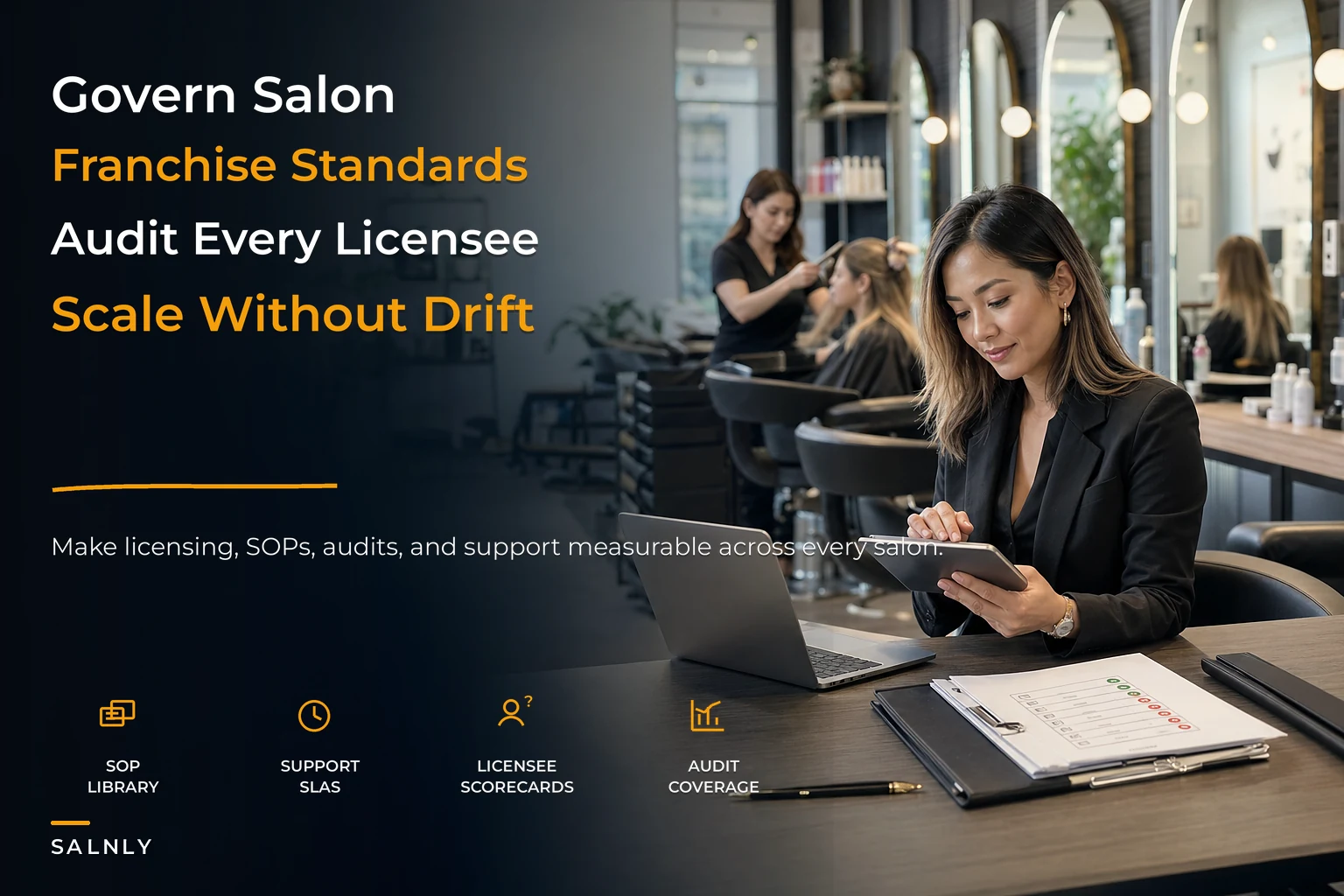
An SOP library and a scorecard tell you what should be happening and what the numbers say is happening. Audits tell you what's actually happening on the floor. You need all three, because they catch different failures.
The scorecard might show healthy rebook rates while an audit reveals the location is rebooking clients through heavy discounting — propping up the metric while destroying margin. The SOP library says every client gets a patch test; the audit is how you confirm it.
Audit layers workflow visualization:
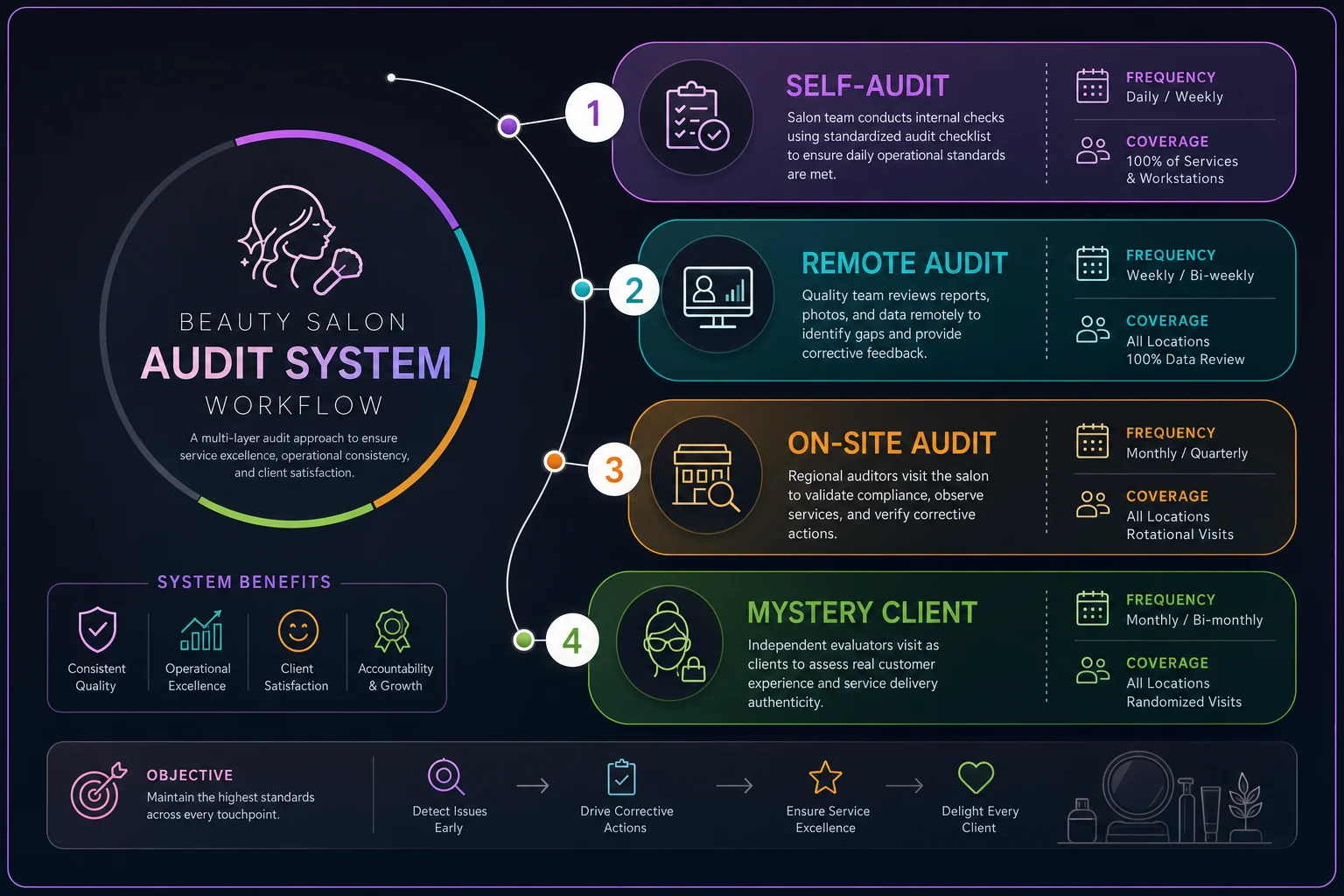
A workable audit system has a few layers:
-
Self-audits — the location manager runs a standardized checklist monthly and submits it. Low cost, keeps standards top of mind, but obviously self-reported.
-
Remote audits — HQ reviews data, photos, logs, and recorded consultations (with appropriate consent) without traveling. Catches a lot and scales well.
-
On-site audits — a trained auditor visits on a schedule, say twice a year for established locations and more frequently for new or struggling ones. Expensive but irreplaceable for catching what data hides.
-
Mystery-client audits — someone experiences the location as a real client and reports against a standard rubric. This is probably the single best way to measure what the brand experience actually feels like.
The mistake brands make is treating audits as punishment. If a failed audit just means a scolding, licensees learn to game the process rather than fix operations. The better frame: an audit is a diagnostic that triggers support. A failed sanitation audit should automatically kick off a retraining module and a follow-up visit, not just a demerit. When audits feed into the same system as your SOPs and support tickets, a failure can trigger the fix — assign the retraining, schedule the re-audit, log the resolution — instead of relying on someone remembering to follow up weeks later.
Build the audit templates once, centrally, and version them like SOPs. If every location is audited against a slightly different checklist, you can't compare locations, and comparison is the whole point.
Licensee onboarding: the first 90 days set the ceiling
How a licensee is onboarded sets the maximum quality that location will ever reach. A rushed onboarding produces an operator who never fully understood the system and spends the next three years improvising around the gaps. A deliberate one produces an operator who runs the brand correctly almost by instinct.
Most dilution traces back to this window. The founder was excited to collect the franchise fee, the licensee was eager to open, and both agreed to compress a process that should have been slower. It's a surprisingly easy mistake to make when everyone involved is optimistic.
-
Immersion at a flagship location — the licensee, and ideally their first manager, works inside a top-performing location for a defined period, seeing the standard live rather than reading about it.
-
SOP certification — the licensee demonstrates they can execute and teach the core brand-critical procedures, not just that they've attended a training session. Certification, not attendance.
-
Pre-opening buildout review — HQ signs off on the physical space, station setup, retail layout, and tech stack against the brand standard before launch, not after complaints roll in.
-
Supervised soft launch — the first few weeks run with HQ support present or closely monitoring, with lower booking volume by design so the team builds habits before the pressure hits.
-
Scorecard baseline — the location's scorecard starts tracking from day one so drift is visible early, while it's still cheap to correct.
-
Graduated autonomy — audit frequency and support intensity step down as the location proves it can hold the standard, rather than dropping off a cliff on opening day.
The rollout of new procedures to an existing team is a related but distinct challenge, and getting the change-management mechanics right matters as much for a new licensee as for your original location. The sequencing and adoption gates in our 8-week SOP rollout playbook translate cleanly to the franchise onboarding window.
A real scenario: where the architecture actually pays off
Consider a color-focused salon brand that licensed its first three locations off the strength of a strong flagship. The founder handed over a PDF manual, a logo, and a lot of personal attention to location one — which happened to be ten minutes away.
By the time locations four and five opened in a neighboring metro, the cracks showed. Location four's redo rate on color corrections ran noticeably higher than the flagship's. New-client rebooking at location five sat around 35% while the flagship held near 55%. Revenue at both looked fine for the first couple of quarters, which is exactly why no one acted — until the review averages started sliding and the founder realized they had no idea what was actually happening on those floors.
The fix wasn't dramatic. They split the SOP library into mandatory versus discretionary, certified each location manager on the mandatory protocols, and started a monthly scorecard that tracked redo rate, rebook rate, and audit compliance rather than just revenue. They added a quarterly on-site audit and a defined support response window so licensees stopped solving problems badly in silence.
Over the following two quarters, location five's rebook rate climbed back toward the high 40s and location four's redo rate dropped meaningfully as the consultation protocol got re-enforced. Nothing about the service itself changed. What changed was that the brand standard became visible and enforceable from a distance — and the founder stopped being the only quality-control mechanism in the system.
When franchising your salon is a bad idea
Don't franchise if your flagship still depends on your personal presence to hit its numbers. If the business dips every time you take two weeks off, you haven't built a system — you've built a job for yourself, and you can't license a job.
Don't franchise if you can't articulate why clients choose you in a way that survives being written into a procedure. "Our stylists are just really talented" isn't a franchiseable advantage. "Our consultation protocol catches miscommunications before they become redos" is.
Don't franchise if you aren't prepared to be in the support and governance business. Franchising isn't passive income — you're trading the work of running salons for the work of running a support and compliance operation. Some founders genuinely hate that work, and it's better to find out before you've sold licenses.
This makes sense when you have a documented system that produces consistent results independent of any single person, a clear and defensible brand advantage, and the appetite to build the unglamorous governance layer that keeps distant locations honest.
The thread that ties it together
Every piece of this — the SOP library, the scorecards, the support SLAs, the audits, the onboarding — is really one system with four jobs: define the standard, measure the standard, support people in hitting it, and verify it's actually being met. Pull out any one of those and the others can't compensate. A great SOP library with no audits is theater. Great audits with no support just punish people for failures the system set them up for.
The brands that scale without diluting aren't the ones with the strictest control. They're the ones that made consistency verifiable from a distance — so a location two states away, run by someone the founder barely knows, still delivers the thing clients fell in love with at the original. That's not a logo. That's architecture, and it has to come before the licenses.
The brands that scale without diluting aren't the ones with the strictest control. They're the ones that made consistency verifiable from a distance — so a location two states away, run by someone the founder barely knows, still delivers the thing clients fell in love with at the original. That's not a logo. That's architecture, and it has to come before the licenses.
Ready to simplify your salon operations?
Join 1,000+ salons using Salnly to save time, reduce scheduling chaos, and deliver better client experiences.