

Opening a second location feels like the obvious next move when your first salon is running well. Books are full, the team is solid, clients keep asking when you're expanding closer to them. What catches most owners off guard is that operational complexity doesn't just double when you add a second location — it compounds in ways that are genuinely hard to anticipate until you're living it.
The most common mistake is trying to clone location one. Take all the processes, all the rules, the management approach, and copy-paste everything to the new spot. Then wonder why location two never quite performs the same way, why quality control becomes a constant battle, and why you're suddenly burning hours every week driving between locations dealing with problems that shouldn't need your attention.
A real multi-location playbook has to be smarter than that. Some things absolutely need to be standardized — your brand promise, quality standards, financial controls. But other things need to flex based on the neighborhood, the team, the specific client base. Getting that balance wrong is what turns expansion from a growth opportunity into an operational drain that costs you margins and sleep.
The centralization trap: why copying everything from location one usually fails
The second-location plan most owners start with is simple: take what works and replicate it. Same service menu, same pricing, same scheduling logic, same product lines. Makes sense on paper.
Except it rarely works that cleanly.
A downtown location might thrive on corporate lunch-hour blowouts and after-work color appointments. A suburban location operates on a completely different rhythm — Saturday morning highlights, Tuesday afternoon appointments, different income brackets, different service preferences, different tipping habits.
One owner had a thriving location in a trendy urban neighborhood — lots of fashion-forward color, experimental cuts, clients who booked treatments as self-care splurges. When she opened her second location in a family-oriented suburb, she kept the exact same menu and pricing. Six months later it was bleeding money. The elaborate color services that drove downtown revenue? Suburban clients wanted practical, maintainable results. The luxury treatments? They wanted efficiency, not an experience.
The fix wasn't making the second location a different business entirely. It was identifying which elements needed to stay consistent for brand integrity — color formulation standards, consultation process, safety protocols — and which ones needed local adaptation: service mix, scheduling patterns, retail product selection.
Building your centralized vs. localized SOP framework
Think of your operational structure in three layers. The first layer — core brand standards — must be centralized, full stop. Every client at every location should recognize your salon's experience. The second layer covers operational efficiency standards that keep quality consistent while allowing some local variation. The third layer is purely local, responding to neighborhood dynamics, team strengths, and specific client preferences.
Stop losing appointments in the chaos.
Salnly helps you book, confirm & manage every appointment—efficiently.
- Centralized appointment management
- Client notifications
- Calendar & staff scheduling
No credit card required
Core Centralized SOPs (Non-negotiable across all locations):
Color formulation needs to be identical everywhere. If a client gets highlights at location A and needs a touch-up at location B, the result should be seamless. That means centralized training on your color system, standardized mixing ratios, and consistent documentation in client records.
Safety and sanitation protocols can't vary by location. Tool sterilization, chemical handling, client consultations for allergies and sensitivities — these protect both your clients and your business. One location cutting corners puts the entire operation at risk.
Financial controls and cash handling need rigid consistency. How you handle deposits, process refunds, manage till reconciliation — these protect against both theft and honest mistakes that multiply across locations.
Client data management and privacy standards must be uniform. How you store client information, who can access it, how preferences and notes are handled — this matters even more when clients move between locations.
Flexible Operational Standards (Standardized but locally adaptable):
Scheduling templates should have a consistent framework but flex for local patterns. A downtown location might need to optimize for quick lunch services while a suburban location needs longer Saturday appointment blocks. The booking system and time-blocking principles stay the same; the actual schedule grid adapts.
Retail product mix works well on an 80/20 rule. Eighty percent stays consistent for brand cohesion and simplified inventory management. That remaining twenty percent? Let each location manager curate products that actually resonate with their clientele.
Track that 20% via your POS by location monthly so you can objectively decide which products to swap.
Staff scheduling and role distribution should match local demand. Maybe the city location needs more colorists on Thursday evenings while the suburban spot needs extra stylists for Saturday family bookings.
Localized Decisions (Managed at unit level):
Community partnerships and local marketing should be decided by location managers who know their neighborhood. The yoga studio referral partnership that drives traffic downtown might be completely useless in the suburbs, where partnering with a local school's PTA fundraiser actually moves the needle.
Team incentive structures may need adjusting based on local competition for talent. If one location sits near several other salons, you might need different commission structures or perks to attract quality stylists.
Unit-level KPIs that actually predict location health
Once you can't personally observe everything happening day-to-day, tracking the right metrics becomes critical. Total revenue and number of services performed are fine for bookkeeping but don't tell you much about whether a location is genuinely healthy or quietly heading toward trouble.
Revenue per available chair hour gives you the real productivity story. Take total service revenue for the week and divide it by the total hours chairs were available — not just staffed, but bookable. This immediately shows whether a location is efficiently using its capacity or just staying busy without being profitable.
A healthy location typically lands somewhere in the $65–85 range per available chair hour, depending on your market and service mix. If location A is hitting $78 while location B is stuck at $52, you know exactly where to focus.
| KPI | Location A (Urban) | Location B (Suburban) | Target Range |
|---|---|---|---|
| Revenue per chair hour | $78 | $52 | $65–$85 |
| Rebook rate | 68% | 51% | 60–70% |
| Product attachment rate | 34% | 19% | 25–40% |
| New client 90-day retention | 58% | 41% | 50–65% |
| Service mix (color %) | 54% | 31% | Varies by market |
Service mix variance tracks whether each location is selling your full range or drifting toward low-margin ruts. Calculate the percentage of revenue from each category — cuts, color, treatments, styling — monthly. If one location generates 70% of revenue from basic cuts while another balances across categories, you've identified both a problem and an opportunity.
Rebook rate by stylist AND by location reveals both individual performance issues and systemic problems. If every stylist at one location has lower rebook rates than your company average, it's not a training issue — something about that location's operations, culture, or client experience is broken.
Product attachment rate should be tracked not just as a percentage of clients who buy retail, but as retail revenue per service ticket. This tells you whether your team is genuinely consulting clients and whether your product selection actually fits what people want.
Utilization variance measures how much actual appointment time varies from booked time. If one location consistently runs 15 minutes behind while another stays on schedule, you need different buffer strategies — not a universal scheduling rule applied everywhere.
New client retention at 90 days, tracked separately for each location, shows whether you're successfully converting first-time visitors into regulars. A location might look strong on new client traffic but if they're not coming back, you're just churning through the neighborhood without building anything sustainable.
Regional management design: the bridge between locations
Once you hit three locations, you need someone whose job is not to work in any single salon but across all of them. This regional manager role is where a lot of expansion plans fall apart — owners either don't create the position early enough or they promote their best salon manager without properly redefining what the job actually is.
Your regional manager shouldn't be your best stylist or even your best location manager. They need to be your best systems thinker. Their job is pattern recognition across locations, operational problem-solving, and serving as the connective tissue between centralized standards and local implementation.
The role should spend roughly 40% of their time on scheduled location visits — not surprise inspections, but operational reviews where they observe workflows, identify bottlenecks, and coach managers. Another 30% goes to analyzing cross-location data and developing operational improvements. Around 20% is training and development, ensuring SOPs are understood and implemented consistently. The remaining 10% is crisis response, because things will go wrong and location managers need someone to call who isn't the owner.
This person needs actual authority. Can they approve scheduling changes? Authorize emergency supply orders? Mediate staff conflicts? If they're just a messenger between location managers and the owner, the role becomes a bottleneck rather than a bridge.
Compensation structure matters too. Base salary plus bonuses tied to overall multi-location performance — not individual location performance — aligns their incentives with building a strong network rather than playing favorites.
The 2–5 location launch checklist: a phased approach
Launching locations 2 through 5 requires a different approach than opening your first salon. You're not figuring everything out from scratch — you're adapting a proven model to new contexts while maintaining operational control.
Phase 1: Location Selection and Validation (12–16 weeks before opening)
Start with demographic analysis, but go deeper than population and income levels. Study commute patterns — are people coming from work or home? Check competition density, but also compatibility. Being near other salons isn't automatically bad if you serve different segments.
Validate your service mix assumptions by surveying potential clients in the area. Don't ask what services they want — ask what they currently get done and where. The gap between those answers reveals your real opportunity.
Test your pricing assumptions too. Downtown premium pricing might not hold in a suburban strip mall, even when demographics look similar on paper.
Phase 2: Operational Infrastructure (8–12 weeks before opening)
Set up your technology stack first. Your booking system, scheduling platform, inventory management, and client database need to be fully integrated before you hire your first stylist. Bolting these on after opening creates chaos that's genuinely hard to walk back.
Design your staffing model based on projected demand patterns, not optimism. If you're expecting 60% of weekly revenue on Friday and Saturday, don't spread your best stylists evenly across every day.
Create location-specific training materials that supplement your core program — parking instructions, nearby lunch spots for staff, building quirks, neighborhood dynamics. Small stuff, but it matters during onboarding.
Phase 3: Team Building (4–8 weeks before opening)
Hire your location manager first, at least six weeks before opening. They need time to understand your systems, build relationships with other managers, and genuinely take ownership of the launch.
Stagger stylist hiring so you're not training everyone at once. Bring in two or three core team members early, let them train properly, then add others. It creates internal mentorship from day one.
If possible, have new hires spend time working at an existing location before the new one opens. They learn real workflows instead of theoretical ones and bring some of that culture with them.
Phase 4: Soft Launch and Calibration (2 weeks before to 2 weeks after opening)
Run a genuine soft launch with limited hours and services. This isn't just about working out operational kinks — it's about testing your assumptions against reality. Which services are clients actually booking? What questions come up that you didn't anticipate?
Price-test during soft launch. Offer different service packages to different client groups and measure response. You have one window to set market expectations — don't waste it.
Measure everything obsessively for the first month. Service times, product usage, client flow patterns, peak demand windows. This baseline data shapes every future optimization decision.
Phase 5: Stabilization and Optimization (Months 2–6)
Weeks five through eight are critical. The new salon excitement has worn off, operational problems have surfaced, and your team is settling into patterns — good and bad. This is when focused management attention matters most, before those patterns become permanent.
Weekly reviews with the location manager should focus on specific metric variances — not "how's it going?" but "why is Wednesday utilization 20% below projection?" and "what would it take to increase your average ticket by $8?"
Monthly cross-location manager meetings where they share what's working and what isn't. The suburban location's solution for back-to-school booking chaos might be exactly what the downtown location needs for conference season.
Here's a simple diagram showing how information and decisions flow across locations.
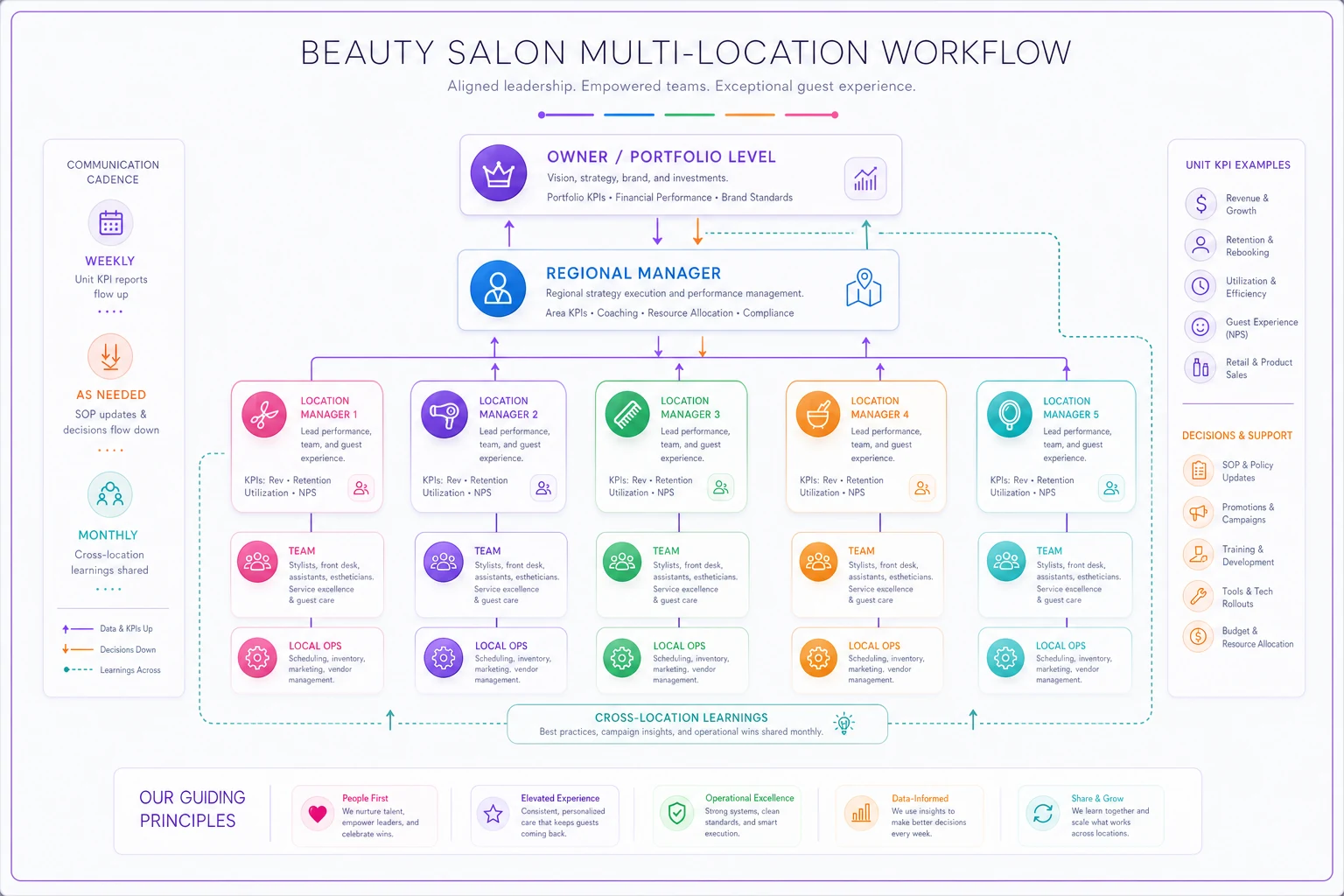
↑ Unit KPIs flow up weekly ↓ SOP updates and decisions flow down ↔ Cross-location learnings shared monthly
Governance templates that prevent chaos without creating bureaucracy
As you scale, documentation becomes critical — but not the corporate handbook variety nobody opens. You need living documents that actually get used, updated, and referenced during real operations.
The Location Performance Dashboard
Each location needs a one-page weekly dashboard that takes about 10 minutes to complete but captures everything that matters. Revenue versus the same week last year. Chair utilization. Rebook percentage. Top three operational issues. One thing that went better than expected.
The value isn't in any single week's numbers — it's in patterns across weeks and locations. When all three locations flag scheduling challenges the same week, you know it's a systemic issue, not a local management problem.
The Escalation Matrix
Define which decisions happen at which level. Can a location manager comp a service for an unhappy client? Up to what dollar amount? Can they terminate a stylist? Adjust operating hours for a holiday?
Without clear escalation rules, you either have location managers calling for permission constantly — a bottleneck — or making calls beyond their authority. Neither works.
The Experiment Log
Every location should be running small operational experiments, but you need to track what's being tested, why, and what happened. Location B tries a new consultation process that increases average tickets by 15%? That experiment log becomes the playbook for rolling it out everywhere.
-
Date started
-
Hypothesis
-
Success metrics
-
Results
-
Decision — continue, modify, or stop
-
Next steps
If it's complicated to maintain, it won't get maintained.
The Incident Report System
Not just for serious problems — for any deviation from standard operations that required management intervention. Client complaints that escalated. Staff no-shows. Equipment failures. Supply disruptions.
These reports aren't about assigning blame. They're about pattern recognition. Three incidents about online booking confusion across different locations? That's a systemic problem that needs a real solution, not a location-by-location patch.
Governance doesn't have to mean bureaucracy. The goal is giving your managers enough structure to make good decisions independently — and giving you enough visibility to catch problems before they become expensive.
Managing information flow: turning operational data into competitive advantage
Once you have multiple locations, the biggest operational challenge isn't managing people or inventory. It's managing information. Every location generates data about what's working, what's breaking, and what clients want. Without good systems for collecting and sharing that information, you end up making decisions based on gut feel and whoever happened to call you that morning.
Operational software becomes essential here — not just for booking, but for creating a single source of truth across the business. When a client calls location A about an appointment they think they made at location B, your team needs to pull that up instantly. When a stylist moves between locations, their schedule, client notes, and preferences should move with them without anyone manually transferring anything.
AI-assisted platforms can surface patterns that would otherwise go unnoticed — a consistent scheduling crunch Thursday afternoons at location A, clients who buy a specific treatment rebooking at a significantly higher rate within six weeks, inventory usage patterns that suggest waste or shrinkage. These things are technically visible in the raw data. They just never get spotted when someone's manually reviewing spreadsheets between appointments.
That said, technology is infrastructure, not a solution by itself. The Thursday afternoon crunch might be school pickup time — adding more stylists doesn't fix a demand constraint. You have to understand the underlying issue before you can design around it.
Your client lifecycle systems get more important, not less, as you add locations. A client might discover you online, book their first appointment at location A, become a regular at location B, and refer friends to location C. Without integrated systems tracking that full journey, you can't measure what's actually driving growth or optimize the experience at each touchpoint.
The scaling mistakes that look like success until they aren't
Some operational problems look like wins in the short term. That's what makes them dangerous when you're scaling.
Consistently full books across all locations feels like the dream. But running at 95% capacity means you have no room to optimize. You can't fit in high-value color corrections for good clients. You can't accommodate loyal clients who need to reschedule. You can't test new services or providers. Full books feel successful but actually cap your growth and start frustrating the clients who matter most.
Universal standardization sounds professional and scalable. Every location does things exactly the same way. But if your urban location closes at 6pm and is leaving revenue on the table, while your suburban location is forced to stay open until 9pm and burning payroll on slow nights, that's not smart standardization — it's just inflexibility wearing professional clothing.
Promoting your best performers into management roles seems logical. But your star stylist billing $5,000 a week might generate more value staying on the floor than managing others. Management requires entirely different skills, and being exceptional at cutting hair doesn't mean someone will be good at scheduling, inventory, or conflict resolution.
Seasonal patterns can vary dramatically by location — sometimes even within the same city. A downtown location might go quiet in summer when corporate clients are on vacation. A location near a beach or resort area might be slammed with tourists during those same weeks. Running the same promotional calendar and staffing model across both wastes opportunity at one and creates chaos at the other.
The human cost of expansion: protecting culture while scaling operations
Every salon owner talks about maintaining culture as they grow. Few actually manage it. The close-knit feel of a single salon naturally fades when staff are split across different locations and might never work side by side.
But you can design intentional touchpoints that preserve what matters. Monthly all-hands meetings where locations share wins and problems. Rotation programs where stylists work occasional shifts at different locations, spreading best practices and building real connections across the team. Recognition that celebrates both individual and cross-location achievements.
Compensation and incentive structures need rethinking too. Single-location bonuses create competition between sites. One location discounting services to hit a monthly target can undercut another location's full-price positioning. Build incentives that reward collaboration — bonuses for cross-location client referrals, recognition for mentoring staff at newer locations, rewards for experiments that get adopted system-wide.
The owner's role changes fundamentally as well. You're no longer the best stylist who also runs the business. You're building a portfolio of related businesses and your job is the portfolio, not any single location. That transition is genuinely hard for owners who love the hands-on work. Trying to stay operationally involved in daily salon life while managing multiple locations leads to burnout and limits how far you can actually grow.
Making the multi-location transition actually work
A real multi-location playbook isn't about perfecting your first location and photocopying it. It's about identifying what must be consistent for brand integrity and operational efficiency, while giving individual locations enough flexibility to actually perform in their specific context.
Centralized SOPs should cover safety, quality standards, and financial controls — the non-negotiables that protect your business and reputation. Localized decisions should respond to neighborhood dynamics, demographic patterns, and the competitive landscape each location actually operates in.
Unit-level KPIs need to measure true operational health, not just topline revenue. Revenue per chair hour, service mix balance, and new client retention tell you more about location viability than gross sales will ever reveal on their own.
Building the right management layer between you and your locations is what makes or breaks the whole structure. Your regional manager needs genuine authority, analytical capability, and the judgment to balance standardization with local adaptation.
The technology infrastructure you choose matters more than most owners expect. Operational platforms that integrate scheduling, inventory, client management, and analytics give you the visibility needed to manage multiple locations without living in your car. The right AI-assisted tools can surface patterns and flag problems early, freeing you to focus on strategy instead of constantly reacting to whatever fire just got called in.
Locations 2 through 5 aren't copies of location 1. Each has its own personality, its own path to profitability, its own optimal operating model. Your job is to build a framework flexible enough to support those differences while maintaining the standards that made your brand worth scaling in the first place.
The salons that successfully grow to multiple locations aren't the ones with the most rigid systems or the loosest standards. They're the ones that thoughtfully balance consistency with adaptation, measure what actually matters, and build operational infrastructure before they desperately need it. Get that balance right and multiple locations become a genuine wealth-building engine. Get it wrong and you've multiplied your headaches while dividing your margins.
Ready to simplify your salon operations?
Join 1,000+ salons using Salnly to save time, reduce scheduling chaos, and deliver better client experiences.