


Writing a good SOP is the easy part. The document isn't the problem — the gap is between “we wrote it” and “everyone does it, every day, without being reminded.” This playbook focuses on the rollout system, not the policy text.
Most rollouts die in week three because there was no pilot, no training rhythm, no scored ownership, and no baseline. This walkthrough gives an eight-week, gate-driven timeline that survives contact with a busy salon.
This is not a motivational framework. It's a timeline with pass/fail gates: measure baseline, pilot small, refine from real objections, train in focused reps, and lock the habit into onboarding.
Why most SOP rollouts collapse in the first month
The common pattern: an owner announces a change to the whole team on a busy day, everyone nods, and the workday swallows the change. Without structure, adoption is polite agreement, not durable behavior.
-
No pilot
when the change fails for everyone, you can't learn whether the SOP or the training broke.
-
No owner of the behavior
if no manager is scored on adoption, adoption is optional.
-
No baseline
you can't prove improvement if you never recorded the starting KPI.
-
Training as a one-time announcement
behavior changes from practice and correction, not a single lecture.
A quieter failure mode: changes touch multiple roles but get rolled out as if they touch one. Rollouts that miss role intersections (reception, stylist, confirmations) fragment immediately.
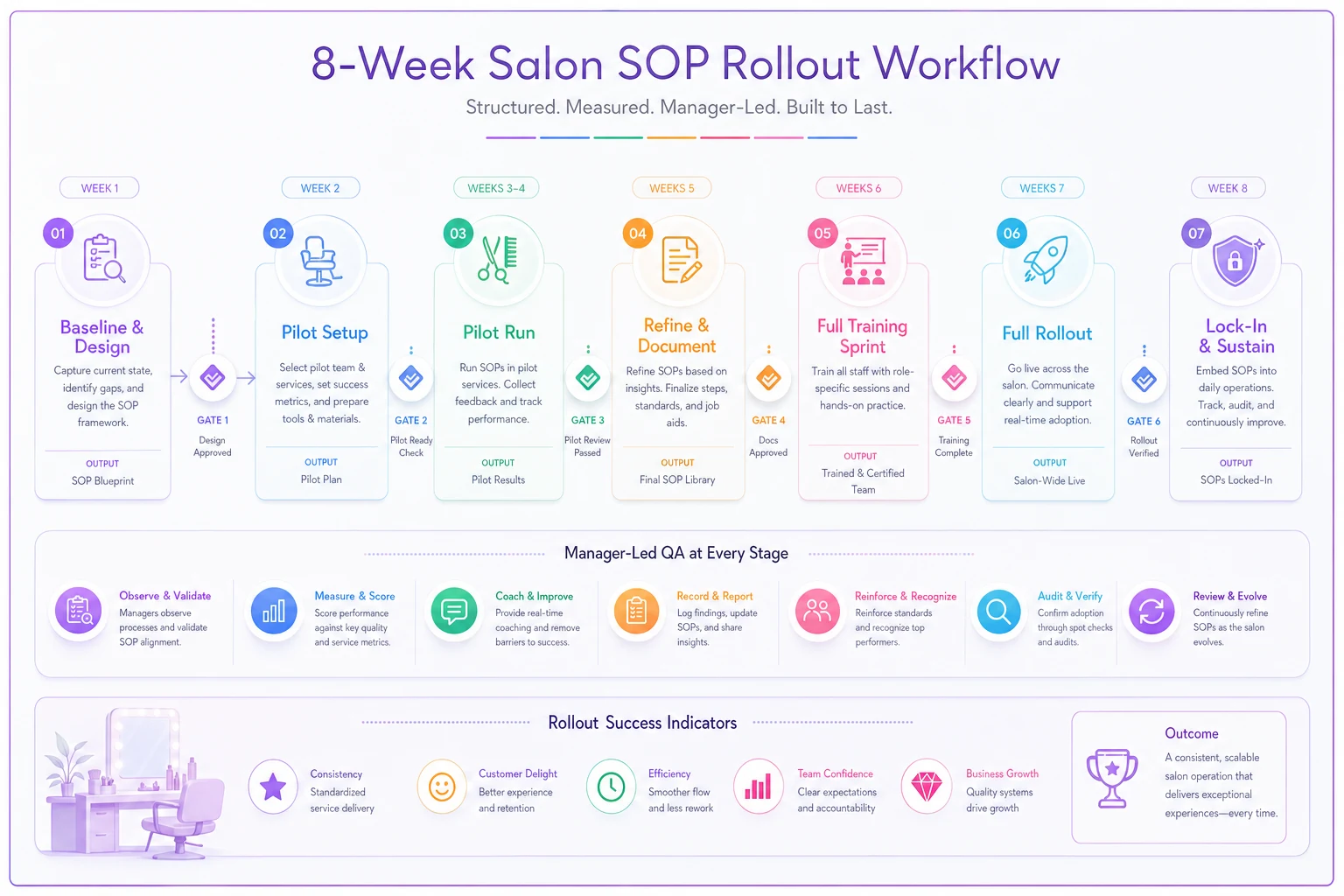
The shape of an 8-week rollout
| Weeks | Phase | Main job | Gate to pass before moving on |
|---|---|---|---|
| 1 | Baseline & design | Measure current state, finalize SOP | Baseline KPIs recorded, SOP one-pager approved |
| 2 | Pilot setup | Pick pilot group, train them, set QA scorecard | Pilot team can perform SOP unprompted in role-play |
| 3–4 | Pilot run | Small group runs it live, daily QA | Pilot hits 80% adoption + no KPI regression |
| 5 | Refine & document | Fix what broke, rewrite unclear steps | Revised SOP + FAQ from real objections |
| 6 | Full training sprint | Train whole team in short reps | Every stylist/reception passes a scored run |
| 7 | Full rollout | Everyone live, manager coaching daily | Team-wide adoption ≥ 70%, climbing |
| 8 | Lock-in | Move from enforcement to habit | Adoption ≥ 85%, tied to a KPI checkpoint |
The calendar is a scaffold; the gates are the guardrails. If a gate fails, repeat the phase until the gate is clean. A 10-week rollout that passed all gates is better than an 8-week rollout that didn't.
Stop losing appointments in the chaos.
Salnly helps you book, confirm & manage every appointment—efficiently.
- Centralized appointment management
- Client notifications
- Calendar & staff scheduling
No credit card required
Week 1: Baseline and design (don't skip this)
Before training, write down the metric you're trying to move: rebook rate, no-show rate, or retail per ticket. Without a baseline, all you have is a feeling, not defendable numbers.
Turn the SOP into a one-page sheet a stylist can read in 90 seconds. If you can't, the process is too complex to adopt.
-
The trigger (when does this happen?)
-
The exact steps or script
-
What to do when the client pushes back
-
What 'done right' looks like
Week 2: Pick the pilot and set the scorecard
Pick two to three pilot participants: one strong operator and one average-but-willing person. If it only works for the superstar, it's not an SOP.
Set a binary QA scorecard for manager audits. Keep it short — a card that takes longer than 20 seconds won't be used reliably.
-
Did they mention rebooking before the client stood up? (Y/N)
-
Did they suggest a specific date/interval, not 'whenever'? (Y/N)
-
Did they handle the first objection with the script? (Y/N)
-
Did they actually put it in the calendar or send the link? (Y/N)
Train the pilot with role-play until they can perform the SOP cold. Gate to leave week 2: pilot team can perform the SOP unprompted in mock interactions.
Weeks 3–4: Run the pilot live and watch the QA
The pilot runs live while the manager scores a sample of interactions daily. Same-day feedback changes behavior; delayed feedback usually doesn't.
-
Adoption
watch adoption climb toward 80%+ in the pilot group; identify which specific step is skipped.
-
KPI safety
verify the change doesn't hurt guardrail metrics (e.g., booking conversion, no-shows).
If adoption stalls, it's usually the SOP step, not the person. The gate to advance: pilot hits 80% adoption and no regression in guardrail KPIs; otherwise extend the pilot.
Week 5: Refine using what the pilot actually taught you
Collect real objections and edge cases from the pilot team and rewrite the SOP one-pager and FAQ using those exact objections and responses.
Decide whether to scale or kill the change. A clean pilot that shows the SOP is fiddly or harmful should be stopped; killing early is a win compared to wrecking trust across the whole team.
Week 6: The full training sprint
Train the whole team in short reps: a 15-minute intro covering the why and the one-pager, scored role-play in pairs, then a live day with heavy QA.
Everyone must pass a scored run before they're considered trained. Managers must be trained first and able to coach the script, not just describe it.
If you use a week-by-week training curriculum, the rollout sprint slots into the same drills-and-QA rhythm, targeting a specific new process.
Manager coaching scripts (micro-scripts)
Managers need simple, specific language to correct behavior. Practice short scripts that open with observation and end with a question or a specific next step.
-
In-the-moment nudge (private, same day)
'I caught two tickets today where the rebook didn't get offered before they stood up. Walk me through what happened on the 2pm?'
-
Reinforcing what's working
'Your objection handling on the color client was exactly it — you gave a specific date instead of "whenever." That's the thing.'
-
The pattern conversation (recurring miss)
'This is the third day the close step got skipped. Is it a time issue, a comfort issue, or does the script feel wrong to you? I want to fix the actual problem.'
These micro-scripts work best inside an existing daily-huddle rhythm where adoption numbers and quick corrective conversations are standard.
Weeks 7–8: Rollout, adoption gates, and lock-in
Week 7 runs everyone live with daily QA and coaching. Expect a dip when going wide; what matters is the adoption trajectory, not the immediate number.
Week 8 moves from enforcement to habit. The signal of lock-in is adoption holding at 85%+ without daily enforcement and a meaningful positive move in the target KPI versus baseline.
-
Adoption sampled at 85%+ across relevant roles, not just top performers
-
Target KPI moved meaningfully versus the week‑1 baseline
-
No guardrail KPI has regressed
-
SOP one-pager and FAQ are final and accessible
-
Managers can coach it without the owner’s involvement
-
New-hire onboarding includes this SOP by default
A real scenario: rolling out a rebooking SOP
A three-chair salon with a 33–35% baseline rebook rate ran the 8-week process. The pilot exposed that the close step was weak: stylist mentions happened, but clients left without booking.
In week 5 they rewrote the close to offer two specific dates and book in the chair. Full rollout dipped to low 60s adoption due to one stylist's discomfort; coaching allowed her to adapt phrasing while keeping required steps.
By week 8 rebook rate reached the mid-40s and held for two weeks without daily nudging — an eight-to-ten-point durable lift because the rollout used a pilot, real feedback, and daily coaching.
Adoption to revenue: connecting process compliance to dollars
Tracking adoption only matters if you can show how consistent habits drive revenue. Three core metrics connect process compliance to cash: SOP adoption rate, rebooking rate, and average ticket value.
Metric 1: SOP Adoption Rate — Formula: SOP Adoption Rate = (Checklist steps completed correctly ÷ Total checklist steps audited) × 100
In plain English: this measures the percentage of required operational steps executed correctly during manager audits. Example: 40 correct steps out of 50 = 80%.
Metric 2: Rebooking Rate — Formula: Rebooking Rate = (Clients who book their next appointment before leaving ÷ Total client visits served) × 100
In plain English: the share of guests who secure their next appointment before walking out. Example: 176 pre-booked of 400 visits = 44%.
Metric 3: Average Ticket Value — Formula: Average Ticket Value = Total service and retail revenue ÷ Total client visits served
In plain English: the typical revenue from each client visit. Example: $32,000 across 400 visits = $80 average ticket.
Worked revenue example: connect audit consistency to top-line revenue so managers can celebrate concrete wins during huddles.
-
Baseline (34% rebooking)
400 visits × 34% = 136 pre-booked appointments
-
Post-rollout (44% rebooking)
400 visits × 44% = 176 pre-booked appointments
-
Monthly volume gain
176 − 136 = 40 additional pre-booked appointments
-
Monthly revenue impact
40 × $80 average ticket = $3,200 in forward-booked revenue
Over a quarter, that improvement secures roughly $9,600 in predictable visit revenue while reducing the hours managers scramble to fill open slots.
When this full process makes sense — and when it's overkill
Use the full 8-week structure when the change touches multiple roles, affects revenue directly, or has failed to stick before. Pilot and gates are worth the investment for high-stakes changes.
-
Skip it for tiny, single-role changes (e.g., towel-folding); a one-page instruction and quick huddle mention suffice
-
Do not run this if no manager will commit to daily QA; the rollout depends on someone scoring interactions and coaching daily
-
If nobody owns adoption behavior, fix that first rather than launching another SOP
The tooling reality
The process can run on a clipboard and whiteboard, but tracking and daily visibility are the friction points. Manual tracking often gets abandoned by week 6, exactly when you need it most.
A salon management platform helps by automating the boring parts: pulling baseline KPIs, flagging skipped steps, and keeping adoption trends visible so managers can coach from data instead of memory.
Closing thought: salons that reliably change how they operate treat rollout as its own skill. Pilot first, train in reps, gate on adoption, and coach daily until the behavior is invisible because it is how things work now.
Download a single workbook that includes an audit sampling CSV template, QA scorecard, KPI→revenue attribution calculator with a worked example, and manager coaching-script cards for floor use. Salon SOP Rollout Workbook CSV companion: Download the CSV template
Ready to simplify your salon operations?
Join 1,000+ salons using Salnly to save time, reduce scheduling chaos, and deliver better client experiences.