

Most salons treat their client list like one big pile. Everyone gets the same "we miss you" text, the same birthday coupon, the same reactivation blast. And then owners wonder why response rates are flat and margins keep leaking.
The problem isn't the messaging. It's that you're talking to a 6-visit-a-year color client the same way you talk to someone who came in once for a blowout eight months ago. Those two people are worth completely different amounts to your business, and they need completely different treatment.
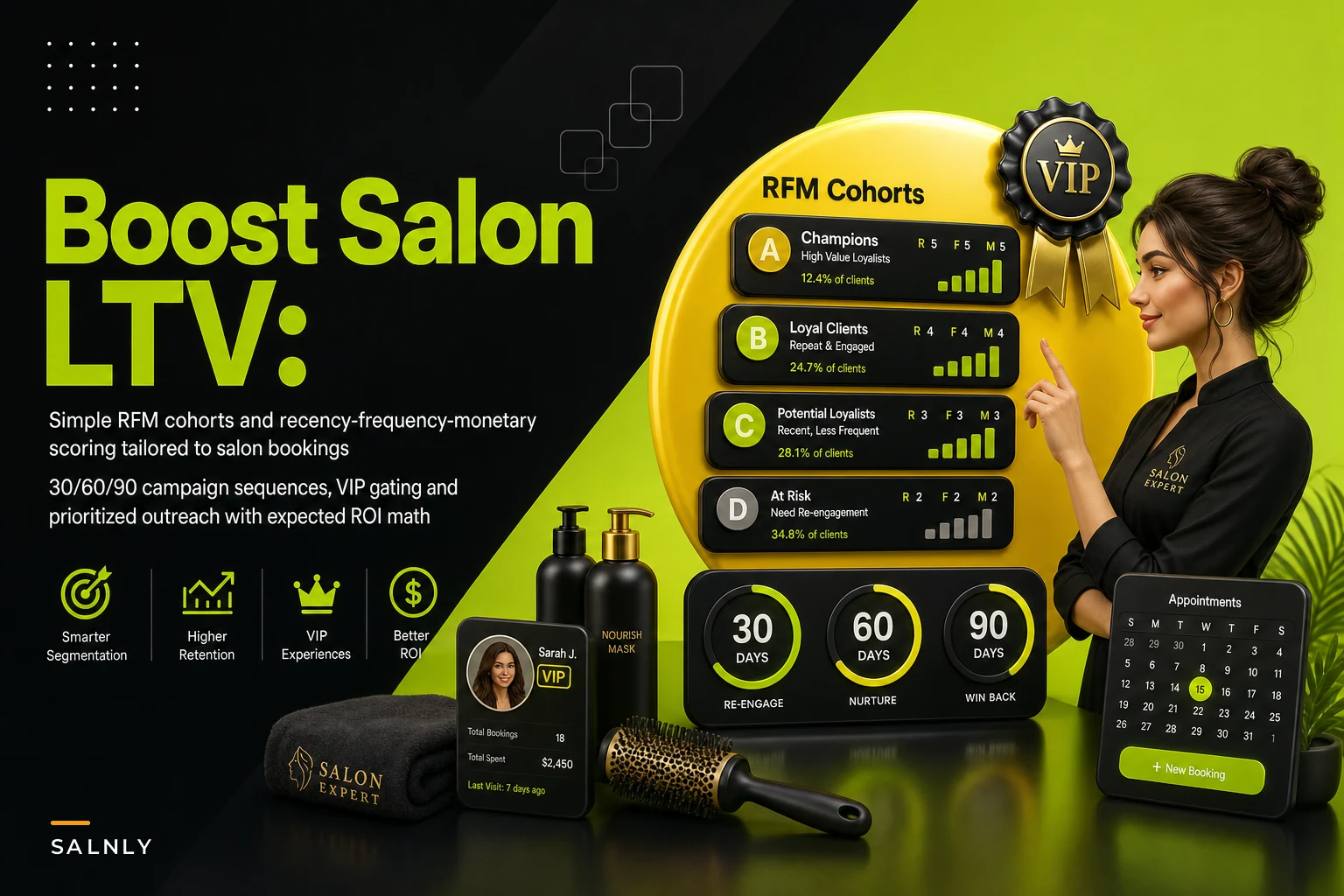
Salon client segmentation using an RFM model fixes that — and you don't need a data team to pull it off. You need three columns you already have in your booking software: when someone last came in, how often they come, and how much they spend. Recency, Frequency, Monetary. That's the whole thing.
Why the "one blast for everyone" approach quietly bleeds money
The pattern that shows up in almost every unsegmented salon: the top 15–20% of clients generate somewhere around half the revenue, sometimes more. But marketing effort gets spread evenly across the whole list. So your highest-value people — the ones who'd respond to a personal touch — get a generic coupon that actually cheapens their relationship with you. Meanwhile the low-value, rarely-returning names soak up discount dollars they were never going to convert on anyway.
There's a second cost that's less obvious. When you discount to everyone, your best clients learn to wait for the discount. A woman who happily paid full price for balayage every 10 weeks starts booking every 12 weeks and only when the promo hits. You trained her to do that. Segmentation lets you stop sending price signals to people who don't need them.
The whole point of building cohorts is to answer one question before you spend a dollar or a staff hour on outreach: is this person worth a personal call, an automated nudge, or nothing at all right now?
Building RFM scores that make sense for a salon (not a retail chain)
Standard RFM tutorials are written for e-commerce, where someone might buy weekly. Salon cadence is different — a loyal color client might only visit 5–6 times a year, and that's excellent. Your scoring bands have to reflect real salon rhythm.
Stop losing appointments in the chaos.
Salnly helps you book, confirm & manage every appointment—efficiently.
- Centralized appointment management
- Client notifications
- Calendar & staff scheduling
No credit card required
Score each client 1–3 on three dimensions. Keep it to three tiers, not five. Five tiers looks precise but nobody at the desk will act on it.
Recency — when did they last come in?
| Score | Last visit |
|---|---|
| 3 | Within 8 weeks |
| 2 | 9–16 weeks |
| 1 | 17+ weeks |
Frequency — visits in the last 12 months?
| Score | Visits / year |
|---|---|
| 3 | 5 or more |
| 2 | 3–4 |
| 1 | 1–2 |
Monetary — average ticket (or 12-month spend)?
| Score | Avg ticket |
|---|---|
| 3 | Top ~25% of your tickets |
| 2 | Middle |
| 1 | Bottom ~25% |
A client with recent visits, high frequency, and a big ticket scores 3-3-3. Someone who came in once last spring for a cheap cut scores 1-1-1. You now have a three-digit tag per person that tells you exactly how to treat them.
One adjustment worth making: for the Monetary band, use service spend, not total. A client who buys a lot of retail but rarely sits in a chair isn't a high-value service client — they're a retail relationship, which is worth something, but shouldn't gate them into your VIP chair-time perks.
The five cohorts you actually manage
You don't need to memorize 27 possible score combinations. In practice, salons run on five buckets:
-
VIPs (3-3-3, 3-3-2, 2-3-3) Recent, frequent, high spend. Your core revenue.
-
Loyal-but-slipping (was frequent, recency dropping — e.g., 2-3-2, 1-3-2): Good history, but the gap between visits is quietly growing.
-
Big-ticket occasionals (high Monetary, low Frequency — 3-1-3, 2-1-3) Spend a lot when they come, but come rarely. Bridal, special-occasion, extensions clients.
-
Steady middles (2s across the board) Reliable, unremarkable, the backbone of your utilization.
-
At-risk / low-value (1-1-1, 1-1-2) Haven't been back in a while, thin history. Handle cheaply or not at all.
The mistake most owners make is treating "big-ticket occasionals" like VIPs because the ticket looks juicy. But a $600 extensions client who comes once a year is far less predictable than a $130 color client who comes six times. Frequency is what makes revenue forecastable. Guard your frequent clients hardest.
The prioritization rule: who gets a human, who gets a text
Outreach effort should scale with value and risk:
-
VIPs who are slipping in recency get a personal call or a hand-typed text from their stylist. This is your highest-ROI hour of the week.
-
Loyal-but-slipping get a semi-personal message referencing their usual service ("time for your root touch-up?").
-
Big-ticket occasionals get a scheduled, calendar-aware nudge tied to their event cycle, not a generic promo.
-
Steady middles get automated reminders and light rebooking prompts.
-
At-risk / low-value get one low-cost automated attempt, then you let them go.
The counterintuitive part: your at-risk high-value clients — someone who scored 3-3-3 six months ago and has gone quiet — should jump the entire queue. They haven't churned in their head yet. A former VIP going silent is a five-alarm situation, not a "we miss you" coupon situation. Catch them in the first 6–8 weeks of silence and you usually keep them.
For the mechanics of the reminders and win-back sequences themselves, the 30/60/90 reactivation funnel and the in-chair rebooking micro-process pair directly with this — segmentation tells you who, those pieces tell you how.
VIP tier gating: don't hand out status for free
The most common VIP-program failure is making it too easy to qualify. If everyone's a VIP, no one is, and you've just given away perks to people who'd have paid full price anyway.
Gate VIP status on frequency plus recency, not just spend. A single big ticket shouldn't buy someone in. A realistic gate looks like:
-
5+ service visits in the trailing 12 months, and
-
A visit within the last 10 weeks, and
-
Service spend in your top ~30%.
Review the list quarterly and let people age out. A VIP who stops coming should lose the perks that were meant to reward frequency — otherwise you're subsidizing someone who already left.
What the VIP tier should actually get: priority booking windows, first access to your best stylists' cancellations, occasional surprise upgrades (a free treatment add-on, not a discount). Notice none of that is "20% off." You want VIP perks to increase stickiness, not erode price. Discounts train price sensitivity; access and recognition don't.
Sample 30/60/90 campaigns per cohort — with the ROI math
Here's where it gets concrete. Below are campaign arcs by cohort, with rough expected-return math. Numbers are illustrative for a mid-size salon — run them against your own averages, because your ticket sizes and list size change everything.
VIPs (goal: protect and slightly deepen)
-
Day 0–30 Personal thank-you from their stylist. No offer. Just recognition and a pre-booked next appointment if they haven't got one.
-
Day 31–60 Surprise upgrade at their next visit (free deep-conditioning or gloss).
-
Day 61–90 Early access to a seasonal booking window before it opens publicly.
ROI logic: If you have around 120 VIPs at an average of $140/visit and 6 visits a year, that's roughly $100k of annual revenue sitting in this cohort. Even keeping 3–4 people from drifting per quarter protects several thousand dollars. The campaign cost is mostly staff time plus a few product upgrades. The return isn't a "sale" — it's churn you didn't have.
Loyal-but-slipping (goal: reset the visit cadence)
-
Day 0–30 "Time for your [usual service]?" message referencing their exact last service and stylist.
-
Day 31–60 If no rebook, a small value-based nudge — a complimentary add-on with a booked service, not a price cut.
-
Day 61–90 A soft "we held a spot" message if a good slot opens with their preferred stylist.
ROI logic: Say 80 clients in this cohort, average ticket around $110. If the sequence pulls back even 20–25 of them into a booking they'd otherwise have delayed or skipped, that's roughly $2,200–$2,800 in near-term revenue, plus the much larger value of restarting their cadence.
Big-ticket occasionals (goal: capture the next event, don't overspend)
-
Day 0–30 Check-in tied to their likely cycle ("planning anything this season?").
-
Day 31–60 Offer to pre-book their next big service with a held date.
-
Day 61–90 Referral ask — these clients often know others planning similar events.
ROI logic: Small cohort, big tickets. Converting a handful of $400–$600 bookings makes the effort worth it. The trap is discounting to chase them; these clients are event-driven, not price-driven, so discounts just lower your margin on a sale you'd have gotten anyway.
Steady middles (goal: automate, nudge, occasionally upgrade)
-
Day 0–30 Standard rebooking reminder.
-
Day 31–60 Light prompt to try one adjacent service.
-
Day 61–90 Seasonal offer, capacity-permitting.
ROI logic: This is your volume play. Margin per person is thin, so the whole cohort has to run on automation, not staff time. Small percentage lifts across a large group add up.
At-risk / low-value (goal: one cheap swing, then move on)
-
Day 0–30 One automated win-back message.
-
Day 31–90 Nothing further unless they respond.
ROI logic: Spend as close to zero as possible here. The point of scoring this cohort low is to stop spending on it. Reclaiming a few is upside; chasing all of them is a losing trade.
A real scenario
A three-stylist salon with about 900 active-ish clients on file was sending the same monthly "book now" blast to everyone. Response was mushy — a few bookings, mostly from people who'd have come anyway.
They scored the list over a weekend using a spreadsheet export. About 140 clients landed as VIP or near-VIP, and roughly 60 of those had slipped past 10 weeks without a visit — quietly, unnoticed under the generic blast. The stylists personally texted those 60 over two weeks. A little under half rebooked within the month, several of them mentioning a slot they'd been meaning to book "eventually."
At the same time they cut the generic blast to the bottom cohort entirely, which saved a chunk of discount spend that had been converting almost nobody. Net effect over the quarter was a noticeable revenue bump — somewhere in the low four figures per month — with less marketing effort, because the effort was finally aimed at the right people. Nothing exotic. Just talking to the right cohort in the right voice.
When this makes sense — and when it doesn't
Do this if you have at least a few hundred clients with visit history, and you're currently marketing to everyone the same way. The bigger and messier your list, the more segmentation pays off.
Skip it (for now) if you're a brand-new solo booth renter with 40 clients you know by name. You already have the segmentation in your head. Formalizing it is overhead you don't need yet.
Don't do this if your data is a disaster — duplicate profiles, missing tickets, walk-ins never logged. Garbage scores produce confidently wrong outreach. Clean your client records first, or at minimum trust the Frequency and Recency columns (which are usually cleaner) more than Monetary.
Making it actually run week to week
The scoring itself is a one-time build; keeping it current is the real work. Recency changes every day someone doesn't come in, so a static spreadsheet goes stale fast. This is where salon software that recalculates cohorts automatically earns its keep — flagging the VIP who just crossed into "slipping," queuing the right sequence for each cohort, and keeping the generic-blast dollars off your low-value names without anyone re-sorting the list by hand.
Start manual though. Score your list once, run the VIP-slipping calls yourself, and watch what comes back before you automate anything. Pair it with the basics that keep clients in the chair once they book — a solid confirmation sequence so your hard-won rebookings don't turn into no-shows.
A quick ops flow helps teams know what to run each week.
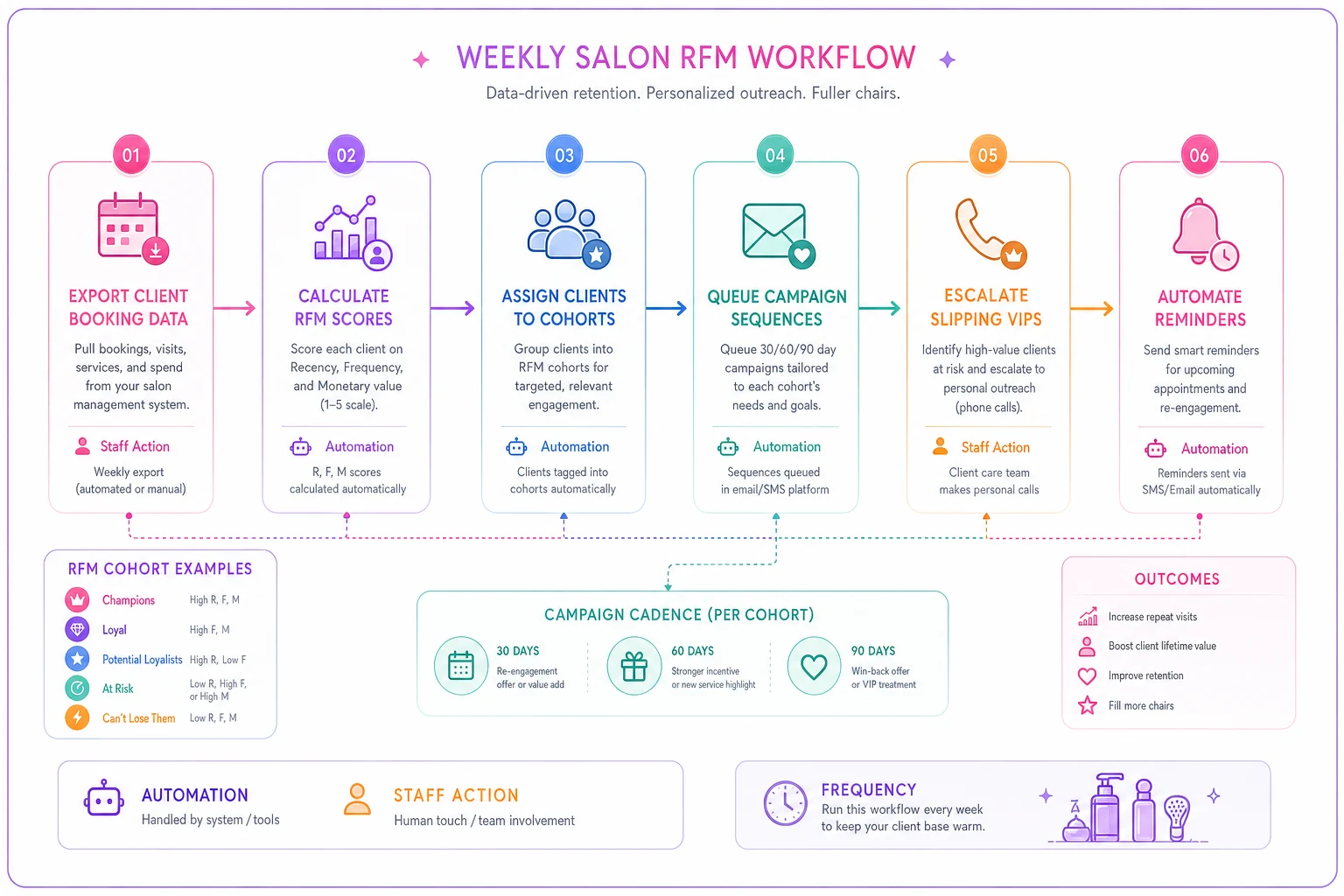
Start manual, then automate the points that save the most time while keeping the human touches where they matter.
Stop asking "how do I get more people to respond to my promo?" and start asking "which clients actually move my revenue, and what does each one need from me right now?" The list you already have will answer that — you just have to sort it.
Ready to simplify your salon operations?
Join 1,000+ salons using Salnly to save time, reduce scheduling chaos, and deliver better client experiences.