

Most salons hemorrhage clients through the simplest gap: stylists finish the service, clients pay, and nobody asks about the next appointment. Not because staff don't care, but because there's no actual process defining when to ask, what to say, or who's responsible.
A salon in Phoenix tracked this for two weeks. Their stylists asked about rebooking maybe 40% of the time. When they did ask, the language varied wildly — sometimes pushy, sometimes apologetic, mostly vague. The receptionist assumed stylists handled it. Stylists assumed reception would catch it at checkout. Result: 68% of clients left without booking, and the salon spent thousands on Instagram ads trying to win them back three months later.
The operational fix isn't motivation or training videos. It's building an actual rebooking workflow with specific timing triggers, exact language, and clear ownership at each step.
Why rebooking falls apart (beyond "we forget to ask")
The rebooking problem looks like forgetfulness but actually stems from process ambiguity. Nobody's clear on who owns the ask, when it should happen, or what exactly to say.
Take a typical color service. The stylist's focused on achieving the right tone while the processing timer counts down. They're thinking about the next client who just texted they're running late. The shampoo assistant takes over for the rinse. Back at the chair for styling, the conversation shifts to maintenance tips and product recommendations. By checkout, three different people have interacted with the client, but rebooking wasn't anyone's specific responsibility at any specific moment.
Even when someone remembers to ask, the approach varies. One stylist asks while blow-drying (client can't hear properly). Another mentions it while removing the cape (client's gathering belongings and distracted). The receptionist asks at payment (client's focused on the total and whether to tip on the card or cash).
The variation creates inconsistent results. Some clients book because their regular stylist always asks at the mirror reveal when they're admiring the result. Others slip through because today's stylist got pulled into a color consultation mid-blowdry and forgot.
Without clear process ownership and timing rules, rebooking becomes optional. Optional tasks in busy salons don't happen.
The 4-touch rebooking sequence that actually gets followed
The exact rebooking workflow that's lifted rebook rates by 20-35% in salons that actually implement it:
Stop losing appointments in the chaos.
Salnly helps you book, confirm & manage every appointment—efficiently.
- Centralized appointment management
- Client notifications
- Calendar & staff scheduling
No credit card required
Touch 1: During the service (stylist owns this) Timing: While styling, not during chemical processing Script: "Your hair grows pretty quick/slow through here [touch the area]. I'm thinking 5-6 weeks would keep this shape perfect. Does that timeline usually work with your schedule?" This plants the seed without pressure. You're discussing timing, not selling. The physical reference point (touching where it grows fastest) makes it tangible.
Touch 2: At the reveal (stylist owns this) Timing: Immediately after showing the back with the mirror Script: "This color will evolve beautifully over the next few weeks. To keep it this vibrant, we should see you back first week of February. Want me to have Sarah hold your usual Saturday?" Notice the assumptive but soft language. "We should see you" not "you need to come." Mentioning their usual day shows you remember their preferences.
Touch 3: During checkout (receptionist owns this) Timing: After running the card, before handing the receipt Script: "Did [stylist name] get you scheduled for your next visit? I can grab you the same slot if that works." This isn't redundant — it's a safety net. The receptionist isn't re-selling; they're confirming. If the client already booked, perfect. If not, it's positioned as helpful, not pushy.
Touch 4: The follow-up (system owns this) Timing: 3 days post-visit Message: "Hi [name]! Quick reminder that we're booking into late January now. Reply YES if you'd like me to grab your spot for [specific date around their timeline]." This catches anyone who needed to check their calendar. The specific date removes friction — they just reply YES rather than negotiating timing.
When mentioning weeks, reference a physical touch point—clients respond better to concrete cues.
Visualize this flow to share during training.
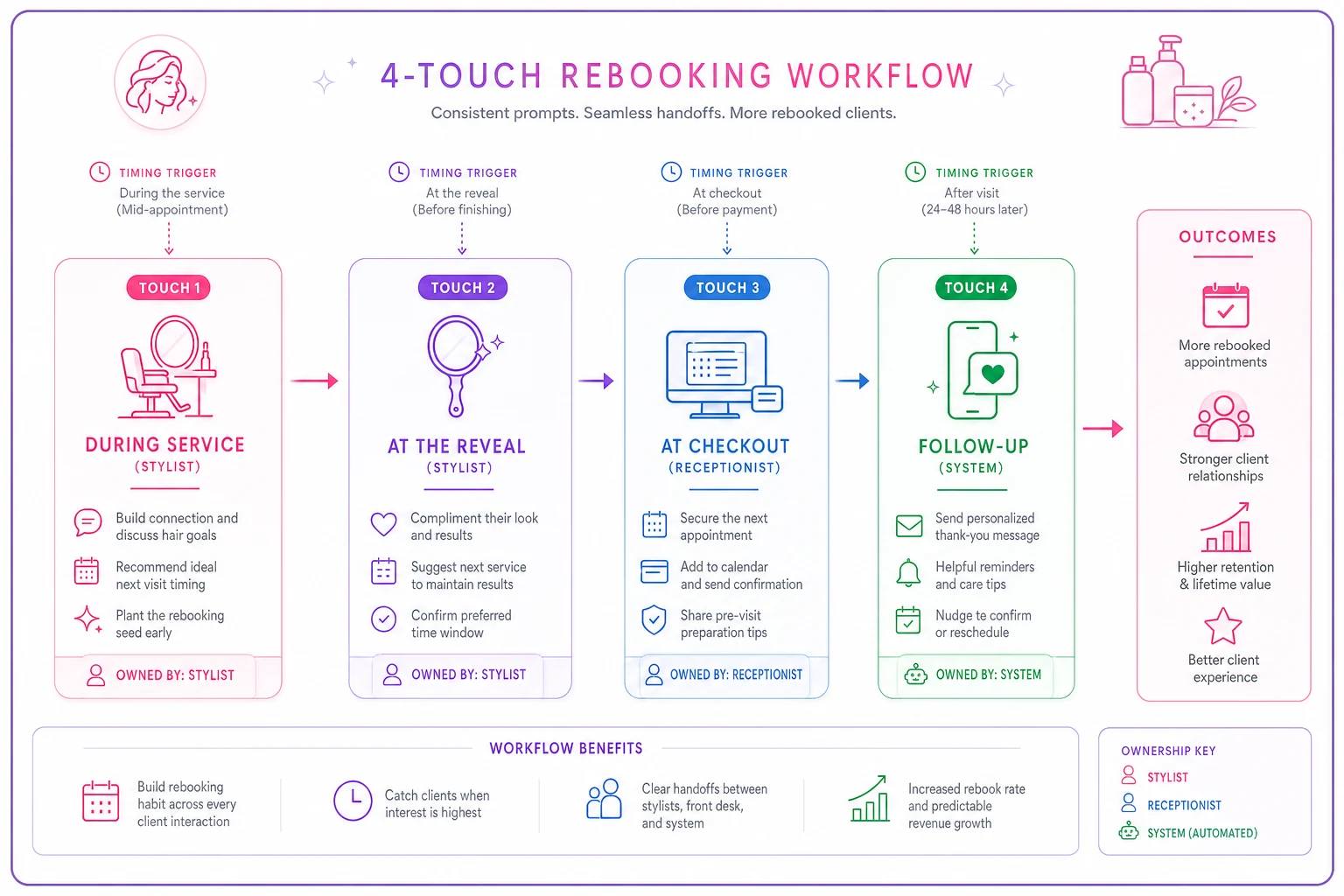
Use this visual in team training.
Exact booking screen fields that prevent rebooking failures
The rebooking conversation means nothing if the appointment doesn't get entered correctly. These fields need to be mandatory in your booking system:
Required fields:
-
Rebook status
"Booked" / "Declined" / "Will call"
-
If declined
Reason (select from list: checking schedule, prefers to call, spacing out appointments, trying another salon, financial, moving)
-
If booked
Appointment ID of next visit
-
Preferred frequency
Weeks between visits (auto-populate from history)
-
Preferred booking window
How far ahead they typically book
| Required fields |
|---|
| Rebook status: "Booked" / "Declined" / "Will call" |
| If declined: Reason (select from list: checking schedule, prefers to call, spacing out appointments, trying another salon, financial, moving) |
| If booked: Appointment ID of next visit |
| Preferred frequency: Weeks between visits (auto-populate from history) |
| Preferred booking window: How far ahead they typically book |
Why each field matters:
The rebook status forces accountability. Staff can't just skip the conversation — they have to record an outcome.
Decline reasons reveal patterns. If 30% select "financial," you might need a maintenance service at a lower price point. If many choose "checking schedule," your follow-up text becomes critical.
Linking the appointment ID creates a data trail. You can track if rebooked appointments actually happen or get cancelled.
Preferred frequency helps stylists give accurate timing. A client who comes every 4 weeks shouldn't get pushed to 8-week intervals just because that's the salon's default suggestion.
Manager QA: the inspection points that ensure this actually happens
Creating scripts without accountability is useless. The manager inspection system that makes rebooking processes stick:
Daily spot checks: Each day, managers review 5 random completed appointments from yesterday:
-
Check the booking system for rebook status
-
If marked "declined" or "will call," text the client directly: "Hi! Just making sure [stylist] offered to schedule your next appointment. Need help finding a good time?"
-
Track which stylists consistently have lower rebook rates
Weekly team huddle review:
-
Share rebook percentages by stylist (not to shame, but to identify who needs help)
-
Role-play the scripts with whoever's struggling
-
Review any client complaints about pushy rebooking (adjust if needed)
Monthly deep dive:
-
Pull rebook rates by service type
-
Compare rebook rates to actual return rates (did they show up?)
-
Calculate revenue impact
rebooked clients vs. those who book themselves later
One salon discovered their newest stylist had a 85% rebook rate while their veteran had 45%. Turned out the veteran thought rebooking was "pushy" and only mentioned it casually. Five minutes of role-play and clear expectation-setting brought her to 70% within two weeks.
Role-play scenarios: handling the tricky responses
Scripts fail when clients don't follow the script. How to handle real responses:
Scenario 1: "I'll call when I need to come in" What NOT to say: "Are you sure? We get really booked up." Better response: "Totally understand! I'll make a note that you like to book closer to time. Just so you know, we're usually booking out about 3 weeks now. Would you like me to send you a reminder text in about 5 weeks so you don't miss your window?"
Scenario 2: "I'm trying to stretch out my appointments" What NOT to say: "But your roots will really show." Better response: "I get it, lots of my clients are spacing things out right now. What if we scheduled a root touch-up in 8 weeks instead of the full color? Keeps you looking fresh for about half the cost."
Scenario 3: "Let me check with my husband/partner" What NOT to say: "You can always cancel if it doesn't work." Better response: "Of course! How about I pencil you in for your usual Saturday in 6 weeks, and you can confirm by Thursday? That way the spot's held but you're not committed."
Scenario 4: "I might be switching to someone closer to home" What NOT to say: Nothing (letting them walk out) Better response: "I totally understand convenience matters. If you do decide to switch, would you mind letting me know what made the difference? And if you ever want to come back for special occasions, we'd love to see you."
The business case: what 15% better rebooking actually means
Model this with real numbers. Say your salon sees around 800 appointments monthly. Current rebook rate sits at 45%. Average ticket is $85.
At 45% rebooking:
-
360 clients rebook
-
440 need reactivation marketing
-
Reactivation cost
$12 per client average (ads, discounts, time)
-
Monthly reactivation spend
$5,280
Lift rebooking to 60%:
-
480 clients rebook
-
320 need reactivation
-
Monthly reactivation spend
$3,840
-
Savings
$1,440 monthly / $17,280 annually
But that's just cost savings. The revenue impact is bigger. Rebooked clients show up 85% of the time. Self-booked clients who "will call later" show up maybe 60% (and often after 10+ weeks instead of 6).
-
102 kept appointments (85% show rate)
-
$8,670 monthly revenue
-
Versus maybe 72 eventual self-books (60% of 120)
-
Gap
30 lost appointments monthly
-
Revenue impact
$2,550 monthly / $30,600 annually
Combined impact: $47,880 in saved marketing costs and protected revenue. For a workflow that takes literally 30 seconds per client.
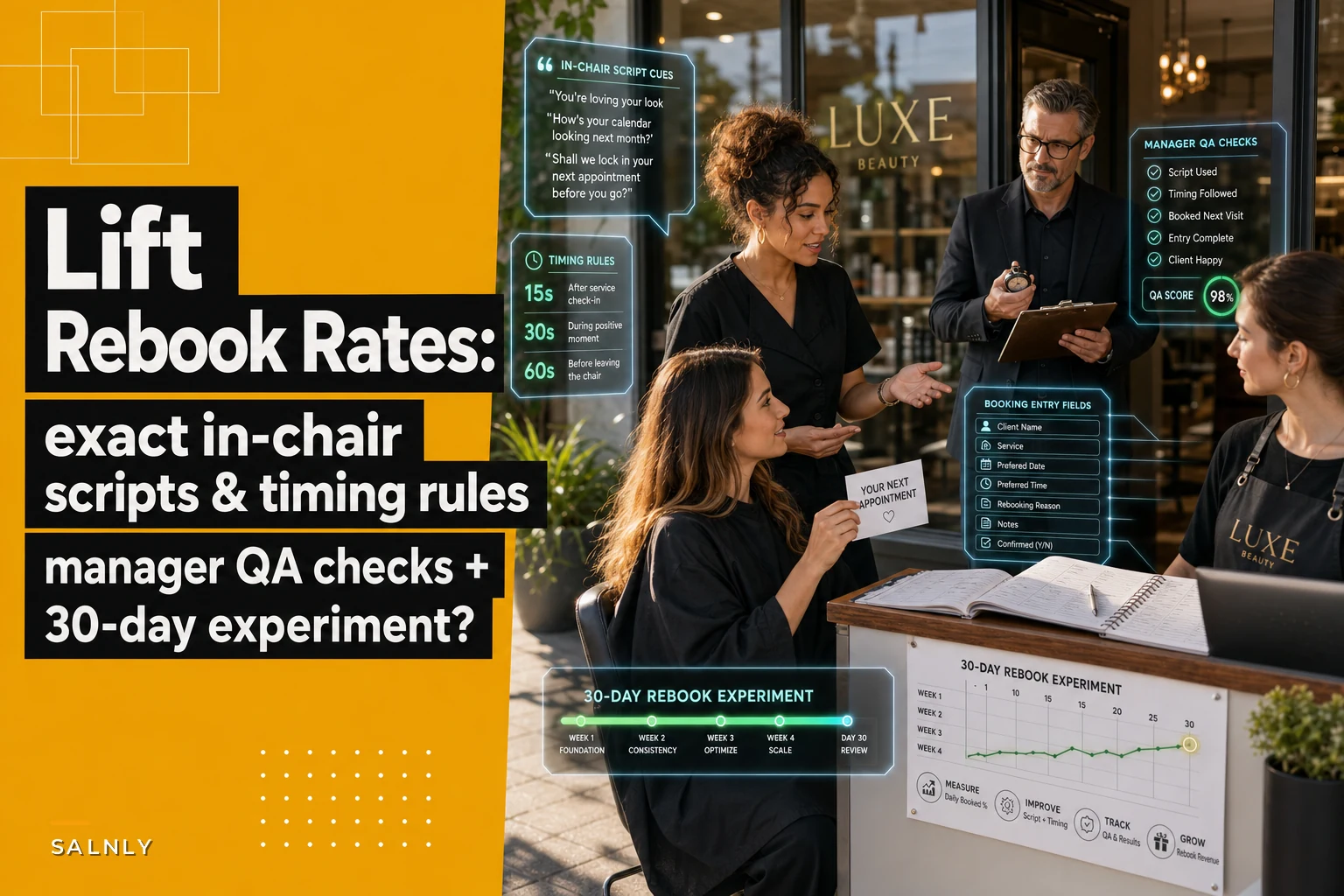
Your 30-day rebooking experiment template
Week 1: Baseline measurement
-
Track current rebook rate (don't tell staff you're measuring yet)
-
Note which stylists naturally rebook well
-
Document current language being used
Week 2: Implementation
-
Monday
All-hands meeting to introduce the process
-
Tuesday-Wednesday
Role-play practice during slow periods
-
Thursday
Go live with the new system
-
Friday
First QA spot checks
Week 3: Refinement
-
Daily spot checks continue
-
Adjust scripts based on what's working
-
Address stylist resistance individually
-
Start tracking decline reasons
Week 4: Accountability
-
Post daily rebook rates where staff can see
-
Celebrate improvements (not perfection)
-
Calculate early revenue impact
-
Decide on permanent QA rhythm
Success metrics to track:
-
Rebook rate by stylist
-
Rebook rate by service type
-
Decline reasons distribution
-
Follow-up text conversion rate
-
Actual return rate of rebooked clients
-
Revenue per appointment (rebooked vs. self-booked)
Warning: Some stylists will resist this initially as "salesy." Key response: "We're not selling anything extra. We're helping clients maintain what they already decided they want. The pushy thing is letting them leave without a plan and then bombarding them with marketing texts later."
When rebooking structure meets actual tracking
Most rebooking failures aren't about motivation or sales skills. They're about process gaps — unclear ownership, inconsistent timing, and no accountability mechanism.
The salon rebooking scripts and workflow outlined close those gaps. But the real shift happens when you connect this process to data. Which salon KPIs actually move profitability becomes clear when you track rebook rates alongside lifetime value and visit frequency.
For salons running membership programs, the rebooking process becomes even more critical. Members who don't rebook tend to pause or cancel within 90 days. The rebooking conversation maintains the relationship momentum that makes memberships profitable.
An AI-powered booking platform can automate the follow-up touches and QA tracking, but the in-chair conversation still needs human execution with clear process ownership. The best systems combine structured human touchpoints with automated safety nets — texts for those marked "will call," dashboard tracking of stylist performance, and automatic flag when rebook rates drop below threshold.
The difference between salons that maintain 60%+ rebook rates and those stuck at 30% isn't talent or market position. It's having an actual process that gets inspected, measured, and improved continuously. The scripts and structure work because they remove ambiguity about who does what, when.
Your clients want to look good consistently. Your business needs predictable revenue. Rebooking is the operational bridge between both needs.
Stop treating it as optional and build the structure that makes it automatic.
Ready to simplify your salon operations?
Join 1,000+ salons using Salnly to save time, reduce scheduling chaos, and deliver better client experiences.