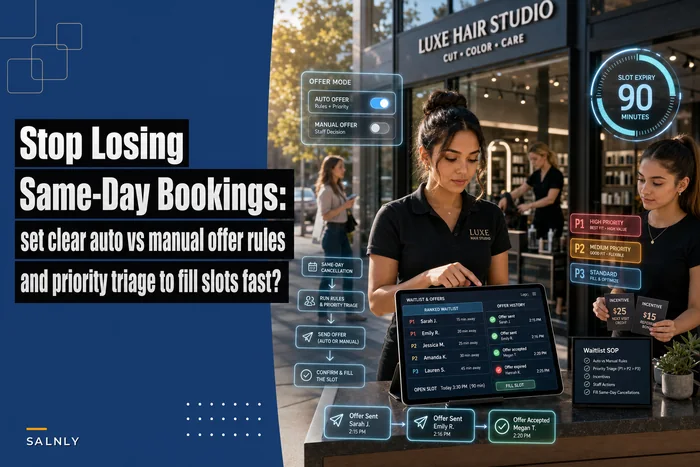



Ask a salon owner how business is going and you'll almost always get a monthly number. Maybe weekly. But almost nobody can tell you what their 2pm–3pm slot on Tuesdays is worth compared to the same hour on Saturdays. That gap — the hour-level blind spot — is where a surprising amount of profit quietly disappears.
The daily view hides everything. A "good day" can be three fully booked stylists in the morning and two people standing around after lunch. The register still totals something decent, so nothing feels broken. Meanwhile rent, utilities, and wages are running across every open hour whether chairs are full or not. Your fixed costs don't care that 11am was slammed. They keep running at 4pm too.
This is what makes time block revenue thinking so useful for salons specifically. Your capacity isn't a warehouse of product you can move whenever demand shows up. It's a perishable grid of chairs × hours. An empty Wednesday 3pm doesn't roll over — it's just gone. Once you start pricing, protecting, and filling hours as individual units rather than lumping everything into daily totals, a whole set of decisions gets a lot clearer.
Why the hour is the real unit of a salon business
A salon doesn't sell haircuts. It sells stylist-hours. Everything else — the service menu, pricing, promos — is just packaging for those hours before they expire.
Think about what you're actually working with. Four stylists, eight-hour days, six days a week — that's roughly 192 stylist-hours a week of sellable capacity. Every one of those hours has a cost baked in: a share of rent, utilities, insurance, front-desk wages, the stylist's pay or booth split. Whether that hour books a $200 balayage or sits empty, most of that cost is already spent.
So the number that actually matters isn't revenue per day. It's revenue per open hour — what each available stylist-hour earns once you divide total revenue by total available hours. Most salons have never calculated it. When they do, it's almost always lower than expected, because the empty hours drag the average down hard.
Two salons can post identical monthly revenue while running completely different businesses underneath. One is slammed at peak and dead the rest of the time. The other has steadier, smoother flow. The second is usually more profitable and less stressful at the same top-line number, simply because it wastes fewer paid-for hours.
Where the leaks actually happen
Break the week into hour blocks and the underperformers tend to fall into the same recurring buckets regardless of salon size or location.
Stop losing appointments in the chaos.
Salnly helps you book, confirm & manage every appointment—efficiently.
- Centralized appointment management
- Client notifications
- Calendar & staff scheduling
No credit card required
-
Structural dead zones. Weekday mid-mornings and early afternoons. Everyone knows Tuesday 10am–1pm is slow, but most salons don't do anything deliberate about it besides hope it picks up.
-
The post-lunch sag. 1pm–3pm on weekdays, where the morning rush is gone and the after-work crowd hasn't arrived. Stylists are present and on the clock, chairs are open.
-
The last hour. The final slot before close books poorly because clients don't want to feel rushed and staff don't want to run late. It quietly gets written off.
-
Mismatched staffing. A senior colorist scheduled through a stretch that only ever fills with quick trims. Expensive hours spent on low-ticket work — or nothing at all.
-
Peak overflow you can't capture. Saturday 11am is turning people away while Thursday 2pm sits empty. That's not a demand problem. That's a distribution problem.
The mistake most owners make is treating all of these the same — usually a blanket discount across the whole week. That trains full-price clients to wait for deals and does nothing to shift demand into the specific hours that actually need it. The fix has to be hour-specific because the problem is hour-specific.
The four levers: pricing, protected slots, micro‑offers, roll‑forward
A working time-block system rests on four parts that support each other. Pull one out and the others get weaker.
1. Hour-tiered pricing
Not every hour is worth the same, so not every hour should cost the client the same. Airlines and hotels figured this out decades ago. Salons have mostly resisted it because it feels awkward. It doesn't have to be dramatic.
| Hour tier | When | Pricing posture | Goal |
|---|---|---|---|
| Peak | Fri PM, Sat, holiday runs | Full price, protected | Maximize revenue per hour |
| Standard | Most weekday afternoons, evenings | Menu price | Steady baseline fill |
| Soft | Weekday mid-mornings, post-lunch, last slot | Value-add, not deep discount | Pull demand forward, fill capacity |
The key distinction: you're not discounting soft hours so much as adding value to them. A price cut signals "cheap." A free 10-minute scalp treatment or a bundled blowout for booking a Tuesday 11am feels like a perk. Same margin math, completely different message to the client.
2. Protected slots
This is the counterweight that keeps the pricing lever from cannibalizing your best hours. Protected slots are peak times you refuse to discount — no promos, no codes, no "just this once" exceptions at the desk.
In practice, the failure looks like this: a slow week makes an owner nervous, they blast a 20%-off Saturday promo. It fills, the register looks great. But most of those Saturday clients would've paid full price anyway — Saturday was already your highest-demand block. You didn't create new revenue. You handed a discount to people who were coming regardless.
Protected slots draw a hard line. Hours that already fill themselves stay full-price, always. Your fill efforts get aimed only at the soft hours that genuinely need help. This one rule alone protects more margin than most owners expect.
3. Dynamic micro-offers
Micro-offers are small, targeted, short-window nudges built to fill a specific underperforming block — not a blanket sale. They work because they're precise.
A typical example: it's Monday, Wednesday afternoon is looking thin — three open stylist-hours between 1pm and 4pm. Instead of a generic promo, you send a narrow offer to a narrow group. Maybe color clients who are roughly due for a refresh, offered a bundled add-on if they book that Wednesday window. The offer expires when the slot fills or when Wednesday arrives, whichever comes first.
-
Identify the weak block early in the week, before it's too late to act.
-
Match the offer to the block. A quick-service window gets a quick-service offer — don't try to sell a four-hour color correction into a two-hour gap.
-
Target a small, relevant segment rather than your whole list. This keeps offers away from clients who'd have paid full price anyway.
-
Set a hard expiration so the offer creates urgency and doesn't just linger.
-
Kill the offer the moment the slot fills. Overfilling defeats the point and creates scheduling headaches.
Done right, micro-offers are the opposite of the blanket-discount trap. They move demand into exactly the hours you need it, using the smallest incentive that gets the job done. This connects closely with how you handle same-day gaps — the waitlist SOP for filling cancellations fast is the reactive version of the same instinct, while micro-offers are the proactive one.
4. The weekly roll-forward routine
The first three levers are useless without a regular habit that surfaces problems while there's still time to act. That's the roll-forward: a short weekly review where you look at the upcoming week's grid, not last week's results.
Most salon reporting is a rear-view mirror. The roll-forward flips it. You're asking "which hours next week are already looking soft, and what am I doing about them now?" — not "why was last Tuesday slow?" By the time you're reviewing last Tuesday, it's unrecoverable.
The weekly roll-forward, step by step
Run this every Monday morning, or whatever your slowest admin window is. It takes 20–30 minutes once you've done it a few times.
-
Pull next week's grid. Lay out every stylist-hour for the coming 7 days and mark what's booked.
-
Flag the soft blocks. Anything under roughly 50–60% booked with 5–6 days of lead time gets circled. These are your targets.
-
Check staffing against demand. If a soft block has a senior stylist scheduled with nothing on the books, that's a signal to adjust the roster or aim a higher-value offer at that window.
-
Assign a fill action to each flagged block. Micro-offer? Waitlist outreach? Rebooking reminders? Every soft block leaves the meeting with a specific play attached.
-
Confirm protected slots are untouched. Make sure no promo or exception has crept into a peak hour.
-
Log what you did. Write down which block, which action, and revisit next week to see if it filled.
Here's a simple workflow to run the roll-forward each week.
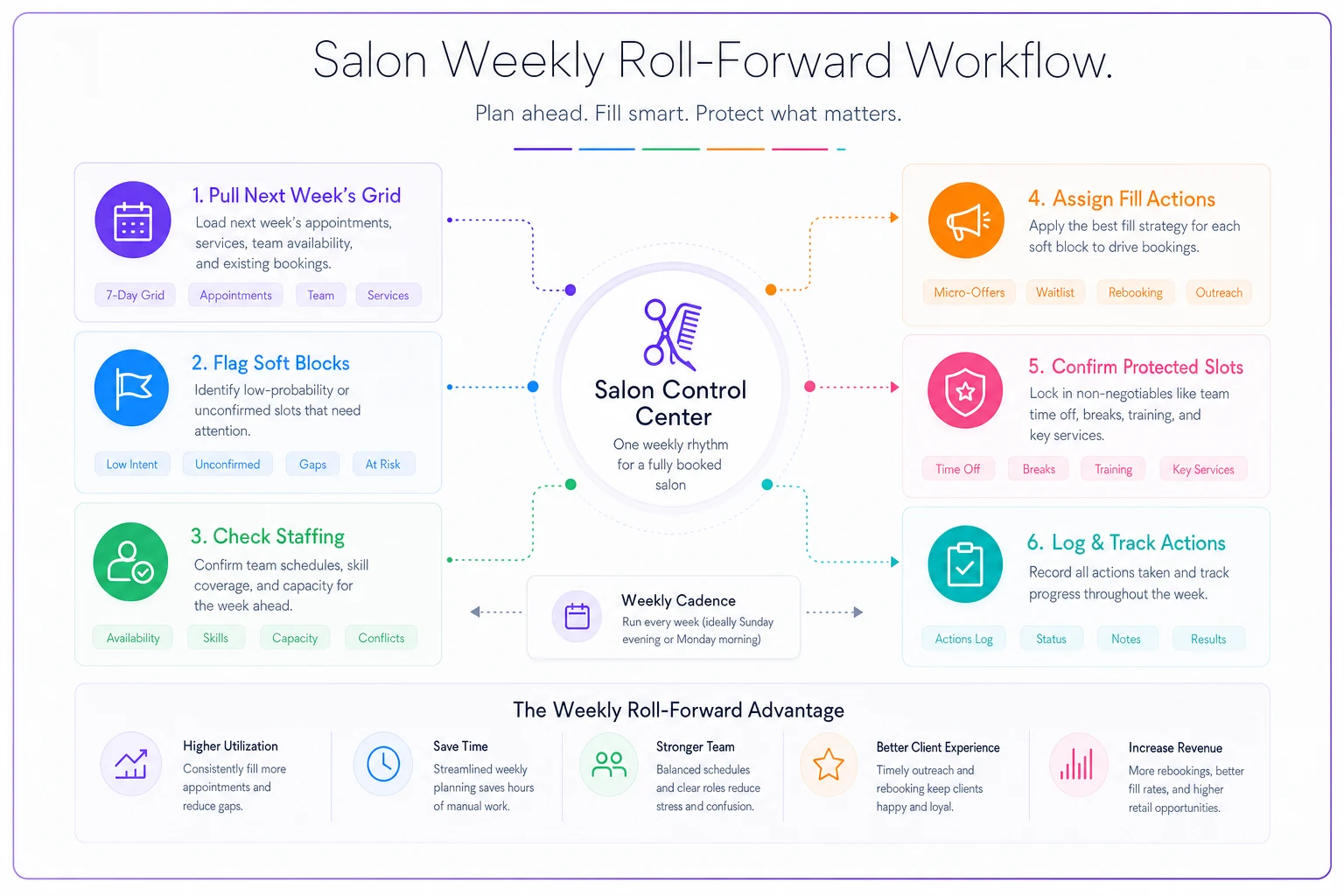
That last step is the one everyone skips and the one that matters most. Over a few months, the log tells you which fill tactics actually work for which blocks. You stop guessing and start running plays you know convert.
The roll-forward pairs naturally with longer-range planning. Where seasonal forecasting sets your rough staffing and stock levels over a 12-week horizon, the weekly roll-forward is the fine adjustment that catches soft hours the forecast can't anticipate.
A real scenario
A mid-sized salon — 5 stylists, somewhere around 330–360 appointments a month — was posting solid monthly numbers but couldn't figure out why margins felt tight. When they finally broke revenue down by hour, things got clear quickly: Saturdays and Friday afternoons were running near full, but weekday 11am–3pm was booking at maybe 40%. Around 20–25 stylist-hours a week were just evaporating.
Their old approach had been a monthly discount email, which mostly ate into Saturday margins without touching the weekday gap at all. They switched. Fridays and Saturdays became protected — full price, no exceptions. The weekday midday blocks got a soft-hour value bundle (a complimentary treatment add-on, not a price cut), and they started running a Monday roll-forward to flag and target the coming week's weak windows with small, segmented micro-offers.
Nothing dramatic happened overnight. But over about two months, weekday midday fill climbed into the 60s and revenue per open hour moved in a way that actually showed on the P&L — a meaningful bump without adding a single stylist or extending hours. Just as important, the Saturday margin bleed stopped because they quit discounting hours that never needed it.
When this makes sense — and when it doesn't
This system earns its keep when you have real, recurring soft blocks and enough demand elsewhere to redistribute. If your Saturdays are jammed and Tuesdays are dead every single week, you've got exactly the imbalance this is built for.
It's also worth the effort once you're past a couple of stylists. At that scale, coordination becomes a real problem — you can't hold the whole grid in your head — and the hour-level view starts paying off quickly. Combined with tighter micro-scheduling rules, it turns a vague sense of "we're kind of slow midweek" into specific, fixable blocks.
When it's a bad idea: if you're fully booked and turning people away across the board, this isn't your bottleneck — pricing and capacity are. Don't build a fill system for a salon that has nothing to fill. Solo operators can probably skip it too; the overhead of hour-tiering and weekly roll-forwards likely outweighs the gain when you already know your own week intimately.
Who should wait: brand-new salons still figuring out baseline demand. You need a few months of booking history before the soft blocks are real patterns rather than startup noise. Trying to optimize hours before you know your rhythm just adds complexity you can't yet use.
Making the grid manageable
The real obstacle isn't understanding any of this — it's the manual work. Pulling next week's grid, flagging soft blocks, matching offers, tracking what filled, keeping protected slots clean. Done by hand every week, it's exactly the kind of routine that gets skipped the moment things get busy — which is precisely when you need it most.
Scheduling and management platforms with built-in automation help here, not by replacing your judgment but by removing the tedium around it. The right system can surface which upcoming blocks are booking soft, flag when a high-value stylist is sitting on empty hours, and hold the line on protected slots automatically instead of relying on the front desk to remember the rule at 5pm on a chaotic Friday. You stay in charge of the strategy; the software keeps the weekly discipline from slipping.
The point of a time-block approach isn't squeezing every last dollar out of every hour — that's a recipe for burned-out staff and annoyed clients. It's about seeing your capacity honestly, protecting the hours that already work, and steadily filling the ones that don't. Once you're looking at the week as a grid of individual hours rather than a stack of daily totals, the leaks stop hiding, and fixing them becomes a routine instead of a scramble.
Ready to simplify your salon operations?
Join 1,000+ salons using Salnly to save time, reduce scheduling chaos, and deliver better client experiences.