



Most salons approach sustainability backwards. They start with the marketing — the "eco-friendly" badge on the website, the compostable cups, the sign about towel reuse — and hope it eventually saves money. It rarely does. You end up spending on green-branded products that cost 15–20% more while your backbar waste, overordering, and color mixing habits stay exactly the same.
A cost‑first approach flips that order. You reduce waste because it's bleeding margin, and then the sustainability story writes itself — backed by real numbers instead of vibes. That's the version that actually holds up when a client asks about it, and the version that shows up on your P&L.
This is the difference between a slogan and a salon sustainability system. One is decoration. The other quietly changes how much product hits the drain every week.
Where the money actually leaks
Before touching suppliers or guest-facing anything, it helps to see where product margin disappears in a typical salon. It's almost never one big thing. It's a dozen small leaks that nobody tracks because each one feels too minor to matter.
-
Over-mixed color. A colorist eyeballs the formula, mixes 90g, uses 60g, scrapes the rest into the bin. Multiply that across a busy day and you're throwing out a meaningful chunk of your most expensive category.
-
Backbar overpour. Shampoo and conditioner pumped by feel, not by hair length or density. Long-hair guests get the right amount; everyone else gets 30–40% too much.
-
Expired stock. Products bought on a distributor promo, tucked in the back, forgotten, tossed at expiry.
-
Retail deadstock. Shelves full of SKUs that sounded good at the trade show and never moved.
-
Foils, single-use everything. Cheap per unit, brutal in aggregate, and increasingly something clients actually notice.
None of these are behavior problems in the "my team is careless" sense. They're measurement problems. Nobody wastes color on purpose. They waste it because there's no par, no standard mix chart, and no feedback loop telling them 90g was 30g too many. When you can't see the leak, you can't plug it.
Why sustainability efforts usually fail in salons
The failure mode is almost always the same: sustainability gets treated as a project instead of something baked into daily operations.
Stop losing appointments in the chaos.
Salnly helps you book, confirm & manage every appointment—efficiently.
- Centralized appointment management
- Client notifications
- Calendar & staff scheduling
No credit card required
Someone gets excited, buys refillable dispensers, sets up a plastic recycling bin, prints a nice sign. For about three weeks the team is enthusiastic. Then a busy Saturday hits, the refill station runs dry, nobody's job description includes topping it up, and it quietly dies. Six months later the dispensers are decorative.
What breaks is coordination. A salon sustainability system touches ordering, mixing, station setup, front-desk scripting, and retail all at once — and if no single workflow owns each piece, all of it drifts back to old habits. These initiatives don't fail because people don't care. They fail because they were never tied to a standard someone is responsible for maintaining.
The second reason they fail: no connection to money. If reducing waste doesn't visibly protect anyone's margin or commission, it stays a nice-to-have that loses every time it competes with a full appointment book.
Start with par and swap rules, not with suppliers
The foundation isn't your vendor list. It's par levels and swap rules — the boring operational spine that makes everything else stick.
Par levels are simply the min/max quantity you keep of each product tied to real service demand, not gut feel. If you've already built a backbar system, this will feel familiar — the backbar and inventory system tied to service demand is the mechanism that stops both overordering and the panic-buy stockouts that make people over-order next time to compensate.
Swap rules are the second half. A swap rule says: when this product runs low or gets discontinued, here's the pre-approved substitute and here's the threshold to switch. Without swap rules, every stockout becomes an improvised decision — someone grabs whatever's on the shelf, waste creeps in, formulas get inconsistent, and clients notice.
Here's a simple way to think about the mix reduction piece:
| Practice | Typical waste | With par + mix chart |
|---|---|---|
| Eyeball color mixing | 20–35% overmix on many services | Standardized grams per length/density |
| "Grab and pump" backbar | 30–40% overpour on shorter hair | Metered by hair type |
| Reorder by memory | Panic buys + expired backstock | Reorder triggers at set thresholds |
| No substitute plan | Random swaps, formula drift | Pre-approved swap tiers |
The mix chart is the highest-ROI move in the whole system.
Color is usually your priciest category, and standardizing grams per head by hair length and density does two things at once: it cuts what goes down the drain, and it makes every colorist's formulas repeatable — which helps consistency and training, not just waste.
A quick workflow map:
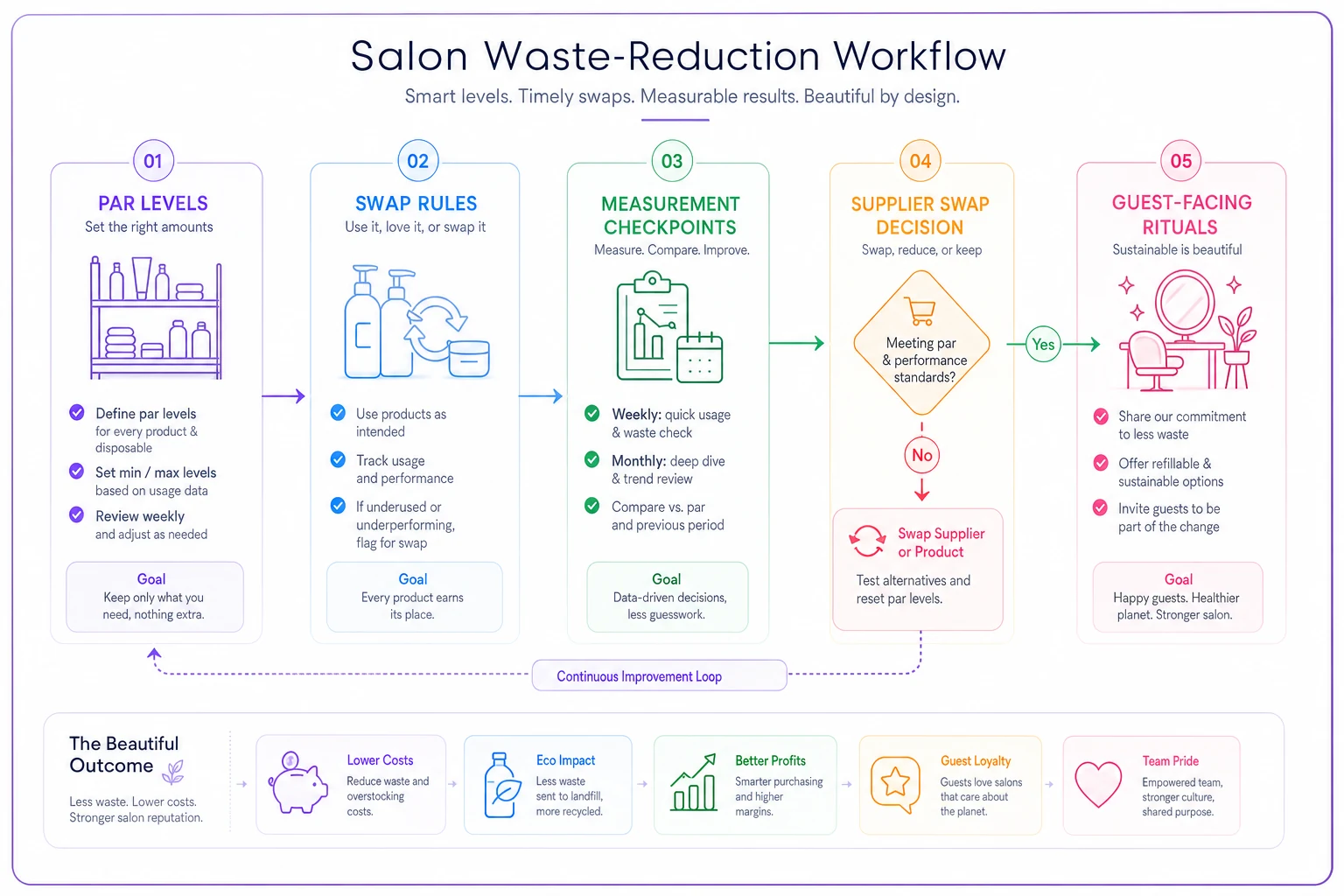
This shows how each operational piece feeds the next.
Supplier swaps: where cost and sustainability actually agree
Once par and swap rules are in place, the supplier conversation gets much sharper — because now you know your real usage instead of guessing.
The trap is swapping to "green" products blindly and eating a 15–20% cost increase. Sometimes that's worth it for a hero product clients actually ask about. Often it isn't. The smarter play is running supplier swaps through the same lens you'd use for any vendor decision: cost per service, consistency, and whether the switch reduces waste upstream.
-
Concentrate or bulk backbar over individual bottles — less packaging, lower cost per use, fewer deliveries.
-
Refillable retail lines where the brand supports it — clients bring the bottle back, you sell the refill at better margin.
-
Recyclable or reduced foil alternatives for color — a visible, guest-facing change that also often prices competitively at volume.
-
Consolidating SKUs so you buy more of fewer things — better pricing tiers and less deadstock.
This is exactly where a supplier scorecard and SKU rationalization process earns its keep. Rating vendors on cost, reliability, and sustainability in the same quarterly review means the eco decision and the margin decision stop competing. You're not choosing between green and profitable — you're scoring both at once and swapping only when the numbers support it.
When a supplier swap makes sense: you've got usage data, the swap holds or improves cost per service, and it's a product either the team touches constantly (backbar) or clients ask about (hero retail).
When it's a bad idea: you're swapping a specialty color line clients are loyal to just to say you're greener, and it introduces formula inconsistency. Don't break a working chemistry to win a marketing point.
Measurement: the part everyone skips
You can't manage waste you don't measure, and this is where most salons quietly give up. But it doesn't require a sustainability consultant or a spreadsheet you'll abandon in a month.
Track three things, monthly:
-
Product cost as a percentage of service revenue. This is your master number. If the system is working, it trends down.
-
Color waste, spot-checked. Once a month, weigh what goes in the color bin over a single day. You don't need it perfect — you need the trend.
-
Deadstock and expiry. What did you throw out because it aged out or never sold?
You don't need continuous measurement to run this. You need periodic measurement that's consistent. A one-day color-bin weigh-in every month tells you more than a fancy tracking system nobody maintains. The goal is a trend line, not a lab.
One mistake to avoid — don't try to measure everything at once. Start with color, because that's where the money is. Get that leak plugged and tracked, then move to backbar and retail. Trying to instrument the whole salon on day one is how measurement efforts die.
Guest-facing rituals: turn the savings into a story
This is the part that ties waste reduction to marketing — and the part most salons do too early. You earn the right to talk about sustainability after the operational work is real. Then the rituals land, because they're true.
A "ritual" is just a small, repeatable, visible moment that signals your values without a lecture. Done well, they cost almost nothing and become part of why clients pick you.
-
The refill moment — a client brings back their retail bottle, you refill it, they save a couple dollars, and it becomes a habit that also locks in repeat retail visits.
-
A one-line consultation mention
"We mix your color to exact measurements, so there's no waste and your formula's always consistent." That single sentence does double duty — it signals precision and sustainability.
-
A visible foil or waste-reduction note at the station, kept low-key.
-
An annual "here's what we saved" moment — pounds of product kept out of the drain, packaging eliminated — shared on social with real numbers.
The connection to retail matters here. Sustainability rituals give your team a natural, non-pushy reason to talk product — which is exactly the kind of station-level habit that a predictable retail system is built to reinforce. The refill conversation is a retail conversation. The waste-reduction story is a differentiation story. When these overlap, sustainability stops being a cost center and starts pulling revenue.
Who should not lead with guest-facing rituals: any salon that hasn't done the backbar and measurement work yet. If a client asks a follow-up question and your "eco" story falls apart, you've spent trust you can't easily rebuild. Build the substance first.
A real scenario
A three-chair color-focused salon was running product cost around 14–15% of service revenue — high enough that the owner assumed it was just "the cost of good color." No mix chart, colorists mixing by eye, backbar pumped by feel, and a back room with a few hundred dollars of aging product nobody was going to use.
They started narrow. Built a grams-per-head mix chart by hair length and density, set backbar dispensers with a metered pump, and put reorder triggers on their top dozen SKUs. No supplier changes yet — just standards and measurement. They weighed the color bin one day a month.
Over roughly a quarter, product cost drifted down toward the 11–12% range. Nothing dramatic month to month — just less overmix, fewer panic reorders, and almost no expiry loss. On their revenue that worked out to a few thousand dollars a year back in margin, plus a color line that was suddenly more consistent across all three chairs.
Then they added the guest-facing layer — a refill program on two hero retail products and the "measured mixing, no waste" line in consultations. Retail on those two SKUs picked up noticeably over the next couple months, and a handful of new clients specifically mentioned the sustainability angle when booking. The marketing worked precisely because the operations were already true.
Putting it together
The order is the whole point. Most sustainability efforts collapse because they start at the visible end — the sign, the badge, the branded product — and never touch the workflows where waste actually lives. A cost‑first system runs the other direction: par and swap rules first, then supplier decisions scored on cost and sustainability, then simple periodic measurement, and only then the guest-facing rituals that turn all of it into a differentiator.
Do it in that sequence and each layer supports the next. Par levels give you real usage data. Usage data makes supplier swaps smart instead of expensive. Measurement proves the savings. And the rituals — refills, consistent formulas, an honest annual number — give clients a reason to choose you that competitors down the street can't fake because they haven't done the work.
That's a salon sustainability system worth building. Not because it looks good on the website, but because it protects your best margin category, tightens your operation, and hands your front desk a story that's actually true.
Ready to simplify your salon operations?
Join 1,000+ salons using Salnly to save time, reduce scheduling chaos, and deliver better client experiences.