



Most salon owners assume the hard part of scaling is opening the next location. It isn't. The hard part is that the informal coordination habits that quietly held everything together — a group chat, a founder who "just knows," a spreadsheet only one person understands — stop working somewhere around the fifth unit. Not because those habits are bad, but because they don't scale linearly. They scale until they don't, and then they fail all at once.
Governance is the boring word for the thing that fixes this. It's the set of rules that decide who owns what, which decisions are made centrally versus locally, how you measure each unit against the others, and what has to be true before you're allowed to open the next door. Get this right and the sixth, seventh, and eighth locations feel repeatable. Get it wrong and every new location adds chaos faster than it adds revenue.
This is a systems article, not a tips list. The goal is to show you how the pieces connect — SOP ownership, KPI rollups, regional roles, adoption gates — and where the whole thing tends to snap when owners scale past five.
The real failure isn't operational — it's ownership ambiguity
When a salon group has three locations, the founder is usually still the connective tissue. They visit each shop weekly, they know every manager by name, and when something's off, they feel it before a report tells them. That works because the span of control is small enough for one brain.
At six locations, that same founder is now stretched across too many units to feel anything in real time. What tends to happen across multi-unit operators is that the breakdown rarely shows up as a dramatic collapse. It shows up as drift. One location quietly stops doing consultations the "right" way. Another manager reinterprets the refund policy. A third starts running its own promos because nobody said no fast enough. None of these are disasters on their own. Together, they mean you no longer run one brand — you run six similar-but-different businesses under one logo.
The root cause is almost always the same: nobody wrote down which decisions belong to headquarters and which belong to the location. Everyone assumed it was obvious. It was obvious when the founder was in the room. It stopped being obvious the moment they weren't.
So before you touch KPIs or roles, you have to solve the ownership question. That's what a central-vs-local rubric is for.
Central vs local: a rubric for deciding what to standardize
The instinct when things get messy is to centralize everything. That's a mistake. Over-centralize and your managers become order-takers who stop thinking, your best locations get dragged down to the average, and headquarters becomes a bottleneck for decisions that should take ten seconds locally.
Stop losing appointments in the chaos.
Salnly helps you book, confirm & manage every appointment—efficiently.
- Centralized appointment management
- Client notifications
- Calendar & staff scheduling
No credit card required
The opposite — letting each location run itself — is what caused the drift in the first place.
A useful way to think about it: centralize anything that protects the brand, the client's safety, or the numbers you report on. Localize anything that responds to a specific market, team, or client base. If a wrong decision could damage the brand across all locations, it belongs at the center. If it only affects one shop's day, it belongs local.
| Decision area | Central (HQ owns) | Local (manager owns) |
|---|---|---|
| Service menu & core pricing | Yes — protects margin and brand consistency | Location can request regional add-ons |
| Consultation & safety SOPs | Yes — legal and brand risk | No |
| Refund & service-recovery limits | Policy set centrally | Manager approves within a dollar cap |
| Staff scheduling & rostering | Framework and rules | Day-to-day roster |
| Local promos & community events | Guardrails and blackout rules | Execution and timing |
| Retail assortment | Core SKUs mandated | Regional tier flexibility |
| Hiring standards & scorecards | Yes | Interviewing and selection |
| Brand voice on reviews & social | Templates and rules | Local responses within template |
Define clear local decision zones so managers can act without waiting on HQ.
The point of the rubric isn't the specific rows — it's that every category gets an explicit owner. What breaks multi-unit groups is the gray zone: decisions nobody clearly owns, so they get made inconsistently or not at all. A large chunk of "why is this location different" problems disappear the moment you assign every category to exactly one owner and write it down.
If you're still figuring out which SOPs belong where at the 2–5 location stage, the multi-location salon playbook on which SOPs to centralize is the right groundwork before you layer on the heavier governance this article describes.
KPI rollups: why your dashboards stop telling the truth at scale
At three locations, you can eyeball performance. At six-plus, you're drowning in numbers, and the ones you look at are usually the wrong ones — or worse, they're not comparable across shops.
The classic failure here is comparing raw totals. Location A did $92k last month, Location B did $61k, so Location A is your star? Not if Location A has nine stations and B has four. Not if A sits in a downtown corridor with three times the foot traffic. Raw numbers at scale are noise. What you need are normalized, rolled-up metrics that let you compare a four-chair suburban shop against a nine-chair flagship on equal footing.
A rollup template works in layers. Each location reports the same handful of core metrics in the same format. Those get normalized — per station, per stylist hour, per available chair-hour — then rolled up into a regional view, then into a group view. The value isn't the top-line number. It's that you can drill from "the group's rebook rate slipped" down to "it's actually one location dragging the East region."
The metrics worth rolling up for a multi-unit salon group usually fall into four buckets:
-
Capacity utilization — revenue per available chair-hour, prebooked percentage of next week's capacity. This tells you if you're filling the seats you're paying rent on.
-
Client health — rebook rate, new-client retention at 90 days, reactivation success. This predicts revenue two to three months out.
-
Financial efficiency — payroll as a percent of service revenue, retail attach rate, average ticket. This tells you if growth is profitable or just bigger.
-
Operational discipline — no-show rate, consultation completion, SOP adherence spot-check scores. This is your early warning system for drift.
A common mistake is measuring twenty things. You don't need twenty. You need the six to eight that actually move profit and that a manager can influence with daily actions — covered in more depth in the breakdown of which salon KPIs actually move profitability. Everything else is a report you'll stop reading by month two.
Where this gets operationally heavy
The hidden cost of KPI rollups isn't the metrics — it's the data collection. If every location manager is manually pulling numbers into a spreadsheet on the 3rd of every month, you'll get late data, inconsistent definitions, and quiet fudging. By location six, that manual process alone can eat a full day of someone's week.
Here's a quick visual of the KPI rollup workflow.
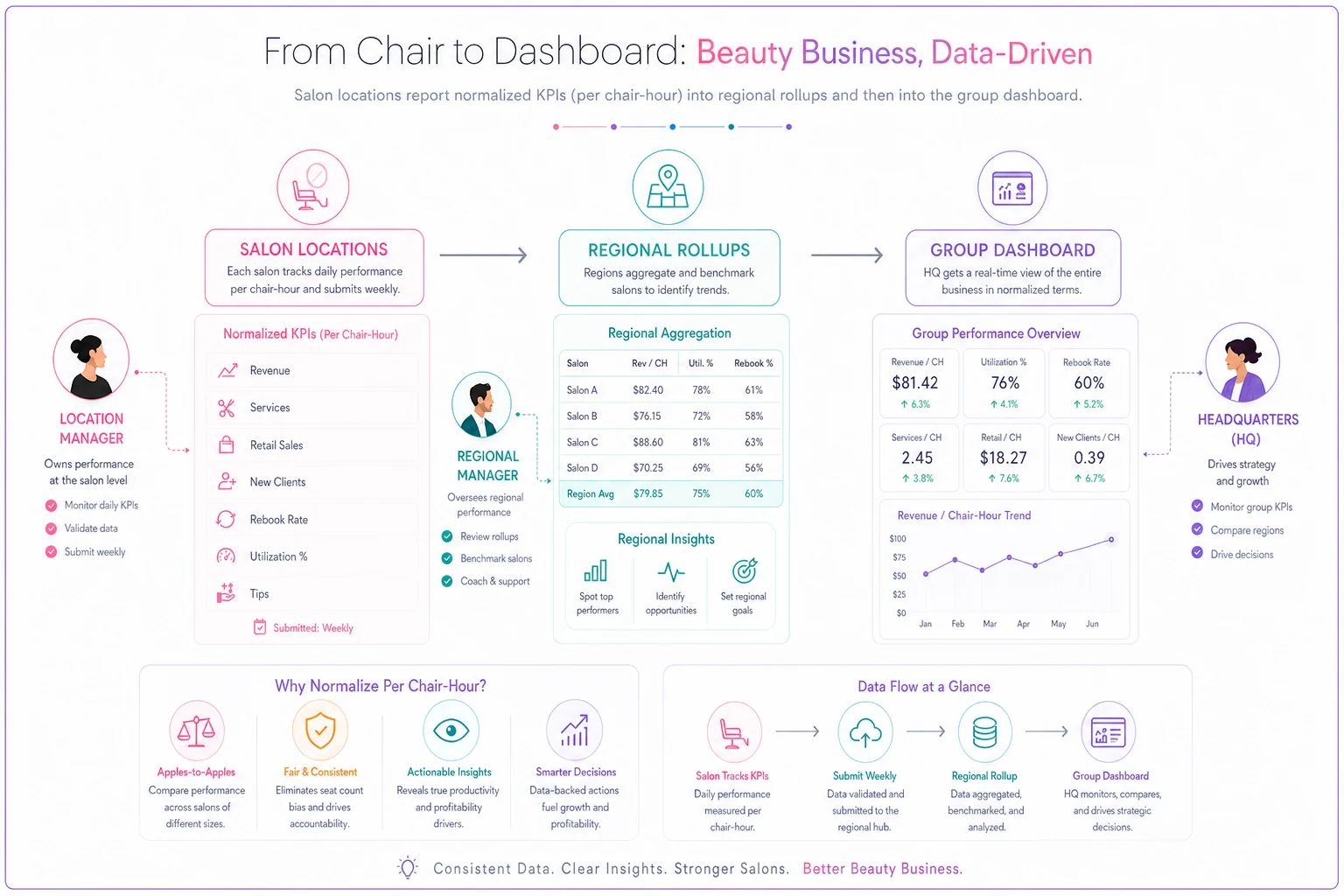
This is where operational software that pulls booking, payroll, and retail data into one normalized view earns its keep — not because dashboards are exciting, but because it removes the human step where numbers get delayed or massaged. When the rollup is automatic, managers spend their time acting on the numbers instead of assembling them. That's the difference between a dashboard you glance at and one you actually run the business from.
Regional roles: the layer most groups add too late
Somewhere between five and eight locations, the founder can no longer be the direct manager of every location manager. The math is simple: too many direct reports means nobody gets real attention. The answer is a regional layer — but this is where owners consistently get the sequencing wrong.
-
Promoting your best stylist into a regional role because they're loyal. A great stylist is not automatically a great multi-unit operator. The regional job is about coaching managers, reading rollup data, and enforcing standards — a completely different skill set.
-
Adding the regional role too late, after drift has already set in, so the new regional manager spends their first six months cleaning up inconsistency instead of driving performance.
A regional manager's job is narrow and should stay that way: they own the KPI rollup for their cluster, coach location managers, and act as the enforcement layer for central SOPs. They're the reason a standard actually gets followed instead of just existing in a document nobody reads. Think of them as the connective tissue that used to be the founder's personal presence, now built into a repeatable role.
A workable span is roughly one regional manager per three to five locations. Cross that threshold and you're back to the same problem you were trying to solve. The signal that you need this layer isn't a location count — it's when you're making the same correction at multiple shops and it isn't sticking. That's the founder trying to be in six places at once and losing.
Adoption gates: the discipline that keeps rollouts from silently failing
There's a pattern that quietly kills scaling groups: headquarters rolls out a new SOP — a new consultation flow, a new retail process — and assumes that because it was announced, it's happening. Six weeks later, spot-checks reveal two locations do it correctly, two do a watered-down version, and two never started.
The fix is adoption gates. An adoption gate is a defined checkpoint where you verify a change is actually live and working before you move on to the next initiative or open the next location. It's the difference between "we launched it" and "it's adopted." Rolling out change across multiple locations without gates is how you accumulate half-finished initiatives that all technically exist but none of which actually run.
The principle: you don't scale a change until it clears the gate at a pilot location. Run it at one or two shops, verify adoption with real evidence — not just the manager's word — fix what broke, then roll to the rest. This same discipline shows up in the 8-week SOP change-management playbook with training sprints and adoption gates. At six-plus locations, that discipline stops being optional and becomes the only thing keeping your standards from fracturing.
A real scenario: a six-location group that was scaling chaos
A salon group in the Southeast had grown from three to six locations in about eighteen months. Revenue was up — roughly $4.1M across all units — but the founder felt increasingly out of control. Two locations were consistently strong, two were fine, and two were quietly leaking money nobody could fully explain.
Once the problems were mapped, they were all governance problems:
-
No central-vs-local rubric, so each manager had reinterpreted the refund and rebooking policies differently. One location was giving away roughly $2k–$3k a month in unauthorized service redos.
-
KPI reporting was a monthly spreadsheet compiled by hand, arriving about ten days late, with each manager defining "rebook rate" slightly differently — so the numbers weren't even comparable.
-
No regional layer. The founder was the direct manager of all six locations and was, understandably, burned out.
The fix took a few months and wasn't glamorous. They wrote a one-page central-vs-local rubric and assigned an owner to every decision category. They standardized six core KPIs with a single definition each and moved the rollup off manual spreadsheets so the numbers came in weekly, normalized per chair-hour. They promoted one strong operator into a regional role over the three weakest locations, with a clear mandate: own the rollup, coach the managers, enforce the SOPs.
The measurable change over the following two quarters wasn't a revenue explosion — it was the leak stopping. The two weak locations' payroll-to-revenue ratio came back into line, unauthorized redos basically disappeared, and prebooked capacity across the group improved by a noticeable margin because rebook standards were finally consistent. The founder, for the first time in about a year, could take a week off. That last one mattered more than any single metric.
The reusable launch checklist for opening location six and beyond
Once your governance layer exists, opening the next location should feel like running a known play, not improvising. Before you open, this should all be true:
-
[ ] Central-vs-local rubric is documented and the new location's manager has read and acknowledged it
-
[ ] All core SOPs (consultation, safety, refund, rebooking, retail) are in the new location's onboarding, not just "known"
-
[ ] The location is assigned to a region with a regional manager who has capacity for it
-
[ ] KPI reporting is wired in from day one — the location appears in the rollup before it opens, even at zero
-
[ ] Adoption gates are defined for the first 90 days, with checkpoints at 30, 60, and 90
-
[ ] Manager hired and trained against the standard hiring scorecard, not hired in a rush
-
[ ] Payroll-to-revenue and break-even targets are set for the location before opening, not backfilled later
-
[ ] A named person owns each of the above — no unowned items
The single most common thing missing from this list in real groups is the last line. Every failed multi-unit launch has at least one critical item that everyone assumed someone else owned.
When heavy governance is a mistake
Worth saying plainly: not every group needs this. If you have two or three locations and the founder can still be genuinely present at each, adding regional managers and formal rollup templates is premature overhead. You'll be paying for structure you don't need and slowing down decisions that used to take seconds.
Governance scales with complexity, not ambition. Build the rubric early because it's cheap and it prevents drift. But don't add the regional layer, the formal adoption gates, and the automated rollups until the pain of not having them is real — usually right around the point where you feel yourself becoming the bottleneck. If you're adding structure because it sounds professional rather than because something is actually breaking, you're probably too early.
The owners who scale past five locations cleanly aren't the ones with the fanciest systems. They're the ones who made ownership explicit before it got ambiguous, measured the right handful of things consistently, and refused to open the next location until the last one was actually running the way it was supposed to.
The governance isn't the goal — it's the thing that lets the growth stop being fragile.
Ready to simplify your salon operations?
Join 1,000+ salons using Salnly to save time, reduce scheduling chaos, and deliver better client experiences.