


Nobody warns you when you expand past one location that your training "system" was never actually a system. It was you. It was the senior stylist who happened to be good at explaining balayage. It was the way things got absorbed because everyone worked in the same 1,200 square feet and bad habits got corrected in real time.
Take that same team and split it across three locations, and something quietly breaks. The stylist you certified at Location A is doing color corrections completely differently than the one at Location C, and neither of them is technically wrong — they just learned from different people, on different days, under different pressure. Multiply that by a few years and you end up with what a lot of multi-site owners describe as "the same brand that doesn't feel like the same brand."
This article is about building a salon training certification pipeline that survives scaling — one with actual structure behind it: modular training, mentor ratios that don't collapse, certification gates that mean something, and audits that catch skill drift before a client does.
The real problem isn't training — it's propagation
Most salons can train one person reasonably well. What they can't do is reliably propagate a skill from the person who has it to everyone who needs it, across locations, without the skill degrading on the way there.
Think of it like a photocopy of a photocopy. Your best educator teaches a senior. The senior teaches a mid-level during a busy Saturday. The mid-level, six months later, shows a new hire "how we do it here" — except now it's three copies removed from the original standard, and nobody audited any step of it. Each handoff loses a little fidelity, and nobody notices because everything still looks fine on the surface.
The training problem tends to get misdiagnosed as a hiring problem. Owners assume they're bringing in weaker stylists. Usually they're not. They're running an uncontrolled copy chain where quality erodes with every informal handoff. The fix isn't stricter hiring — it's controlling how skill moves through the organization.
That's the whole point of a pipeline. Not "we train people." A defined path where a skill enters at a known standard, moves through controlled checkpoints, and comes out verified — the same way at every site.
The four parts that actually make a pipeline hold
A real certification pipeline has four load-bearing components. Pull any one out and the whole thing sags at scale.
Stop losing appointments in the chaos.
Salnly helps you book, confirm & manage every appointment—efficiently.
- Centralized appointment management
- Client notifications
- Calendar & staff scheduling
No credit card required
| Component | What it controls | What breaks without it |
|---|---|---|
| Modular training | What gets taught, in reusable units | Everyone teaches a different version from memory |
| Mentor-to-trainee ratios | How much attention each trainee gets | Mentors burn out, trainees get neglected, quality drops |
| Certification gates | When someone is allowed to do a service solo | Unready stylists on paying clients, inconsistent skill |
| Knowledge audits | Whether skills hold over time | Silent drift — certified people slowly getting worse |
The mistake most owners make is building one of these and assuming it's enough. They write a beautiful curriculum and then let a stressed senior "mentor" four people at once with no gate and no audit. Six months later the curriculum is a PDF nobody opens and skill level is back to being a function of whoever happened to be nearby.
Modular training: build once, deploy everywhere
The core idea behind modularity is that you break every skill into a self-contained unit that can be taught by anyone certified to teach it — not just the one person who invented your approach.
A module isn't a vague topic like "color." It's a tight, defined chunk: root shadow application on previously highlighted hair. Each module should have:
-
A short written standard (what "correct" looks like)
-
A demo component (watch it done to standard)
-
A supervised-practice component (do it with someone watching)
-
A pass/fail checkpoint tied to specific, observable criteria
Modules matter for multi-site because they decouple the skill from the teacher. Once "root shadow on highlighted hair" is a module with clear criteria, it doesn't matter whether the educator at Location B taught it or the one at Location D — the trainee learns the same thing to the same standard.
Schedule module refresh sessions after audits to keep standards current.
One thing worth noting: salons that modularize tend to discover their menu is bloated. When you sit down to define each service as a teachable unit, you realize three of your "signature" treatments are basically the same technique with different names. Modularizing training quietly forces a menu audit, which is a side benefit most owners don't expect.
If you've already built a week-by-week structure, this is the natural evolution of it. The difference between a repeatable training curriculum with a skills matrix and daily drills and a true pipeline is that the curriculum tells you what to teach in order — the pipeline adds the gates, ratios, and audits that keep it honest as you add locations.
Mentor-to-trainee ratios: the quiet thing that collapses first
This is a failure almost every scaling salon hits. The pipeline looks great on paper, but one educator is effectively mentoring everyone. Ratios get ignored because mentoring doesn't show up on the schedule as "real" work the way a booked client does.
In practice, this usually happens when a star senior gets promoted to "educator" but keeps a full column of clients. Now they're supposedly mentoring three trainees while running a $1,800 Saturday. Guess which one gets attention. The trainees get drive-by feedback between blow-drys, and the certification gate becomes a rubber stamp because nobody actually watched them work.
-
Foundational modules (shampoo, consultation, basic blow-dry)
1 mentor to 3–4 trainees is fine, because the stakes are low and corrections are obvious.
-
Intermediate technical (single-process color, basic cutting)
tighten to 1 to 2. You need eyes on the work consistently.
-
Advanced/chemical (corrections, lightening, structural cuts)
1 to 1 during supervised practice. No exceptions. The cost of a mistake here is a client's hair and your reputation.
The non-obvious part: ratios have to be scheduled and protected, not aspirational. If a mentor has two advanced trainees, that mentor's client column needs to be lighter on mentoring days — and that lost chair revenue is a real training cost you should be budgeting for, not pretending doesn't exist. Salons that hide this cost end up with mentors who quietly stop mentoring, because the system is punishing them for it.
Certification gates: where "learned it" becomes "allowed to do it"
A gate is a hard line. You do not perform this service solo on a paying client until you've passed the gate for it. That's the whole concept, and it's where most informal systems fall apart — because without a gate, "trained" and "untrained" blur into "well, they've kind of done it a few times."
A good gate has three properties:
-
Observable criteria. Not "did a good job." Specific things a certifier checks off — sectioning clean, saturation even, timing correct, finish to standard.
-
A named certifier. One accountable person signs off, and their name is attached. This matters when you later audit and find a skill has drifted — you can trace who certified it.
-
A re-test path. Failing a gate isn't a punishment, it's information. The trainee goes back to the relevant module and re-attempts. No shame, just the loop running again.
An easy mistake to make: setting gates only at hiring. You certify someone when they start, then never again. But a stylist certified on lightening 18 months ago, who's only done it twice since, is not the same as they were the day they passed. Gates shouldn't only be entry points — some need to recur, which is exactly what audits are for.
This connects tightly to onboarding. A strong 90-day stylist onboarding system with shadow schedules and revenue KPIs is really the first stretch of the pipeline — the gates you hit in those first 90 days are the foundation everything else stacks on. The pipeline just extends that same discipline across a stylist's whole tenure instead of letting it stop after ramp.
Quarterly knowledge audits: catching drift before clients do
This is the part almost nobody does, and it's the part that separates a brand that holds its standard across ten locations from one that slowly becomes ten different salons.
An audit is a scheduled, structured check that certified skills still meet the standard. Quarterly works for most multi-site operations — frequent enough to catch drift, rare enough not to feel like surveillance.
A practical audit cycle:
-
Pull the sample. Each quarter, select a handful of services per location — a mix of routine and advanced. Don't audit everything; audit enough to be representative.
-
Score against the same module criteria. The exact checklist used in the certification gate. If the standard was good enough to certify on, it's good enough to audit on.
-
Flag drift, not failure. You're looking for patterns. If three stylists at one location are all cutting corners on sectioning, that's not three bad stylists — that's a local norm that's drifted, and it points back to a mentor or a gate that's gone soft.
-
Feed it back into modules. Drift reveals weak modules. If everyone struggles with the same step, your training unit for that step isn't clear enough. Fix the module, re-certify, and the whole system gets sharper.
Audits are a diagnostic for your training system, not a report card for individuals. Owners who treat them as "gotcha" inspections get resistance and fudged results. Owners who treat them as "where is our pipeline leaking" get honest data and a system that actually improves over time.
A typical pattern: the first audit is uncomfortable because it reveals how much drift already exists. The second one is noticeably cleaner. By the third or fourth, drift is caught small instead of becoming a reputation problem.
Manager coaching scripts: making the human side repeatable
The soft spot in every pipeline is the conversation. A mentor sees a problem and either avoids it or handles it in a way that lands badly. Across locations, this inconsistency is just as damaging as technical drift — you end up with one site where feedback feels supportive and another where it feels like a threat.
Coaching scripts fix this by giving managers a repeatable frame for recurring conversations:
-
The gate-fail conversation how to deliver a "not yet" without crushing someone.
-
The drift conversation how to address a skill that's slipped on a stylist who's been certified for a while and may feel insulted.
-
The mentor-overload conversation how a manager raises "you're not actually mentoring" without it feeling like an attack on a busy senior.
Scripts aren't about turning managers into robots reading lines. They're about making sure the structure of hard conversations is consistent — open with specifics, reference the standard not the person, end with a clear next step. The words flex; the frame holds.
This is really a change-management problem underneath, and it behaves like one. If you've rolled out new standards before using something like an 8-week SOP rollout with training sprints and adoption gates, the certification pipeline uses the same muscle — you're not just publishing a standard, you're building the gates and conversations that make it stick.
Where the whole thing connects
Step back and the pieces interlock in a way that's easy to miss when you look at them individually.
Modules define the standard. Gates enforce it at the point of entry. Ratios make sure people get enough attention to actually reach the gate. Audits confirm the standard holds over time and feed drift back into the modules. Coaching scripts make the human handoffs consistent across every manager and location.
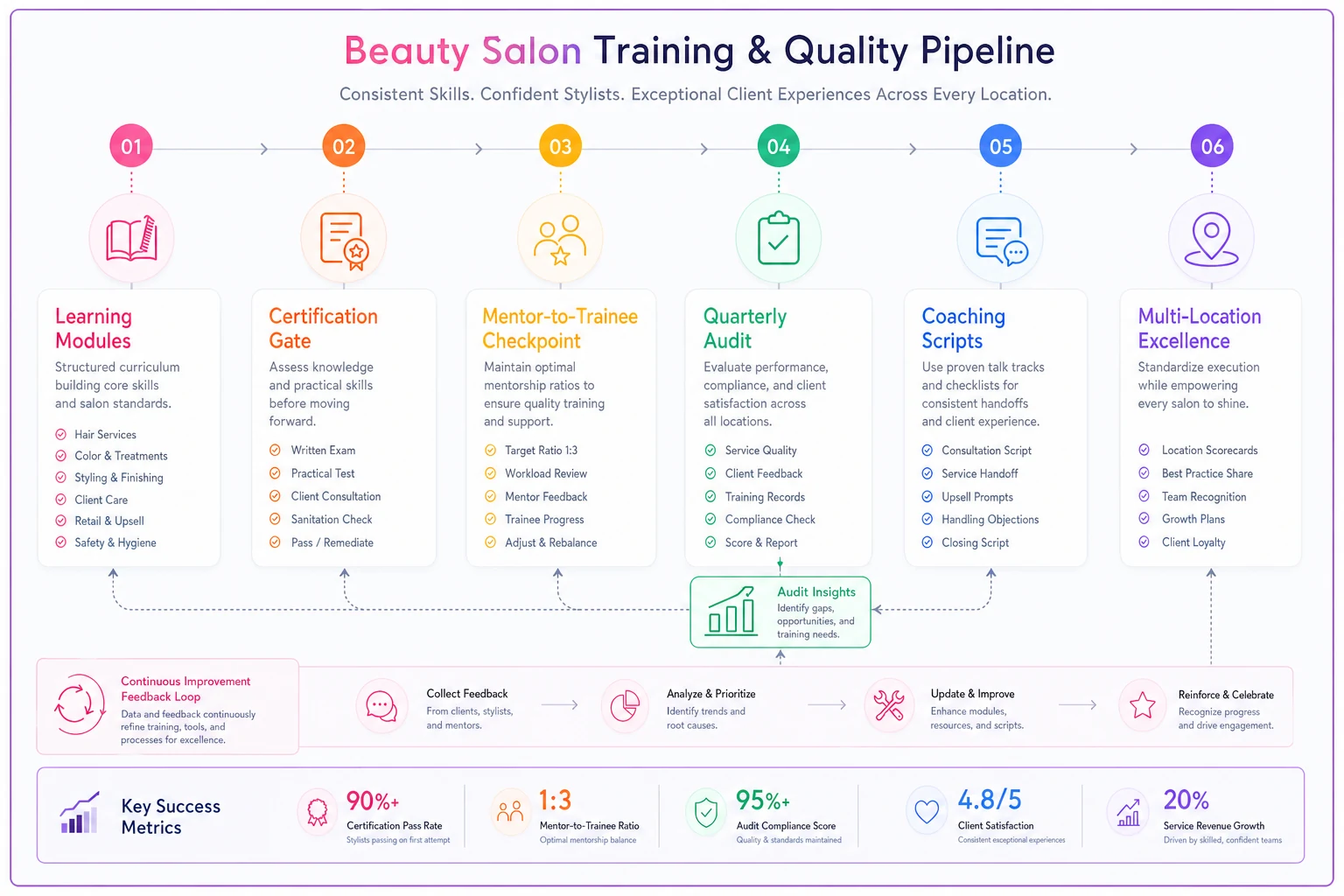
A quick visual makes the flow and feedback loops clearer.
Pull one out and watch the cascade: no ratios, and mentors can't get people to the gate properly, so gates soften. Soft gates let unready stylists through, so audits light up with drift. No audits, and you never find out until a client posts photos. The components aren't a menu — they're a chain, and the chain is only as strong as the piece you're tempted to skip because it doesn't generate revenue today.
A real scenario
A three-location salon, roughly 22 stylists total, kept getting inconsistent color-correction results between sites. Rebook rates at one location were visibly lower, and the owner assumed it was a staffing issue.
When they actually mapped it out, the problem was propagation. Advanced color had never been modularized — it lived in two senior stylists' heads, both at the flagship. The third location learned it thirdhand. There was no gate, so three stylists were doing corrections who'd never been properly signed off. No one had ever audited the work.
They spent about two months building modules for their top eight services, set 1-to-1 ratios for advanced work, and ran their first audit the following quarter. It was rough — several "certified" stylists didn't meet the written standard on sectioning and saturation. But because it was framed as a system check rather than a punishment, people re-trained instead of getting defensive.
Over the next two quarters, the lagging location's correction redo rate dropped meaningfully, and client complaints about uneven color went from a recurring theme to occasional. The owner's own words were that the three locations finally "felt like one salon again." No heroics — just skill moving through a controlled pipeline instead of leaking out the sides.
When this makes sense — and when it doesn't
This is worth building when:
-
You operate more than one location, or you're about to.
-
Service quality visibly varies between stylists or sites.
-
Your training currently depends on one or two key people being present.
-
You've had client-facing quality incidents that trace back to inconsistent skill.
This is probably overkill when:
-
You're a single location with a small, stable, senior team who've worked together for years. Informal propagation still works at that size, and the overhead of formal gates and quarterly audits may cost more than it returns.
-
You're in pure survival mode on cashflow. Build this when you have the bandwidth to protect mentor time — a pipeline you can't staff is just paperwork.
Who should not do this: owners looking for a one-time fix. A certification pipeline is a standing system, not a project you finish. If you build the modules and gates but skip the recurring audits, you've built a nice onboarding flow that will quietly drift within a year — which is the exact problem you started with.
Keeping it alive as you grow
The hard truth about any pipeline is that it decays if nobody owns it. Modules go stale, ratios get ignored on busy weeks, audits get skipped "just this quarter." At a few locations you can hold it together with attention. Past that, the tracking itself becomes the bottleneck — spreadsheets of who's certified on what, when their last audit was, which modules changed, which trainees are stuck at which gate.
This is where operational software earns its keep: certification status per stylist per service, audit schedules that surface automatically, module versions tied to who was certified under which version. Not to replace human judgment — a gate still needs a person watching the work — but to keep the pipeline from quietly falling apart because nobody had time to update the master sheet. The skill propagation is human. The memory of the system shouldn't have to.
Build the four parts, protect the mentor time even though it costs chair revenue, and run the audits even when the quarter is busy. That's the difference between a brand that scales its standard and one that scales its inconsistency.
Ready to simplify your salon operations?
Join 1,000+ salons using Salnly to save time, reduce scheduling chaos, and deliver better client experiences.