

Most salon training fails because it dumps everything on new stylists at once. They get overwhelmed, managers get frustrated watching them forget basics, and within 90 days you're either carrying dead weight or starting the hiring cycle over again.
The salons that consistently develop strong performers do the opposite. They break training into tiny, measurable chunks. They practice one micro-skill daily until it's automatic. They tie every skill directly to rebook rates or retail averages. It sounds simple, but almost nobody actually does it.
The fundamental problem with typical salon training
Traditional salon training looks like this: two weeks of shadowing, a binder of policies, maybe some product knowledge sessions, then throw them on the floor and hope for the best. Managers complain that new stylists don't sell retail, don't rebook clients, take too long on services. But nobody actually taught them the specific mechanics of doing those things while managing a full book.
What happens is pretty predictable. New stylists default to survival mode — just getting through services without making mistakes. They skip rebooking because they're not confident suggesting it. They avoid retail recommendations because they haven't practiced the conversation. Six months later, their numbers are bad and everyone wonders why.
The issue isn't motivation or talent. It's that we expect complex behaviors without building the component skills first. Asking someone to "increase retail sales" when they haven't mastered product knowledge, consultation questions, or closing techniques is setting them up to fail.
Breaking skills into trainable micro-components
Effective training starts by breaking each outcome into its smallest teachable parts. Take rebooking. Most managers tell stylists to "ask every client to rebook." But rebooking actually involves several discrete skills:
Stop losing appointments in the chaos.
Salnly helps you book, confirm & manage every appointment—efficiently.
- Centralized appointment management
- Client notifications
- Calendar & staff scheduling
No credit card required
-
Reading service history to identify booking patterns.
-
Calculating appropriate intervals based on service type.
-
Suggesting specific dates while checking availability.
-
Handling common objections.
-
Entering appointments accurately.
-
Following up on tentative bookings.
Each of these needs separate practice before you can expect consistent rebooking performance. Same with retail. Before someone can hit $40 per ticket, they need to master product identification, usage explanation, needs assessment, recommendation timing, and closing phrases.
The salons getting results map every skill component, then systematically train each piece — not through lectures or videos, but through daily repetition until the behavior becomes automatic.
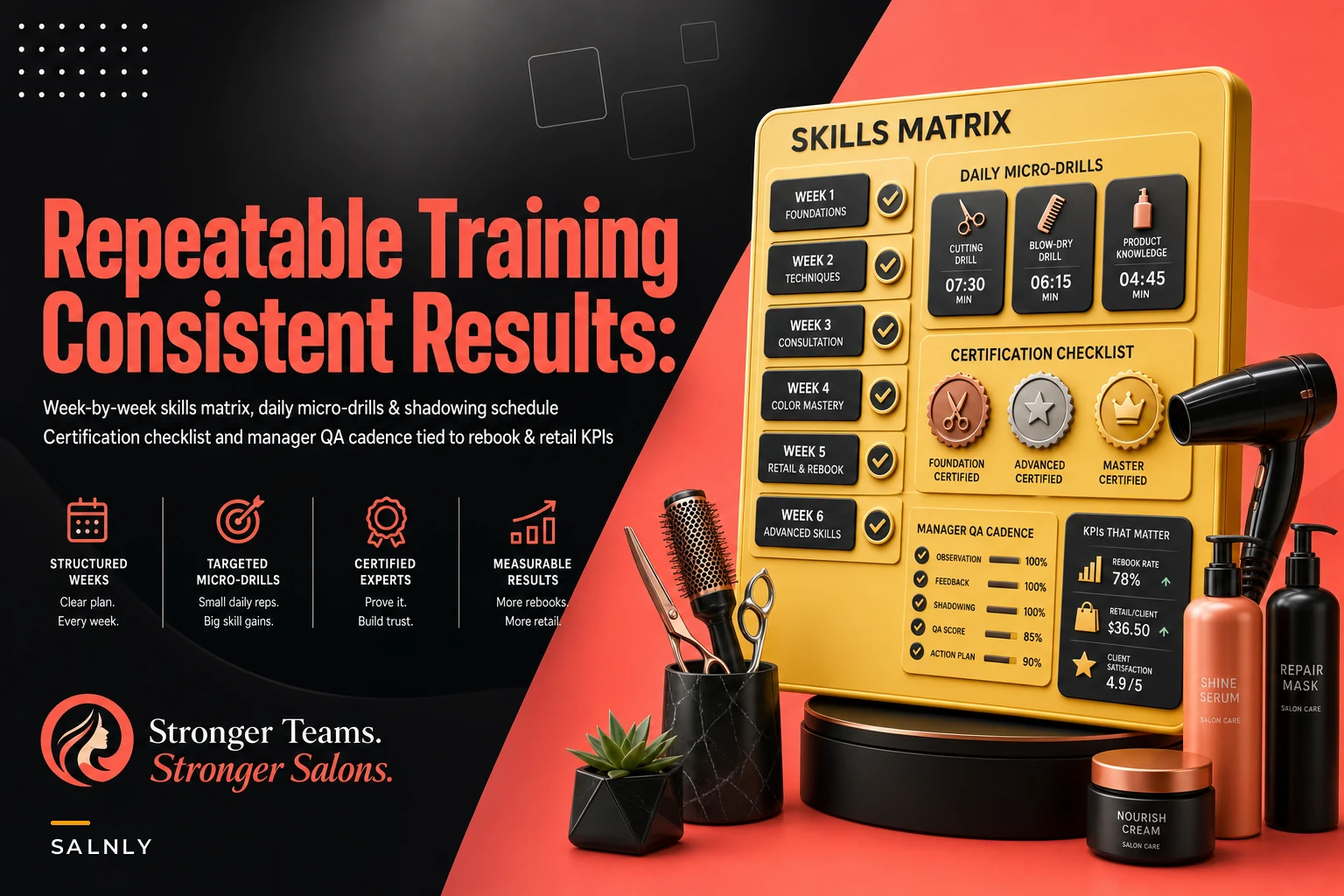
Week-by-week progression matrix
Here's how successful salons structure the first 12 weeks to build complete stylists:
Weeks 1-2: Foundation Skills
-
Station setup and sanitation protocols
-
Basic consultation framework
-
Service timing benchmarks
-
POS navigation and appointment entry
-
Client greeting and seating flow
Daily practice: 15-minute station setup drill before open. Managers check setup consistency and timing.
Weeks 3-4: Technical Precision
-
Core service execution to standard
-
Time management within service blocks
-
Basic product application techniques
-
Client comfort checks during service
-
Clean-as-you-go protocols
Daily practice: One supervised service with immediate feedback. Focus on hitting time targets while maintaining quality.
Weeks 5-6: Consultation Mastery
-
Lifestyle questioning sequence
-
Maintenance education for each service
-
Identifying unstated needs
-
Documenting preferences accurately
-
Managing consultation within scheduled time
Daily practice: Role-play consultations with team members. Record three real consultations for manager review.
Weeks 7-8: Rebooking Mechanics
-
Service interval recommendations
-
Calendar navigation while styling
-
Soft rebooking phrases that feel natural
-
Handling "I'll call you" responses
-
Following up on missed rebounds
Daily practice: Rebook role-play with five different scenarios. Track actual rebook attempts and outcomes.
Weeks 9-10: Retail Integration
-
Product knowledge for top 10 SKUs
-
Identifying client needs from service observations
-
Natural recommendation timing
-
Demonstrating products during service
-
Closing without being pushy
Daily practice: Present one product to the team during morning huddle. Practice recommendations on three clients.
Weeks 11-12: Advanced Skills
-
Upselling appropriate add-ons
-
Managing difficult clients
-
Coordinating with support staff
-
Building request clientele
-
Time optimization techniques
Daily practice: Shadow senior stylist for complex situations. Complete weekly skills assessment with manager.
This progression ensures stylists master the basics before adding complexity. Each week builds on what came before while maintaining earlier standards.
Daily micro-practice structure
The difference between salons that develop talent and those that don't comes down to daily practice. Not training sessions or workshops — actual daily repetition of specific skills.
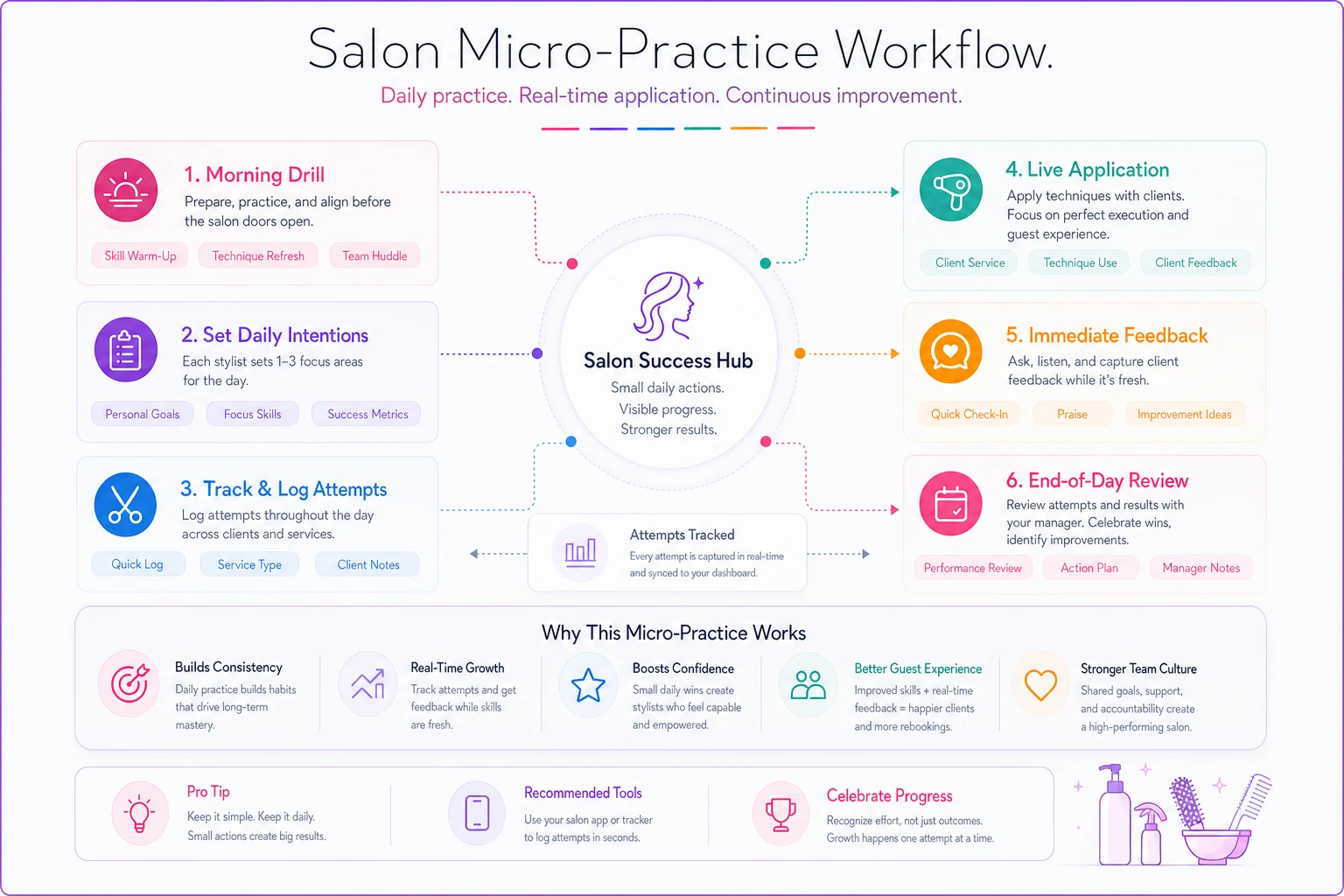
Effective daily practice follows this structure:
Morning drill (10 minutes before opening): Practice one specific skill with a partner. Could be rebooking scripts, retail presentations, or consultation questions. Same skill all week until it's automatic.
Live application (throughout shift): Apply the skill with actual clients. Start with easier scenarios, progress to more challenging ones. Document attempts and outcomes.
End-of-day review (5 minutes): Quick debrief with manager or senior stylist. What worked, what didn't, what to adjust tomorrow.
Visual workflow of the daily practice loop.
Pro-tip: Keep the same micro-skill the focus all week so reps stack and the behavior becomes automatic.
For rebooking practice, stylists might spend Monday through Friday on the same closing phrase: "Based on today's service, I recommend rebooking in 4-5 weeks to maintain this look. I have availability on [specific date] — should I reserve that for you?" By Friday, it flows naturally without thinking.
Retail practice might focus on one product all week. Learn everything about it. Practice explaining the benefits. Try different recommendation approaches. By week's end, that product recommendation becomes automatic whenever the situation calls for it.
This level of repetition might feel excessive, but it's how you build unconscious competence. The behavior has to become automatic before moving to the next skill.
Shadowing that actually develops skills
Most shadowing programs waste everyone's time. New stylists watch passively. Senior stylists work normally. Nobody learns much.
Effective shadowing requires structure and active participation. During weeks 1-4, new stylists shadow with specific observation tasks:
Week 1 shadowing focus: Document how senior stylists manage time. Track actual vs scheduled service duration. Note techniques for staying on schedule. Identify time-wasters to avoid.
Week 2 shadowing focus: Study consultation techniques. Write down exact questions asked. Note how stylists identify upsell opportunities. Track how they document preferences.
Week 3 shadowing focus: Observe rebooking approaches. Count attempts vs successes. Document exact phrasing used. Note timing within the service.
Week 4 shadowing focus: Watch retail integration. Track when products are mentioned. Note demonstration techniques. Document closing phrases that work.
After each shadow shift, new stylists present three observations to their manager — what they learned, what surprised them, what they'll incorporate into their own practice.
Active observation accelerates learning far more than passive watching. New stylists start recognizing patterns and building mental models for what success actually looks like.
Certification checkpoints tied to KPIs
Training without measurement is just hoping for improvement. Successful salons establish clear certification checkpoints with specific performance standards.
| Skill Area | Week 4 Standard | Week 8 Standard | Week 12 Standard | KPI Impact |
|---|---|---|---|---|
| Service Timing | Within 15 min of standard | Within 10 min of standard | Within 5 min of standard | Utilization rate |
| Consultation Completion | 60% documented properly | 80% documented properly | 95% documented properly | Client retention |
| Rebooking Attempts | 50% of clients | 75% of clients | 90% of clients | Rebooking rate |
| Rebooking Success | 30% success rate | 50% success rate | 70% success rate | Rebooking rate |
| Retail Recommendations | 1 per 3 clients | 1 per 2 clients | 3 per 4 clients | Retail per ticket |
| Retail Conversion | $10 average when sold | $20 average when sold | $30 average when sold | Retail per ticket |
Stylists can't move to the next training phase until they hit current standards consistently for one full week. This prevents advancing before foundations are solid.
Some stylists hit standards early and move faster. Others need extra time on certain skills. That's fine — individualized pacing ensures everyone reaches proficiency rather than just completing time requirements.
Manager QA cadence and correction protocols
The fastest way to kill a training curriculum is inconsistent manager oversight. Skills decay without regular quality checks and immediate correction.
Effective QA follows this rhythm:
Daily spot checks (5 minutes): Manager observes one client interaction. Focuses on the weekly training skill. Provides immediate feedback after the client leaves.
Weekly skill assessment (20 minutes): Formal evaluation of the week's focus skill. Stylist demonstrates competency through role-play or live observation. Manager documents proficiency level and improvement areas.
Biweekly number review (15 minutes): Review actual KPIs vs training standards. Identify which skills need additional focus. Adjust daily practice based on performance gaps.
When stylists fall below standards, managers use a simple corrective protocol:
First miss: Additional practice session that day.
Second miss: Dedicated 30-minute skill session with a senior stylist.
Third miss: Return to the previous week's training level until consistency improves.
This might seem strict, but inconsistent standards destroy training programs. Stylists learn that targets are suggestions, not requirements, and performance gradually declines across the entire team.
The salons hitting 85% rebooking rates and $40+ retail tickets hold these standards consistently — not through punishment, but through practice and support until everyone performs at standard.
Connecting daily actions to business metrics
The biggest mistake in salon training is teaching skills without showing their business impact. Stylists practice rebooking because they're told to, not because they understand how it affects their own paycheck.
Smart training programs make these connections explicit.
A stylist working 32 hours weekly with 75% rebooking keeps their book full at roughly 85% capacity. Drop to 50% rebooking and utilization falls to around 65%. That's five or six fewer clients weekly, or somewhere in the range of $400-500 in lost service revenue.
On retail, the math is even clearer. Moving from $15 to $35 average retail per ticket adds $20 per client. With 25 clients weekly, that's $500 in additional revenue and typically $100-150 in extra commission.
When stylists see those numbers laid out, daily practice suddenly matters. They understand that mastering rebooking phrases directly impacts their income. Retail training stops feeling like a salon requirement and starts feeling like an investment in their own earnings.
Managers reinforce these connections during daily huddles. Share yesterday's team rebooking rate. Calculate the revenue impact. Celebrate improvements. Make the link between training and results impossible to ignore.
Building muscle memory through repetition
Professional athletes don't think about their form during competition — they've practiced until correct movement is automatic. Salon skills work the same way.
Consistency can't be built through occasional training. It requires daily repetition until the behavior happens without conscious thought.
Take the retail recommendation process. New stylists often freeze when trying to suggest products. They're simultaneously thinking about what to recommend, when to bring it up, how to phrase it, and whether the client seems receptive. That cognitive load guarantees an awkward delivery every time.
Daily practice removes the overload. Week one, they just practice identifying client needs from observation. Week two, they learn to mention products naturally during service. Week three, they practice closing phrases. By week four, the entire sequence flows without thinking.
This graduated approach works because it respects how humans actually develop skills. You can't master complex behaviors all at once. But you can master simple components, then chain them together into something that looks effortless.
Common training failures to avoid
Even with a solid curriculum, certain mistakes consistently derail salon training programs:
Information dumping: Trying to teach everything in the first two weeks. New stylists retain almost nothing and feel overwhelmed. Spread learning across 12+ weeks minimum.
Inconsistent standards: Different managers enforcing different expectations. One says 70% rebooking is good, another demands 85%. Stylists get confused and stop trying. Document exact standards and make sure all managers enforce them the same way.
Missing practice time: Expecting skills to develop without daily repetition. You wouldn't expect someone to learn piano without practicing. Salon skills are no different.
Generic training: Using the same program for everyone regardless of experience level. A stylist with five years of experience needs different development than a fresh beauty school graduate. Customize starting points based on incoming skill level.
Lack of connection to outcomes: Teaching skills without showing business impact. Stylists comply but don't internalize why it matters. Always connect skills to personal income and salon performance.
No accountability structure: Training without measurement or consequences for missing standards. Performance gradually declines as stylists figure out nobody's really watching. Implement consistent QA with clear correction protocols.
Technology and systems to support training consistency
Manual tracking of training progress falls apart fast. Managers forget to do assessments. Standards drift. New stylists slip through cracks.
AI-powered operational software can fill this gap without replacing the human side of coaching. These platforms track skill progression automatically, remind managers when assessments are due, flag when stylists fall below standards, and compile performance data to show which training elements need adjustment.
They also standardize the experience. New stylists access the same materials, practice the same skills, and meet the same standards regardless of which manager oversees their development — something that's genuinely hard to maintain manually, especially across multiple locations.
The automation handles scheduling shadow sessions, tracking certification progress, and calculating KPI impacts. Managers focus on actual coaching rather than administrative work.
For multi-tier teams, these platforms become especially useful. They track different skill requirements for each level, automate advancement criteria, and ensure juniors are developing steadily toward senior capabilities rather than stagnating.
Measuring long-term impact
The real test of any training curriculum isn't week 12 performance — it's what happens at month six, twelve, and beyond. Do skills hold? Do KPIs improve? Does the investment actually pay off?
Track these metrics to evaluate program effectiveness:
90-day retention rate: What percentage of new stylists remain after three months? Strong training programs typically see 80%+ retention vs an industry average closer to 60%.
Time to profitability: How quickly do new stylists cover their costs? Effective training can compress this from six-plus months down to roughly three or four.
Performance consistency: Do KPIs remain stable after training ends? Look for maintained rebooking rates and retail averages six months post-training.
Request client development: How quickly do new stylists build loyal clientele? Good training accelerates this by teaching relationship-building skills early.
Team performance lift: Does overall salon performance improve as more stylists complete training? You should see gradual increases in salon-wide rebooking and retail metrics over time.
These longer-term numbers justify the investment in structured training. Yes, it requires manager time and some delayed productivity from new stylists upfront. But the payoff in consistent performance and reduced turnover more than makes up for it.
Making training sustainable
The best curriculum means nothing if managers can't sustain it. Daily practices, weekly assessments, and consistent standards require real time investment. Without the right support structure, even committed managers eventually let things slide — not because they don't care, but because the administrative burden quietly crushes the habit.
This is where operational systems matter. Instead of managers trying to remember when assessments are due, automated reminders handle it. Instead of manually tracking skill progression, software compiles the data. Instead of building training materials from scratch, managers work from proven templates and adjust as needed.
The goal isn't to remove human coaching — that part stays essential. But technology handles the administrative side that causes training programs to collapse over time.
The salons consistently producing high-performing stylists have figured out this balance. They use systems to maintain structure and consistency while preserving the human elements of mentorship and actual coaching. That combination creates training that sticks beyond the first 90 days.
Building stylists who hit 85% rebooking and $40+ retail tickets isn't about finding naturals or hiring experience. It's about systematic skill development through daily practice, consistent standards, and clear measurement. The salons getting these results don't necessarily have better people — they have better training systems that turn average stylists into consistent performers.
Ready to simplify your salon operations?
Join 1,000+ salons using Salnly to save time, reduce scheduling chaos, and deliver better client experiences.