


Most salon owners think tiered pricing is just about charging less for junior stylists. Then they wonder why their margins tank when juniors get busy while seniors sit empty.
The real problem isn't the price difference. It's that you're running one operational model for two completely different service tiers. Your juniors need different booking windows, different service menus, different training schedules — and definitely different availability rules. Without those guardrails, tiered pricing becomes a race to the bottom where clients cherry-pick junior appointments for everything, seniors get frustrated with empty chairs, and your overall revenue drops even though you're technically busier.
The junior trap that kills salon profits
You hire a promising junior, set their cuts at $35 versus your senior's $65, and open up their calendar. Within two months, regular clients start booking juniors for simple trims. Your senior stylists watch their books thin out. The junior gets overwhelmed with back-to-back appointments they're not quite ready for. Service quality drops. Complaints increase. And somehow you're working harder for less money.
The mistake is treating tiered pricing like a simple discount instead of a complete operational system. When a client sees two price points, they don't think about skill levels or service complexity — they think about saving money. Without clear rules about who books what and when, your tiered system becomes a free-for-all that hurts everyone.
One salon I worked with discovered their juniors were doing 70% of all root touch-ups, a service that should've been protected for senior colorists. The owner thought she was being smart by keeping juniors busy. Instead, she was training clients to expect premium services at junior prices. When she tried to redirect those clients back to seniors, half of them left for cheaper salons.
Why traditional rostering fails with tiered pricing
Standard salon scheduling treats all stylists like interchangeable slots. Tuesday at 2pm? Sure, book anyone available. But when you're running tiered pricing, that availability mindset creates chaos.
Stop losing appointments in the chaos.
Salnly helps you book, confirm & manage every appointment—efficiently.
- Centralized appointment management
- Client notifications
- Calendar & staff scheduling
No credit card required
Your juniors shouldn't be available for walk-ins during peak Saturday hours when seniors could take those high-margin appointments. Your seniors shouldn't be wasting Tuesday mornings on basic mens cuts that juniors could handle perfectly. Yet most salons run everyone on the same schedule, same booking rules, same service menu.
The scheduling software doesn't care about protecting margins. It just fills slots. So you get situations where a senior stylist sits idle on Saturday afternoon because all the appointments went to juniors who were "available" first.
Think about the actual math. If a senior can generate $95 per hour during peak times but sits empty while a junior handles $45-per-hour cuts, you're losing $50 every hour. Multiply that across your peak periods and you're easily dropping thousands monthly. Not because you're not busy — but because you're busy wrong.
Building protection zones that preserve margins
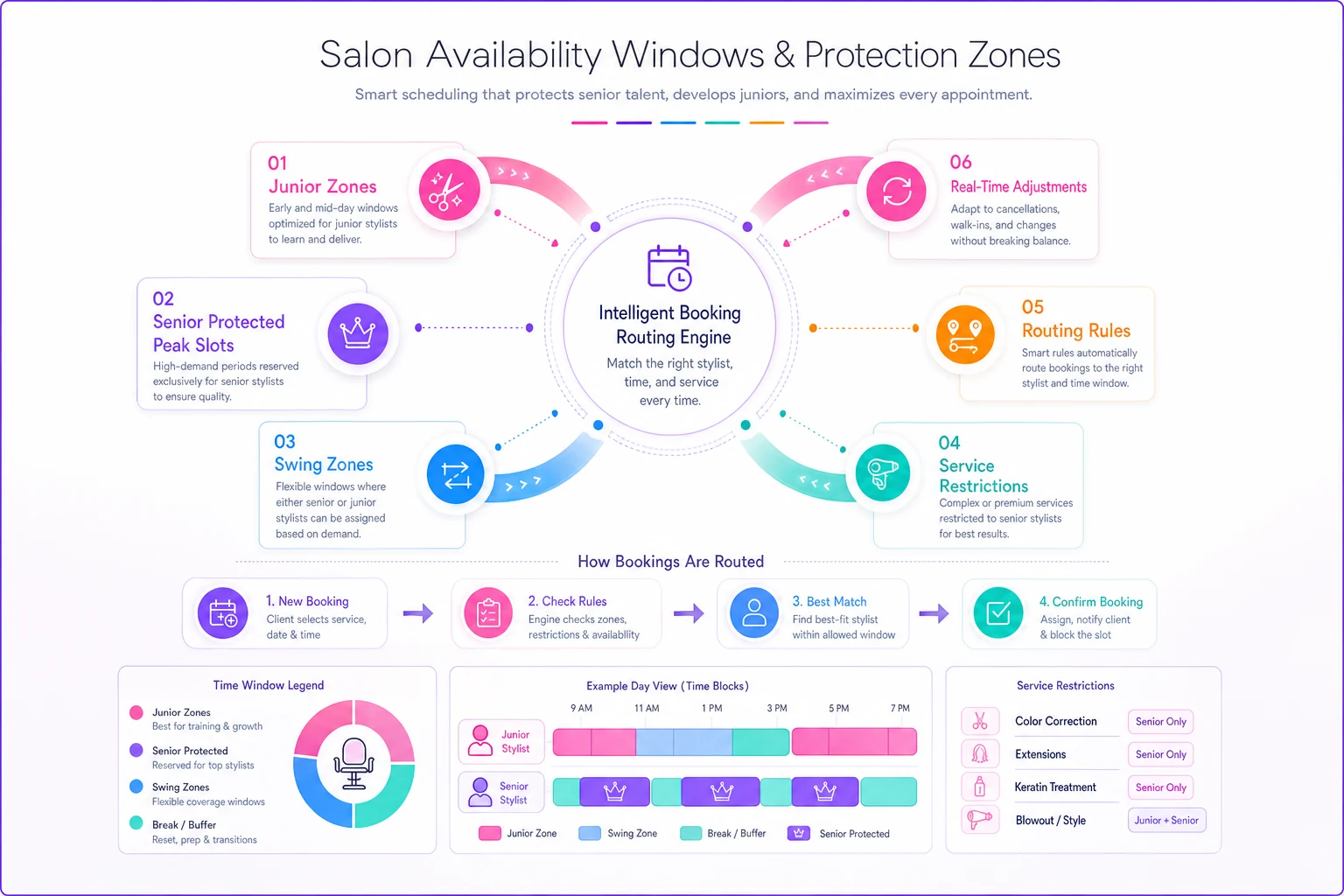
The fix starts with availability windows linked directly to your pricing tiers. Juniors get specific hours where they're the primary option. Seniors get protected time slots where they're prioritized. And certain services stay completely off-limits based on tier level.
What actually works:
Junior availability zones:
-
Monday through Wednesday, all day
-
Thursday/Friday before 11am and after 6pm
-
Saturday mornings before 10am only
-
Never during Saturday 11am-4pm rush
-
Never for last-minute same-day bookings on weekends
Senior protection windows:
-
Thursday through Saturday, 10am-6pm priority
-
All color corrections and major transformations
-
All new client consultations
-
Any service over $150
-
All same-day availability on peak days
Swing zones (either tier):
-
Tuesday/Wednesday afternoons
-
Friday early evening
-
Services under 45 minutes
-
Basic maintenance appointments
But availability windows alone don't work without service restrictions. Your juniors shouldn't touch certain high-risk, high-margin services until they've completed specific training benchmarks. This isn't about limiting their growth — it's about protecting your reputation while they develop.
Here's a visual of the rostering and availability workflow.
This isn't about limiting their growth — it's about protecting your reputation while they develop.
Service progression tied to training milestones
Instead of throwing juniors into the deep end or keeping them on shampoo duty forever, you need clear service unlock points based on completed training and supervised work.
Month 1-2: Foundation services only
-
Men's cuts (basic)
-
Single-process touch-ups (roots only)
-
Blow-dry and style
-
Basic trims (no layers or texturizing)
Month 3-4: After 50 supervised services
-
Women's one-length cuts
-
Toner applications
-
Semi-permanent color
-
Children's cuts
Month 5-6: After 100 services + advanced training
-
Layered cuts
-
Partial highlights
-
Permanent color (single process)
-
Beard shaping and design
Month 7-12: Evaluation-based unlocks
-
Full highlights (with supervision initially)
-
Color corrections (assisted only)
-
Textured/razor cuts
-
Balayage basics
Year 2+: Full service menu except:
-
Complex color corrections
-
Full transformations
-
Bridal services
-
Extension applications
Notice how each unlock requires actual completed services, not just time passed. A junior who does 15 cuts a week will advance faster than one doing 5. This creates motivation while ensuring skill development.
Demand throttling to prevent junior overflow
Even with availability windows, you need active controls to prevent everyone from booking juniors exclusively. This means limiting how many junior appointments can be booked per day and creating barriers that nudge price-insensitive clients toward seniors.
Start with daily caps. If you have two juniors, cap them at 6-7 appointments daily even if they could handle more. This forces overflow to seniors and prevents juniors from burning out on volume.
Start with daily caps of 6-7 appointments per junior to prevent burnout and force overflow to seniors.
Then add booking friction for junior appointments:
-
Online booking only shows seniors first
-
Junior appointments require 48-hour advance booking
-
No junior bookings available through Instagram DMs
-
Reception prioritizes senior availability when clients call
For specific services, make the junior option less convenient:
-
Junior color appointments only on certain days
-
Junior cuts need manager approval for complex styles
-
Junior bookings can't be modified within 24 hours
-
No product samples or extras with junior services
Clients who really need the lower price will plan ahead and accept limitations. Clients who can afford senior prices will pay for convenience. You're not hiding your junior option — you're just making sure it doesn't cannibalize your full-price business.
Protecting fairness while maximizing revenue
Your senior stylists will revolt if they see juniors getting all the easy money while they handle difficult clients and complex fixes. But juniors will leave if they feel stuck doing only the worst services.
Share the client load strategically:
-
Seniors get first pick of new clients
-
Juniors get overflow only after senior books hit 75%
-
Difficult clients rotate between all staff levels
-
High-tippers protected for whoever earned them
Create upward mobility paths:
-
Juniors can "graduate" clients to their book after 6 months
-
Commission bumps at each service unlock level
-
Clear timeline to senior pricing (usually 18-24 months)
-
Opportunity to assist on senior services for learning
Use data to prove fairness:
-
Track revenue per hour by stylist level
-
Show how junior appointments feed future senior bookings
-
Measure client retention from junior to senior transition
-
Calculate total salon revenue impact of tiered model
One salon shared monthly numbers showing that while juniors averaged $52 per service versus seniors at $89, the junior appointments brought in 40% new clients who later booked senior services. That data stopped the complaints because everyone could see how the system benefited the whole team.
The booking rules that make this work
Your front desk or booking system needs specific protocols to maintain your tiered structure. These can't be suggestions — they need to be hard rules built into how appointments get scheduled.
For phone bookings:
-
Always offer senior appointment first
-
If client asks for lower price, mention junior option
-
Check if service is approved for junior level
-
Verify junior availability windows
-
Confirm longer wait time for junior booking
For online scheduling:
-
Senior calendars display by default
-
Junior option requires extra click
-
Service menu filtered by stylist level automatically
-
Junior slots show "limited availability" warning
-
Price difference clearly marked
For walk-ins:
-
Seniors get priority unless specifically requesting junior
-
Junior walk-ins only during designated slow periods
-
Manager approval for junior walk-in color services
-
Clear signage about tiered pricing at reception
For rebooking:
-
Clients stay with their tier unless requesting change
-
Moving from junior to senior requires availability check
-
Moving from senior to junior requires manager approval
-
Tier changes can't happen same-day
These can't be suggestions — they need to be hard rules built into how appointments get scheduled.
Transitioning clients between tiers
Moving clients from junior to senior stylists without losing them typically happens two ways: when juniors get promoted to senior pricing, or when clients outgrow junior capabilities.
For junior promotions, give clients 60 days notice:
-
Email announcing the stylist's advancement
-
Offer three appointments at current pricing
-
Introduce senior mentor as alternative option
-
Provide clear value reasons for price increase
-
Allow grandfathered rates for long-term clients (limit 5-10)
For service complexity transitions:
-
Flag when clients need senior expertise
-
Have junior recommend senior for next appointment
-
Offer joint consultation with both stylists
-
Price the difference as technique upgrade, not stylist change
-
Book return maintenance with junior to maintain relationship
A salon in Denver managed this brilliantly. When their junior colorist hit the 18-month mark, they threw a small "graduation" event. Clients got champagne, the stylist got a new station, and everyone understood this was a celebration, not a price hike. They retained 85% of the junior's clients at the new senior rate.
Measuring whether your tiered model actually works
Most salons never measure tiered pricing properly, which is why they don't catch problems until revenue drops.
Track these numbers monthly:
| Metric | Target | Red Flag |
|---|---|---|
| Senior utilization rate | 75-85% | Below 65% |
| Junior utilization rate | 60-70% | Above 80% |
| Average ticket (senior) | Steady or growing | Declining 5%+ |
| Average ticket (junior) | 50-60% of senior | Above 70% of senior |
| New client percentage | 30-40% via juniors | Below 20% |
| Client upgrade rate | 25% junior to senior annually | Below 15% |
| Service mix by tier | 65/35 senior/junior | Below 60% senior |
| Hourly revenue by tier | Senior 2x junior minimum | Less than 1.5x |
The warning signs your tiered pricing is failing:
-
Seniors complaining about empty schedules
-
Juniors overwhelmed with complex services
-
Overall revenue down despite being busier
-
Clients angry about availability restrictions
-
High turnover at either tier level
If you see these patterns, your operational rules need adjustment. Usually it means juniors have too much availability during peak times or too many premium services on their menu.
Common mistakes that break tiered pricing
Mistake 1: Making juniors too available
When juniors can be booked anytime, anywhere, for anything, they become the default choice. Restrict their availability to protect senior bookings.
Mistake 2: Unclear service boundaries
If clients don't understand why certain services require senior stylists, they'll fight the restrictions. Create clear, logical service tiers based on complexity.
Mistake 3: No progression pathway
Juniors stuck at the same level for years will leave. Seniors who see no junior development won't support the system. Build clear advancement triggers.
Mistake 4: Ignoring the numbers
Tiered pricing can slowly erode margins if you're not watching. Track everything, especially revenue per hour by tier.
Mistake 5: Weak front desk enforcement
If your receptionist books juniors for senior services "just this once," your whole system collapses. Rules need to be absolute.
The operational backbone that supports multiple tiers
Behind every successful tiered pricing model is an operational system that handles the complexity. You can't manually track who's approved for what service, which availability windows apply when, and whether someone's ready for advancement.
This is where operational software makes the difference between theory and execution. When your booking platform automatically enforces tier rules, filters service menus by stylist level, and tracks progression milestones, the system runs itself. Your front desk doesn't have to remember that Sarah can't do highlights yet or that junior Saturday bookings aren't allowed.
AI-powered scheduling platforms can take this further by analyzing booking patterns to optimize your tier rules. They'll spot when seniors have too much downtime and automatically adjust junior availability windows. They track client progression from junior to senior bookings and identify who's ready for tier upgrades. They even predict which services should move between tiers based on actual complexity and time requirements.
These systems remove the emotion from enforcement. The software doesn't care if a client complains about junior availability. It just follows the rules you've set to protect your margins. Your staff doesn't have to be the bad guy explaining why someone can't book their favorite junior on Saturday afternoon — the system simply doesn't offer that option.
When to add a third tier (or not)
Some salons consider adding an intermediate tier between junior and senior. This sounds logical but usually creates more problems than it solves. You end up with three different price points to manage, three sets of availability rules, and confused clients.
The only time a third tier makes sense:
-
You have 15+ stylists
-
Clear skill gaps exist between experience levels
-
Geographic market expects multiple price points
-
Physical space separated by floor or section
-
Different target demographics for each tier
If you do add that middle tier, keep the operational rules simpler. Maybe intermediates share senior availability windows but have a restricted service menu. Or they get junior pricing but senior scheduling priority. Don't create three completely separate systems — your staff and clients won't keep them straight.
Making the transition to tiered operations
If you're currently running single-tier pricing, transitioning to a tiered model takes planning. You can't just announce junior pricing tomorrow and expect it to work.
Start with these steps over 60-90 days:
Phase 1: Preparation (Month 1)
-
Identify which stylists fit each tier
-
Define service menus for each level
-
Set availability windows and booking rules
-
Train reception on new protocols
-
Configure scheduling software
Phase 2: Soft Launch (Month 2)
-
Introduce junior pricing for new clients only
-
Test availability windows with limited hours
-
Gather feedback from both tiers
-
Adjust rules based on real patterns
-
Track initial metrics
Phase 3: Full Implementation (Month 3)
-
Open junior pricing to all clients
-
Enforce all availability restrictions
-
Implement progression pathways
-
Monitor metrics weekly
-
Make quick adjustments as needed
The biggest resistance will come from senior stylists worried about losing clients. Show them the math — how protected windows and service restrictions actually increase their hourly revenue even if they see slightly fewer clients. Most seniors would rather do six $95 services than ten $50 ones.
The bottom line on tiered pricing operations
Tiered pricing in salons only works with the right operational backbone. Without strict availability windows, service progressions, and booking rules, you're just offering discounts that eat your margins. The salons succeeding with tiered models understand it's not about having different prices — it's about running different operational tracks that protect profitability while creating growth opportunities.
The framework outlined here might seem complex, but it's far simpler than trying to fix the chaos that comes from unstructured tiered pricing. When juniors know exactly which services they can perform, seniors see their premium bookings protected, and clients understand the value difference between tiers, the system runs smoothly.
This isn't about limiting anyone. It's about creating clear pathways where juniors develop skills properly, seniors maintain their earning power, and your salon builds sustainable revenue. The rules and restrictions aren't barriers — they're the structure that lets everyone succeed without stepping on each other.
The salons that nail this operational model see something interesting happen. Their juniors develop faster because they're handling appropriate services. Their seniors become mentors instead of competitors. And their overall revenue grows because they're capturing different market segments without cannibalization.
If your current tiered pricing feels chaotic, it's not the concept that's broken — it's the operational structure supporting it. Fix the framework, and the pricing tiers finally deliver what they promised: a way to serve more clients profitably while developing your team.
Ready to simplify your salon operations?
Join 1,000+ salons using Salnly to save time, reduce scheduling chaos, and deliver better client experiences.