


Most salons lose somewhere between $8,000 and $12,000 in potential revenue during a new stylist's first 90 days. Not because the stylist can't do the work, but because nobody built a proper system to bring them up to speed.
Think about what actually happens when you hire someone. They show up, you introduce them around, maybe pair them with a senior stylist for a few days, then start trickling in client bookings. By week three they're running at maybe 40% capacity. Week six, still hovering around 55%. Three months in, barely hitting 70% while their rebook rates sit at half what your established stylists achieve.
The real damage runs deeper than slow bookings though. Without structured onboarding, new stylists build their own workflows—and those workflows don't match your standards. They quote different service times. They blow through product. They miss upsell opportunities your experienced team catches automatically. Worst case, they develop bad habits that take months to undo, assuming you catch them at all.
Why traditional salon training falls apart
Most salons rely on osmosis. Owners assume experienced stylists will naturally share their knowledge. They expect new hires to absorb culture through proximity. They trust that skills demonstrated in an interview will translate into consistent performance on the floor.
It doesn't work that way. Your senior stylists are running full books—they don't have bandwidth for real training. Knowledge transfer happens in scattered five-minute conversations between clients. Critical operational details get skipped because nobody actually owns the onboarding process.
-
New stylists hit revenue benchmarks 45-60 days later than those with structured programs
-
Client complaints spike during months two and three as new hires work unsupervised
-
Around a third leave within six months, usually citing lack of support
The cost compounds fast. Poorly onboarded stylists create downstream problems—clients who don't rebook, product waste from bad mixing ratios, scheduling chaos from inaccurate service estimates. One salon discovered their new hires were averaging 22% longer on color services than quoted, which was quietly wrecking the entire daily schedule.
Building your hiring funnel with operational intent
Your onboarding system actually starts before the first interview. Most salons evaluate candidates on technical skill and personality fit and miss the operational signals that actually predict success.
Stop losing appointments in the chaos.
Salnly helps you book, confirm & manage every appointment—efficiently.
- Centralized appointment management
- Client notifications
- Calendar & staff scheduling
No credit card required
Pre-screen for operational fit first
A simple 10-question assessment focused on workflow compatibility filters out mismatches early:
-
How do you estimate service timing for a full highlight on medium-length hair?
-
Walk me through how you manage back-to-back color appointments
-
How do you approach retail recommendations during a service?
-
What do you do when you're running 15 minutes behind?
These questions reveal whether someone thinks systematically about salon operations, not just hair.
Interview scorecard framework
| Category | Weight | Key Indicators | Red Flags |
|---|---|---|---|
| Technical Skill | 30% | Portfolio quality, technique demonstration | Inconsistent results, outdated methods |
| Operational Thinking | 25% | Time management, workflow description | No system for timing, reactive planning |
| Client Management | 20% | Consultation approach, rebooking habits | Rushes consultations, weak follow-up |
| Product Knowledge | 15% | Brand familiarity, usage efficiency | Overwashing, poor mixing ratios |
| Team Compatibility | 10% | Communication style, flexibility | Rigid preferences, poor listening |
Score each category 1-5. Candidates scoring below 3.5 overall rarely succeed regardless of how good their portfolio looks.
The working interview that actually predicts performance
-
Have them observe and document a senior stylist's consultation (15 min)
-
Watch them prep a station for the next service (10 min)
-
Test their ability to check inventory and flag what's low (10 min)
-
Observe them helping with a simple task like washing or blow-drying (20 min)
-
Have them write up service timing estimates for three different scenarios (15 min)
That 70-minute assessment tells you a lot—how they think about efficiency, whether they notice details, whether they can adapt to someone else's system.
The 90-day ramp structure that actually works
Throwing new hires into full service after a week of shadowing is exactly why most stylists take four to six months to hit productivity targets. A phased ramp with clear benchmarks changes that trajectory significantly.
Days 1-30: Foundation and observation
Week one focuses entirely on operational integration. No client services yet.
-
Day 1-2
Salon systems—booking software, inventory locations, cleaning protocols
-
Day 3-4
Shadow different stylists, document what they observe
-
Day 5
Review observations with a manager, identify best practices
Weeks two and three introduce assisted services. The new stylist works alongside a mentor but doesn't own the client relationship yet. They handle specific tasks—shampooing, blow-drying, mixing color under supervision. This builds muscle memory for your specific workflows without putting client satisfaction at risk.
Week four begins independent services with some guardrails. Start with lower-complexity services like single-process color or men's cuts. Cap them at 30% capacity. The remaining time goes toward continued shadowing and operational tasks.
Mentor pairing rules
-
Works similar hours so overlap is consistent
-
Excels in the areas where the new hire needs the most development
-
Has actual bandwidth—keep their booking at 85% max during the training period
-
Demonstrates solid operational discipline, not just technical skill
Compensate mentors properly. Either reduce their booking target by 10% or pay a flat monthly training bonus. Mentoring is real work.
Compensate mentors properly—either reduce their booking target by 10% or pay a flat monthly training bonus.
Days 31-60: Graduated independence
Month two shifts from observation to ownership. The new stylist takes primary responsibility for clients while staying in regular contact with their mentor.
-
Week 5
40% capacity, basic services only
-
Week 6
50% capacity, add highlights
-
Week 7
60% capacity, add complex color
-
Week 8
70% capacity, full service menu
Each week includes structured review sessions—not casual check-ins, but operational huddles focused on specific metrics:
-
Average service time vs. standard
-
Product usage per service
-
Client satisfaction from immediate feedback
-
Rebooking rate
Document the gaps between expected and actual performance. Create specific action items for the following week.
Days 61-90: Performance optimization
The final month shifts from learning to optimization. The stylist should be operating at 80-90% capacity while tightening efficiency.
-
Service times at or near salon standard
-
60% rebooking rate minimum
-
Weekly retail sales hitting your target dollar amount
-
Client satisfaction above 4.5/5
This phase includes deliberate practice on weak spots. If color timing consistently runs long, schedule more color services with built-in buffer time. If retail lags, pair them with your strongest retail performer for a week.
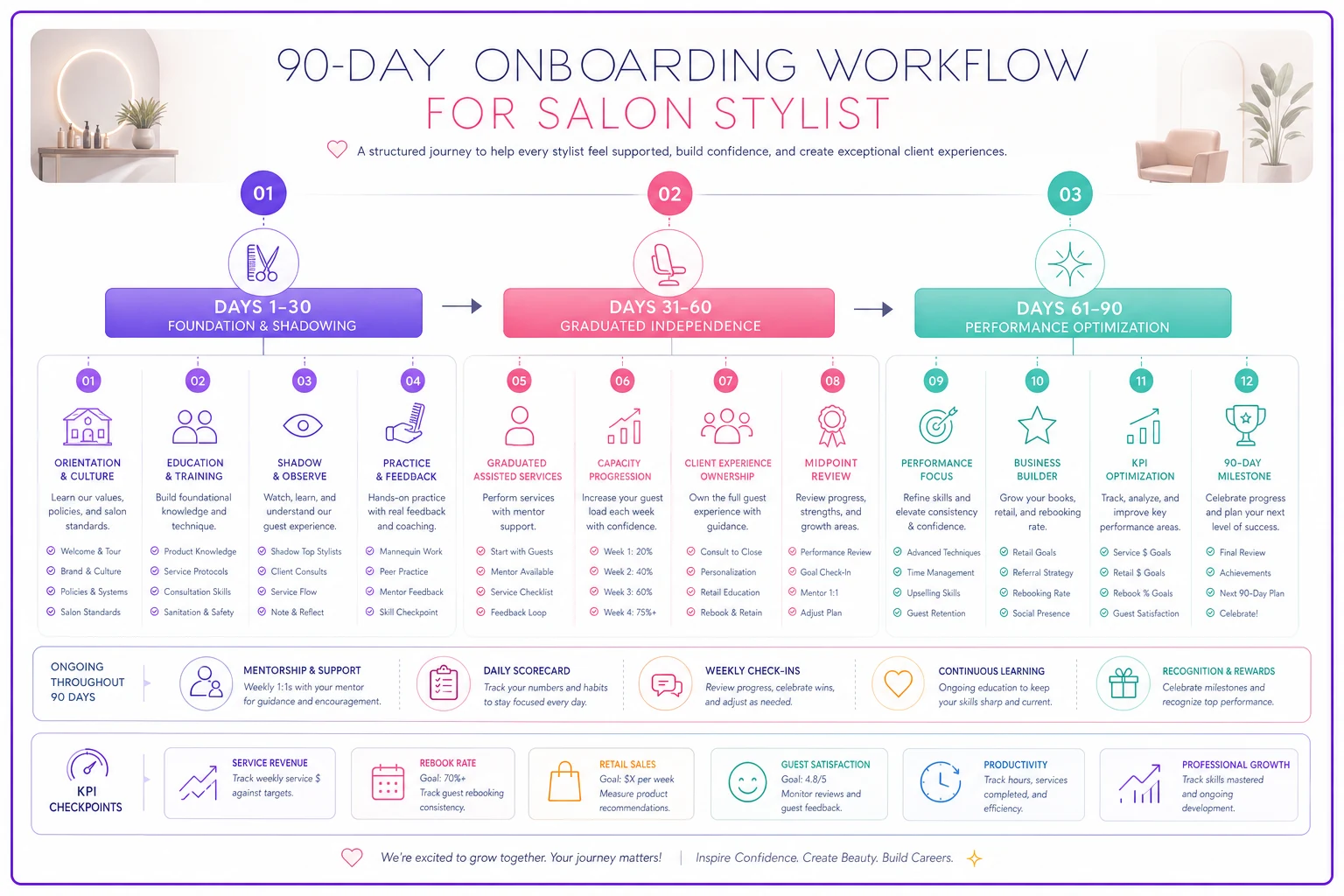
This visual maps the phased ramp, mentor checkpoints, and KPI review points.
Daily shadow schedules that transfer real knowledge
Generic shadowing—"just follow Sarah around today"—produces generic results. Structured shadow schedules with specific observation targets actually transfer knowledge.
Week 1 shadow schedule template
-
Monday - Consultation mastery - 8
00-10:00: Shadow senior stylist, focus on consultation process - 10:00-10:30: Document consultation questions and flow - 10:30-12:00: Shadow a different stylist, compare approaches - 1:00-2:00: Review notes with manager - 2:00-4:00: Practice consultations on a training head
-
Tuesday - Timing and efficiency - 8
00-12:00: Track service timing for five different services - Document prep time, processing time, finishing time separately - 1:00-2:00: Compare tracked times against salon standards - 2:00-4:00: Shadow your fastest stylist, identify their efficiency habits
-
Wednesday - Product knowledge - 8
00-10:00: Inventory review with manager - 10:00-12:00: Shadow color mixing for three different formulas - 1:00-3:00: Practice mixing on training heads - 3:00-4:00: Review product costs and usage guidelines
Shadow observation sheets
Give new hires something specific to track during shadowing:
-
Service Observation Log
- Client name/service - Quoted time vs. actual time - Products used (specific amounts) - Consultation questions asked - Upsells offered - Rebooking approach - Challenges encountered - Questions to follow up
Without an observation sheet, shadowing is passive watching. With one, it's active learning.
KPIs tied to revenue and rebooking reality
Most salons assess new hire progress through gut feeling. "They seem to be doing well" is not a metric. Real onboarding systems track specific, revenue-linked numbers from the start.
The metrics that matter
Average revenue per service hour:
-
Week 4 target
$45-50/hour
-
Week 8 target
$65-70/hour
-
Week 12 target
$80-85/hour
Rebooking rate:
-
Week 4
35% (still learning the ask)
-
Week 8
50% (building confidence)
-
Week 12
65% (approaching team average)
Service time variance:
-
Week 4
+20% vs. standard is acceptable
-
Week 8
+10% vs. standard
-
Week 12
Within 5% of standard
These assume mid-market pricing—adjust for your area, but keep the progression curve intact.
The daily scorecard approach
Weekly metrics hide daily problems. A simple daily tracking system closes that gap:
-
Services completed
___
-
Total service revenue
$___
-
Clients rebooked
/
-
Product sold
$___
-
Running behind? Y/N, minutes
___
Review daily scorecards during weekly check-ins. Patterns surface quickly—maybe Thursdays always run behind, or rebooking drops on busy Saturdays. Specific patterns get targeted solutions.
Correcting course when the ramp stalls
Even solid systems hit snags. The difference is how fast you catch and address them.
Common week 3-4 plateau
New stylists often hit a wall around week three, when the initial excitement wears off and the real grind sets in. Service times stretch. Rebooking attempts get halfhearted. Confidence dips.
The fix: reduce complexity temporarily. Pull back from complex services and build volume on simpler ones. Build confidence through repetition, then layer complexity back in gradually.
Week 6-7 efficiency drop
As booking capacity increases, operational discipline often slips. Stylists start cutting corners—skipping full consultations, rushing services, forgetting retail recommendations.
The fix: flip the shadow model. Have the new stylist perform services while the mentor observes and documents gaps. Review immediately after each service, not at day's end when details blur.
Week 10-12 rebooking resistance
Some stylists hit technical benchmarks but resist the sales side. Great hair, won't push prebooking or retail.
The fix: daily role-play. Start each morning with five minutes of rebooking practice. Give them a script card for their station. Make it mechanical until it becomes second nature.
The retention connection most salons miss
Strong onboarding doesn't just speed up productivity—it significantly improves retention. Stylists who feel supported and see clear progress stay. Those thrown into chaos leave.
Salons with formal 90-day programs retain around 85% of new hires through their first year. Those without structured onboarding are closer to 60%. At an average replacement cost somewhere between $3,000 and $4,000 per stylist—recruiting, training, lost revenue—the math on proper onboarding becomes pretty obvious.
But retention goes beyond keeping seats filled. Well-onboarded stylists become culture carriers. They understand your operational standards and reinforce them naturally. They model the right behaviors for the next wave of hires. That consistency compounds into a salon reputation that's hard to build any other way.
Implementation without overwhelming your team
The full system here might feel like a lot if you're currently winging onboarding. Start with three components:
-
The interview scorecard—immediately improves hiring decisions
-
A basic mentor pairing system with the 10% capacity reduction
-
Weekly KPI tracking for new hires
Add pieces over time. Maybe month two you add structured shadow schedules. Month three you layer in daily scorecards. Build the system while you're using it.
For salons already running at capacity, batch hiring is worth considering. Onboard two or three stylists at once. They support each other through the process, you consolidate training time, and one mentor can guide multiple new hires through shadow sessions. Group product and systems training saves significant repetition.
The biggest implementation mistake is halfhearted adoption. Managers who treat the system as optional guarantee it fails. When you commit to this, actually commit. Block time for check-ins. Protect mentor capacity. Track metrics consistently. The structure only works when you work it.
Where operational software changes the game
Manually tracking all of these metrics and schedules eats a lot of administrative time. Spreadsheets for scorecards, paper shadow schedules, verbal check-ins—manageable for one new hire, but it breaks down fast at any real scale.
AI-powered operational platforms make a genuine difference here. Instead of managers manually calculating daily KPIs, the system pulls revenue per service hour directly from your booking data. Rather than building shadow schedules from scratch each time, you load templates that adjust based on where the new hire is in their progression.
The automation handles the repetitive coordination—sending daily scorecard reminders, flagging when metrics dip below benchmarks, surfacing patterns before they become bigger problems. It's like having a training coordinator who never drops a check-in or misses a warning sign.
These platforms also preserve institutional knowledge in a way manual systems can't. Every completed onboarding creates data. Which shadow sequences produce the fastest ramp times? Which mentors generate the highest retention? Which early KPI trends predict long-term success? The system learns from each cycle and refines the process over time.
Mentor feedback gets easier too. Instead of lengthy forms, mentors leave voice notes that get transcribed and categorized. Daily scorecards become quick mobile inputs instead of paper to file. The easier the compliance, the more consistent your team becomes.
The compound effect of systematic onboarding
A proper onboarding system does more than accelerate individual ramp time. It changes how the whole salon operates.
New stylists reaching productivity faster means less pressure on senior staff to carry revenue. Consistent training standards mean fewer client complaints and fewer scheduling surprises. Higher retention stabilizes your team dynamics. And each successful onboarding makes the next one easier as the process becomes embedded in how your salon runs.
The financial impact compounds too. If proper onboarding accelerates productivity by just 30 days, that's roughly $3,000 to $4,000 in additional revenue per stylist. Multiply across your annual hiring volume. Add reduced turnover costs. Factor in the operational efficiency gains. The numbers get significant quickly.
But honestly, the biggest gain might just be peace of mind. Knowing you have a system that consistently produces capable, confident stylists changes how you approach growth. Expansion feels less risky. Replacing a departing stylist feels manageable. You stop crossing your fingers on new hires and start expecting them to succeed—because your onboarding system is built to make sure they do.
The templates, scorecards, and schedules outlined here aren't theoretical. They come from actual salons that turned around their hiring outcomes. The ones stuck with six-month ramp times and high turnover shared the same gap: no systematic approach to bringing stylists to full productivity. Fix the system, fix the outcome.
The templates, scorecards, and schedules outlined here aren't theoretical. They come from actual salons that turned around their hiring outcomes. The ones stuck with six-month ramp times and high turnover shared the same gap: no systematic approach to bringing stylists to full productivity. Fix the system, fix the outcome.
Ready to simplify your salon operations?
Join 1,000+ salons using Salnly to save time, reduce scheduling chaos, and deliver better client experiences.