



Most salon growth decisions don't fail because the owner picked the wrong option. They fail because the decision got made on gut feel, with no station-level math behind it, and no cash buffer to survive the gap between "we committed" and "it started paying." A new stylist looks affordable in April and becomes terrifying in July when a slow month drains the account. A second location pencils out on a napkin and then eats eighteen months of runway before the schedule fills.
The three growth levers almost every profitable salon eventually faces are: hire (add capacity through people), tech (add capacity or margin through systems), or location (add capacity through a new box). They compete for the same money, and they have wildly different breakeven timelines and risk profiles. Treating them as three separate conversations is the mistake. They're one decision, and the thing that ties them together is your cash runway and how each option maps against station-level P&L.
This is the framework I'd want any owner to run before signing anything.
Why growth decisions get made blind
There's a pattern that shows up constantly. The salon is busy. The owner is turning clients away on Saturdays, the waitlist is real, and the natural conclusion is "we need more capacity." So they hire. Or they upgrade to a fancier booking system. Or a great retail space opens two towns over and the landlord is offering three months free.
The problem is that "we're busy" tells you almost nothing about which lever to pull. Busy on Saturday and dead on Tuesday is a scheduling problem, not a capacity problem. High demand but thin margins per service is a pricing or product-mix problem. Full chairs but slow rebooking is a retention problem. Each of these gets "solved" by throwing a hire or a location at it — and each of those solutions can quietly make the P&L worse.
What separates salons that scale cleanly from the ones that stall is that disciplined operators force every growth idea through the same two questions before anything else: what does this do to my per-station contribution, and how long is the cash gap before it breaks even. If you can't answer both with real numbers, you're not making a decision — you're placing a bet.
If you haven't already built out per-chair economics, the per-station break-even and payroll decision rules work is the prerequisite for everything below. You can't run this matrix without knowing what a single station actually earns and costs.
Start with station-level P&L, not salon-level P&L
Salon-wide numbers hide the truth. A shop can be "profitable" overall while two of its six chairs are underwater, subsidized by the top producers. When you map growth options to a salon-level P&L, you're making decisions on an average that doesn't exist anywhere in the building.
Stop losing appointments in the chaos.
Salnly helps you book, confirm & manage every appointment—efficiently.
- Centralized appointment management
- Client notifications
- Calendar & staff scheduling
No credit card required
Station-level P&L means you assign revenue and directly attributable cost to each chair — or each stylist, if you're commission-based. At minimum, per station you want:
-
Revenue
service + retail attributed to that chair
-
Direct labor
the stylist's pay tied to that station (commission or allocated wage + payroll tax)
-
Direct product / backbar
color, consumables, per-service cost
-
Allocated fixed cost
rent, utilities, software, front desk, insurance — divided by number of active stations
The number that matters for growth decisions is contribution per station after direct cost, before allocated fixed cost. That tells you how much each incremental chair throws off to cover overhead and profit. Here's a simplified snapshot of what a six-chair salon might actually look like once you stop averaging:
| Station | Monthly revenue | Direct labor | Direct product | Contribution (pre-fixed) | Contribution margin |
|---|---|---|---|---|---|
| 1 (senior) | $14,200 | $6,400 | $1,300 | $6,500 | 46% |
| 2 (senior) | $12,800 | $5,900 | $1,150 | $5,750 | 45% |
| 3 (mid) | $9,600 | $4,600 | $980 | $4,020 | 42% |
| 4 (mid) | $8,900 | $4,300 | $900 | $3,700 | 42% |
| 5 (junior) | $5,400 | $2,900 | $620 | $1,880 | 35% |
| 6 (junior/rotating) | $3,100 | $1,900 | $410 | $790 | 25% |
Notice chair 6. It's technically contributing, but barely — and once you subtract its share of allocated fixed cost (say ~$2,100/chair in this scenario), it's losing money. If your growth plan is "add chair 7," the honest question is whether chair 7 looks like chair 3 or chair 6, and how long it takes to climb.
The three levers, side by side
Once station economics are clear, the three options become comparable instead of philosophical. What actually differs is how fast each one reaches breakeven and how much cash you need to float before it does.
| Lever | Typical breakeven timing | Upfront cash needed | Cash-drain risk | Best when |
|---|---|---|---|---|
| Hire | 3–6 months to fill a book | Low–moderate (ramp payroll, training) | Moderate — payroll hits before book fills | Existing stations near full, waitlist is real, demand exceeds chairs |
| Tech / systems | 1–4 months (some almost immediate) | Low | Low — usually monthly, cancellable | Chairs aren't full but utilization/retention/margin is leaking |
| Location | 12–24 months to full maturity | High (buildout, deposits, fixtures) | High — long negative-cash window | Current box is genuinely capacity-capped and market demand is proven |
The most useful insight here: tech and hiring are often solving different problems that owners confuse for the same one. If your chairs are full and you're turning people away, that's a real capacity constraint — hire, or eventually add a location. If your chairs aren't full but revenue is disappointing, adding a person just adds an underperforming chair. The fix is a systems fix: better rebooking, tighter scheduling, less no-show leakage, higher average ticket. That's why the KPIs that actually move profitability matter before any capital commitment — they tell you whether you have a demand problem or an efficiency problem.
Breakeven timing: the number owners consistently underestimate
The hire looks cheap because the salary number is knowable. What's not on the spreadsheet is the ramp gap — the weeks and months where you're paying someone whose book is only 40% full.
A realistic hire scenario for a mid-level stylist: guarantee or base plus commission running roughly $3,800–$4,600/month in true cost during ramp. In month one they might book 30% of capacity, month two 50%, month three 65%, hitting a mature ~80% somewhere around month five or six. During that ramp they may only cover 40–70% of their own cost. That gap — call it $6k–$10k cumulative — is real cash leaving the account before any comes in.
Location is the same problem, scaled up and stretched out. A second box doesn't ramp in months, it ramps over a year or more, dragging fixed cost the whole time. A build that runs $60k–$120k plus a lease that adds $4k–$8k/month in rent means you can be $150k+ into a location before it produces a positive month. That's not a reason not to do it — mature second locations are often the single biggest profit unlock a salon has. It's a reason to only do it when your cash buffer can survive the full negative-cash window, and when demand is genuinely proven, not hoped for. The multi-location launch checklist and unit KPIs walks through what has to be true operationally before you sign the second lease.
Tech is the outlier because breakeven is short and the downside is capped. A scheduling or confirmation system that recovers even a handful of no-shows a week can pay for itself in the first month, and if it doesn't work, you cancel it. The risk isn't cash — it's adoption. Software your team ignores costs you the subscription fee and nothing changes.
Cash buffer rules that keep growth from killing you
Hold to this rule before pulling any lever: never let a growth commitment push your operating cash below a defined floor. Growth failures are almost never "the idea was bad." They're "the idea was fine but we ran out of runway before it matured, panicked, and unwound it at the worst moment."
-
Baseline reserve hold at least 6–8 weeks of full fixed operating cost (rent, payroll, software, insurance, loan payments) untouched at all times. This is not the growth fund. This is the "bad January" fund.
-
Growth-specific buffer before a hire, set aside the full projected ramp gap plus 30%. If a hire's ramp gap is ~$8k, you want ~$10k parked specifically for it.
-
Location rule for a new box, hold enough to cover the entire projected negative-cash window to breakeven — not just the average month. Model the worst three consecutive months and make sure you survive them with the baseline reserve still intact.
-
Never stack two long-payback bets. Don't hire two juniors and commit to a location in the same quarter. Long-ramp commitments compound cash drain in ways a monthly spreadsheet view quietly hides.
When sizing a location buffer, explicitly model the worst three consecutive months rather than relying on an average case.
The owners who get burned almost always violated that last rule. Everything looked fine month by month, but two overlapping ramp periods drained the account during a slow stretch, and suddenly a perfectly reasonable decision turned into an emergency.
The sensitivity table you can run in ten minutes
The point of sensitivity analysis isn't precision. It's finding out how fragile your decision is. If the plan only works in the best-case scenario, it's not a plan — it's a wish.
For any lever, run three columns — pessimistic, expected, optimistic — against the two or three inputs that actually swing the outcome. For a hire, those inputs are ramp speed, mature utilization, and average ticket. Here's what that looks like for a mid-level hire:
| Input | Pessimistic | Expected | Optimistic |
|---|---|---|---|
| Months to mature book | 8 | 5 | 3 |
| Mature utilization | 65% | 78% | 88% |
| Avg ticket | $58 | $68 | $78 |
| Cumulative cash gap before breakeven | ~$14k | ~$8k | ~$3k |
| Monthly contribution once mature | ~$1,900 | ~$3,400 | ~$4,800 |
Now the decision has shape. If your cash buffer can comfortably absorb the pessimistic $14k gap, the hire is safe — even if it goes slowly, you survive it. If you can only survive the optimistic $3k case, you're betting on everything going right, which it rarely does.
Run the same three-column structure for tech (inputs: adoption rate, no-shows recovered, retention lift) and for location (inputs: months to breakeven, mature monthly revenue, actual buildout cost vs. quote). Build it once in a spreadsheet and you can re-run any decision in minutes.
A real scenario: the hire that should have been a systems fix
A four-chair salon, roughly $46k–$50k monthly revenue, was slammed on weekends and convinced they needed a fifth stylist. Saturdays booked out two weeks ahead; the waitlist felt like proof.
Before hiring, they mapped station-level utilization across the whole week — not just Saturday. Weekends ran near 90% utilization, but Tuesday through Thursday sat around 48%. They were also losing roughly 9–11% of booked slots to no-shows and late cancels, concentrated exactly on the busy days. The "capacity problem" was really two problems wearing the same costume: dead midweek hours and leaky peak-day slots.
Instead of the hire — projected ramp gap of ~$9k plus ongoing payroll — they spent about three months tightening the system. A real confirmation and deposit flow for peak slots, a short-notice fill process for gaps, midweek incentives to shift flexible clients off Saturday. No-shows dropped to around 4%. Midweek utilization climbed into the low 60s. Effective capacity went up meaningfully with zero added payroll, and contribution improved by roughly $2,500–$3,000 a month — money that had previously walked out the door as empty chairs.
The flow below shows the decision sequence they ran.
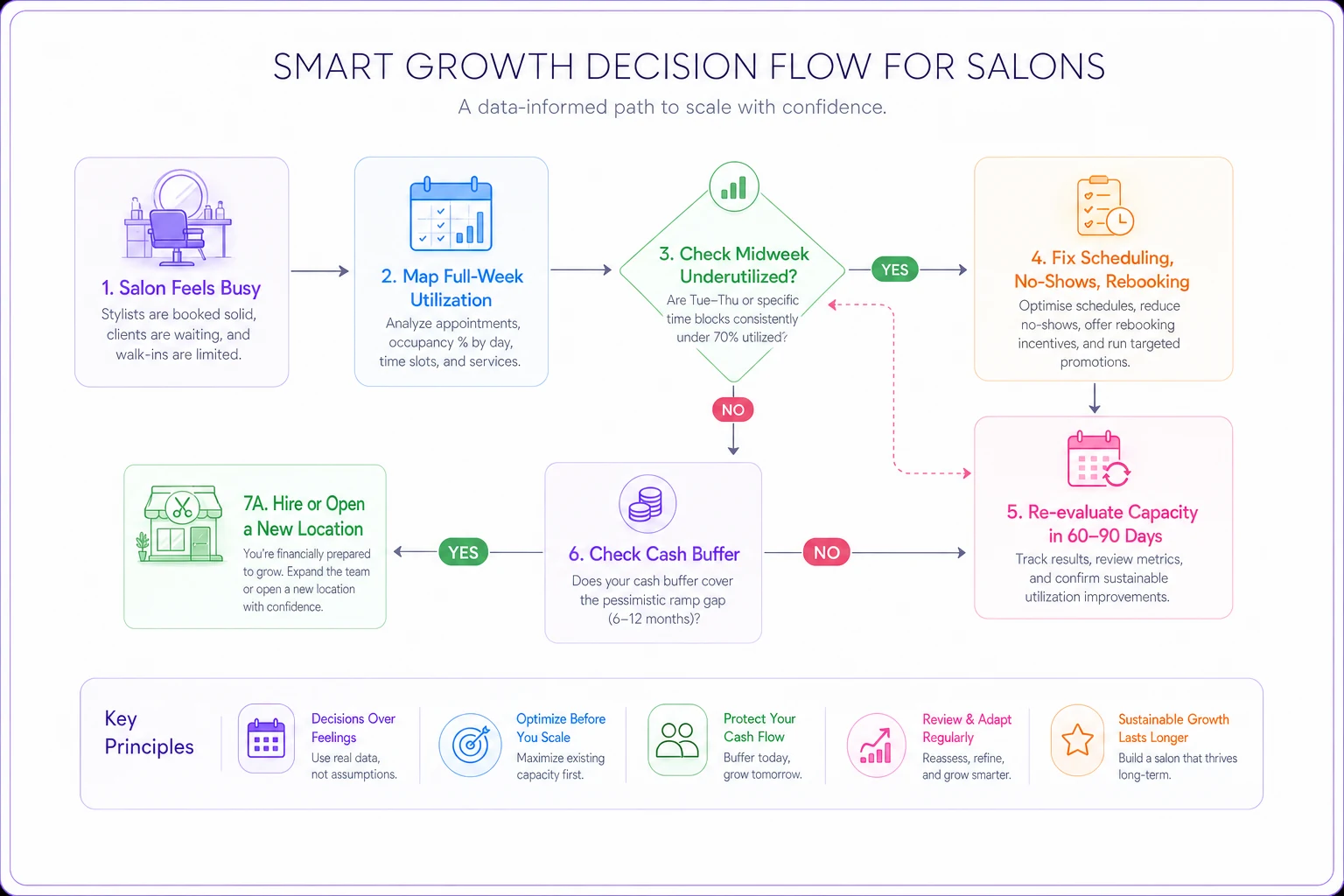
About eight months later they did hire, because demand had genuinely outgrown the tightened schedule. But by then the hire landed on a full, efficient base instead of masking inefficiency. The new stylist ramped faster because the systems fed her the overflow. That's the right sequence — systems first to expose true capacity, then people to expand it.
When each lever actually makes sense
Hire when: your existing stations are genuinely near mature utilization across the whole week — not just peaks — your rebooking and no-show numbers are already tight, and you have the ramp gap plus buffer in cash. A hire multiplies an efficient system; it can't fix a leaky one.
Invest in tech when: chairs aren't full, or they're full but revenue-per-chair disappoints, or you're bleeding capacity to no-shows, poor scheduling, or weak rebooking. Also worth doing before you hire or add a location — scaling on messy systems just scales the mess. This is where well-designed operational software earns its keep quietly: not as a magic fix, but as the thing that surfaces where capacity is actually leaking and keeps the schedule tight without piling on more front-desk labor.
Open a location when: your current box is truly capacity-capped — verified across the full week, not just Saturdays — demand is proven and durable, your core salon runs on documented systems that can be replicated, and your cash buffer can survive the entire pessimistic negative-cash window with the baseline reserve still untouched.
Who should NOT pull any of these levers yet
Some salons shouldn't be running this matrix at all — they need to fix the base first:
-
If you don't know your contribution per station, stop. Build station-level P&L before spending a dollar on growth.
-
If your no-show and rebooking numbers are poor, a hire or a location will just replicate the leak at larger scale.
-
If your baseline 6–8 week reserve doesn't exist, you have no business absorbing a ramp gap. Build the reserve first.
-
If your systems live in your head and one manager's memory, you can't clone the operation into a second box. Document first.
Most "we need to grow" moments are actually "we need to fix" moments. Growth applied to a broken base doesn't scale the good parts — it scales the leaks.
Bringing it together
Salon growth planning isn't about picking the exciting option. It's about forcing hire, tech, and location through the same lens: what does this do to per-station contribution, how long is the cash gap before it pays back, and can my buffer survive the pessimistic case.
When you run all three options that way, the right answer usually stops being a debate. And just as often, the answer for the next few months is "tighten the system I already have" before committing capital to people or square footage. The salons that scale without drama aren't always the ones with the most demand — they're the ones that didn't move until the math was honest.
Build the station-level P&L once. Build the three-column sensitivity table once. Set your buffer rules and don't break them.
After that, every growth decision becomes a short exercise instead of a sleepless gamble — and you'll stop confusing a busy Saturday for a reason to sign a lease.
Ready to simplify your salon operations?
Join 1,000+ salons using Salnly to save time, reduce scheduling chaos, and deliver better client experiences.