

Walk into your best-performing location on a Tuesday and you'll probably see it humming. Front desk knows the regulars, stylists are on time, the recovery on a botched color happens before the client even leaves upset. Walk into your second or third location that same day and something feels off — not broken exactly, just looser. Longer waits at checkout. Nobody offers water. A color correction turns into a refund because nobody knew who was allowed to comp what.
Same brand. Same training deck. Wildly different experience.
This is the core problem with salon customer experience systems once you go past a single location: experience quality doesn't scale on its own. It leaks. And it leaks in predictable places — the handoffs between people, the moments nobody explicitly owns, the standards that live in one manager's head instead of anywhere else.
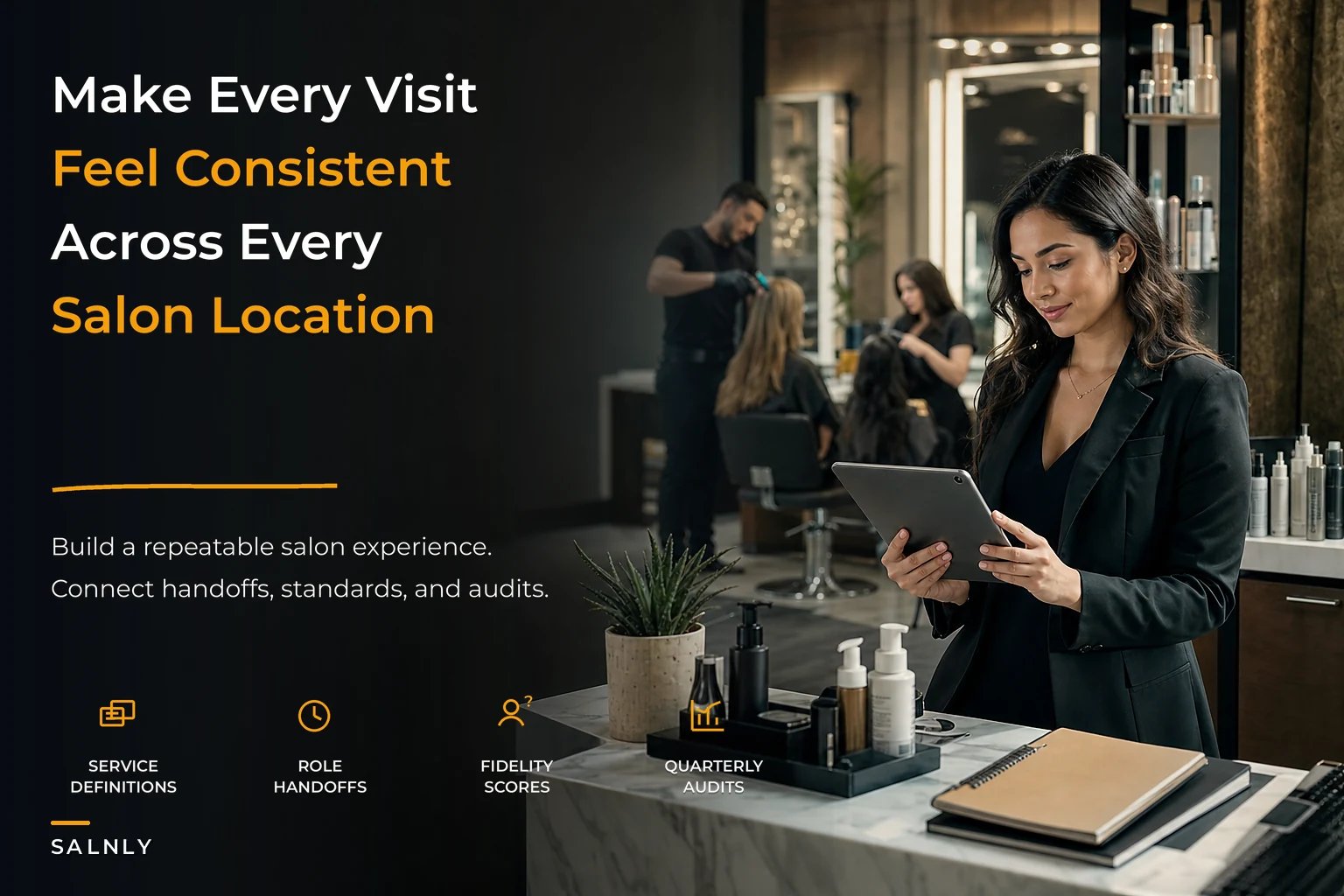
Salons that stay consistent across locations don't do it with better people or more inspiring culture speeches. They do it by turning "great service" into something measurable, owned, and audited on a schedule. That's what this is about — not tips, but the connected system that holds experience together as you grow.
The real reason experience drifts between locations
Most owners assume inconsistency is a hiring or attitude problem. Occasionally it is. But far more often it's a definition problem.
At one location, "greet the client warmly" means a receptionist stands up, uses the client's name, and offers a drink within 30 seconds. At another, the same phrase means someone glances up from the screen and says "be right with you." Both staff think they're doing the job. Neither is technically wrong according to the training material — because the training material never defined warmly in a way you could actually observe or score.
Experience drift is almost always the gap between an intention ("clients should feel taken care of") and an operational definition ("water offered, wait acknowledged, next step stated"). Intentions don't transfer between buildings. Definitions do.
The second driver is invisible handoffs. A haircut isn't one experience — it's a chain of maybe eight micro-experiences: booking, confirmation, arrival, consult, service, recovery-if-needed, checkout, rebook. Each handoff between people is a place where the ball can drop. At a single location the owner catches most drops in real time. Across three or four locations, nobody's watching every handoff, so the drops quietly become normal.
The four layers that actually hold experience together
A working CX system isn't one document. It's four layers stacked, each solving a different failure mode. Skip a layer and the whole thing sags.
Stop losing appointments in the chaos.
Salnly helps you book, confirm & manage every appointment—efficiently.
- Centralized appointment management
- Client notifications
- Calendar & staff scheduling
No credit card required
| Layer | What it defines | Failure it prevents |
|---|---|---|
| Service-level definitions | The observable standard for each moment | "Warmly" meaning ten different things |
| Role-by-role handoffs | Who owns the client at each step | Balls dropped between people |
| Fidelity scorecards | Whether the standard actually happened | Standards that exist on paper only |
| Audit routines | How often you check, and who fixes gaps | Slow, silent drift over months |
Most salons have a rough version of layer one and nothing underneath. That's why their SOPs feel good in the binder and change nothing on the floor.
Here's a visual workflow of how the four layers connect.
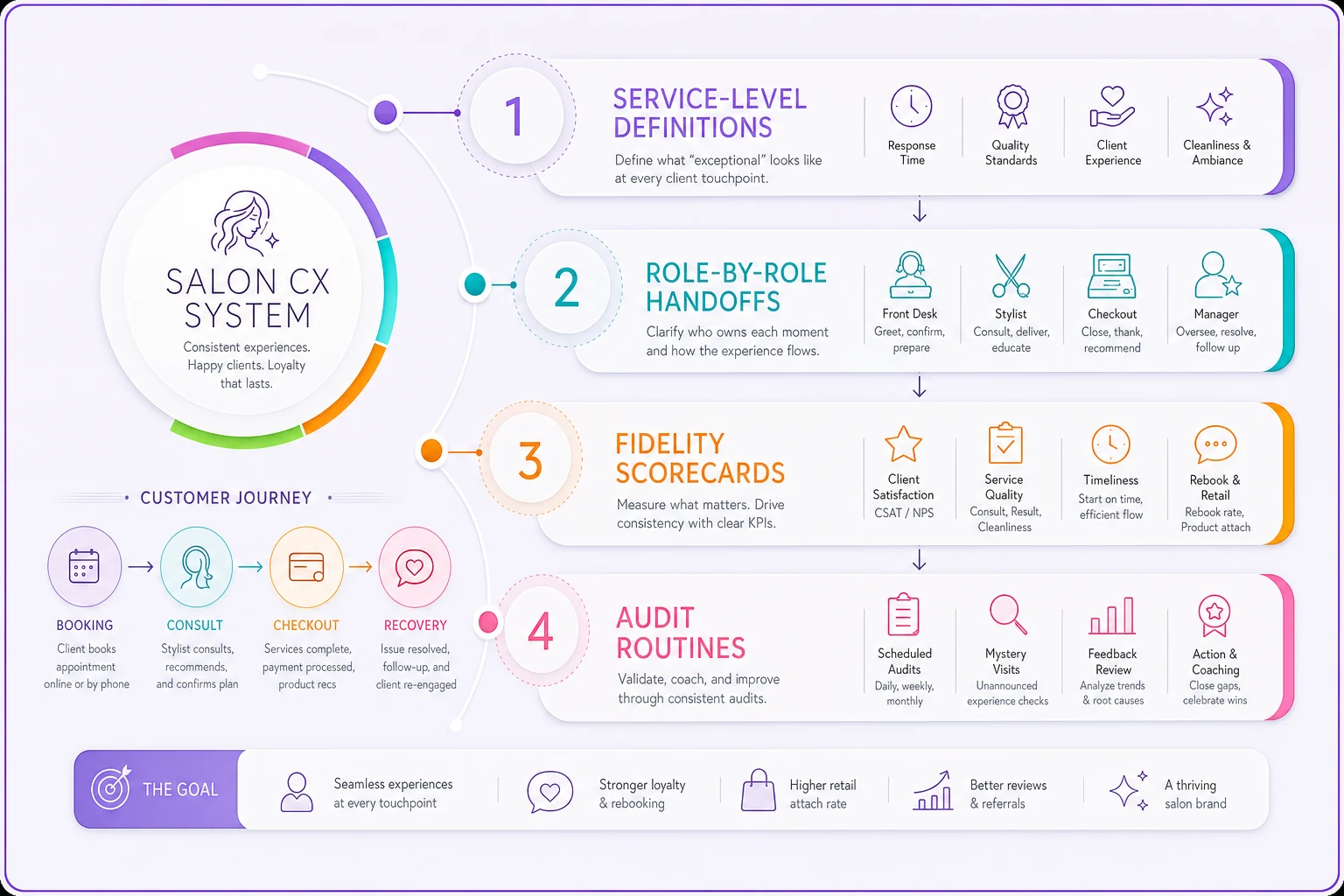
Place the system elements so they show where handoffs happen and where scorecards and audits sample real client journeys.
Layer 1: Service-level definitions written to be observed, not admired
A service-level definition is a standard someone can watch happen and mark yes or no. That "observable" part is everything. If two managers can't independently agree on whether a standard was met, it's not a definition — it's a mood.
Compare these:
-
- Weak
"Consultations should be thorough."
-
- Usable
"Consult includes: confirming today's service out loud, checking last visit's notes, asking one maintenance question, and stating the finish time before starting."
The second one you can score from across the room. The first you can argue about forever.
A common mistake is writing definitions for the pleasant moments and skipping the ugly ones. The moments that most damage experience across locations are almost always the awkward ones — the client who's unhappy, the running-behind apology, the "we're out of your toner" conversation. Those need definitions more than the greeting does, because they're where staff freeze and improvise. And improvisation is what varies between buildings.
Write definitions for at least these moments:
-
Arrival and wait acknowledgment
-
Consultation and expectation-setting
-
The "we're running behind" script and threshold (at how many minutes do you proactively reach out?)
-
On-the-spot service issues
-
Checkout and payment
-
Rebook offer
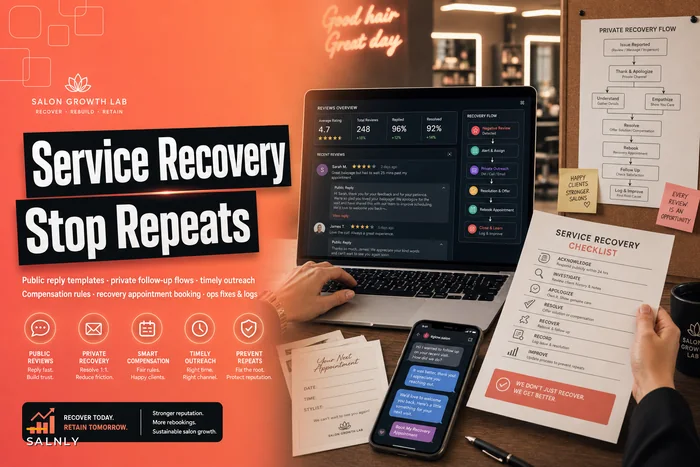
When you get to the recovery moments specifically, tie them to your existing recovery playbook so the in-chair fix and the after-the-fact response are part of the same system. Our breakdown on service recovery for salons covers the private recovery flows and the rules that stop the same issue repeating — those only work if the front-line definition of "handle an unhappy client" matches what the recovery process expects.
Layer 2: Role-by-role handoffs — where the client actually gets dropped
Definitions tell you what good looks like. Handoffs decide whether the client stays "owned" the whole way through, or falls into a gap where nobody's responsible.
Think of the client as a baton. The question at every step is: who's holding the baton right now, and who takes it next? When that's fuzzy, you get two classic failures — double-ownership (two people assume the other has it, so nobody does) and no-ownership (the client sits in the gray zone between the stylist finishing and the desk checking them out).
-
Booking → Confirmation Front desk owns until the confirmation sequence fires. Handoff point: appointment is booked and client contact is verified.
-
Confirmation → Arrival System/desk owns. Handoff point: client checks in, wait is acknowledged, stylist is notified.
-
Arrival → Consult Stylist takes the baton. Handoff point: stylist greets by name and pulls up notes within a defined window.
-
Consult → Service Same stylist, but a new sub-standard — expectations and finish time confirmed before product touches hair.
-
Service → Recovery (if needed) Stylist owns first, escalates to manager only past a defined threshold (what can a stylist comp vs. what needs a manager).
-
Service → Checkout Stylist walks client to desk or explicitly hands off. Handoff point: stylist tells desk what was done and what to rebook.
-
Checkout → Rebook Desk owns. Handoff point: rebook offered, next visit or follow-up logged.
The single most common drop is step 6. The stylist finishes, says "the front will take care of you," and drifts to their next client. The desk doesn't know what service happened, what to sell, or what to rebook. The client leaves without a next appointment. Across three locations, that one weak handoff quietly costs a significant chunk of rebook revenue — and it's invisible because everyone technically did their job.
Fixing it isn't a personality change. It's assigning the baton clearly: the stylist doesn't get to release the client until the desk has confirmed receipt of what to do next. That's a handoff rule, not a vibe.
Layer 3: Fidelity scorecards — proving the standard actually happened
Here's the uncomfortable part: definitions and handoffs written down do almost nothing without measurement. Staff drift toward whatever gets checked. If nobody scores the consult, the consult shrinks. If nobody scores the rebook offer, it disappears on busy days first.
A fidelity scorecard is a short, observable checklist tied to your definitions, filled out by a manager on a sample of appointments. Not every appointment — a sample. Five to ten client journeys per stylist per week, spot-checked.
Keep it brutally short. Long scorecards don't get used. Something like:
-
- [ ] Client greeted by name within the arrival window
-
- [ ] Consult included last-visit notes + one maintenance question
-
- [ ] Finish time stated before service started
-
- [ ] Any delay over threshold was proactively communicated
-
- [ ] Checkout handoff completed (desk knew service + rebook)
-
- [ ] Rebook or follow-up offered
Six boxes. Yes/no. Scoreable in the moment or right after.
The insight most owners miss: the scorecard isn't a report card for punishing people. It's a drift detector. When one location's checkout-handoff score sits at 60% while the others are at 90%, you don't have a bad team — you have a broken handoff at one building that you can now see and fix. The number points you to the gap.
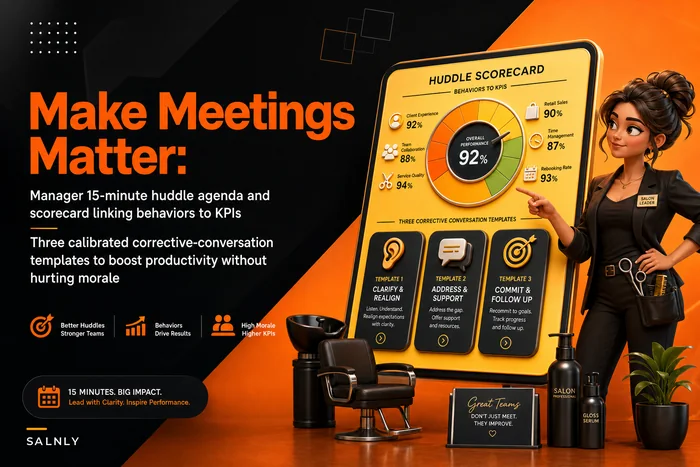
These scores should feed directly into your team's regular rhythm, not sit in a spreadsheet nobody opens. The fastest way to make scorecards real is to review two or three of them in the daily huddle. We laid out a tight version of that in the 15-minute salon huddle and scorecard toolkit — the point is that the number gets discussed daily, so drift gets caught in days instead of quarters.
The fastest way to make scorecards real is to review two or three of them in the daily huddle.
We laid out a tight version of that in the 15-minute salon huddle and scorecard toolkit — the point is that the number gets discussed daily, so drift gets caught in days instead of quarters.
Layer 4: Audit routines — catching drift before it becomes culture
Scorecards catch daily and weekly slippage. Audits catch the slower, sneakier stuff — the standards that erode so gradually nobody notices until a location just feels different.
An audit is a scheduled, deeper look at whether the whole system is still holding. The cadence that works for most multi-location salons:
-
Weekly Managers review scorecard samples, flag any standard under target.
-
Monthly Cross-location comparison — same standards, different buildings, side by side. This is where drift shows up as a pattern.
-
Quarterly Full CX audit pack (below), tying the whole thing back to training and SOPs.
The mistake is auditing only when something breaks. Reactive auditing means you find the problem after clients have already felt it — after the review, after the churn. Scheduled auditing finds it while it's still just a number moving in the wrong direction.
One thing worth naming: audits fail when they measure output but never trace it back to a cause. "Rebook rate dropped at Location 2" is an observation. "Rebook rate dropped at Location 2 because the checkout handoff score dropped, because two new stylists joined and never got the handoff properly drilled" is a diagnosis. The audit's job is to get from the first sentence to the second — and then to an actual training fix.
The quarterly CX audit pack — where training, SOPs, and outcomes finally connect
This is the piece that ties everything together, and it's the piece almost nobody builds. Most salons have training over here, SOPs over there, and CX metrics somewhere else entirely, none of them touching. The quarterly pack forces them into one loop: did our training and SOPs actually produce the experience outcomes we wanted, and if not, where's the break?
-
Standards review — Are our service-level definitions still right? Any moment we're missing? Any standard that's gone vague again?
-
Scorecard trends by location — Twelve weeks of fidelity scores, side by side. Which standards are slipping, and where.
-
Handoff failure log — Every dropped-baton incident logged this quarter, grouped by handoff step. Which handoff breaks most?
-
Outcome tie-back — Match scorecard movement against real outcomes
rebook rate, complaint volume, recovery incidents, review scores. Are the standards we're scoring the ones that actually move the client?
-
Training gap map — For each slipping standard, which staff are behind, and what specific drill fixes it.
-
SOP updates — Any definition or handoff rule that needs rewriting because reality proved it wrong.
The most valuable part is step 4. It's where you learn whether you're measuring the right things. Sometimes you'll find a standard everyone scores high on that has zero correlation with client return — you're spending effort policing something that doesn't matter. Other times a quietly-ignored standard turns out to be the one that predicts churn. The tie-back tells you where to actually point people's attention.
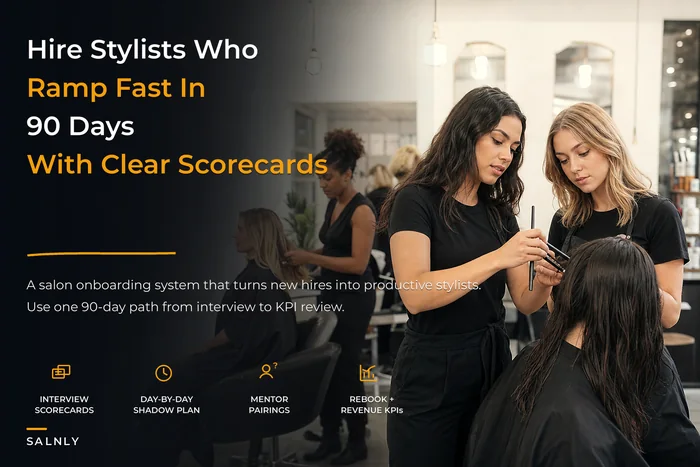
Step 5 is where this connects to onboarding. Most fidelity gaps at a given location trace back to whoever joined most recently and never got the standard properly drilled. A CX audit that surfaces "new stylists are missing the consult standard" is only useful if you have a ramp that fixes it. Our 90-day stylist onboarding system ties the shadow schedule and KPIs to exactly these standards, so a new hire is scored against the same definitions the audit checks.
A real scenario: three locations, one that kept "feeling off"
A three-location salon group — combined book of roughly 900–1,000 visits a month — had a persistent issue at their newest location. Revenue was fine. Prices matched. But that location's Google reviews ran a full star lower, and rebook rate sat noticeably below the other two, somewhere in the low-to-mid 30s percent versus the high 40s elsewhere.
The owner's first instinct was "wrong hires, wrong vibe" and she almost restaffed. Instead they ran a basic version of the four-layer system for one quarter. The scorecards found it fast: the checkout handoff at the new location was landing well under half the time. Stylists finished and vanished; the desk didn't know what to rebook.
The fix wasn't dramatic. They wrote one handoff rule — stylist doesn't release the client until the desk confirms the next step — drilled it in the daily huddle, and scored it weekly. Within about a quarter the checkout-handoff score climbed into the 80s, rebook rate at that location moved up into the low 40s, and the review gap between locations mostly closed.
No new hires. No new menu. They found a broken handoff and made it visible. That's the whole game.
When this level of system makes sense — and when it doesn't
When it makes sense:
-
You run two or more locations and experience feels inconsistent between them.
-
You're about to open a new location and want the standard to transfer, not get reinvented.
-
Rebook or review scores vary by building with no obvious staffing reason.
-
You catch problems only after clients complain, never before.
When it's overkill:
-
Single location where the owner is on the floor most days. You can hold the standard in person; a full audit pack is bureaucracy you don't need yet. Write the definitions, skip the quarterly machinery.
-
Very early-stage or booth-rent models where you don't actually control the experience your renters deliver.
Who should not do this yet: If your service durations, menu, and pricing aren't standardized across locations, fix that first. A CX audit on top of chaotic operations just measures the chaos. Get the operational floor level before you install the experience ceiling.
Where software quietly earns its place
None of this requires software to design — the definitions, handoffs, and audit cadence are decisions, not features. But holding it together across locations by hand gets brutal fast. The scorecards, the handoff logs, the quarterly tie-back between standards and outcomes — doing all of that in scattered spreadsheets is where most salons quietly give up around month three.
This is the one spot where an operational platform with AI-assisted workflow tracking actually pulls its weight: automatically logging where in the client journey handoffs stall, flagging when a location's fidelity scores start drifting before it shows up in reviews, and pulling the quarterly outcome tie-back together instead of someone rebuilding it from raw exports every few months. The system stays the same either way — the software just keeps it from collapsing under its own admin as you scale.
The takeaway that actually matters
Consistent experience across locations isn't a talent problem and it isn't a culture speech. It's an engineering problem with four connected parts: define the standard so it can be observed, own the handoffs so the client never falls in a gap, score the fidelity so drift shows up as a number, and audit on a schedule so you catch it early and trace it back to a training or SOP fix.
Build those four layers and your locations start feeling like the same salon — not because everyone's inspired, but because the system doesn't let them drift. Skip any one layer and you're back to that Tuesday where two of your locations, same brand and all, deliver two completely different experiences and you can't quite explain why.
Build those four layers and your locations start feeling like the same salon — not because everyone's inspired, but because the system doesn't let them drift. Skip any one layer and you're back to that Tuesday where two of your locations, same brand and all, deliver two completely different experiences and you can't quite explain why.
Ready to simplify your salon operations?
Join 1,000+ salons using Salnly to save time, reduce scheduling chaos, and deliver better client experiences.