
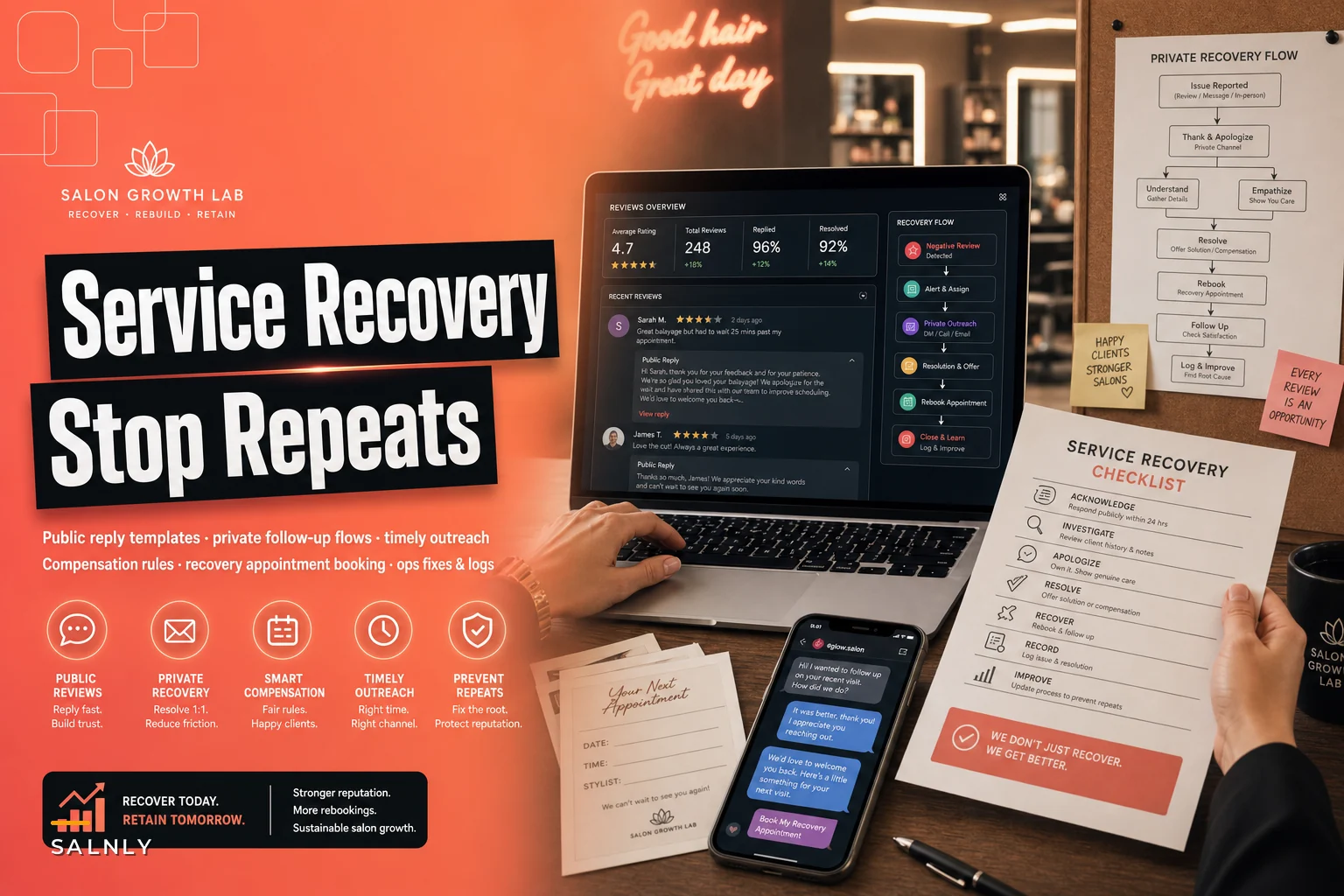

The gap between apologizing and actually fixing what went wrong
Most salons handle bad reviews backwards. They pour energy into the public reply — crafting the perfect apologetic paragraph for a 1-star Google review — and almost nothing into the private recovery that actually decides whether that client comes back. Then the same problem happens again three weeks later with a different client, and nobody connects the dots.
That's the real failure. Not the bad review itself. It's that a service recovery event produces a nice-sounding reply and zero operational change.
This post is about building a recovery SOP that does three things at once: responds publicly in a way that doesn't make you look defensive, runs a private follow-up that has a real chance of saving the relationship, and — the part almost everyone skips — feeds what you learned back into your operations so the same complaint stops showing up.
Start with the part everyone gets wrong: separating the audience
When a client leaves a public review, you're actually writing for two different audiences who want completely different things.
The upset client wants acknowledgment and a fix. The 40 future clients silently reading that review want to know one thing: if something goes wrong here, will they handle it like adults?
The mistake is writing the public reply as if it's your recovery conversation. It's not. The public reply is a signal to future readers. The recovery conversation happens privately, where you can actually solve the problem, offer compensation, and dig into what went wrong without airing it for everyone.
Salons that blur these two lose both ways. Their public replies get long and defensive — because they're trying to solve the problem in public — and their private follow-up gets weak because they already feel like they handled it. Keep them separate. Public reply = short, calm, moves it offline. Private flow = where the real work happens.
Public response templates that don't sound like a legal department
The best public review responses share a rhythm: acknowledge, take responsibility without over-explaining, move it offline, and stop. Three to four sentences. No essays.
Stop losing appointments in the chaos.
Salnly helps you book, confirm & manage every appointment—efficiently.
- Centralized appointment management
- Client notifications
- Calendar & staff scheduling
No credit card required
Here's the structure broken down by review type:
| Review situation | What to acknowledge | What to avoid | Offline move |
|---|---|---|---|
| Genuinely bad service (color wrong, botched cut) | The specific outcome, not just "your experience" | Excuses, blaming the stylist by name | Direct invite to make it right, name a contact |
| Long wait / running behind | The wait, and that their time matters | "We were short-staffed" (sounds like their problem now) | Offer to discuss scheduling directly |
| Rude/personality clash | That they felt unwelcome | Defending the staff member publicly | Ask them to reach out to the owner |
| Pricing surprise | The confusion about cost | Justifying prices line by line | Offer to walk through it privately |
| Unfair or false review | Nothing you didn't do; state your side once, calmly | Arguing, sarcasm, calling them a liar | Invite them to contact you to resolve |
A few templates you can adapt:
For a real service failure: > "Hi [Name] — I'm sorry your color didn't come out the way we discussed. That's on us to fix, and I'd genuinely like the chance to. Please reach out to me directly at [contact] — I'll take care of it personally. — [Owner name]"
For a wait-time complaint: > "Thanks for flagging this, [Name]. Running behind on your appointment isn't the experience we want anyone to have. I'd like to hear more about what happened — can you reach me at [contact]? — [Owner name]"
For a review you believe is unfair: > "Hi [Name], thanks for the feedback. Our record shows things a little differently, but I'd rather understand your side than debate it here. I'd appreciate the chance to talk — [contact]."
Notice what's missing: no coupon codes in public, no "we value all feedback," no defensive paragraphs. Using the owner's real name matters — it signals a person is accountable, not a brand.
One pattern worth naming: never publicly offer compensation. The moment you post "we'd love to offer you a free service," every future one-star review becomes a negotiation for freebies. Keep compensation private, always.
The private recovery flow (this is where clients actually get saved)
A public reply buys you goodwill. The private follow-up decides whether they rebook. Most salons never build this part into a repeatable process — they handle each blowup by feel, which means recovery quality depends entirely on who happens to catch the message that day.
Here's a private recovery flow that stays consistent:
-
Respond within a few hours, not days. Speed matters more than eloquence. A quick "I saw your review, I want to make this right, when's a good time to talk?" outperforms a polished reply that arrives two days later.
-
Get them on a call or in a real message thread, not a form. The upset client wants to feel heard by a human. A canned "your ticket has been received" kills recovery.
-
Let them talk first. Don't lead with the fix. People calm down when they finish their sentence. Ask "walk me through what happened" and actually listen before you problem-solve.
-
Name the specific fix and the compensation together. "I want to bring you back in with our senior colorist to correct this, no charge, and I'll add a treatment on us for the trouble." Clear, specific, done.
-
Book the recovery appointment on the spot if they're willing. A vague "reach out whenever" almost never converts. A scheduled slot does.
-
Close the loop after the recovery service. A short message a day later — "how are you feeling about the color now?" — is what turns a saved client into a loyal one.
That last step is the one that gets skipped most. Salons that fix the problem but never follow up afterward leave the client wondering if it was a genuine change or just a one-off apology. That follow-up message costs almost nothing, and it's the difference between "they fixed it" and "I actually trust them now."
Compensation rules: decide these before you need them
The reason compensation gets messy is that nobody sets the rules in advance, so every situation becomes a judgment call under stress — and those calls tend to over-give or under-give wildly depending on the day.
-
Tier 1 — Minor (short wait, small miscommunication) A sincere apology plus a small gesture — a complimentary add-on next visit, or a modest discount. No manager approval needed.
-
Tier 2 — Real service failure (correctable) Free correction of the service, done by a senior stylist, plus a small credit toward the next visit. Front desk can offer this without escalating.
-
Tier 3 — Significant failure (damage, major cost, health/safety) Full refund of the service, and the owner handles it personally. Never delegated.
Two rules that protect your margins:
Cap the freebies per client. If someone is on their third "free correction" in a few months, that's not a service-recovery situation anymore — it's either a chronic mismatch or a client working the system. Recovery is for genuine failures, not a permanent discount channel.
Correction over cash where possible. A free re-do costs you product and chair time but keeps the client in your building, where you have another shot at the relationship. A refund ends things politely. Default to correction unless the failure was severe.
When generous compensation actually makes sense
If the client is a high-value regular — the kind of relationship worth real money over a few years — err on the generous side. Losing someone who books consistently is far more expensive than one extra free treatment. Knowing which clients fall into that bracket before you're in the middle of a recovery situation is exactly why it helps to map the salon client lifecycle before anything goes wrong.
Map the salon client lifecycle so you can identify high-value regulars before a recovery situation.
When over-compensating is a mistake
First-time client who booked on a discount, complained about something minor, and seems to be angling for free work? Stay in Tier 1. Not every complaint deserves an escalating apology, and salons that fold immediately train a small slice of clients to complain strategically.
The step everyone skips: feeding learnings back into operations
This is the part that separates a salon that gets fewer complaints over time from one that keeps apologizing for the same thing on a loop.
Every recovery event contains information. But if that information lives only in the head of whoever handled it, it evaporates. The complaint gets solved, the client gets saved, and the cause stays fully intact — ready to catch the next person.
You need a simple log. After every recovery event, record:
-
What actually went wrong (the operational cause, not just "client was upset")
-
Which stylist, station, or service was involved
-
What it cost to fix — comp value plus chair time
-
Whether the same issue has come up before
Then, once a month, look at the log as a whole. That's where patterns show up that no single incident reveals on its own.
A typical example: a salon kept getting color-correction complaints. Handled one at a time, each looked like a one-off. Logged together, three of five complaints over two months traced back to the same thing — a service booked at 30 minutes when it realistically needed 45, so stylists were rushing the processing. The complaint wasn't a skill problem. It was a scheduling problem creating a skill-looking symptom. They adjusted the service duration, and that category of complaint mostly went away.
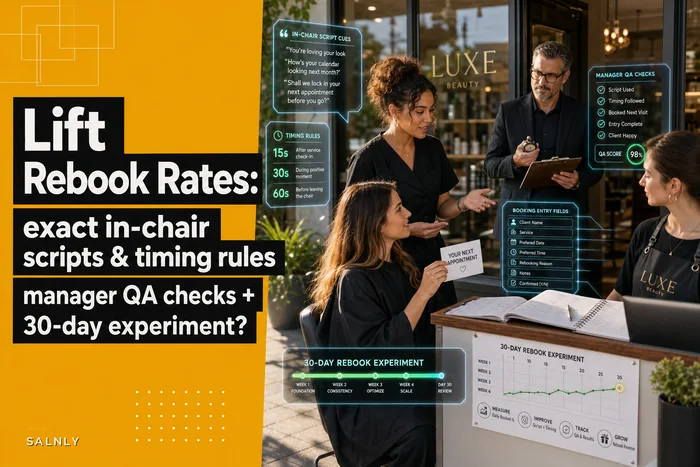
Complaints that look like people problems are frequently process problems in disguise. Standardizing durations, tightening rebooking scripts, or fixing a consult step often removes the root cause entirely. If your recovery log keeps pointing at inconsistent service outcomes, tightening your in-chair process — including something as specific as the in-chair rebooking micro-process and manager QA — tends to catch issues before they ever reach a review.
Here's how a complaint moves through the full recovery loop — from the moment a review goes live to the operational fix on the back end:
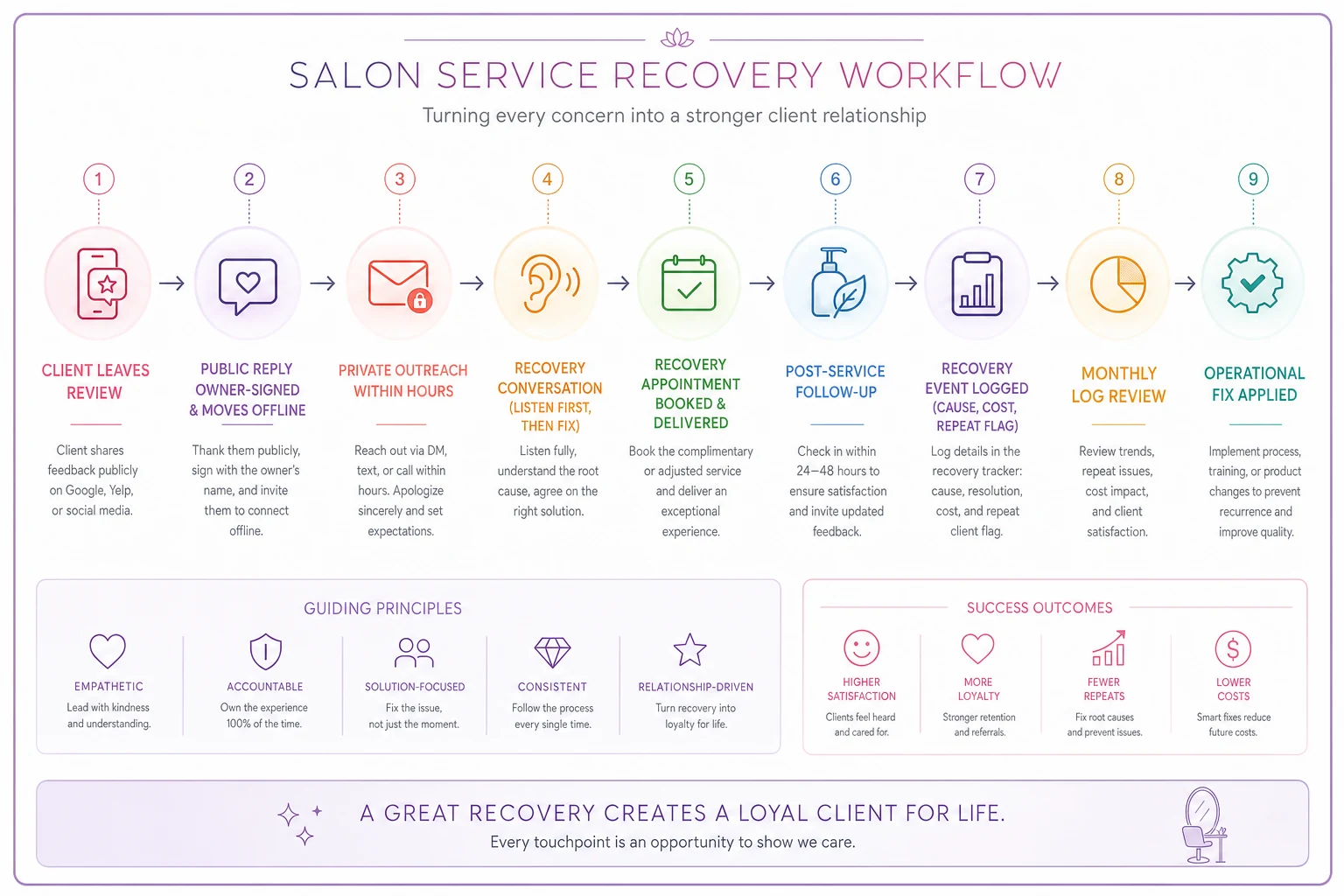
This graphic shows the recovery loop and where operational fixes attach.
[Client leaves review] ↓ [Public reply posted — same day, owner-signed, moves offline] ↓ [Private outreach — within a few hours] ↓ [Recovery conversation — listen first, then fix] ↓ [Recovery appointment booked + delivered] ↓ [Post-service follow-up — 1 day later] ↓ [Recovery event logged — cause, cost, repeat flag] ↓ [Monthly log review — pattern check] ↓ [Operational fix applied if pattern found]
Most salons stop somewhere around step four. The public reply goes up, the client gets handled, and that's it. The log and the monthly review are what close the loop — and they're also the part that takes the least time once you've built the habit.
A quick real scenario
A three-chair salon was averaging two or three bad reviews a month, mostly around color and wait times. Their public replies were fine — polite, professional — but they had no private flow and no logging. Same complaints kept recurring.
They put in three changes: a private recovery flow with a same-day response target, three compensation tiers so the front desk stopped guessing, and a monthly review of a simple complaint log.
Over the next quarter, the volume didn't drop to zero. But the repeat complaints did. The color-correction cluster traced back to one under-timed service and one consult step being skipped when they ran busy. Fixing those two things removed most of that complaint category. The public review average drifted up over the following months, and — the part that mattered financially — clients who'd left bad reviews and got a real recovery call started rebooking at a noticeably higher rate than before. Previously, a bad review basically meant a lost client.
Nothing dramatic. Just a loop that turned complaints into fixes instead of apologies.
Your recovery SOP checklist
Getting all of this out of your head and into a repeatable process is what makes it stick. Run through this periodically — not just when something goes wrong.
-
Public reply templates written for each complaint type — short, calm, owner-signed
-
Hard rule
no compensation offered publicly, ever
-
Private recovery flow with a same-day response target
-
"Listen first, fix second" built into the flow
-
Recovery appointment booked on the spot when possible
-
Post-recovery follow-up message 1 day after the fix
-
Three compensation tiers defined in advance
-
Per-client freebie cap to prevent abuse
-
"Correction over cash" as the default
-
Every recovery event logged with its operational cause
-
Monthly review of the log to catch repeat patterns
-
At least one process change per recurring complaint category
Getting all of this out of your head and into a repeatable process is what makes it stick. Run through this periodically — not just when something goes wrong.
The mindset that actually reduces bad reviews
The salons that quietly stop getting the same complaints aren't the ones with the best-written public apologies. They're the ones treating each recovery as a small investigation — save the client today, then figure out what in the operation let it happen and fix it.
A public reply protects your reputation for the next reader. A private flow protects the relationship with the client in front of you. But only the feedback loop protects you from doing it all over again next month.
Skip that last part, and you'll have beautifully worded apologies and the exact same problems a year from now. Get all three working together, and bad reviews stop being a recurring tax on your business and start becoming the thing that quietly makes your operations tighter every month.
Skip that last part, and you'll have beautifully worded apologies and the exact same problems a year from now. Get all three working together, and bad reviews stop being a recurring tax on your business and start becoming the thing that quietly makes your operations tighter every month.
Ready to simplify your salon operations?
Join 1,000+ salons using Salnly to save time, reduce scheduling chaos, and deliver better client experiences.