
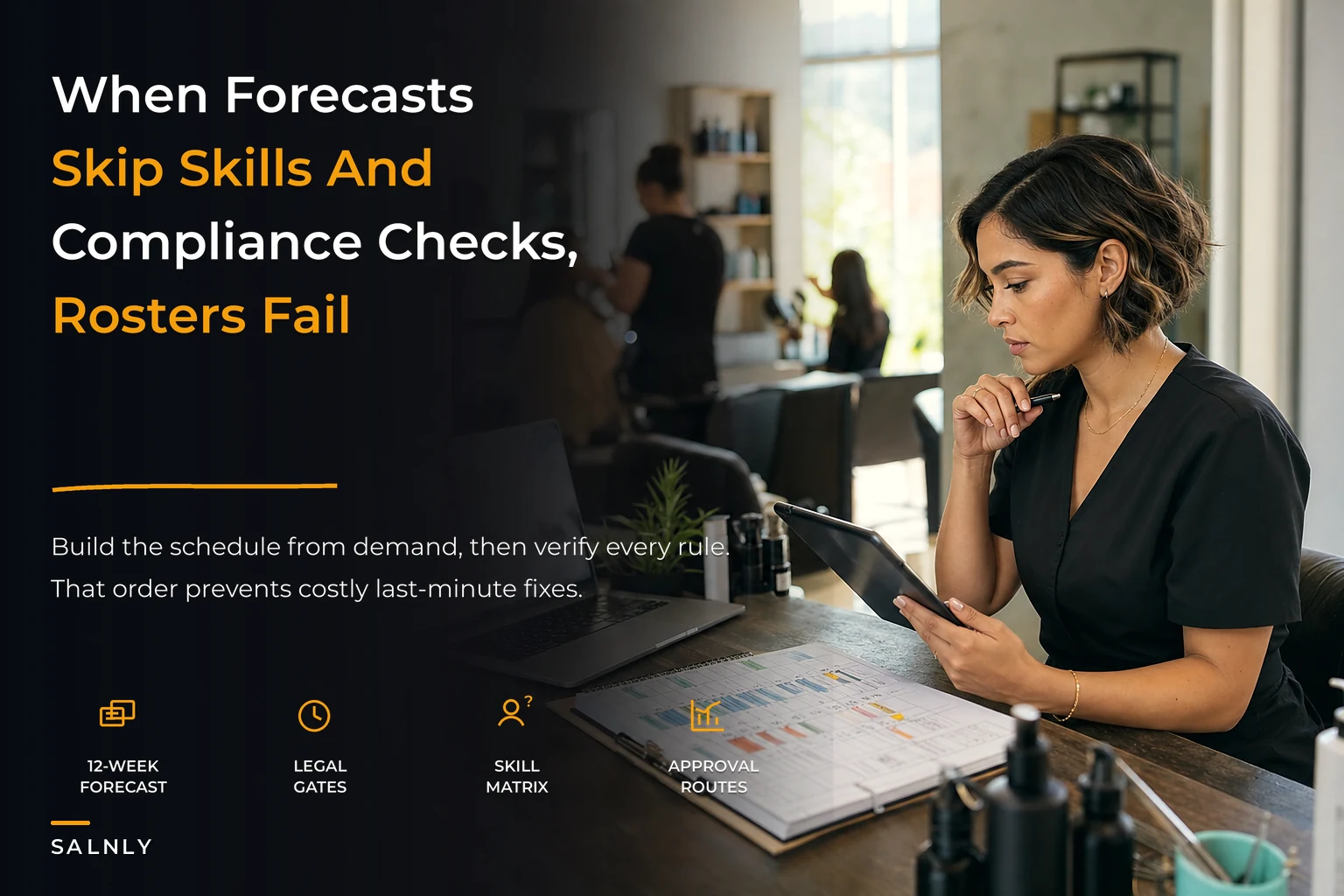

Most salon rosters are built backwards. Someone opens the scheduling app on a Thursday afternoon, looks at who's usually free, drags names into slots, and calls it done. The forecast — if one exists — lives in the owner's head or a spreadsheet nobody's touched since January. The result is a schedule that reflects habit and personality, not demand.
That works fine when you have three chairs and everyone knows each other's rhythm. It falls apart the moment you're juggling color specialists, a couple of juniors, a front desk person who also does blow-dries, and a seasonal spike coming up. Suddenly the person you rostered can't legally work that shift length, or isn't certified for the balayage that's already booked, or you've stacked three seniors on a slow Tuesday morning while Saturday runs skeleton crew.
Demand-driven rostering isn't about fancy software. It's about wiring four things together so they actually inform each other: a rolling forecast, a skills-and-credential map, the legal constraints you can't bend, and a set of rules for when reality goes sideways. When those four pieces connect, the roster mostly builds itself. When they don't, you spend every week firefighting.
Why the "who's usually available" method quietly costs you
The default approach optimizes for one thing — filling shifts — and ignores everything that actually drives profit. You can have a fully staffed floor and still bleed money if the staffing doesn't match what's booked or what's about to be booked.
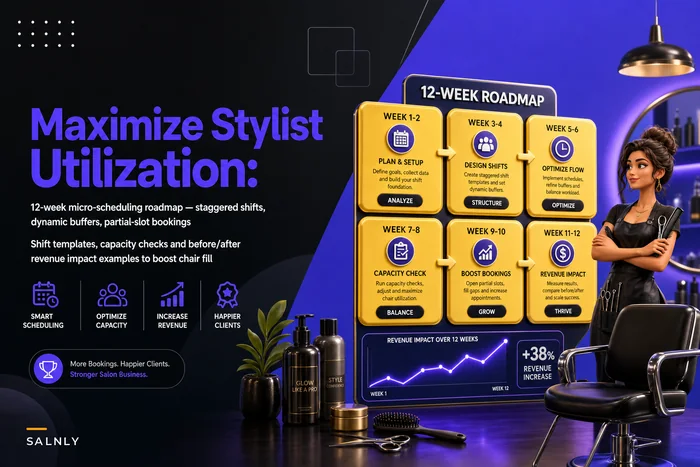
This usually shows up in a few predictable ways. A salon rosters by seniority preference, so top stylists always get the "good" days and juniors get the dead ones. That feels fair internally, but it means your highest-cost labor sits partly idle during quiet stretches while your cheaper capacity goes unused during rushes. Utilization suffers on both ends. There's a whole breakdown on how micro-scheduling gaps quietly drain revenue in our stylist utilization post — rostering is the layer above that. If the roster is wrong, no amount of clever gap-filling saves you.
The second failure is credential blindness. The schedule looks full, but when a keratin treatment gets booked on a Wednesday, the only person working isn't trained on that brand's chemical process. Now you're either turning away the booking, moving the client, or letting someone do a service they shouldn't. None of those are good outcomes.
The third — and this one gets expensive — is compliance drift. Break rules, maximum consecutive days, minor labor restrictions, minimum rest between shifts. Small salons rarely track these deliberately. They schedule, then discover the problem when someone complains or an audit happens. A single misclassified shift pattern repeated weekly across a year is not a rounding error.
The four inputs, and why they have to connect
Think of the roster as an output, not an input. It's what falls out when you feed the system good data. Here are the four feeds.
Stop losing appointments in the chaos.
Salnly helps you book, confirm & manage every appointment—efficiently.
- Centralized appointment management
- Client notifications
- Calendar & staff scheduling
No credit card required
1. The 12-week rolling forecast. Not a static annual guess — a forecast that updates every week and always looks 12 weeks ahead. You're projecting demand by service category and by day-part, because "busy Saturday" isn't specific enough. A Saturday heavy on color needs a very different crew than one loaded with cuts and blow-dries. If you haven't built the forecasting muscle yet, our 12-week seasonal forecasting toolkit is the foundation this whole system sits on.
2. The skills and credential matrix. Every staff member mapped against every service, plus expiry dates on anything certified — color lines, chemical treatments, lash certifications, first aid. The matrix isn't just "can/can't." It's tiered: can do solo, can do with supervision, in training, expired. That nuance matters because a junior who's almost signed off on balayage can be rostered next to a senior who can supervise — which is also how you develop the team without margin loss, something covered in the juniors-and-seniors tiered model.
3. Legal and contractual constraints. Hard limits. Max hours per week, mandatory rest, break entitlements, minor restrictions, contracted minimum hours you owe part-timers. These are non-negotiable and should be treated as boundaries the roster physically cannot cross.
4. Contingency and approval rules. What happens when someone calls in sick, when a big booking lands late, when the forecast jumps. Plus who has to sign off on what — overtime, swaps, bringing in a freelancer.
The value isn't in any single feed. It's that a change in one ripples into the others automatically. Forecast spikes on week 6 → system checks which skills that demand requires → checks who's available and certified → checks whether rostering them breaks any legal limit → flags what needs manager approval. That chain is the whole point.
What the skills matrix actually looks like
People overcomplicate this. A workable matrix fits on one screen. Rows are staff, columns are service categories, cells hold a status and an expiry where relevant.
| Staff | Cut & Style | Color (Line A) | Balayage | Keratin | Lash | Cert Expiry |
|---|---|---|---|---|---|---|
| Dana | Solo | Solo | Solo | Solo | — | Keratin: Mar |
| Priya | Solo | Solo | Supervised | — | Solo | Lash: Aug |
| Marco | Solo | Solo | — | — | — | — |
| Kel | Solo | Supervised | In training | — | — | — |
| Sam (jr) | Supervised | In training | — | — | — | — |
The insight most owners miss: this table isn't static reference material, it's a scheduling constraint. When balayage demand climbs in your forecast, you can see instantly that you've got exactly one solo balayage stylist (Dana) and two developing (Priya supervised, Kel in training). If Dana takes a week off during a color-heavy stretch, you have a capacity hole no amount of general staffing fixes. That's the kind of thing you want to see 12 weeks out, not the Monday it happens.
The expiry column earns its keep too. A lash cert lapsing in August, unnoticed, means you're either booking services you can't legally deliver or scrambling for renewal at the worst time. Tie the matrix to the forecast and you can flag it early: "Priya's lash cert expires before your projected September lash spike." That's useful. Finding out in late August is not.
Building the roster: the actual sequence
Here's the order that keeps you out of trouble. Do it in this sequence and most conflicts resolve themselves before they exist.
-
Pull the forecast for the target week. Break it down by day-part and service category, not just total headcount. You want to know Tuesday-morning color demand, not just Tuesday demand.
-
Translate demand into required skill-hours. If Saturday projects 14 color appointments averaging 90 minutes, that's roughly 21 color-capable hours needed. Do this per category.
-
Layer in legal boundaries first — before assigning names. Mark who's unavailable, who's near their weekly cap, who needs a rest day after a long stretch. This is the fence. Nothing gets scheduled outside it.
-
Assign to demand, matching skill tiers. Fill the high-skill demand with solo-certified staff, then place developing staff in supervised slots that cover demand and build capability at the same time.
-
Run the coverage check. Any category where projected demand exceeds available certified hours gets flagged now — while you still have weeks to react (cross-train, book a freelancer, adjust promos).
-
Route exceptions to approval. Overtime, freelancer spend, shift swaps that push someone toward a cap — these hit the manager's desk with the reason attached, not buried in a group chat.
-
Publish, then re-forecast next week. The 12-week window rolls forward. Week 2 becomes week 1. You're never more than a week from a fresh look.
The step people consistently skip is #3 — laying the legal fence before assigning names. If you assign first and check compliance last, you end up unpicking a roster you've already emotionally committed to, and that's exactly when owners convince themselves to "just this once" break a rest rule.
Here's a quick visual of the sequence so you can map it to your process.
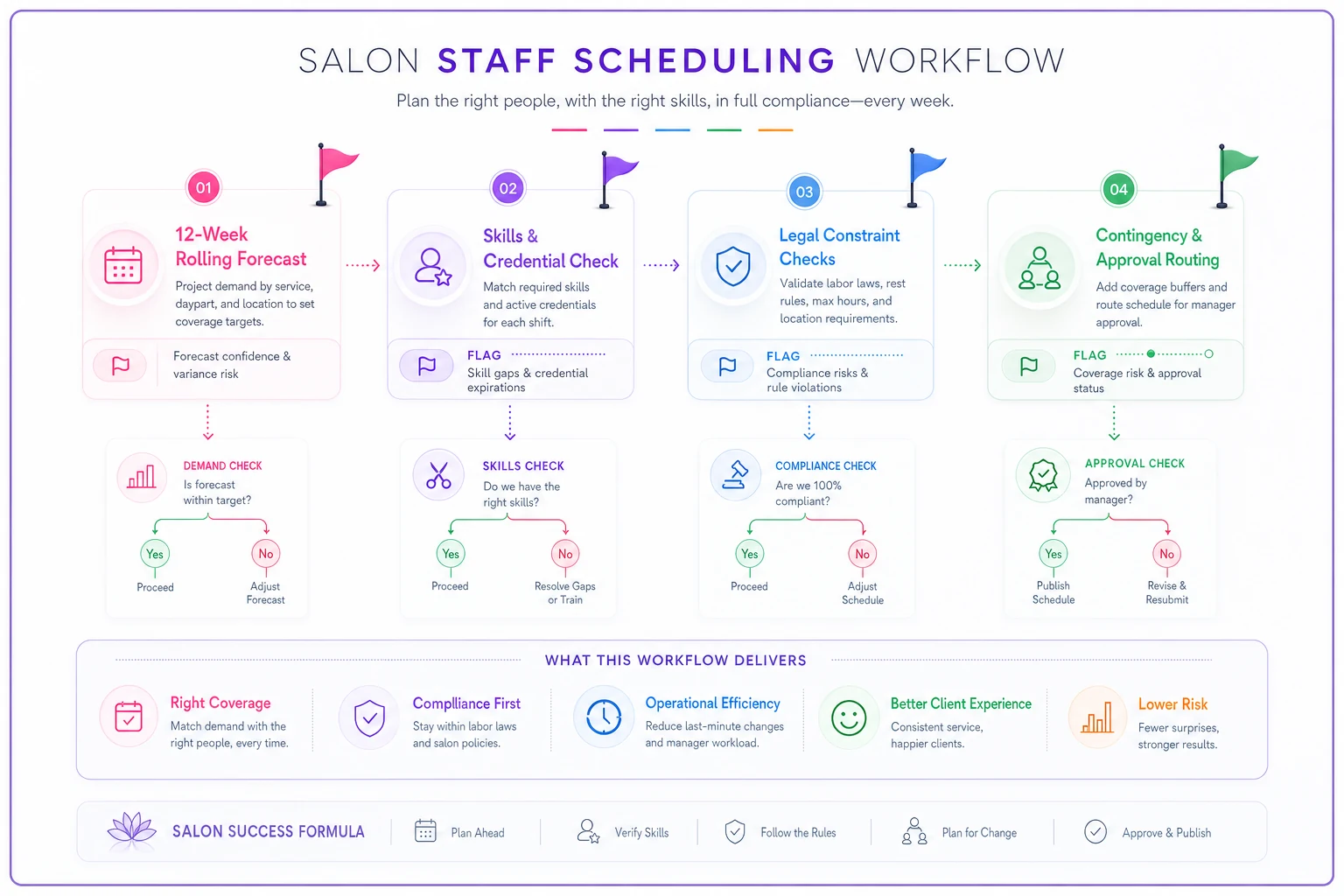
Apply legal boundary checks before assigning names to avoid reworking an emotionally-committed draft.
If you assign first and check compliance last, you end up unpicking a roster you've already emotionally committed to, and that's exactly when owners convince themselves to "just this once" break a rest rule.
Contingency rules: the part that saves your weekends
A roster is a plan, and plans meet reality. The salons that stay calm aren't the ones with perfect forecasts — they're the ones with pre-decided rules for deviation, so nobody's improvising at 8am on a Monday.
Your contingency layer should answer, in advance:
-
Sick call before open who's the first-call backup by skill category, and what's the freelancer threshold before you start moving bookings?
-
Late large booking if a bridal party or event lands inside the week, which rules govern pulling someone in versus declining?
-
Forecast jump if projected demand for a category rises past your certified capacity by more than, say, 15%, what triggers — cross-cover, freelancer, or capping bookings?
-
No-show staff distinct from sick — how does it get logged, and what's the coverage move?
-
Overstaffed slow day rules for voluntary early-outs so you're not paying idle chair time.
Most salons have reactions to these events but not rules. The difference is that reactions depend on who's working and how stressed they are that day. Rules produce the same sensible outcome regardless. A backup-by-skill list matters more than a generic "who can come in" list, because showing up isn't useful if the person can't do the booked service.
Approval matrices: stop decisions leaking
Once you're past one location or one manager, "just text me" stops working. Decisions leak — someone approves overtime informally, someone else brings in a freelancer nobody budgeted, and by month-end the labor line is 8% over with no clear trail.
| Decision | Auto-allowed | Needs manager | Needs owner |
|---|---|---|---|
| Shift swap, same skill tier, no cap breach | ✓ | ||
| Overtime under 3 hrs/week | ✓ | ||
| Freelancer booking | ✓ (up to set rate) | above rate | |
| Booking that requires a supervised junior | ✓ | ||
| Anything touching a legal limit | ✓ |
It's not about control for its own sake. When the same decisions always route the same way, you get consistency and a paper trail — which matters a lot if labor cost drifts and you're trying to figure out where it went.
A real scenario
A four-chair salon, color-heavy, roughly 300–330 appointments a month. They rostered by preference and habit. Two recurring problems: Saturdays ran short on color capacity about twice a month (turning away or squeezing in bookings), and their two most experienced stylists were regularly scheduled together on quiet Tuesdays, so senior labor sat underused while Saturday demand went unmet.
They didn't buy anything complicated. They built the skills matrix on one sheet, started keeping a rolling 12-week category forecast updated each Friday in about twenty minutes, and wrote down five contingency rules and a basic approval map.
Within a couple of months the Saturday color shortfalls mostly disappeared — they could see the gap three to four weeks out and shift a stylist's day or book a freelancer with lead time instead of panic. Tuesday senior-stacking stopped once the roster was built from demand rather than preference. The honest outcome wasn't some dramatic revenue explosion — it was fewer turned-away color clients (somewhere around 6–10 recovered bookings a month by their estimate) and noticeably less last-minute scrambling. The owner's Thursday roster session went from a stressful hour of guessing to about fifteen minutes of adjusting a mostly-correct draft.
When this system makes sense — and when it doesn't
It makes sense when you've got mixed skill levels, credential-dependent services, more than a couple of chairs, or any seasonal swing in demand. The more your services differ in who can perform them, the more this pays off.
It's overkill when you're a solo operator or two generalists who do everything equally. If anyone can perform any service and there's no certification variance, the skills matrix collapses to nothing and you're just staffing to a forecast — which is simpler.
Who should be careful: salons that treat the roster as a morale tool first. If your team is used to getting their preferred days regardless of demand, moving to demand-driven rostering is a change-management job as much as an operational one. Roll it in gradually, explain the reasoning, and protect a reasonable amount of schedule preference within the demand constraints — otherwise you'll win the schedule and lose the team.
Where tools quietly help
None of this requires software to start — a spreadsheet and some discipline will get you most of the way there. But the connections between the four feeds are exactly the kind of thing that gets tedious to maintain by hand as you grow. Recalculating required skill-hours every time the forecast shifts, checking every proposed shift against legal limits, flagging expiring certs before a seasonal spike — that's mechanical, repetitive work.
That's where operational software with built-in AI automation earns its place: not making decisions for you, but handling the cross-checking so exceptions surface automatically. The forecast updates, and the system quietly re-runs the coverage check, flags the shifts that now breach a rest rule, and notes that Saturday color demand just outran your certified capacity. You still decide what to do. You just stop discovering problems the morning they blow up. The judgment stays human; the tedious reconciliation doesn't have to.
Demand-driven rostering isn't a scheduling trick — it's a small system where the forecast, the skills map, the legal limits, and your contingency rules constrain and inform each other. Build it in that order, keep the forecast rolling twelve weeks out, and the weekly roster stops being a guessing game.
The salons that struggle with staffing usually don't have a staffing problem. They have a connection problem — four things that should talk to each other living in four separate places, reconciled only in someone's head on a busy Thursday. Get those four feeds into one loop and the schedule starts reflecting your actual business instead of last week's habits.
Ready to simplify your salon operations?
Join 1,000+ salons using Salnly to save time, reduce scheduling chaos, and deliver better client experiences.