

The moment you open a second location, your client data quietly stops being one clean picture and turns into two competing versions of the truth. The same client books color downtown and a blowout at the suburban shop. Two records get created. One has her mobile number, the other has her email. One shows she's allergic to a certain developer, the other doesn't. Neither front desk knows the other exists.
Multiply that across three, four, or five locations and a few years of bookings, and you end up with a database where "Jennifer M." might be four different people or the same person four times — and nobody can tell which. This is the part of scaling nobody warns you about, and it's exactly where salon customer data consolidation becomes an operational necessity rather than an IT afterthought.
This isn't a "click merge duplicates" problem. Done carelessly, a merge can overwrite a formula card, wipe a gift card balance, or attach one client's chemical history to another's file. That's why the smart approach is a canonical record strategy with clear priority rules, a dry‑run before you touch anything live, and a reconciliation report at the end that proves nothing important got lost.
Why the data splinters in the first place
The duplication isn't caused by sloppiness. It's baked into how salons actually operate.
Front desks are trained to keep the line moving. When a client walks in and the receptionist can't instantly find her, the fastest resolution is to create a new record and move on. Nobody's going to make a paying client stand there for four minutes while someone searches by three different spellings of her last name. So a duplicate gets born, and it happens dozens of times a week per location.
Then there's the phone‑vs‑email split. Online booking often captures email. Walk‑ins and phone bookings capture a mobile number. The system treats those as different identifiers, so the same person ends up with two profiles depending on how they came in the door.
Location‑specific systems make it worse. A lot of growing salons don't start on one platform — they inherit whatever the acquired location was already running, or they spin up a fresh instance per site because it was simpler at launch. Now you've got parallel databases that were never designed to talk to each other. When you finally try to unify them, you discover Location A stored phone numbers as (555) 123‑4567 and Location B stored them as 5551234567, and your matching logic chokes on the formatting difference.
Clients change too. New number, married name, new email after a job switch. Every one of those updates is an opportunity for a fresh duplicate if the front desk can't connect it to the existing file.
The result is predictable. Across most multi‑location salons, somewhere between 15% and 30% of "clients" in the combined database turn out to be duplicates or fragments once you dig in. That's not an edge case — that's a structural feature of how the data got created in the first place.
What actually breaks when the data is fragmented
Chemical and allergy history gets stranded. This is the one that should keep owners up at night. If a colorist at your third location pulls up a record that doesn't include the reaction a client had at your first location, you're one appointment away from a genuine incident. Consolidating client history isn't a nice‑to‑have when advanced services are involved — it's part of your risk management.
Stop losing appointments in the chaos.
Salnly helps you book, confirm & manage every appointment—efficiently.
- Centralized appointment management
- Client notifications
- Calendar & staff scheduling
No credit card required
Loyalty and gift card balances get miscounted. A client thinks she has $60 left on a gift card. It's split across two records — $40 on one, $20 on the other — and the front desk only sees one. Now she's frustrated, and you're either eating the difference or arguing with a good client at the desk.
Marketing gets embarrassing. Duplicate records mean the same person gets the same "we miss you" text twice, or gets a first‑timer discount offer despite being a five‑year regular. It reads as careless, and it quietly trains your best clients to tune out your messages entirely.
Your reporting lies to you. Retention rate, average lifetime value, visit frequency — all of it depends on knowing that visits belong to the same person. When one client is fragmented into three records, your data says you have three low‑value clients instead of one high‑value one. Owners making staffing and marketing decisions off that data are steering with a broken compass. If you're trying to build reliable cohorts the way we describe in mapping the salon client lifecycle, dirty records will sabotage the whole analysis.
Personalization dies. The stylist can't see that this client always books extra time, prefers a specific toner, or has a standing preference — because half that history lives on a record nobody's looking at.
The canonical record: pick one truth, on purpose
The foundation of any safe consolidation is deciding, in advance, what the "canonical" record is — the single surviving profile that everything else merges into. This sounds obvious until you realize most salons never make the decision explicitly, which means their software makes it for them, usually badly.
A canonical record is the master version of a client. When you find duplicates, one of them becomes canonical and absorbs the others. The question is: which one wins, and which fields survive?
The principle that saves you the most grief: the winning record isn't always the "primary" one — you merge the best field from each source, not the whole record. A blanket "keep Record A, delete Record B" approach is how you lose the allergy note that only existed on Record B.
So you define canonical per field, not per record:
| Field | Canonical source rule | Why |
|---|---|---|
| Chemical/allergy history | Union of all sources (keep everything) | Safety data should never be discarded in a merge |
| Mobile phone | Most recently used number (booked or confirmed) | Recency beats whatever was entered first |
| Most recently active / most recently opened | Same logic — dead emails hurt deliverability | |
| First/last name | Longest complete, non‑nickname version | "Jennifer Martinez" over "Jen M." |
| Loyalty / gift card balance | Sum across all records | Never pick one — always total them |
| Formula/service notes | Union, timestamped | Merge all notes, keep dates so stylists see progression |
| Visit history | Combine all appointments | This is how LTV and retention become accurate |
| Preferred location | Most frequent visit location | Drives smarter routing and marketing |
The table above is the actual spine of the project. Get these rules written down and agreed on before you touch the database, and 80% of the risk disappears.
Dedupe priority rules: how to decide two records are the same person
Matching is where consolidations go wrong. Match too loosely and you fuse two different clients into a Frankenstein record — a disaster to untangle. Match too strictly and you leave thousands of duplicates behind, and the whole project feels pointless.
The trick is a tiered confidence system. Not every match is equal, and not every match should be auto‑merged.
Tier 1 — Auto‑merge (high confidence). These are matches strong enough to merge without a human looking:
-
Exact mobile number match plus matching first name
-
Exact email match plus matching last name
-
Identical name plus identical date of birth
Tier 2 — Review queue (probable, needs eyes). Strong signals, but with enough ambiguity that a person should confirm:
-
Same mobile number, different name (could be a shared household phone)
-
Same email, different name (spouses, roommates, family plans)
-
Same name and same location, no matching contact info
Tier 3 — Leave alone (weak). Do not merge on these alone:
-
Same first and last name, nothing else in common (common names are everywhere)
-
Similar‑but‑not‑identical phone numbers (one transposed digit could be a real second person)
The mistake people make is treating name similarity as a strong signal. It isn't. In any database of a few thousand clients, you'll have real, distinct people who share a name. Phone and email are your reliable anchors; names are supporting evidence only.
One more rule worth locking into the process: shared contact info doesn't automatically mean same person. Households share phones. Couples share emails. A mother books for her teenage daughter under her own number. If you auto‑merge on phone alone, you'll blend two real clients and their two real chemical histories — which is the single most dangerous mistake in this entire exercise. That's exactly what the Tier 2 review queue is for.
The dry‑run: never touch live data first
This is the step that separates a clean consolidation from a catastrophe. You run the entire merge against a copy of the data first, generate a report of what would happen, and review it before anything real changes.
-
Total records flagged for merge, broken down by tier
-
A sample of 30–50 proposed Tier 1 merges shown side by side
-
The full list of Tier 2 review‑queue matches
-
Any record where a gift card or loyalty balance would change, with before/after amounts
-
Any record where a chemical/allergy note exists on one side but not the other
-
A count of records that will be created vs retired
Then you actually read it. Not skim — read the balance changes and the safety‑note merges line by line, because those are the two categories where a mistake is expensive or dangerous.
Here's a practical dry‑run checklist to work through before you approve the live run:
-
Every location's data has been normalized to the same format (phone, email, name casing) before matching runs
-
Backup of every source database exists and has been verified restorable
-
Field‑level canonical rules are documented and signed off by an owner or manager
-
Tier 1 sample reviewed — no two obviously different people got fused
-
Every gift card / loyalty balance change reviewed against original values
-
Chemical/allergy union confirmed — no safety notes dropped
-
Tier 2 review queue assigned to a specific person with a deadline
-
A "do not merge" exception list exists for known edge cases (VIPs, staff accounts, test records)
-
Rollback plan written
how you'd undo the merge if something's wrong
If any box is unchecked, you don't run the live merge. That's the whole discipline.
The consolidation workflow, start to finish
Here's how the full process actually sequences when it's done right:
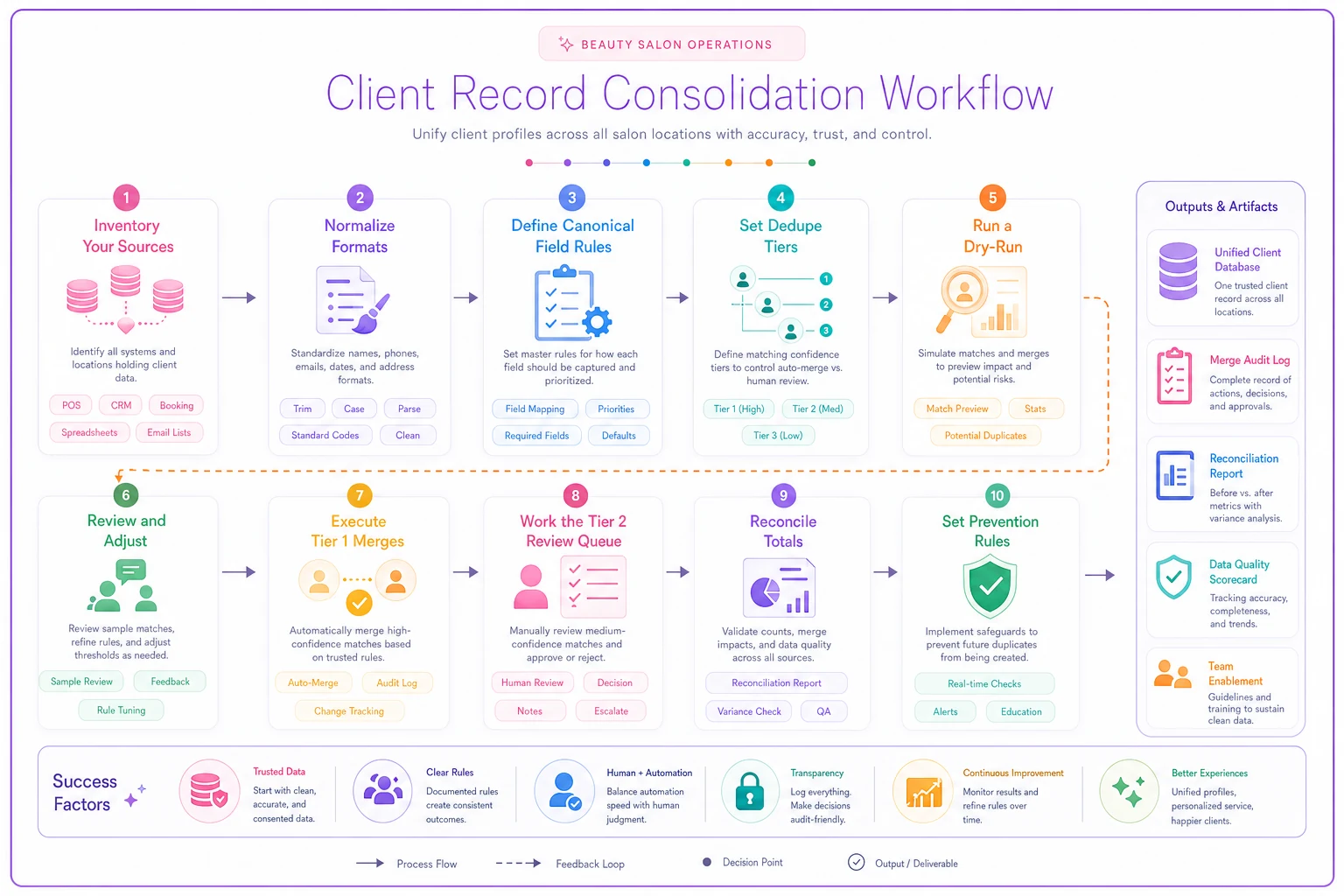
A simple visual of the workflow helps teams follow the sequence.
-
Inventory your sources. List every system holding client data — each location's booking platform, any old spreadsheets, gift card systems, email marketing lists. You can't consolidate what you haven't found.
-
Normalize formats. Standardize phone numbers, email casing, and name formatting across all sources before you attempt any matching. This one step eliminates a huge chunk of false non‑matches.
-
Define canonical field rules. Fill out your version of the field table above. Get sign‑off.
-
Set dedupe tiers. Write the Tier 1 / 2 / 3 matching logic explicitly.
-
Run the dry‑run. Generate the full report against copies, change nothing live.
-
Review and adjust. Read balance and safety changes carefully. Tune the rules if the sample shows problems, then dry‑run again.
-
Execute Tier 1 merges. Only after the dry‑run is clean.
-
Work the Tier 2 queue. A human confirms or rejects each probable match.
-
Reconcile. Compare pre‑ and post‑merge totals — client count, total loyalty liability, total appointment history — and confirm the numbers tie out.
-
Set prevention rules going forward so you're not doing this again in eighteen months.
That reconciliation step is non‑negotiable. Your total gift card liability should be identical before and after (you're combining balances, not creating or destroying value). Your total appointment count shouldn't drop. If the post‑merge numbers don't match the pre‑merge numbers, something went wrong and you catch it here instead of at the front desk three weeks later.
A real scenario
A three‑location color‑focused salon group came into a consolidation with roughly 11,000 client records across two different booking systems. On inspection, about 2,400 of those were duplicates or fragments — right around the 20% range that's typical.
The problems were exactly the predictable ones. Gift card balances split across records meant the front desk regularly had to comp small differences to avoid arguments, costing a few hundred dollars a month. Their "active client" count was inflated, which made their retention numbers look worse than reality — they thought they were losing clients they'd actually just double‑counted. And there had already been one near‑miss where a client's sensitivity note lived only on the record from her original location.
The consolidation ran field‑level rules with the tiered matching approach described above. Tier 1 auto‑merged cleanly. The Tier 2 queue came out to about 380 records that a manager reviewed over a couple of afternoons — and roughly 40 of those turned out to be genuinely different people sharing a household phone or email. Those would have been bad merges if everything had run automatically.
After reconciliation, the deduplicated client base landed near 8,600. Gift card liability tied out to the penny against the pre‑merge total. The comp‑at‑the‑desk problem essentially stopped, and for the first time their retention reporting reflected real behavior instead of database noise — which changed how they approached their reactivation outreach.
Keeping it clean afterward
Consolidation is a one‑time cleanup; prevention is the ongoing system. Without new habits, you'll rebuild the same mess.
The front desk needs a search‑before‑create rule that's actually enforced — search by phone and by partial name before ever creating a new profile. This is also where a shared platform across locations matters more than any single feature: when all your locations write into one client system instead of separate silos, the duplication rate drops dramatically because there's only one place for a record to live. It's the same argument for centralizing the right systems that we make in the multi‑location salon playbook — some things genuinely should be unified, and client identity is near the top of that list.
Make the search‑before‑create step a required workflow in your booking/POS UI so receptionists can't skip it under pressure.
Modern operational platforms help here by flagging likely duplicates at the moment of creation — "we found a similar client, is this the same person?" — so the receptionist can link instead of duplicate without slowing down the line. That's the right place to catch it: at the point of entry, not in a painful annual cleanup. Reducing that intake friction connects directly to the thinking behind booking‑flow optimization — the smoother the intake process, the less garbage data you generate downstream.
When to do this — and when to wait
When it makes sense:
-
You're running two or more locations and reporting doesn't feel trustworthy
-
You're about to migrate to a new platform (consolidate before you move, not during)
-
Gift card or loyalty disputes are showing up at the desk
-
You're planning any serious marketing or reactivation push and need clean cohorts
When to hold off:
-
You're mid‑season at peak volume — a merge gone sideways during your busiest weeks is the worst possible timing. Do it in a slow stretch.
-
You don't have a verified backup and rollback plan. No exceptions.
-
Nobody's been assigned to work the Tier 2 review queue. An unowned queue means the project stalls half‑done, which is arguably worse than not starting.
Who should not attempt a hands‑on consolidation: single‑location salons with one clean database — you likely just need occasional duplicate flagging, not a full canonical‑record project. And any operator unwilling to do the dry‑run should not run a live merge at all. The dry‑run isn't optional; it's the entire safety net.
Bringing it together
Client records are the connective tissue of a multi‑location salon. Bookings, chemical safety, loyalty balances, marketing, and every KPI you report on all sit on top of the assumption that you know who your clients are. When the data fragments — and at scale it always does — every one of those systems degrades quietly until it costs you a client, a dollar, or a safety incident.
The safe path isn't complicated, but it is disciplined: decide your canonical rules at the field level, tier your matching by confidence, prove it works with a dry‑run before touching anything live, and reconcile the numbers at the end so you can show nothing important was lost. Do that once properly, put entry‑point prevention in place, and your client data finally becomes what it was supposed to be all along — one accurate picture of the people who keep your chairs full.
Ready to simplify your salon operations?
Join 1,000+ salons using Salnly to save time, reduce scheduling chaos, and deliver better client experiences.