

Your highest-value clients are quietly disappearing. Not the dramatic "I'm never coming back" exits — just a slow fade where someone who spent $2,400 a year simply stops booking. Six months later you notice they haven't been in, and by then they've already found someone else.
The math is brutal: acquiring a new client costs roughly 5–7x more than reactivating a lapsed one. Yet most salons have zero systematic approach to winning back dormant clients beyond the occasional "We miss you!" email blast that gets maybe 2% response.
The hidden cost of client drift
Pull your booking data from the last 18 months. Filter for clients who visited at least three times, then stopped. Calculate their average annual spend before they lapsed.
For a typical 8-chair salon, you'll probably find something like:
-
120–180 lapsed clients worth $500+ annually
-
40–60 lapsed clients worth $1,500+ annually
-
15–25 VIP clients worth $3,000+ annually
That's potentially $180,000 in annual revenue sitting dormant in your database. Not cold prospects — actual clients who already trusted you with their hair, already knew your stylists, already had their preferences on file.
The problem isn't that reactivation doesn't work. It's that most salons treat every lapsed client exactly the same. One generic message goes out, response is minimal, and the assumption becomes that reactivation is pointless.
Why the standard "We miss you" approach fails
Generic reactivation campaigns fail because they ignore three pretty basic operational realities.
Stop losing appointments in the chaos.
Salnly helps you book, confirm & manage every appointment—efficiently.
- Centralized appointment management
- Client notifications
- Calendar & staff scheduling
No credit card required
Timing misalignment: Someone who lapsed 30 days ago needs completely different messaging than someone gone 180 days. The 30-day lapse might just be a scheduling conflict. The 180-day lapse has almost certainly found another salon.
Value blindness: Your $3,000/year balayage client deserves more effort than someone who got one $45 haircut. Not because one client matters more as a person, but because the ROI on reactivation effort varies dramatically.
Channel monotony: One email to everyone assumes all clients engage the same way. Some respond to a text. Some need a phone call. Some want a discount. Others just need a convenient booking link dropped in front of them.
The typical blast approach also creates operational chaos when it does work. Send 500 "come back for 20% off" emails, suddenly get 50 bookings for next week, and now you're scrambling to fit them in — probably bumping regulars or overloading stylists.
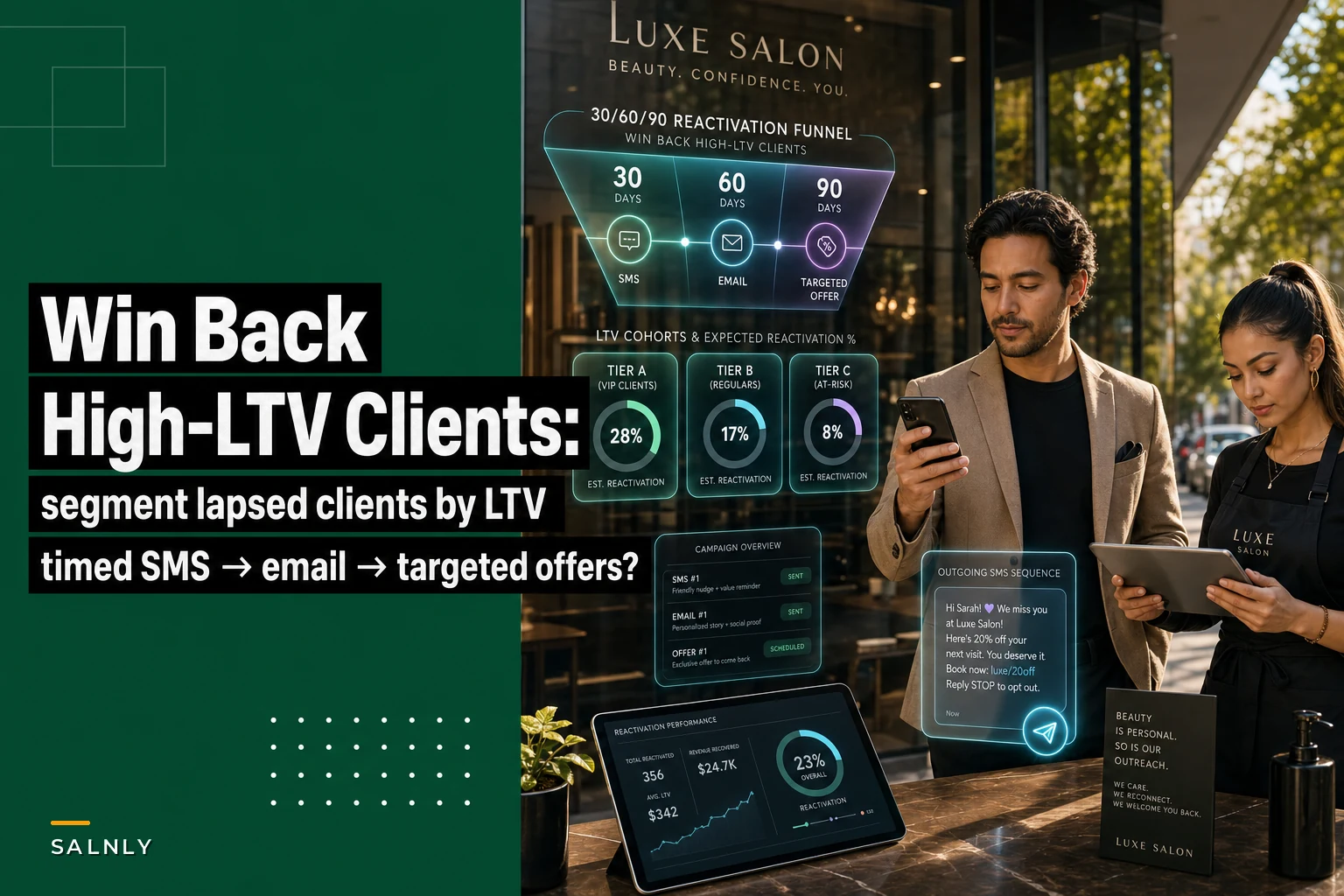
Building your 30/60/90 salon reactivation funnel
Step 1: Segment by lifetime value and lapse duration
Tier A (VIP): $2,000+ annual spend or 8+ visits annually Tier B (Regular): $500–$2,000 annual spend or 4–7 visits annually Tier C (Occasional): Under $500 annual spend or 1–3 visits annually
-
30-day lapse (just drifted)
-
60-day lapse (exploring options)
-
90+ day lapse (likely settled elsewhere)
This gives you nine segments, each needing different treatment.
Step 2: Design your progressive outreach sequence
Don't hit everyone with everything at once. Build escalation into your reactivation.
30-Day Lapse Sequence:
Tier A clients:
-
Day 31
Personal text from their stylist
-
Day 38
Email with preferred appointment slots held
-
Day 45
Manager call with VIP perk offer
Tier B clients:
-
Day 31
Automated friendly text reminder
-
Day 40
Email highlighting new services/products
-
Day 50
Text with limited-time booking incentive
Tier C clients:
-
Day 35
Simple automated text check-in
-
Day 50
Email with general salon updates
60-Day Lapse Sequence:
Tier A clients:
-
Day 61
Personal email from owner/manager
-
Day 68
Text with exclusive VIP offer (complimentary treatment add-on)
-
Day 75
Handwritten note mailed (yes, really)
Tier B clients:
-
Day 61
"We've missed you" text with easy booking link
-
Day 70
Email featuring stylist availability
-
Day 80
Progressive offer (15% off next service)
Tier C clients:
-
Day 65
General reactivation email
-
Day 85
Text with modest incentive
90+ Day Lapse Sequence:
Tier A clients:
-
Day 91
"Win-back" package (significant offer + guaranteed appointment)
-
Day 105
Final personal outreach from owner
-
Day 120
Move to long-term nurture (quarterly touches)
Tier B clients:
-
Day 91
Aggressive offer (20–25% off)
-
Day 110
"Final chance" message
-
Day 130
Move to long-term nurture
Tier C clients:
-
Day 95
Single reactivation offer
-
Move to general marketing list
Here's a quick visual of the funnel.
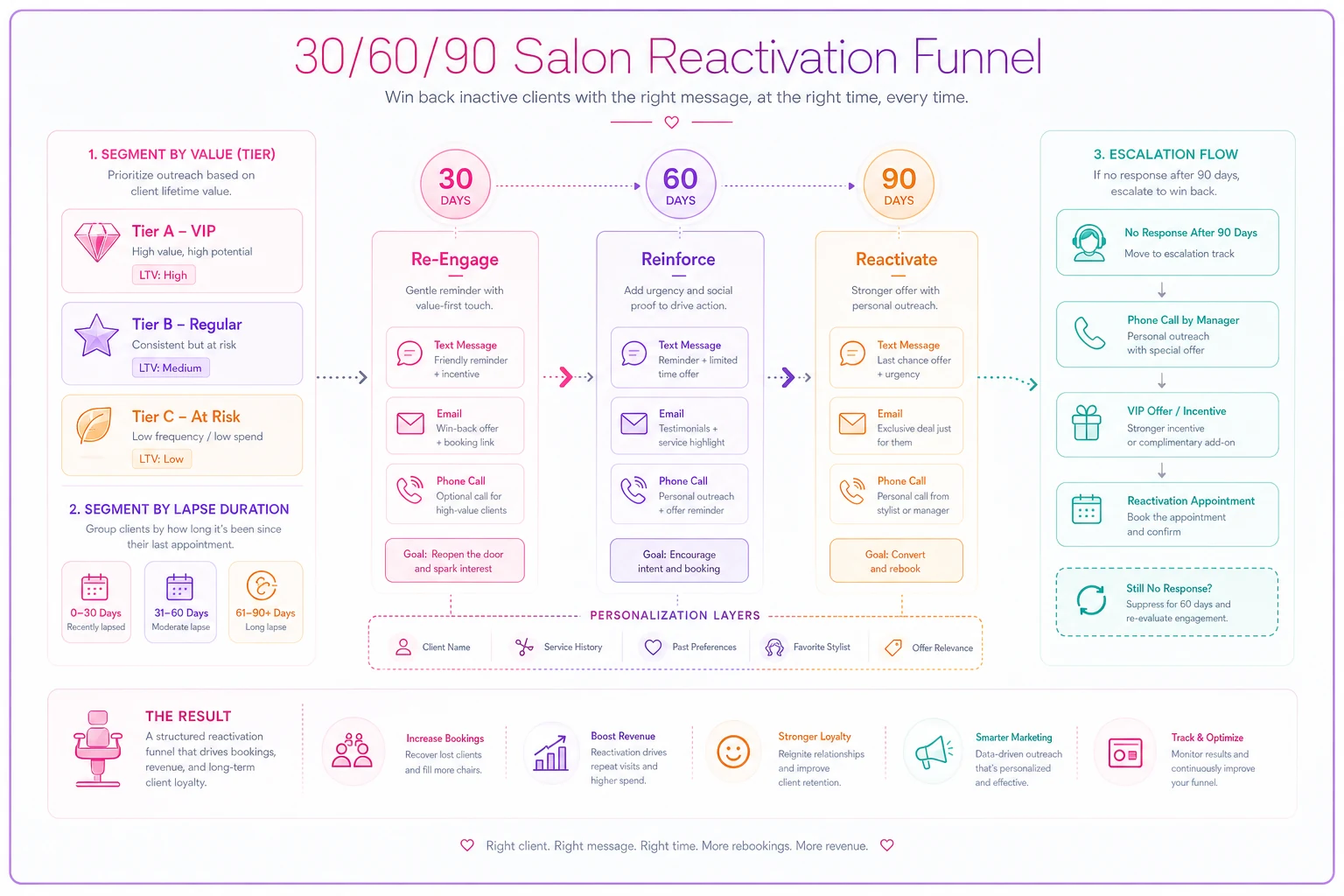
This sequence lets you escalate effort based on value and time-since-last-visit without overwhelming your schedule.
The messaging that actually converts
Generic "miss you" messages get deleted. Here's what works instead.
For 30-day lapses (still warm):
Text: "Hi Sarah, noticed we haven't seen you since your color on [date]. Everything okay? I have openings Tuesday 2pm or Thursday 10am if you'd like to book. - Jessica"
For 60-day lapses (drifting away):
Email subject: "Your usual spot is waiting" Body: "Hi Sarah, your stylist Jessica mentioned she hasn't seen you in a bit. We've held your preferred Saturday 11am slot for next week if you'd like it. P.S. — We just got that Olaplex treatment you asked about last time."
For 90+ day lapses (win-back mode):
Text: "Sarah, it's been 3 months! Honestly, we'd love to have you back. Here's $40 off your next color service, valid for 2 weeks. Jessica has availability Thursday afternoon. Book here: [link]"
Tier-specific messaging adjustments
For VIP clients, make it feel exclusive: "As one of our VIP clients, we'd like to offer you a complimentary scalp treatment with your next service. Jessica cleared her schedule next Wednesday just for her favorite clients."
For occasional clients, keep it simple: "Quick reminder that you're due for a trim! Book online anytime: [link]"
Expected reactivation rates by cohort
Based on actual salon reactivation data:
| Segment | Text Response | Email Response | Combined Response | Avg Lifetime Value Recovery |
|---|---|---|---|---|
| 30-day Tier A | 42% | 28% | 54% | 85% of previous LTV |
| 30-day Tier B | 31% | 19% | 38% | 75% of previous LTV |
| 30-day Tier C | 18% | 11% | 24% | 70% of previous LTV |
| 60-day Tier A | 28% | 21% | 36% | 70% of previous LTV |
| 60-day Tier B | 19% | 14% | 25% | 65% of previous LTV |
| 60-day Tier C | 12% | 8% | 16% | 60% of previous LTV |
| 90-day Tier A | 18% | 15% | 24% | 60% of previous LTV |
| 90-day Tier B | 11% | 9% | 16% | 55% of previous LTV |
| 90-day Tier C | 6% | 5% | 9% | 50% of previous LTV |
The drop-off between 30-day and 90-day response rates is significant. This is exactly why catching clients early matters so much — waiting costs you real money.
Operational capacity planning for reactivation
Most salons mess this up: they launch reactivation campaigns without thinking through what happens when it actually works.
If you have 150 lapsed clients and achieve a 25% reactivation rate, that's 37 returning clients. Can your schedule absorb 37 additional bookings over two weeks without disrupting your regulars?
-
Week 1 Reactivate only Tier A clients (smallest group, highest value)
-
Week 2 Assess booking impact, adjust messaging
-
Week 3 Launch Tier B reactivation
-
Week 4 Evaluate and refine
-
Week 5 Launch Tier C if capacity allows
Stagger your outreach. Better to reactivate 10 clients well each week than to reactivate 40 at once and deliver rushed service that sends them away again for good.
The retention bridge after reactivation
Winning them back is step one. Keeping them is what actually matters.
Visit 1 (The return):
-
Extra attention from their stylist
-
No upselling — just deliver great service
-
Confirm next appointment before they leave
-
Follow-up text that evening thanking them
Visit 2 (The reconnection):
-
Reference something from their last visit
-
Introduce one new service or product naturally
-
Lock in their recurring schedule
Visit 3 (The re-establishment):
-
Treat as a regular client again
Track reactivated client retention separately. If someone lapses again within 90 days of returning, that's a service delivery problem, not a reactivation problem.
Common reactivation mistakes that kill ROI
Offering too much too soon. Leading with 30% off instead of escalating gradually trains clients to wait for discounts. Always start with relationship-based outreach before throwing money at the problem.
Ignoring the reason they left. If someone left because of consistently late-running appointments, winning them back without fixing your scheduling operations just creates another lapse cycle.
Treating reactivation as a one-time campaign. This isn't a campaign — it's an ongoing operational system. Every month, new clients hit the 30-day lapse mark. Without a systematic process, you're constantly leaking revenue you don't even know you're losing.
Not tracking source performance. Which stylists have the highest client lapse rates? Which services retain best? Without tracking, you're treating symptoms instead of causes.
Building your reactivation infrastructure
Manual reactivation doesn't scale past a certain point. You need real systems underneath it.
Data requirements:
-
Last visit date for every client
-
Service history and spend
-
Preferred stylist
-
Contact preferences
-
Previous reactivation attempts
Process requirements:
-
Weekly lapse reports by tier
-
Automated text/email sequences
-
Manual escalation triggers for VIPs
-
Response tracking by channel and offer
Team requirements:
-
Designated reactivation owner (usually the manager)
-
Stylist involvement for personal outreach
-
Front desk training on handling returning clients
Automate weekly lapse reports so the manager only reviews high-value escalations.
This is where AI-powered operational software makes a real difference. Instead of someone manually checking who hasn't visited in 30 days, the system automatically segments clients, triggers the right messages, and tracks responses. What normally takes 8–10 hours a month becomes largely automated, with managers only stepping in for high-value personal touches.
The automation handles the complexity of timing, sequencing, and personalization — things like knowing Jennifer responds to texts while Margaret only opens emails, or that Tyler always books Thursdays and Emma needs evening slots. Routine reactivation runs in the background while the team focuses on actually serving clients. That shift alone is worth more than most salons realize.
When aggressive reactivation makes sense (and when it doesn't)
Push hard when:
-
Seasonal slow periods are approaching
-
A new competitor just opened nearby
-
You've made major service or staffing improvements
-
Capacity significantly exceeds demand
Pull back when:
-
You're already at or near capacity
-
Staff turnover is creating instability
-
Service quality issues haven't been resolved
-
Systems can't handle the returning volume
Reactivation amplifies whatever experience clients receive when they return. If your operations are struggling, fix those first.
Measuring true reactivation ROI
Most salons calculate reactivation ROI wrong. They look at immediate bookings versus campaign cost and call it a day. That misses most of the picture.
Proper ROI calculation:
Revenue side:
-
Immediate reactivation bookings
-
Next 6 months of bookings from reactivated clients
-
Retail purchases from reactivated clients
-
Referrals generated from reactivated clients
Cost side:
-
Staff time for outreach
-
Discounts and offers provided
-
System or software costs
-
Opportunity cost of capacity used
A properly run salon reactivation funnel typically generates 8–12x ROI when you measure 6-month client value. Even accounting for discounts and effort, it outperforms almost every new client acquisition channel you're probably spending money on.
Your 30-day reactivation implementation plan
Week 1: Audit and segment
-
Pull 18 months of booking data
-
Identify all lapsed clients
-
Segment by value and lapse duration
-
Calculate potential recovery value
Week 2: Build your sequences
-
Write templates for each segment and timeline
-
Set up automation or manual tracking
-
Train the team on their roles
-
Establish capacity limits
Week 3: Launch Tier A reactivation
-
Start with highest-value, most recent lapses
-
Track every response
-
Refine messaging based on what you hear
-
Monitor booking impact
Week 4: Expand and optimize
-
Launch Tier B reactivation
-
Analyze Week 3 results
-
Adjust offers and timing as needed
-
Plan your ongoing systematic approach
The gap between salons that grow steadily and those that stagnate often comes down to operational systems exactly like this. Some salons hope clients come back. Others build a process that consistently brings them back.
Your lapsed client list is your lowest-cost growth opportunity. These people already know you. They already trusted you once. They don't need to be convinced that salon services are worth it — they just need the right message at the right time through the right channel.
Stop treating reactivation as something you do when bookings are slow. Build it into your monthly operational rhythm. Work your 30/60/90 day cohorts consistently. Track what converts. Refine over time.
A reactivation funnel that recovers just 20% of lapsed clients at 70% of their previous spend generates more profit than most marketing campaigns will ever deliver — and unlike paid advertising that stops the moment you stop paying, every reactivated client is a relationship rebuilt, ready to keep generating value for years.
Ready to simplify your salon operations?
Join 1,000+ salons using Salnly to save time, reduce scheduling chaos, and deliver better client experiences.