

You know that moment when a client's sitting in your chair, happy with their cut, and you're thinking about suggesting a gloss treatment? But then you glance at the clock, see your next appointment in 20 minutes, and stay quiet because there's no way you're running late again.
That's money walking out the door. Not because clients don't want add-ons — they actually do — but because your bundling strategy doesn't match your actual schedule reality.
Most salons approach add-ons backwards. They build a menu of extras, train staff on selling them, then wonder why uptake stays low and schedules get wrecked. The real problem isn't the add-ons themselves or even your team's selling skills. Nobody's mapped which add-ons actually fit into which appointment types without destroying your carefully planned day.
Why traditional upselling breaks salon schedules
The standard approach treats all add-ons the same. If a client wants something extra, great, we'll squeeze it in. Squeezing leads to cascading delays that compound through the day. Your 10am runs into your 10:30, which pushes your 11am, and suddenly you're apologizing to everyone while your receptionist fields angry calls.
Stylists start avoiding add-ons altogether after getting burned too many times by saying yes to a treatment that seemed quick but wasn't. They protect their schedules by not offering anything extra, even when they technically have time. Meanwhile, retail products sit behind the desk gathering dust.
Pre-pay packages get mentioned randomly. Express services that could genuinely fit into existing appointments never get suggested because nobody's documented which ones work where.
You need the extra revenue from add-ons, but you can't afford the schedule chaos they create. So you settle for base services only, leaving thousands per month unrealized.
Building your schedule-aware compatibility matrix
Map every possible add-on against every service type, with clear yes/no decisions based on real timing data. Not estimates or hopes — actual measured durations from your floor.
Stop losing appointments in the chaos.
Salnly helps you book, confirm & manage every appointment—efficiently.
- Centralized appointment management
- Client notifications
- Calendar & staff scheduling
No credit card required
Start with your five most common services. For most salons, that's probably single-process color, highlights, cuts, blowouts, and root touch-ups. List every add-on you offer or want to offer. Include retail products, express treatments, pre-pay packages, and booking-time upgrades.
Create a simple grid. Services across the top, add-ons down the side. You're not just marking yes or no. You're categorizing each intersection into one of four buckets:
Green zone: Add-on fits comfortably within existing appointment buffer time. These are your money makers — zero schedule impact, pure profit.
Yellow zone: Add-on works if the next appointment is the right type. A quick gloss during a highlight might work if the next client is just a cut, giving you processing time.
Orange zone: Add-on only works with explicit schedule padding or end-of-day slots. These need special handling.
Red zone: Never compatible without rebooking. Don't even try.
Time every add-on service for two weeks — include setup, application, processing, and cleanup — to base decisions on reality.
Stop guessing and start measuring. Time every add-on service for two weeks. Not how long they're supposed to take — how long they actually take including setup, application, processing, and cleanup.
Most salons discover their "10-minute" treatments really take 17 minutes door to door.
Express options that actually fit
Express services get pitched as easy wins, but only specific ones work without schedule creep. Through tracking dozens of salons, these consistently fit into existing appointments:
During processing time: Brow tinting (4 minutes active work), express hand treatments (5 minutes setup), retail consultations with samples (6-8 minutes). Services that don't require the stylist's constant attention.
During blow-dry: Scalp treatments already applied during shampoo, shine drops or serums (30 seconds), booking next appointment with specific package discussion (3 minutes).
During consultation: Travel-size product samples for problems mentioned, pre-pay package explanation for relevant services, membership enrollment for regular clients.
Notice what's not on this list — anything requiring heat tools, anything needing multiple steps, anything where timing varies significantly. Those belong in separate bookings.
Parallel retail strategies without the pushy sell
Retail fails in salons because it gets treated as an afterthought at checkout when clients just want to leave. Instead, build parallel retail offers that flow naturally from service conversations.
| Service Type | Natural Retail Add-On | When to Mention | Script Opener |
|---|---|---|---|
| Color service | Color-safe shampoo/conditioner | During formula discussion | "To keep this shade vibrant between visits..." |
| Keratin treatment | Sulfate-free products | During aftercare explanation | "The treatment works best when you avoid sulfates..." |
| Highlight/balayage | Purple shampoo | While checking tone under lights | "See how the light catches these tones? To maintain that..." |
| Textured cut | Styling products for their hair type | During styling demo | "Watch how this defines the layers we just created..." |
Products suggested during the service, when clients can see and feel the difference, convert at roughly 3x the rate of checkout suggestions.
Pre-pay packages that protect time and increase revenue
Pre-pay packages usually get designed wrong. Salons bundle services clients might want without considering if those combinations actually work operationally. Three highlights plus three cuts sounds good until you realize nobody books them that way.
Build packages around natural progressions that protect your schedule. A root touch-up package for every 5 weeks makes sense — it's predictable, schedulable, and clients who buy it actually show up. A "summer highlights special" with undefined services doesn't work because you can't predict the time needed.
-
Monthly blowout package + express shine treatment (fits within blow-dry time)
-
Color maintenance package + gloss refresh (happens during processing)
-
Men's cut package + beard trim (uses the same chair time efficiently)
Price these at 15-20% less than individual services, but only offer packages where the add-ons genuinely don't extend appointment time. You're not discounting for volume; you're incentivizing efficient combinations.
Booking system fields that capture spend opportunities
Your booking system probably captures name, service, and time. That's not enough to systematically increase revenue. You need fields that identify add-on opportunities before the appointment starts.
-
Last product purchase date and type
-
Mentioned problems or goals from previous visits
-
Previous add-ons purchased
-
Previous add-ons declined (and when)
-
Package eligibility based on service history
-
Time flexibility for current appointment
When Sarah books her regular color, your system should immediately show she mentioned wanting more shine last visit, declined a gloss treatment two appointments ago, and has 30 minutes of flexibility after her appointment.
Instead of a generic upsell attempt, your stylist can say, "I remember you mentioned wanting more shine last time. Since you've got a bit of time today, want to try that gloss treatment we discussed? It processes while your color develops, so no extra chair time."
Scripts that convert without creating pressure
Generic scripts fail because they sound fake. "Would you like to add our special treatment today?" gets an automatic no. Better scripts connect to specific situations and sound like natural conversation.
For the time-conscious client: "While your color processes, I could do that brow tint you mentioned wanting to try. Takes four minutes of actual work, happens while you're sitting here anyway."
For the quality-focused client: "The tone you're going for tends to fade faster in this hair texture. A gloss seal during your processing time — no extra chair time — keeps it looking fresh about three weeks longer."
For the budget-conscious client: "If you prepay your next three root touch-ups, you save about $45 and lock in this time slot. Most people who do this color frequency find it easier than booking each time."
For the product-curious client: "That volume you mentioned wanting — let me show you the difference this mousse makes while I'm styling. If you like what it does, grab it on your way out. If not, at least you know."
These scripts don't ask permission to sell. They offer specific solutions to stated problems. They also explicitly mention when something won't add time, because schedule anxiety kills more add-ons than price concerns.
Testing your matrix: the 30-day implementation
Don't roll out everything at once. Start with your highest-volume service and your three most profitable add-ons that fit within that service's timeframe.
Week 1: Time everything obsessively. Every add-on, every transition, every cleanup. Build your real matrix based on actual data, not estimates.
Week 2: Train one senior stylist on the green-zone add-ons only. Give them the scripts, but let them modify for their voice. Track acceptance rate and actual time impact.
Week 3: Expand to three stylists, add yellow-zone options for end-of-day appointments only. Start tracking which combinations clients actually want versus what you thought they'd want.
Week 4: Full team rollout of successful combinations. Add booking system flags for identified opportunities. Implement follow-up sequences for declined add-ons.
About 60% of what you think will work won't. Either the timing's wrong, clients don't want that combination, or operationally it creates unexpected problems. You're looking for the 40% that consistently generates revenue without schedule impact.
Below is a simple workflow to guide your 30-day test and rollout.
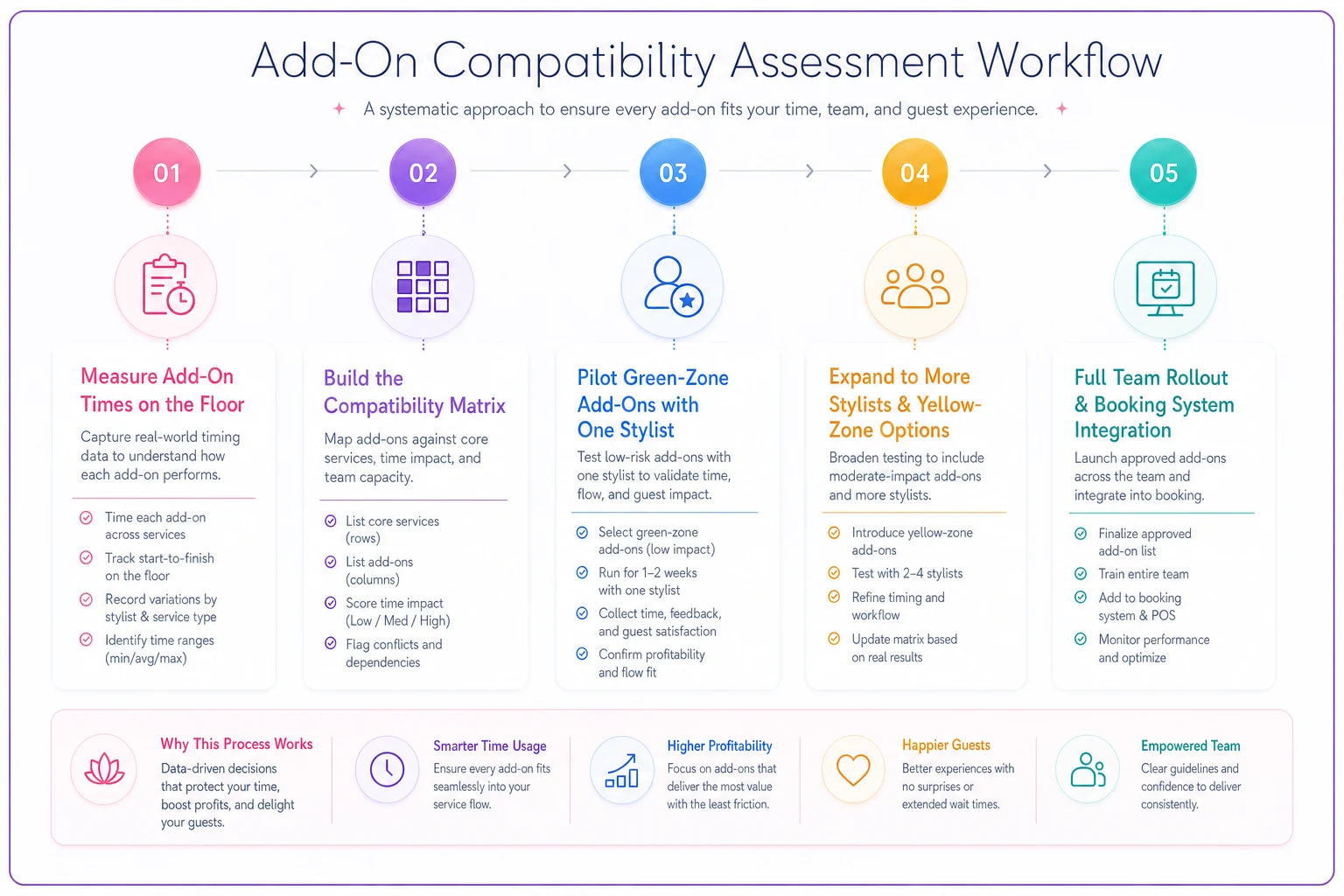
WORKFLOW PLACEHOLDER: Add-on Compatibility Assessment Process
Common compatibility mistakes to avoid
Assuming processing time is free time. Color processing is chemical timing. Adding too many services during this window leads to over-processing and unhappy clients. Limit to one express add-on per processing window.
Ignoring setup/cleanup time. That "5-minute" brow tint needs supplies gathered, area prepped, and cleanup after. Real time: 8-9 minutes. Build your matrix on complete time, not just application.
Offering incompatible product combinations. Selling a keratin treatment client regular shampoo, pushing oil treatments right before color services, or recommending products that conflict with their styling routine. Your matrix needs a "never together" section too.
Forcing add-ons on wrong appointment types. New clients need consultations and relationship building, not aggressive upselling. Complex corrections need full attention, not distractions.
Mark these appointment types as add-on-free zones. Believing all stylists can sell all add-ons. Junior stylists might nail retail recommendations but fumble pre-pay packages. Senior stylists might excel at treatment add-ons but ignore travel sizes. Play to strengths rather than forcing uniformity.
Measuring what matters
Traditional metrics like "average ticket" or "retail percentage" don't tell you if your add-on strategy is working without wrecking operations. Track these instead:
On-time percentage by stylist — If this drops when add-ons increase, your matrix needs adjustment. Target: 85% or higher appointments starting within 5 minutes of scheduled time.
Add-on acceptance by category — Which types get yes most often? Double down there rather than pushing what doesn't work.
Schedule creep by service combination — Which base service + add-on combinations consistently run over? Remove them from your green zone immediately.
Revenue per appointment hour — Not just total revenue, but revenue divided by actual time used. This reveals which add-ons truly increase profitability versus those that just look good on paper.
Rebook rate with add-ons — Clients who buy add-ons should rebook at higher rates. If they don't, you're selling the wrong things or creating bad experiences.
A salon doing 300 appointments monthly should see roughly $2,800-3,500 in additional revenue from properly mapped add-ons without adding any appointment slots.
But more importantly, you should see stable or improving on-time rates and client satisfaction scores.
Why most salons never fix this problem
The real reason salons struggle with add-ons isn't lack of training or motivation. Nobody wants to do the unsexy work of timing services, building matrices, and saying no to combinations that don't work.
It's easier to hope stylists will "sell more" or buy another training program about retail confidence. But hope doesn't fix operational problems. Neither does confidence when you're trying to squeeze 20 minutes of services into 10 minutes of time.
Most owners also underestimate how much schedule anxiety affects both staff and clients. Your stylists aren't avoiding add-ons because they don't want more money — they're avoiding the stress of running behind all day. Your clients aren't cheap — they just hate waiting and feeling rushed.
The matrix approach isn't sexy. It's not going to make a great Instagram post. But it solves the actual problem: capturing available revenue without destroying your carefully built schedule.
Making the system sustainable
Building the matrix is just the start. Keeping it working requires a few key pieces most salons miss.
Someone needs to own this system. Not "everyone sells add-ons" but one person who tracks the data, adjusts the matrix monthly, and coaches specific improvements. Without ownership, you'll revert to chaos within six weeks.
Your booking software needs to support this operationally. If receptionists can't easily see which add-ons fit which appointments, they'll book things wrong. If stylists can't quickly check compatibility, they won't offer anything.
Adjust faster than you think necessary. That add-on that worked great in September might fail in December when appointment density increases. Services that fit perfectly with your senior stylist might need 5 extra minutes with juniors. Stay responsive to what your data tells you.
The salons succeeding with this approach aren't the ones with the best sales training or the most elaborate add-on menus. They're the ones who took the time to map reality, built systems around what actually works, and kept refining based on results rather than assumptions.
Your schedule is a finite resource. Your clients' willingness to spend is not. The gap between those two facts is where profitable salons operate — not by extending time, but by maximizing the value of time you already have.
That starts with knowing exactly what fits where, and having the discipline to say no to everything else.
Ready to simplify your salon operations?
Join 1,000+ salons using Salnly to save time, reduce scheduling chaos, and deliver better client experiences.