


Your receptionist just booked a balayage for 2pm. The stylist needs 3.5 hours. But the system shows 2 hours because that's what corporate training said a balayage takes. Now you've got a client showing up at 4pm for highlights while the 2pm appointment is still processing.
This happens in salons every single day. Not because staff can't schedule properly. Because nobody's ever mapped out how long services actually take when you factor in real-world variables.
I learned this the hard way running operational audits for beauty businesses. One salon in Denver was losing $4,800 monthly from rushed services and booking conflicts. Their owner kept blaming the front desk. Turns out their booking system had the same duration for a root touch-up whether it was done by their master colorist or the newly licensed stylist who joined three weeks ago.
Why duration standards break down in real salon operations
Most salons set service durations once during training and never revisit them. Maybe you grabbed timing from a manufacturer's education guide. Or copied what the salon down the street uses. Then reality hits.
Your senior stylist Maria processes color differently than Jake who just finished cosmetology school. Maria's built muscle memory over 12 years. She can apply foils in half the time. But Jake needs extra minutes for sectioning, checking his placement, making adjustments. Nothing wrong with that—he's learning. The problem is pretending they both need 45 minutes for partial highlights.
Then factor in client hair. The booking system doesn't know Mrs. Patterson has hair down to her waist and takes 20 extra minutes to blow dry. Or that teenage Emma has fine hair that processes color faster than the standard timing chart suggests.
What really breaks things is when you layer in consultation time, mixing color, client small talk, and cleanup between appointments. That "90-minute color service" becomes 115 minutes in practice. Stack three of those timing errors in one day and you're running an hour behind by 3pm.
Stylists start cutting corners to stay on time. They rush through toner application. Skip the second shampoo. Send clients out with damp roots. Service quality drops, clients notice, and that five-star review becomes a three-star complaint about feeling rushed.
Building a complexity multiplier system
Start with your standard service duration for an average appointment with a mid-level stylist. That's your baseline. Then apply multipliers.
Stop losing appointments in the chaos.
Salnly helps you book, confirm & manage every appointment—efficiently.
- Centralized appointment management
- Client notifications
- Calendar & staff scheduling
No credit card required
The Complexity Factor Table
| Service Variable | Time Adjustment |
|---|---|
| Virgin hair to blonde | +40% base time |
| Previous color correction | +30% base time |
| Hair past shoulders | +15% base time |
| Hair past mid-back | +25% base time |
| Fine/damaged hair | +20% base time |
| Thick/coarse texture | +20% base time |
| Multiple processes | +15% per additional |
| New client consultation | +15 minutes flat |
Stylist Level Adjustments
| Experience Level | Speed Modifier |
|---|---|
| Assistant (0-1 year) | Base time +35% |
| Junior (1-3 years) | Base time +20% |
| Senior (3-7 years) | Base time as listed |
| Master (7+ years) | Base time -15% |
| Specialist | Base time -20% |
One salon in Austin implemented this system. They tracked every appointment for two weeks, comparing scheduled versus actual time. Their junior stylists averaged 28% longer than scheduled. Senior stylists finished 12% faster. Once they adjusted their booking rules, late appointments dropped from 31% to 8% within a month.
The audit process that reveals your real service times
Most owners guess at service durations or rely on outdated training manuals. You need actual data from your actual stylists with your actual clients.
Week 1: Silent tracking
Don't announce you're auditing times—it changes behavior. Have someone quietly note:
-
Scheduled start time
-
Actual start time
-
When stylist begins cleanup
-
When client leaves
-
Any delays or issues
Track every appointment for five business days. Include Saturday if that's your busiest day.
Track your busiest day—it's often where timing gaps show up.
Week 2: Calculate patterns
Pull the data into a simple spreadsheet. Look for:
-
Average overage by service type
-
Differences between stylists
-
Time of day patterns
-
Specific services that always run long
You'll spot patterns immediately. Maybe perms always run 25 minutes over. Or your 5pm slots consistently start late because the 3pm appointments drag.
Week 3: Test adjustments
Pick three problematic services. Add 15-20% more time to their duration in your booking system. See what happens. If appointments suddenly run smoother, you've found your real timing.
A small salon in Phoenix discovered their "quick trim" appointments averaged 35 minutes, not the 20 minutes they'd been scheduling. They increased booking time to 30 minutes as a compromise. Result: stylists stopped falling behind after lunch.
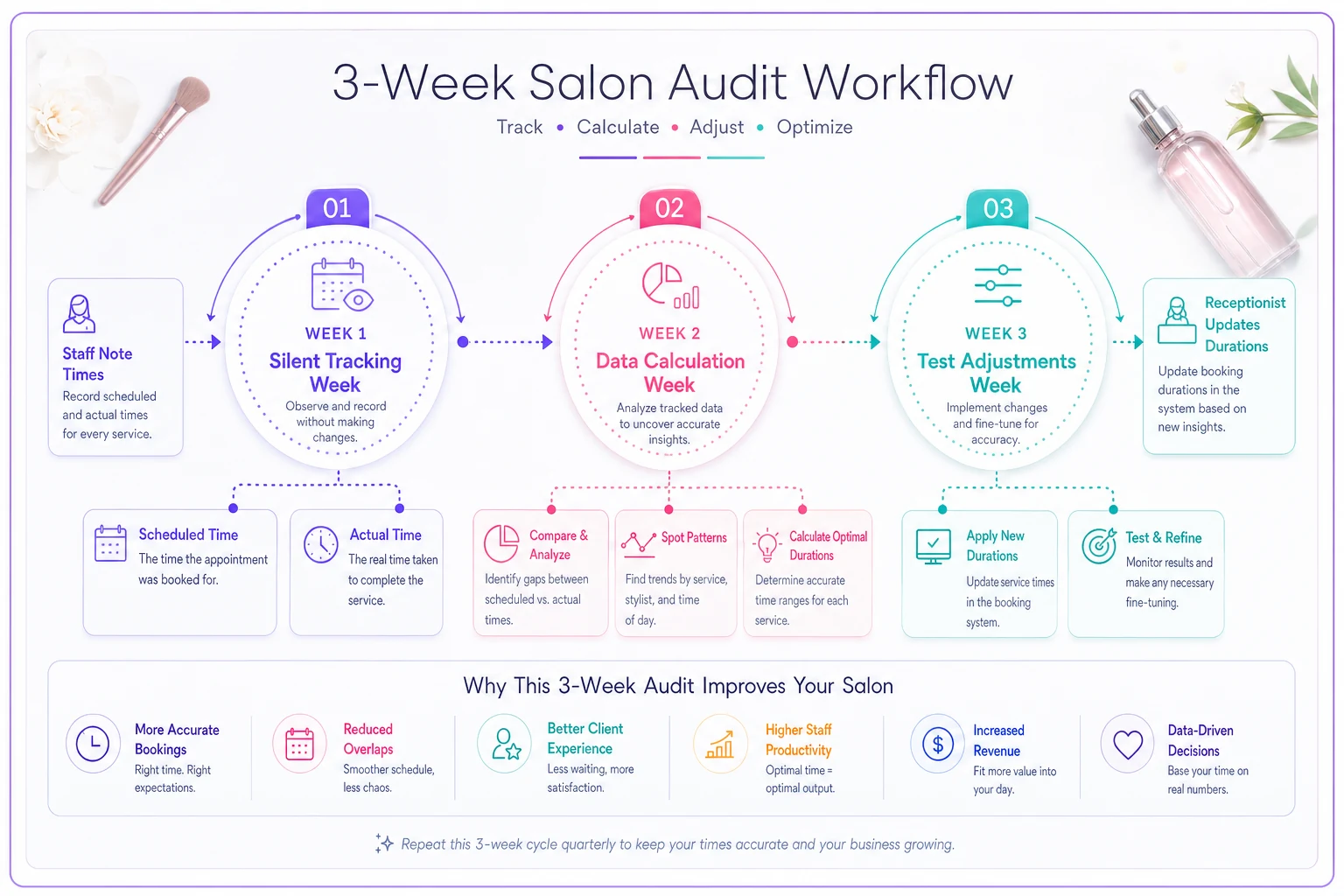
Here's a simple visual of the three-week audit workflow.
Implementation without disrupting current bookings
Changing service durations sounds simple until you realize you've got 400 appointments already booked for next month. You can't call everyone and reschedule.
Start with new bookings only. Keep existing appointments as-is but apply new durations going forward. This creates a transition period where some days follow old timing, others follow new. Mark these clearly in your appointment book so reception knows which system applies.
The rollout sequence:
-
Update duration for one service category first (like color services)
-
Monitor for two weeks
-
Adjust if needed
-
Move to next category
-
Full implementation takes 6-8 weeks
Train reception on the new complexity factors. Give them a cheat sheet:
-
Long hair? Add 15 minutes
-
Corrective color? Add 30% to base time
-
New client? Add consultation time
-
Junior stylist? Add 20% to standard duration
Some salons worry about booking fewer appointments with longer durations. But you deliver better service, clients don't feel rushed, stylists aren't stressed, and everyone leaves happier. Happy clients tip better and return more often.
Handling the "but we'll lose money" conversation
Every salon owner thinks the same thing when you suggest longer appointment slots. Fewer appointments means less revenue, right?
Except that's not how salon operations work.
When you're constantly running behind:
-
Stylists skip recommended treatments to save time
-
Clients get frustrated and don't book their next appointment
-
Your team burns out from constant pressure
-
Online reviews mention feeling "rushed" or "overlooked"
A salon in Portland increased their color service duration by 20 minutes. They thought they'd lose four appointments per stylist each week. Instead, stylists started recommending glosses and treatments they'd been skipping before. Average ticket increased $28. Client retention went from 68% to 79% over three months. They made more money with "fewer" appointments.
Common duration mistakes that create compound delays
Mistake 1: Ignoring setup and cleanup That 45-minute haircut isn't just 45 minutes. It's greeting the client, getting them settled, the consultation, the service, checkout, cleaning the station, and prepping for the next client. Real time: 55-60 minutes.
Mistake 2: Same time for all stylists Your stylist with 15 years experience moves through a full highlight three times faster than someone six months out of school. If the booking system shows the same duration, you're either rushing the newer stylist or leaving the senior stylist with dead time.
Mistake 3: Not accounting for product processing Color needs time to develop. You can't rush chemistry. But salons book the next client as if the color will process in exactly 30 minutes every time. Different brands, different formulas, different hair types—processing varies by 10-15 minutes easily.
Mistake 4: Forgetting conversation time Clients talk. They show photos. They change their mind mid-service. They ask about products. This is good—it builds relationships. But if you schedule back-to-back without buffer time, every conversation pushes you further behind.
The technology side of standardizing durations
Your booking system probably lets you customize service times. Most salon owners just never dig into those settings after initial setup.
Modern scheduling platforms can handle complexity factors automatically. Set rules like "add 20 minutes for long hair" or "reduce by 15% for senior stylists." The system adjusts timing based on the specific combination of service, stylist, and client notes.
But even basic systems work if you train reception properly. Create service codes like:
-
HC-30 (haircut, 30 minutes)
-
HC-45L (haircut, 45 minutes for long hair)
-
COL-120J (color, 120 minutes with junior stylist)
-
COL-90S (color, 90 minutes with senior stylist)
The key is consistency. Everyone needs to follow the same rules. One receptionist freelancing their own timing breaks the entire system.
Some operational software platforms now use AI automation to track actual service times and suggest duration adjustments automatically. Instead of manual audits, the system notices patterns and recommends changes. "Hey, Sarah's highlights consistently run 15 minutes over—want to adjust her color service duration?" This removes guesswork and keeps timing accurate as your team evolves.
Creating your duration adjustment playbook
Implementation checklist based on what works in real salons:
Phase 1: Data gathering (Week 1-2)
-
Track 100+ appointments silently
-
Note stylist level for each service
-
Record any special circumstances
-
Calculate actual vs scheduled time
Phase 2: Analysis and rules (Week 3)
-
Identify your top 10 services by frequency
-
Calculate average overage/underage for each
-
Create complexity multipliers
-
Build stylist-level adjustments
-
Draft new duration standards
Phase 3: Soft launch (Week 4-5)
-
Pick one service category to test
-
Apply new durations to new bookings only
-
Track improvement in on-time performance
-
Gather stylist feedback
-
Adjust if needed
Phase 4: Full rollout (Week 6-8)
-
Expand to all service categories
-
Train all reception staff
-
Update booking system settings
-
Create quick reference guides
-
Monitor daily for two weeks
Phase 5: Optimization (Ongoing)
-
Monthly review of on-time metrics
-
Quarterly duration audits
-
Adjust for seasonal changes
-
Update as stylists gain experience
Phase 5: Optimization (Ongoing)
Real results from a duration overhaul
Small salon in Nashville, six chairs, mix of junior and senior stylists. They were dealing with constant delays, especially on Saturdays. Clients complained. Stylists stressed. The owner blamed everyone and everything.
We ran a two-week audit. Discovered:
-
Color services ran 22 minutes over on average
-
Junior stylists needed 35% more time than scheduled
-
Saturday appointments started late 67% of the time
-
Long hair added 18 minutes to any service
They implemented new duration standards with complexity factors. Within six weeks:
-
On-time performance improved from 42% to 81%
-
Saturday delays dropped by 70%
-
Client complaints about waiting went from 3-4 weekly to almost zero
-
Stylists reported feeling "less rushed" and "more in control"
-
Average tips increased 12% (clients noticed the difference)
The owner stopped firefighting scheduling problems and started focusing on growth. Because when operations actually work, you get your time back to build the business instead of constantly fixing it.
Moving forward with realistic timing
Standardizing service durations isn't about perfection. Some appointments will still run over. Some clients will still arrive late. Some days will still feel chaotic.
But when you base scheduling on reality instead of wishful thinking, most appointments run smoothly. Your team can breathe. Clients get the attention they deserve. And those booking conflicts that used to derail entire afternoons become rare exceptions instead of daily disasters.
The salons that thrive understand this: operational excellence comes from acknowledging how things actually work, not how you wish they worked. Your junior stylist needs more time than your senior stylist. Long, thick hair takes longer than a pixie cut. These aren't failures—they're realities you can plan around.
Start with that silent audit next week. Track what's really happening in your chairs. The data will probably surprise you. Then use it to build duration standards that actually reflect your salon's reality. Your stylists will thank you. Your clients will notice. And you'll wonder why you didn't do this sooner.
Because scheduling isn't about cramming in maximum appointments. It's about delivering consistent, quality service that keeps clients coming back. And that starts with being honest about how long things actually take.
Ready to simplify your salon operations?
Join 1,000+ salons using Salnly to save time, reduce scheduling chaos, and deliver better client experiences.