
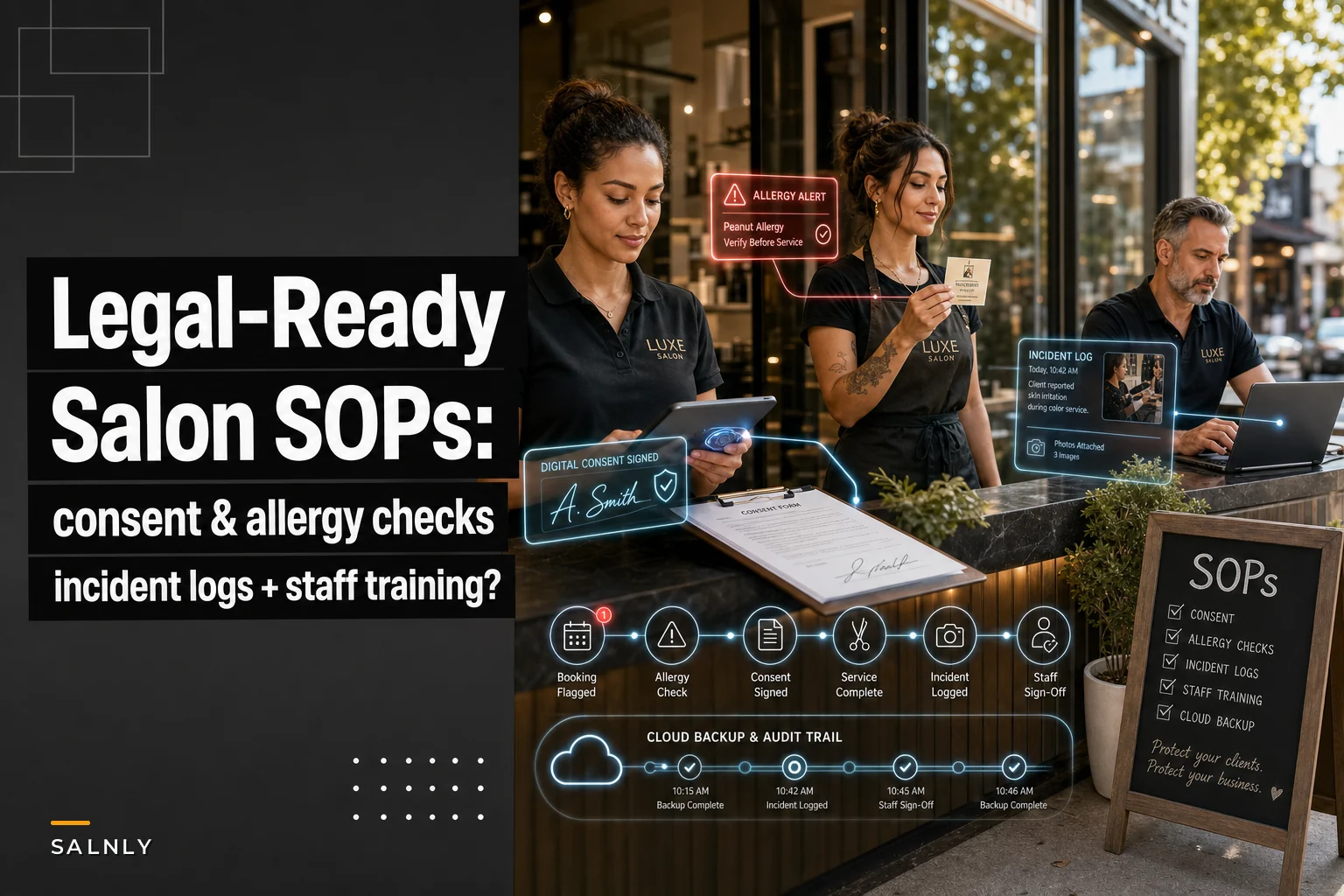

Running a salon means chemicals, heat tools, and close contact with clients' skin and hair every single day. Yet most salons are still operating with photocopied consent forms from 2009, verbal allergy checks nobody documents, and incident reports scribbled on sticky notes.
The moment a client has an allergic reaction to color, a burn from a flat iron, or decides you damaged their hair — without proper documentation you're staring down potential lawsuits, denied insurance claims, and state board investigations that could shut you down.
Getting your legal documentation right isn't about being paranoid. It's about protecting your business while actually improving how your team operates. The salons that survive incidents and the ones that don't usually come down to one thing: having the right paperwork ready before something happens.
Why generic templates create more risk than protection
Most salon owners grab a free consent form template online, swap in the salon name, and call it done. The problem is generic templates miss state-specific requirements, don't reflect your actual services, and sometimes include language that actively weakens your legal position.
Take patch testing consent. A generic form might say "client agrees to patch test" — sounds fine. But in California, for example, you need specific language about the 48-hour waiting period, documentation of the exact products used, and written acknowledgment that reactions can still occur after testing. Miss those details and your consent form is essentially useless in court.
There's also the mismatch problem. If your consent form mentions services you don't offer, or doesn't mention specialized treatments you do, you've got legal gaps. Any halfway decent attorney will tear apart inconsistencies between what your paperwork says and what actually happened in that chair.
And then there's readability. Dense legalese might feel protective, but if a client can credibly argue they didn't understand what they signed, the form loses its power. You want language that's legally sound but clear enough that a reasonable person actually gets what they're agreeing to.
Building consent forms that actually protect you
Chemical service consent structure
Stop losing appointments in the chaos.
Salnly helps you book, confirm & manage every appointment—efficiently.
- Centralized appointment management
- Client notifications
- Calendar & staff scheduling
No credit card required
A tiered consent system based on service risk makes the most sense. Basic cuts need minimal documentation. Chemical services need comprehensive forms.
For color services, your consent needs to cover:
-
Previous chemical service history (last six months minimum)
-
Current medications that affect hair or skin
-
Specific allergies and sensitivities
-
Home care products currently being used
-
Desired outcome versus realistic expectations
-
Photo documentation permission
The trick is making these questions feel conversational while capturing what matters legally. Instead of "List all medications," try something like: "Are you taking any medications that might affect how your hair processes color? Common ones include Accutane, blood thinners, or thyroid medications."
The patch test protocol nobody follows correctly
Patch testing fails because salons treat it as a suggestion rather than a documented process. A two-part patch test form is what actually works.
Part one documents the test application:
-
Date and time applied
-
Exact products and batch numbers
-
Location on skin (behind ear or inner elbow)
-
Stylist initials
-
Client signature acknowledging the 48-hour wait
Part two captures the results:
-
Return date and time
-
Visual inspection results
-
Client-reported sensations
-
Proceed or cancel decision
-
Both signatures again
Keep photos of patch test areas in client files. It sounds excessive until you need to prove you followed protocol and someone claims you didn't.
Allergy management beyond "any allergies?"
Three-layer allergy capture
Layer 1: Booking Train receptionists to ask about allergies during every booking call — not just "any allergies?" but specific prompts:
-
"Do you have sensitivities to fragrances or essential oils?"
-
"Any reactions to hair products in the past?"
-
"Latex allergies?" (gloves issue)
-
"Sensitive to certain metals?" (foil reactions)
Layer 2: Intake A written form at check-in that specifically lists common salon allergens:
-
PPD (para-phenylenediamine) in color
-
Formaldehyde in straightening treatments
-
Specific fragrance compounds
-
Latex
-
Nickel (in tools and foils)
Layer 3: Consultation Stylist verbally confirms allergies before starting the service and documents the discussion in service notes.
A flagging system that actually works
Color-code client files or use prominent digital flags:
-
Red
severe allergies (anaphylaxis risk)
-
Orange
moderate sensitivities
-
Yellow
preferences (fragrance-free only)
Physical stations need allergy alerts too. A small colored dot on the mirror or station tablet instantly tells any stylist about a client's sensitivities without broadcasting private medical information across the room.
Product substitution protocols
When allergies are flagged, you need clear substitution rules documented ahead of time. A standard swap list might look like this:
| Allergen/Sensitivity | Standard Substitution |
|---|---|
| PPD sensitivity | PPD-free color lines |
| Fragrance sensitivity | Fragrance-free processing options |
| Latex allergy | Non-latex gloves for stylist use |
| Metal/nickel sensitivity | Aluminum-free foils |
Pro-tip: Keep a digital log entry template for substitutions so audits show exactly what was swapped and why.
Document every substitution in service records. "Used XXX color line (PPD-free) due to documented sensitivity" protects you if a reaction occurs anyway.
Incident documentation that holds up under scrutiny
The incident response framework
Immediate response (first 5 minutes):
-
Secure client safety — first aid if needed
-
Isolate the area
-
Preserve everything
products, tools, towels
-
Start documenting
Documentation phase (next 15 minutes):
-
Exact time the incident was noticed
-
Services performed step-by-step
-
Products used, including batch numbers
-
Environmental factors — timing, temperature
-
Client's exact words about what they're experiencing
-
Visible symptoms or damage
-
Who was present
Management phase (next 10 minutes):
-
Manager assesses the situation
-
Determine whether medical attention is needed
-
Offer immediate remedies if it's safe to do so
-
Set clear follow-up expectations
-
No admissions of fault
The photograph protocol everyone skips
Photos are your best defense, but they need to be done properly:
-
Multiple angles with good lighting
-
Timestamp verification
-
Close-ups and wider shots
-
Before and after when possible
-
Client's face not visible for privacy
Store photos in three places: physical file, cloud backup, and a separate incident folder. Insurance companies often want documentation months after the fact.
Writing incident reports that actually protect you
Bad incident report: "Client's hair fell out after bleaching. Offered refund."
Good incident report: "At 2:47pm, client Sarah Johnson reported scalp tingling during a 20-volume bleach application (brand XXX, batch #12345). Bleach had been applied for approximately 12 minutes. Immediately rinsed with cool water and applied soothing treatment (brand YYY). Client declined medical attention and stated 'it feels better now.' Minor redness documented on crown area (see photos 1–3). Client left at 3:15pm after observation period. Manager Jane Smith followed up by phone at 6:30pm — client reported no further issues. Scheduled complimentary scalp treatment for Thursday 10am."
The difference is specifics. Timeline, products, actions taken, follow-up. That kind of report shows care and professionalism without admitting wrongdoing.
Staff training that prevents legal nightmares
Weekly scenario drills
Run 15-minute scenario practices during slow periods:
Week 1: Allergic reaction drill "Client in chair develops hives during color processing"
-
Who responds first?
-
Where's the first aid kit?
-
Who calls 911 if needed?
-
Who documents?
-
Who manages other clients in the meantime?
Week 2: Burn incident drill "Client says flat iron burned their ear"
-
Immediate response protocol
-
Documentation requirements
-
When to involve insurance
-
Follow-up procedures
Week 3: Damage claim drill "Client returns saying we ruined their hair"
-
De-escalation techniques
-
Evidence preservation
-
When to stop talking and start documenting
-
Manager escalation triggers
Documentation accountability system
A simple tracking system for form completion goes a long way:
Daily checklist for stylists:
-
- [ ] Consent forms signed before chemicals
-
- [ ] Allergy checks documented
-
- [ ] Service notes completed
-
- [ ] Unusual requests noted
-
- [ ] Product batch numbers recorded for chemical services
Weekly manager audits:
-
Pull five random client files and check
-
Is documentation complete?
-
Are forms properly signed?
-
Do service notes match the appointment?
-
Are allergy flags current?
Stylists with incomplete documentation get a refresher, not punishment. Frame it as protection, not paperwork burden.
The conversation scripts nobody teaches
For pushing back on unsafe requests: "I understand you want platinum blonde today, but based on your hair's current condition, attempting that would likely cause real damage. I can show you what's safely achievable now, or we can put together a plan to get you there over a few appointments."
For clients who won't sign consent: "Completely understand if you're not comfortable with the form. Unfortunately, our insurance requires signatures before chemical services. Would you like to do a consultation today and take some time to think about it?"
For post-incident follow-up: "Hi [name], just calling to check how you're feeling after your appointment yesterday. You mentioned some sensitivity — has that improved? We want to make sure you're completely comfortable."
Building your salon-specific legal toolkit
Essential forms checklist
Beyond basic consent, you need:
-
Service-specific consents - Chemical processing (color, perm, relaxer) - Thermal styling (keratin, Brazilian blowout) - Extension application - Corrective color work
-
Release forms - Photo/video release for social media - Model release for training - Referral permission forms
-
Incident documentation - Incident report template - Witness statement forms - Follow-up log sheets - Insurance notification template
-
Training records - New hire legal training checklist - Annual compliance refreshers - Incident response drill logs
State-specific requirements you're probably missing
Every state has quirks. California requires specific cancer warnings for certain chemicals. New York mandates particular language around skin testing. Texas has unique requirements for minor consent.
Check your state's cosmetology board requirements, but also look at:
-
Local health department rules
-
City business licensing requirements
-
Insurance policy documentation needs
-
Professional association guidelines
Missing even one state-specific requirement can invalidate your entire documentation system when it actually matters in court.
The digital transition that reduces risk
Paper forms create problems — they get lost, damaged, filled out wrong, or just disappear. Moving to digital documentation sounds complicated but it genuinely reduces risk over time.
Digital benefits:
-
Automatic timestamp verification
-
Required fields prevent incomplete forms
-
Cloud backup prevents loss
-
Easier to update when regulations change
-
Instant access during an incident
Start simple with tablet-based forms at reception. As your team gets comfortable, expand to stylist tablets for service documentation. Keep paper backups for the first few months until everyone's settled into the new process.
Common legal myths that get salons in trouble
"The client signed a waiver so we're covered"
Waivers don't eliminate liability for negligence. If you cause injury through improper technique or use products incorrectly, that waiver won't protect you. They only cover inherent risks the client knowingly accepts — not your team's mistakes.
"We've never had a problem so we don't need this"
Insurance companies love when businesses think this way, right until a claim comes in. Then they deny it because documentation is missing. One serious incident can wipe out a salon financially. Prevention costs almost nothing compared to a lawsuit.
"Our insurance handles everything"
Insurance companies look out for themselves first. Without solid documentation, they'll find reasons to deny coverage faster than most people expect. Your documentation is what makes insurance actually function when you need it.
"Verbal agreements are enough"
Try proving what was said six months ago when a client insists you promised something completely different. Verbal agreements are essentially impossible to enforce. If something matters, write it down.
When forms become operational improvements
Here's the part most people don't expect: proper legal documentation actually makes your operations better. The consent process forces real consultations. Allergy tracking prevents reactions before they happen. Incident protocols create consistent service recovery instead of chaos.
Salons with solid documentation tend to see fewer incidents overall because of the prevention focus, faster resolution when incidents do happen, better insurance rates from fewer claims, more confident staff, and noticeably higher client trust.
One salon in Denver saw color correction claims drop by roughly 70% after implementing proper consultation documentation. Not because they got dramatically better at color — but because clients had realistic expectations documented before the service started. That's a meaningful outcome from what most people would dismiss as admin work.
Making legal compliance automatic
Having forms and using them consistently are two different things. That gap is where most salons actually fail.
Build documentation into the natural workflow:
-
Consultation forms on tablets that stylists complete during the conversation
-
Check-in process that requires form completion before the appointment starts
-
Service tickets that prompt for special documentation
-
End-of-day audits that flag missing paperwork
Operational software that integrates consent and documentation directly into your booking system helps significantly here.
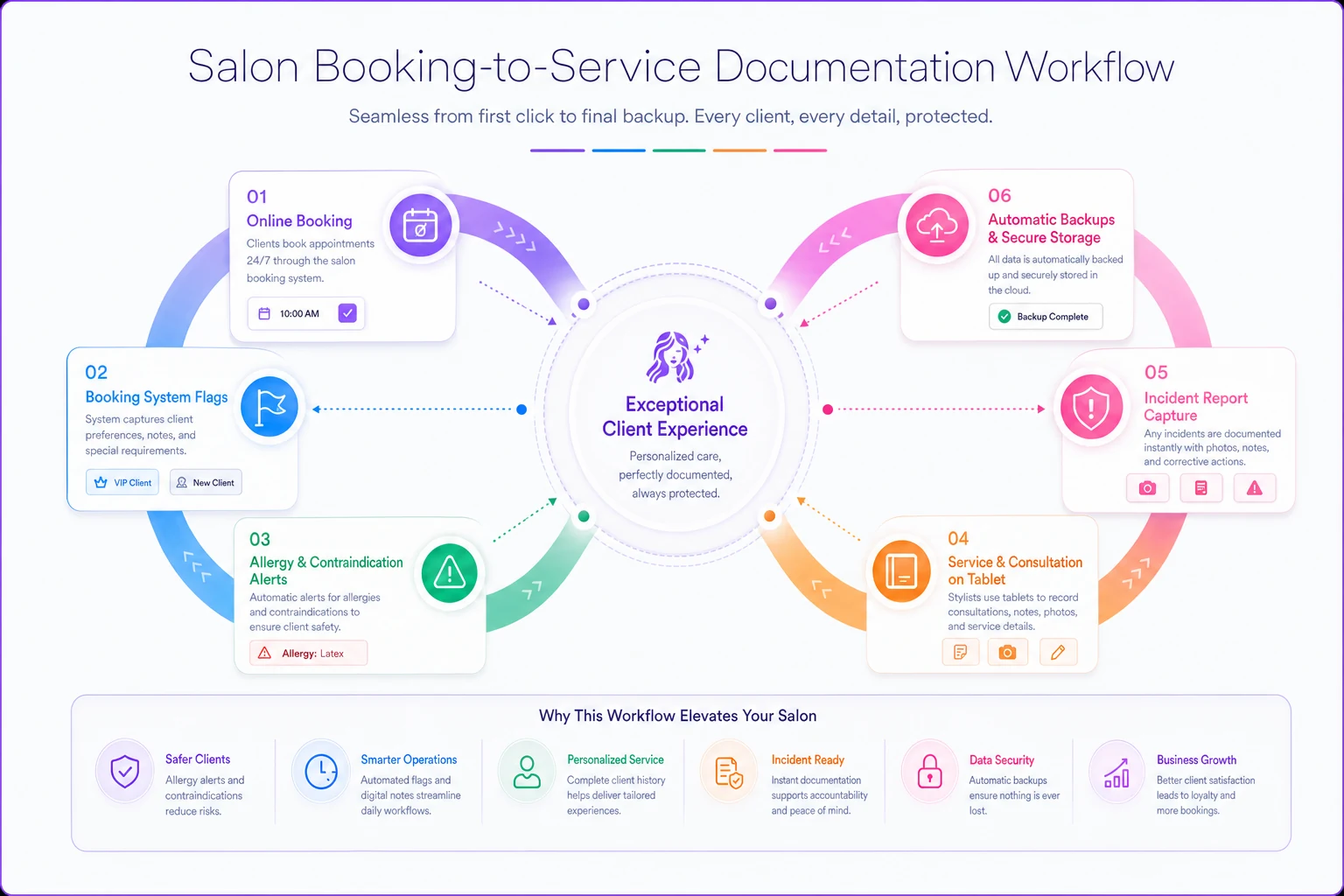
This simple flow shows how booking, allergy flags, service notes, incident capture and backups connect so compliance is part of the job.
When forms auto-populate with client history, allergies flag during booking, and incident reports link directly to service records, your team will actually use the system without being reminded constantly.
The goal isn't perfect paperwork for its own sake. It's protecting your business while delivering services people trust. When legal documentation improves both safety and day-to-day operations, it stops feeling like bureaucracy and starts feeling like just running a professional business.
The lawsuit you prevent is worth more than the one you win. Get your documentation right before you need it, train your team on it properly, and you'll sleep better knowing your salon is actually covered.
Ready to simplify your salon operations?
Join 1,000+ salons using Salnly to save time, reduce scheduling chaos, and deliver better client experiences.