


Last month, a salon owner in Dallas showed me her Saturday booking screen from June. Three stylists blocked from 8am to 3pm for a wedding party. Total revenue: $2,400. Sounds decent until you realize those same chairs normally generate around $3,800 on a regular Saturday with walk-ins, color corrections, and their loyal weekly clients.
The bride had booked eight months in advance with a $200 deposit. By the time the wedding weekend arrived, two bridesmaids had dropped out, one wanted a completely different style than originally discussed, and the mother of the bride showed up expecting to be squeezed in. Meanwhile, their regular Saturday clients — the ones who come every 4-6 weeks and tip generously — had been pushed to other days or simply went elsewhere.
This isn't a staffing problem or a pricing problem. It's an operational gap that happens when salons treat wedding bookings like regular appointments instead of the complex, high-risk events they actually are.
Why wedding parties become operational nightmares
Wedding bookings seem straightforward. A bride calls, books for herself and five bridesmaids, you block the time, take a deposit. Simple transaction, right?
But weddings operate on completely different physics than regular salon appointments. The bride who books you is managing fifteen other vendors, dealing with family drama, and watching her budget evaporate. By the time her wedding day arrives, that original party of six might be four, or eight, or might show up 45 minutes late because the photographer ran over.
A salon in Austin lost $14,000 in regular client revenue over one summer because they took on twelve wedding parties without proper operational controls. Not because the weddings themselves went poorly — most were fine. But each wedding displaced their bread-and-butter Saturday regulars, created scheduling chaos the week before, and left stylists scrambling to accommodate last-minute changes.
The real damage happens in three places. First, your regular clients get shuffled around or can't book at all. These are the people who've been coming to you for years, who refer their friends, who buy retail without being asked. Push them out enough times for wedding parties, and they'll find another salon.
Second, your team burns out on the chaos. Wedding parties arrive stressed, make demands that weren't discussed, and create tension that affects the whole salon atmosphere. Your stylists end up doing therapy as much as hair.
Third, the financial math rarely works. That $2,400 wedding party required two consultation appointments, dozens of text messages, schedule rearrangements, and often ends up running over the allocated time. Meanwhile, you could have put four color clients in those chairs and made more money with less drama.
Building a defensive operational structure
The solution isn't to stop taking weddings — they can be profitable when managed correctly. You need to treat them like the special events they are, with completely different operational rules than your regular services.
Stop losing appointments in the chaos.
Salnly helps you book, confirm & manage every appointment—efficiently.
- Centralized appointment management
- Client notifications
- Calendar & staff scheduling
No credit card required
Start with deposit structures that actually protect you. Most salons take a flat deposit, maybe $200 or $300. But that doesn't cover your real risk. A proper bridal booking SOP for salons uses a tiered deposit system based on party size and service complexity.
| Party Size | Deposit |
|---|---|
| For parties of 3 or fewer | take 40% of the estimated total. |
| For 4-6 people | bump it to 50%. |
| For larger groups | require 60% upfront. |
This isn't just about securing payment — it's about creating commitment. When a bride has $1,200 on the line instead of $200, she's much more careful about managing her party's attendance.
The deposit should be non-refundable after specific milestones. Two weeks before the wedding, that deposit locks in. One week before, they can't reduce party size without forfeiting a portion. This protects you from the inevitable "actually, two bridesmaids can't make it" call that comes three days before the wedding.
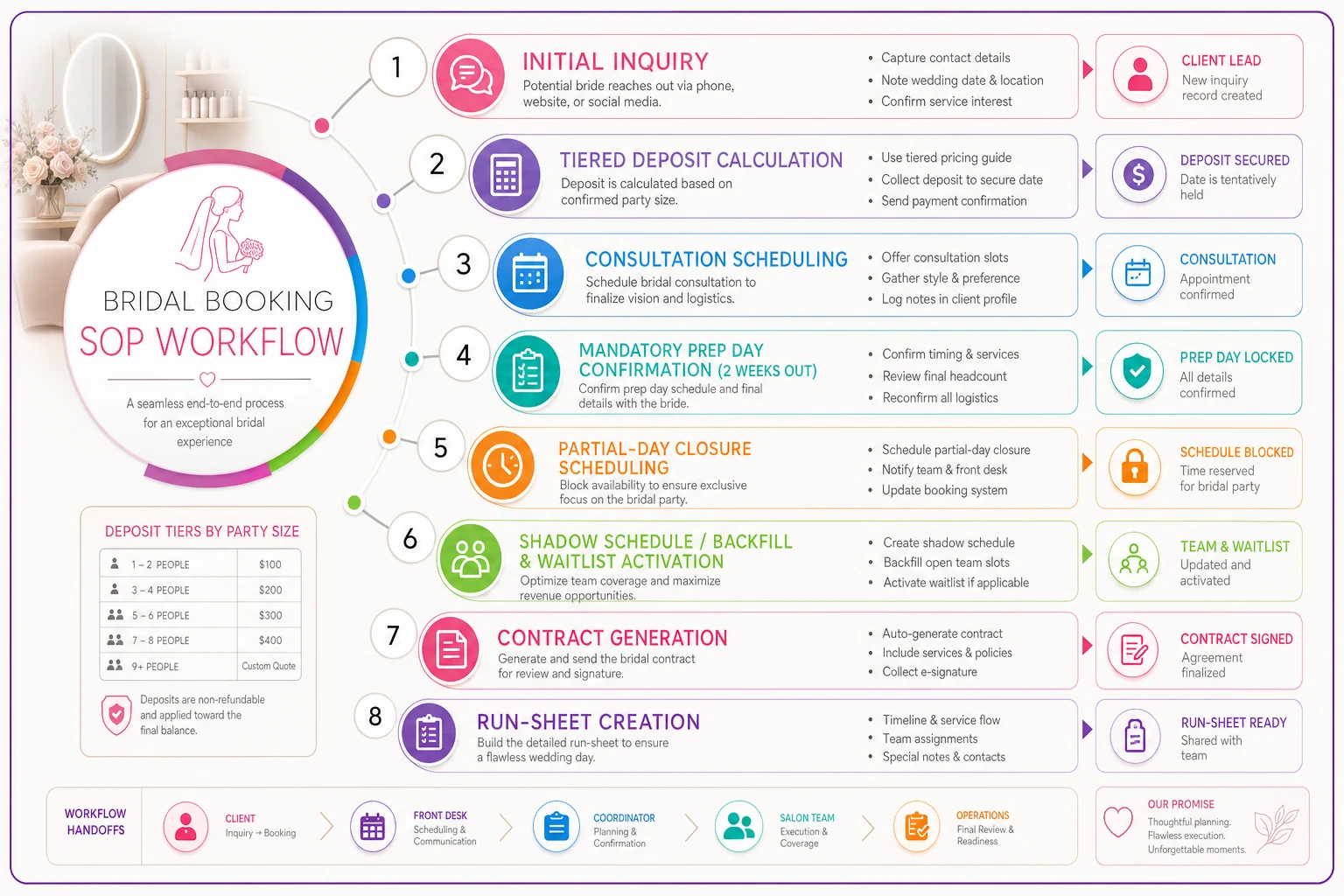
Below is a visual workflow to help teams follow the steps consistently.
The prep day protocol nobody talks about
Every wedding party should have a mandatory prep day. Block out 30 minutes, two weeks before the wedding, for a final confirmation meeting. Not a phone call — an actual meeting.
-
Exact party count with names
-
Specific services for each person
-
Arrival time for each person (staggered, not all at once)
-
Payment method and who's paying for whom
-
Backup plans if someone doesn't show
This meeting serves another purpose — it lets you identify problems before they explode. If the bride seems overwhelmed or the requirements have spiraled beyond your capacity, you can adjust before it's too late.
One salon in Phoenix started requiring prep day meetings and saw their wedding-day chaos drop by roughly 80%. Not because the meetings prevented all problems, but because everyone knew exactly what to expect.
Partial-day closures and schedule architecture
Sometimes it's better to close part of your salon for a wedding than try to run regular operations alongside it.
If you have six chairs and a wedding party needs four, don't try to run normal appointments in those remaining two chairs. The energy is wrong, the noise level is different, and your regular clients feel like they're intruding on someone's special day.
Instead, use a partial-closure model. If the wedding party books 8am to 1pm, close the affected section entirely and run those two remaining stylists on a modified schedule — maybe 1pm to 7pm for regular clients. This clean separation protects both experiences.
Your operational software should enforce these rules automatically. When someone books a wedding party over a certain size, the system should immediately block the surrounding chairs and time slots according to your predetermined rules. This prevents your receptionist from accidentally booking a color correction next to a stressed-out bridal party.
The backfill strategy that saves Saturdays
Every bridal booking needs a backfill protocol built in from day one. When you take that wedding booking six months out, immediately create a "shadow schedule" of what would normally fill those chairs.
Track what you're displacing — if those Saturday morning slots usually host three color clients and two regular cuts, you know exactly what revenue you need to protect. Then, actively work to move those regular appointments to other slots or days, with incentives if needed.
A salon in Denver implemented this system and managed to retain about 85% of their regular Saturday revenue even while taking on wedding parties. They offered their displaced regulars 15% off if they moved to Friday evening or Sunday morning. Most clients were happy to shift for the discount, and the salon maintained their baseline revenue.
Two weeks before any wedding, activate an aggressive waitlist campaign for the surrounding time slots.
The real key is the waitlist activation. Two weeks before any wedding, activate an aggressive waitlist campaign for the surrounding time slots. If that wedding party suddenly shrinks or cancels, you're ready to fill those chairs immediately.
Templated contracts that prevent day-of disasters
Your bridal contract can't be your standard service agreement with "wedding" written at the top. It needs specific operational clauses that prevent the most common day-of problems.
The contract must specify:
-
Latest possible arrival time (usually 15 minutes after scheduled time)
-
What happens if party members arrive late (service modification or cancellation)
-
Who has decision authority if the bride isn't present
-
Maximum service time per person
-
Additional charges for service changes day-of
-
Clear statement that non-party members cannot be added day-of
One critical clause that saves endless grief: "Service timing is based on hair length and condition as assessed during consultation. Significant changes to hair between consultation and service date may require service modification or additional charges."
Stylists get stuck for an extra hour because a bridesmaid decided to add extensions the week before the wedding and didn't mention it. That single clause prevents those situations or at least ensures you're compensated for them.
The run-sheet that keeps everyone sane
The day before any wedding service, generate a detailed run-sheet. Not just appointment times — a minute-by-minute breakdown of the entire service flow.
SATURDAY JUNE 15 - MORRISON WEDDING 7:30am - Team brief, stations setup 7:45am - Coffee/pastries setup in waiting area 8:00am - Bride arrives (Station 1 - Sarah) 8:15am - Bridesmaids 1 & 2 arrive (Stations 2 & 3) 8:30am - Bridesmaids 3 & 4 arrive (Stations 4 & 5) 8:45am - Mother of bride arrives (waiting area, service starts 9:30am) [Service blocks] 8:00-9:30 - Bride hair (includes buffer) 8:15-9:15 - Bridesmaids 1 & 2 8:30-9:30 - Bridesmaids 3 & 4 [Check points] 9:15am - All hair should be complete except bride 9:30am - Photographer arrives (keep in waiting area) 9:45am - Final touches, photos 10:00am - Hard stop, party must depart
This run-sheet gets posted at reception, each station, and in the break room. Everyone knows the timeline, nobody's surprised by the photographer showing up, and there's a clear end time that everyone's aware of.
Protecting your regular revenue
The most successful bridal booking SOP salon framework includes revenue protection built into its core structure. Track your regular Saturday revenue over three months to establish a baseline. Then set a rule: wedding bookings can't drop your Saturday revenue below 85% of that baseline.
This might mean limiting how many weddings you take per month. It might mean charging premium rates that make up for displaced regular services. It might mean only accepting wedding parties during traditionally slower periods.
A busy salon in Tampa implemented a "wedding window" system — they only accept wedding parties on Saturdays before 10am or on Sundays. This protects their prime Saturday afternoon slots while still capturing wedding revenue during times that are typically harder to fill.
Making these decisions based on actual data matters more than gut feeling. Your operational platform should track displaced revenue for every wedding booking, showing you exactly what each wedding party actually costs you beyond the direct service revenue.
When wedding parties make sense (and when they don't)
Wedding parties make sense when:
-
You have at least 4 chairs
-
You have stylists who actually want to do updos and formal styles
-
You can dedicate proper prep time without disrupting regular operations
-
Your location and setup can handle groups
-
You have the operational discipline to enforce all these protocols
They don't make sense when:
-
Your bread and butter is color corrections and complex chemical services
-
Your team is already stretched thin
-
You don't have the physical space for groups to wait comfortably
-
You can't afford to displace your regular Saturday clients
You can't afford to displace your regular Saturday clients
The technology layer that makes this manageable
Managing all these protocols manually is basically impossible. Your receptionist can't remember every rule, track shadow schedules, and enforce deposit structures while also handling walk-ins and phone calls.
AI-powered operational software becomes essential here. The system should automatically enforce your wedding protocols — blocking surrounding appointments, calculating tiered deposits, generating contracts, creating run-sheets, and tracking displaced revenue. When someone calls to book a wedding, your receptionist follows prompts that ensure every protocol is followed.
The system should track the actual profitability of wedding bookings over time. Not just the service revenue, but the true profit after accounting for displaced services, prep time, and operational complexity. This data helps you refine your wedding strategy or decide to exit the wedding business entirely.
Some salons discover they're actually losing money on weddings when all factors are considered. Others find weddings are highly profitable if they follow strict protocols. You won't know which camp you're in without proper tracking and analysis.
Making the framework stick
The hardest part about implementing a bridal booking SOP for salons isn't creating the rules — it's enforcing them consistently. Your team needs to understand that these aren't suggestions, they're requirements.
Start by implementing the framework for new bookings only. Don't try to retroactively apply these rules to weddings already on the books. Train your team on the new protocols, especially whoever handles booking inquiries.
Create a simple checklist that must be completed for every wedding booking:
-
Deposit collected according to tier system
-
Prep meeting scheduled
-
Contract signed and filed
-
Shadow schedule created
-
Run-sheet template assigned
-
Backfill campaign scheduled
Track compliance religiously for the first 90 days. Every wedding booking should follow the exact same process. No exceptions for "nice brides" or "small parties." The framework only works if it's applied universally.
After three months, review the data. How much revenue did you protect? How many day-of disasters did you prevent? How much less stressed was your team? These metrics tell you if the framework is working or needs adjustment.
The goal isn't to make wedding bookings complicated — it's to make them predictable. When everyone knows exactly how weddings work in your salon, from the initial inquiry to the final hairspray, these potentially chaotic events become manageable, profitable services that don't destroy your regular operations.
Your Saturday regulars stay happy, your team stays sane, and wedding parties get the attention they deserve without torpedoing your entire schedule. That's what a proper bridal booking SOP for salons delivers — structure that protects everyone involved.
Ready to simplify your salon operations?
Join 1,000+ salons using Salnly to save time, reduce scheduling chaos, and deliver better client experiences.