

Last Tuesday, a salon owner in Austin texted me a screenshot of her booking system. Three high-ticket color corrections no-showed that week—about $1,400 in lost revenue, not counting the product waste and the colorist who sat around scrolling Instagram for two hours.
She'd been hesitant about requiring deposits. "What if clients get offended? What if we lose bookings?" The usual worries. But after tracking her numbers for a month, she realized something: 82% of her no-shows were for services over $300. The $65 haircuts? People showed up. The $450 transformations? That's where things got sketchy.
Most salons either go too aggressive (50% deposit on everything) or too soft (a meaningless $25 that doesn't actually change behavior). Finding that sweet spot requires a more surgical approach.
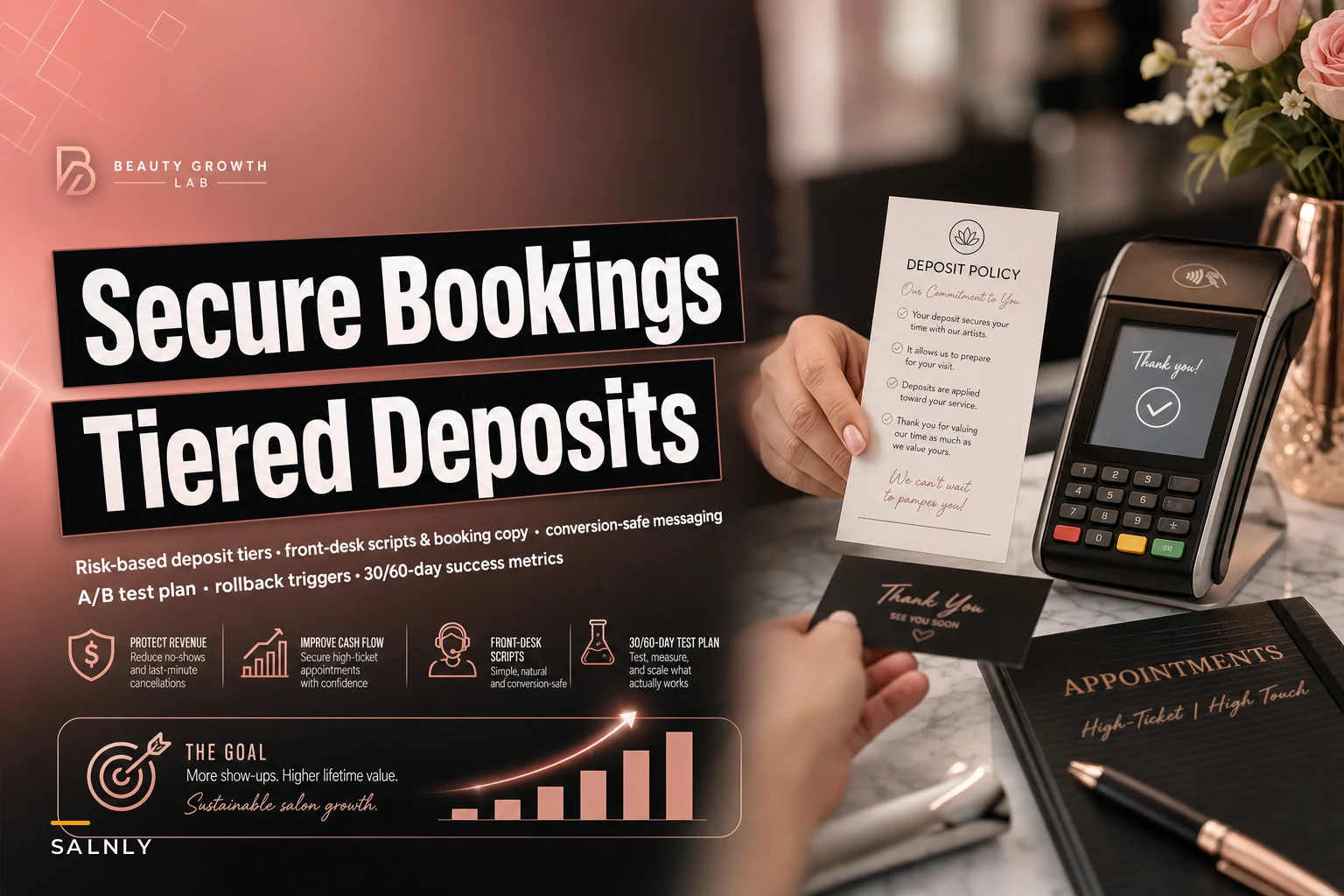
The risk-tiered deposit structure that actually works
After watching dozens of salons fumble through deposit implementations, the pattern becomes clear. Flat deposits annoy reliable clients. Percentage-based deposits scare off new bookings.
Start with your service menu. Pull your last 90 days of bookings and mark every no-show or late cancel. You'll probably see clusters around certain services. Color corrections, Brazilian blowouts, keratin treatments, full highlights with Olaplex—the time-intensive, product-heavy stuff.
Here's a structure that's worked across multiple markets:
-
Tier 1
No deposit required
- Services under $150 - Regular clients with 6+ visits and zero no-shows - Same-day bookings (they're already committed) -
Tier 2
$50 flat deposit
- Services $150-$300 - New clients booking high-ticket services - Weekend appointments for services over $200 -
Tier 3
30% deposit
- Services over $300 - Multi-service bookings (color + extensions, etc.) - Holiday week appointments - Clients with previous no-show history
Your front desk can explain it logically. "For our longer appointments that require special product prep, we do ask for a deposit to hold your time." It's not personal. It's operational.
The key is making it feel routine rather than punitive. When clients understand they're reserving premium time and custom preparation, most don't push back.
Reception scripts that don't kill the booking
Your receptionist picks up the phone. A new client wants to book a full balayage for Saturday. This conversation determines whether you get the booking or they hang up and call your competitor.
Stop losing appointments in the chaos.
Salnly helps you book, confirm & manage every appointment—efficiently.
- Centralized appointment management
- Client notifications
- Calendar & staff scheduling
No credit card required
The wrong way: "We require a 50% deposit for that service. Can I get your card number?"
The right way: "Perfect, I have Saturday at 2pm available with Sarah. For our balayage appointments, since we'll be reserving about 4 hours and preparing your custom color formulas ahead of time, we do take a deposit of $135 to secure your appointment. We can handle that right over the phone, or if you prefer, I can send you a secure link to process it at your convenience. Which would be easier for you?"
See the difference? You're explaining the value exchange, not just demanding money. You're giving them control over how to pay. You're making it feel routine, not confrontational.
For existing clients who've never dealt with deposits: "Hi Jennifer! I have you down for your color correction next Thursday. Just so you know, we recently started taking deposits for our longer appointments to ensure we can properly prepare everything for your service. Since you're one of our regular clients, it's just $50, and of course that comes right off your final total. Can I process that for you now, or would you prefer the payment link?"
Notice "just so you know." You're informing, not asking permission. You're treating it as a done deal because it is.
Send a secure payment link for clients who prefer not to give their card over the phone.
Don't leave your front desk improvising. Train them on these scripts and give them the option language to handle objections smoothly.
The messaging framework that preserves your conversion rate
Implementing deposits will cost you some bookings. Usually around 8-12% initially. But the clients you lose are often the ones most likely to no-show anyway.
Your online booking system needs different messaging than your phone scripts. Online, people have time to think, comparison shop, get annoyed. Keep it brief and benefit-focused:
Online booking message: "For services over $300: A deposit of 30% reserves your appointment and ensures we prepare your custom products in advance. This amount is applied to your service total."
Not: "Deposit required. Non-refundable. 48-hour cancellation policy."
For your social media announcement: "Starting February 1st, we're introducing appointment deposits for our transformation services! This helps us better prepare for your visit—pre-mixing your custom color, blocking adequate time, and ensuring your stylist is fully focused on your service. Deposits are automatically applied to your service total. Questions? Just message us!"
Again, it's about them, not you. You're not protecting yourself from no-shows. You're improving their experience.
The A/B test that tells you what actually works
Most salons implement deposits across the board on Monday and pray it works. That's not a strategy; it's a guess.
Instead, run a controlled test. Pick one service category, ideally your most problematic one. Color corrections work well for this.
Week 1-2: Baseline
-
Track without deposits
-
- Total color correction bookings - No-show rate - Late cancellation rate - Revenue per available hour
Week 3-6: Test Group A
-
Implement 25% deposit requirement
-
- Track same metrics - Note phone objections - Monitor online booking abandonment
Week 7-10: Test Group B
-
Switch to tiered system (first-timers pay 30%, regulars pay $50 flat)
-
- Track all metrics - Compare conversion rates - Calculate actual revenue impact
The numbers tell the story. One salon discovered their 30% deposit killed new client bookings but eliminated no-shows. Their $75 flat deposit maintained bookings but only reduced no-shows by 40%. The winner? A hybrid—30% for new clients booking online, $75 for phone bookings where staff could explain the value.
Use this workflow to run the A/B test and track the metrics.
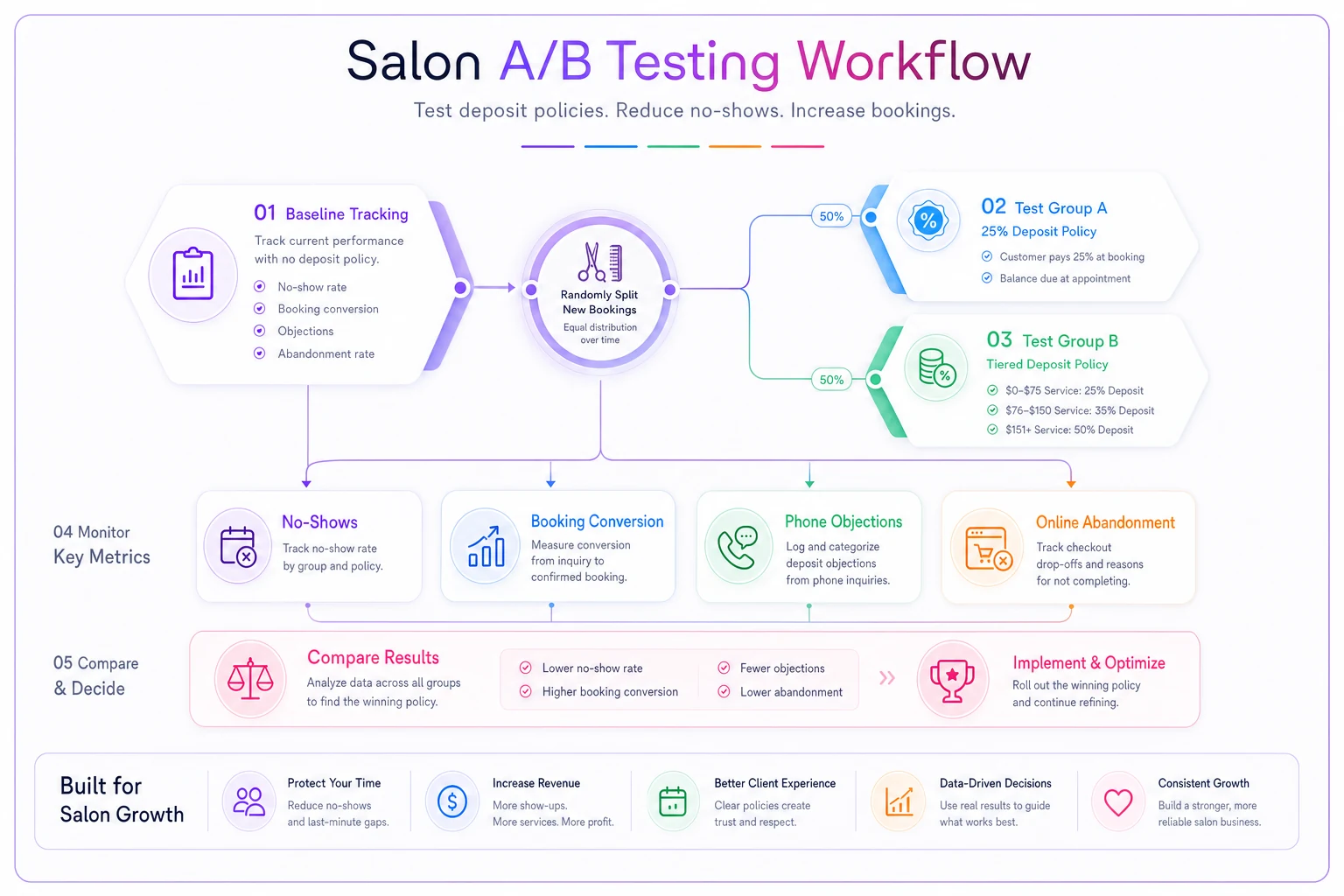
Follow the steps above, track objections and booking abandonment, then compare conversion rates.
Setting up rollback triggers before you need them
Sometimes deposits backfire. A high-end salon in Miami implemented 50% deposits and lost 30% of their bookings in two weeks. They panicked, removed all deposits, and confused everyone.
Define your rollback criteria before you start:
Immediate rollback triggers:
-
Booking rate drops more than 25% week-over-week
-
Customer complaints exceed 10 per week
-
Staff reports consistent booking friction
-
Online reviews mention deposits negatively
Adjustment triggers (modify but don't remove):
-
Booking rate drops 15-20%
-
Specific services show 30%+ booking decline
-
New client bookings drop more than 20%
-
Payment processing issues exceed 5% of deposits
Document everything. If you need to rollback, you want data explaining why, not just "it felt wrong."
The 30-day checkpoint metrics
After a month, you need hard data, not feelings. Pull these specific numbers:
| Metric Category | Before Deposits | After Deposits | Target Range |
|---|---|---|---|
| No-show rate | 12-18% | 3-5% | <5% |
| Booking conversion | 100% baseline | 88-92% | >85% |
| Revenue per hour | Baseline | +10-15% | +8% minimum |
| Product waste | High | Reduced 60-70% | Track reduction |
Revenue metrics:
-
Total revenue vs. previous month (seasonally adjusted)
-
Revenue per available hour
-
No-show revenue loss (before vs. after)
-
Average ticket size
Booking metrics:
-
Total bookings by service category
-
New vs. returning client ratio
-
Booking source (phone/online/walk-in)
-
Cancellation timing (how far in advance)
A successful 30-day checkpoint looks like this: bookings down 5-8%, no-shows down 60-70%, revenue per hour up 10-15%, staff utilization up 8-12%.
If you're seeing bookings down 20% but no-shows only down 30%, your deposit is too high. If no-shows are eliminated but bookings crater, you've overcorrected.
The data doesn't lie. Trust it over gut feelings about what clients want.
The 60-day refinement window
Two months in, patterns emerge. This is when you optimize.
-
Deposit amounts That 30% deposit might need to be 25% for certain services. Your $50 flat rate might work better at $75 for Saturday appointments.
-
Client categories Maybe your 6-visit regulars need 12 visits before deposit exemption. Maybe new clients booking through Instagram need different treatment than website bookings.
-
Service exclusions Perhaps keratin treatments need deposits but Brazilian blowouts don't. Your data will tell you.
-
Payment timing Some salons find taking deposits 48 hours after booking works better than immediate payment. Others need immediate commitment.
The 60-day mark is also when you can implement sophisticated rules. One salon noticed clients who booked more than 2 weeks out were 3x more likely to cancel. They implemented escalating deposits—$50 for appointments within 2 weeks, $100 for appointments beyond that. Cancellations dropped 45%.
These refinements separate the salons that make deposits work long-term from those that abandon them after three months.
You're not stuck with your initial policy. Let the numbers guide your adjustments.
Handling the predictable problems
Three things will definitely happen when you implement deposits:
The loyal client meltdown: "I've been coming here for five years and now you don't trust me?" Have a protocol. Grandfather in your top 20% of clients for 90 days. Give them time to adjust. Most won't even notice if you handle it right.
The chargeback: Someone will dispute their deposit after no-showing. Document everything. Screenshot their booking confirmation, their reminder texts, your confirmation of their deposit agreement. You'll win if you're prepared.
The social media complaint: "Can you believe [Salon Name] wants money upfront now? So greedy!" Respond publicly with grace: "We understand change can be frustrating! The deposit helps us prepare personalized services and ensures our stylists' time is valued. It's fully applied to your service total. We'd love to discuss any concerns directly—please DM us!"
Having standard responses ready for these situations prevents panicked, defensive reactions that make things worse. Train your staff on these scenarios before they happen.
Don't wait until you're in crisis mode to figure out how to respond to pushback.
Integration with your existing systems
Your deposit policy can't exist in a vacuum. It needs to work with your confirmation sequences and your waitlist system.
Think about the client journey: They book and pay a deposit. Your confirmation sequence should acknowledge this: "Your appointment is confirmed and your $100 deposit has been received. This will be applied to your service total of $350."
When someone cancels last-minute and forfeits their deposit, your waitlist system should kick in immediately. That forfeited deposit softens the revenue blow, but filling the chair still matters.
Your booking software needs to track deposit status clearly. Nothing worse than a client showing up and staff not knowing if they've paid a deposit or how much.
This is where proper operational software makes a massive difference. When your front desk can see at a glance who's paid what, when policies apply, and what scripts to use, everything runs smoother.
Clear systems prevent the "wait, did Mrs. Johnson pay a deposit?" conversations that make you look disorganized and unprofessional.
Making the numbers work in your favor
A typical salon doing $40,000 monthly revenue might see:
-
15-20 no-shows per month for high-ticket services
-
Average loss of $250 per no-show
-
Monthly no-show impact
$3,750-$5,000
After implementing tiered deposits:
-
No-shows drop to 5-7 per month
-
Deposits collected on cancelled appointments
$800-$1,200
-
Recovered revenue from reduced no-shows
$2,500-$3,750
-
Deposits collected monthly
$2,000-$3,000 (applied to services)
Even if bookings dip 10%, you're ahead. The math almost always works if you tier correctly.
Plus there's the hidden benefit: your stylists aren't sitting around waiting for clients who never show. That time can be redirected to walk-ins, product organization, or social media content. Staff morale improves when their time isn't wasted.
The rollout timeline that minimizes chaos
Don't flip the switch on Tuesday and hope for the best. Here's a realistic timeline:
-
Week -2 Announce internally. Train staff on scripts. Set up payment processing.
-
Week -1 Soft announce to regulars. "Starting next month..." Give them a heads up. Post on social media.
-
Week 1 Implement for new clients only. Iron out the kinks.
-
Week 2 Expand to all clients booking services over $300.
-
Week 4 Evaluate and adjust deposit amounts based on data.
This gradual approach prevents the jarring "everything changed overnight" feeling that kills client relationships. Your staff gets comfortable with the scripts. Your systems get tested with low stakes.
Rushing the rollout is where most salons mess up. Take your time.
When deposits become part of your operational flow
The best deposit policies eventually feel invisible. Clients expect them. Staff explains them naturally. Your scheduling flows around them.
But getting there requires deliberate design. You can't just copy another salon's policy and expect it to work. Your clientele, your price points, your no-show patterns—they're unique.
The salons that nail this spend time understanding their specific problem before implementing a solution. They test methodically. They adjust based on data, not emotions. They communicate changes clearly and consistently.
Most importantly, they frame deposits as a service enhancement, not a punishment. "This ensures we're fully prepared for your appointment" beats "This protects us from no-shows" every time.
The Austin salon I mentioned at the start? Six months later, their no-show rate for high-ticket services dropped from 12% to 2%. They lost maybe 15 clients who refused to pay deposits. They gained 40 new clients who appreciated the professionalism. Revenue per stylist hour increased 18%.
Start small. Test everything. Track the numbers. In 60 days, you'll wonder why you waited so long.
Ready to simplify your salon operations?
Join 1,000+ salons using Salnly to save time, reduce scheduling chaos, and deliver better client experiences.