
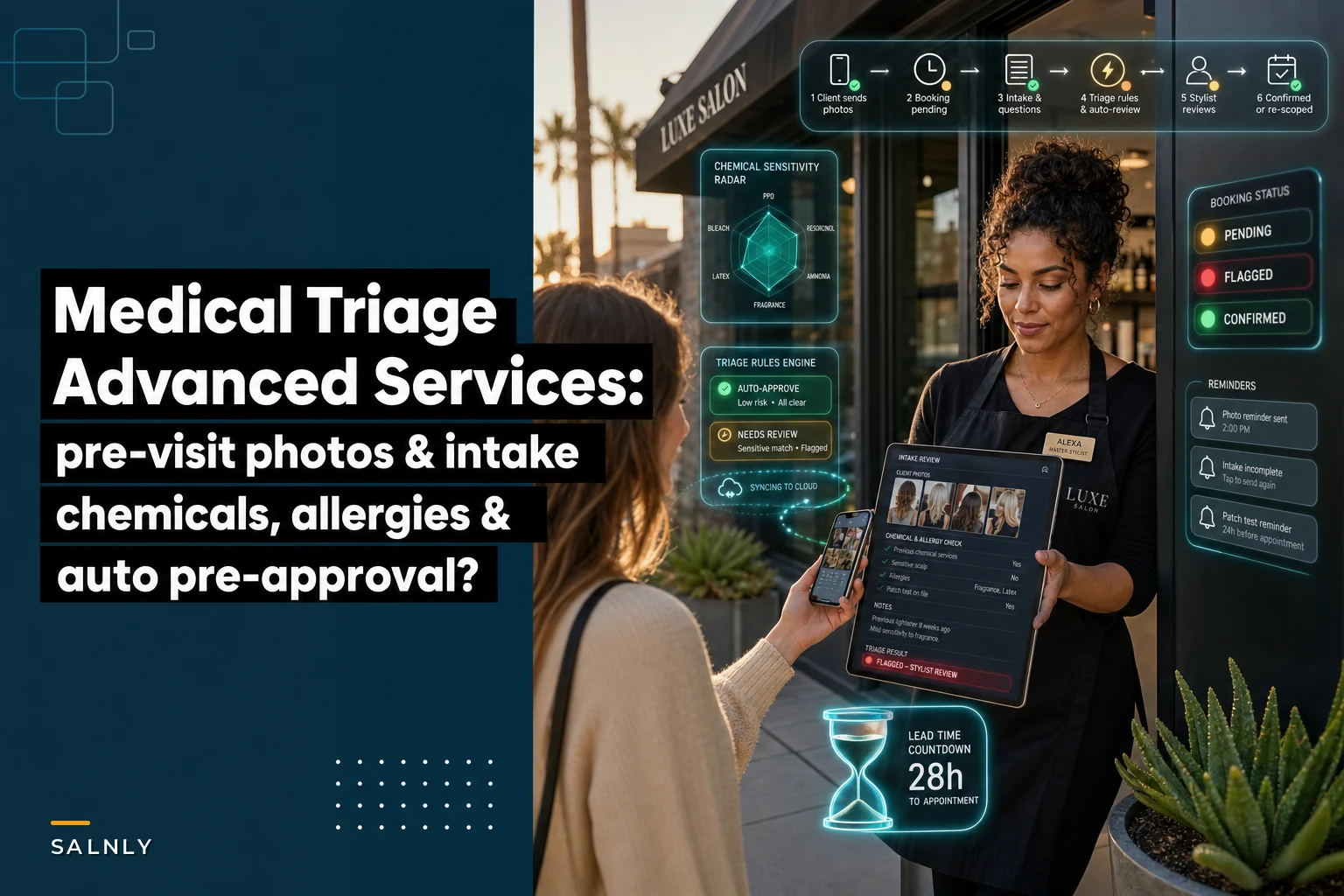

The most expensive words a colorist can hear at the 40-minute mark are: "Oh, I did use a box dye a few weeks ago." Or "I think I had a reaction to something last time, but I'm not sure what." At that point you're already committed. The bowl is mixed, the chair is occupied, the next client is checking in, and you're doing math on whether this appointment just became a liability.
Advanced services — corrective color, keratin, lash lifts, chemical peels, anything involving developer or acids near skin — carry a different risk profile than a wash-and-blowout. The problem isn't that stylists don't know the risks. It's that the information needed to make a safe call arrives after the client is already in the chair, if it arrives at all. A proper salon medical intake form, completed before the client walks in, is the difference between catching a problem Tuesday afternoon and eating the cost of it on Saturday.
This post is narrow on purpose. It's about one thing: getting the right medical, chemical, and photo information before the appointment so you're not making judgment calls with your hands already in someone's hair.
Where mid-service surprises actually come from
Break down the appointments that go sideways and most trace back to one of four gaps. None of them are exotic. They're all predictable and preventable.
The client's hair history is unknown. Box dye, henna, previous bleach, a home glaze from six weeks ago — these change how product behaves. A stylist who doesn't know a client used henna can end up with green hair or, worse, a chemical reaction when bleach hits metallic salts.
Allergy and sensitivity history is missing. PPD sensitivity, past reactions to lash adhesive, sensitivity to glycolic acid — these don't show up until product is on skin. By then it's an incident, not a screening question.
The client's expectation doesn't match what's possible in the booked time. Someone books a "color correction" as a two-hour slot when their level-2 box-dyed hair needs a five-hour multi-session plan. The stylist finds out at consultation, and the schedule is wrecked either way — do the impossible thing badly or cancel on the spot.
The service requires a patch test or lead time nobody enforced. Many color lines and lash adhesives recommend a 48-hour patch test for new clients. If that rule lives only in a stylist's head, it gets skipped when the schedule is busy — which is exactly when you can least afford a reaction.
What these have in common: the information exists, the client usually has it, but there's no structured moment before the appointment where it gets collected and reviewed. The in-chair consultation is too late. You've already given up the slot.
The real cost, and why it's bigger than it looks
Owners tend to price this problem as "the occasional redo." It's much worse once you add up the second-order effects.
Stop losing appointments in the chaos.
Salnly helps you book, confirm & manage every appointment—efficiently.
- Centralized appointment management
- Client notifications
- Calendar & staff scheduling
No credit card required
Take a mid-size salon running advanced color. Say corrective and specialty color makes up around 30–40 bookings a month. If even 3 or 4 of those hit a mid-service surprise — wrong expectation, undisclosed box dye, a patch-test skip that forces a reschedule — you're looking at a mix of:
-
Chair time burned on a service that can't be completed (a 3-hour slot half-used)
-
A comped or discounted redo to keep the client happy
-
The next client pushed late or bumped entirely
-
The stylist's focus and pace thrown off for the rest of the day
A single blown corrective slot can cost you the service revenue plus the downstream appointment. Somewhere in the $150–$300 range per incident once you count the knock-on delay. Four a month is roughly $700–$1,000 monthly leaking out, and that's before the reputational cost of a client who leaves unhappy.
Then there's the tail risk you don't budget for: an actual allergic reaction with no documented patch test. That's not a redo conversation, that's a liability conversation. This ties directly into consent and incident documentation — the kind of legal-ready SOP most salons only build after they've already had a scare.
The fix is a pre-visit gate, not a longer consultation
The instinct is to make the in-chair consultation more thorough. That helps a little but doesn't solve the timing problem — you're still discovering issues after you've committed the slot. The actual fix is moving the screening to before the client arrives.
Think of it as a gate with three parts: photos, questions, and rules.
1. Pre-visit photos
For anything corrective or transformational, you want to see the hair before the day of. Not perfect studio lighting — just honest phone photos.
Ask for:
-
Front, back, and both sides in natural light
-
A close-up of the roots and any previous color line
-
If relevant, a photo of the previous box or product they used
A stylist can often tell from a photo whether a "quick color correction" is actually a multi-session project. Catching that a week early means you rebook it correctly instead of discovering it live. It also protects the stylist — you can decline or re-scope a booking before the client is sitting there with expectations already set.
Worth noting: clients who resist sending photos are often the ones with a history they're not eager to disclose. That reluctance is itself useful information.
2. Chemical and allergy triage questions
This is the core of your salon medical intake form. Keep it short enough that people actually finish it, specific enough to catch real risks. A workable set for advanced services:
-
Have you colored, bleached, henna'd, or used box dye in the last 6 months? (include a "not sure" option — because "not sure" is a flag)
-
Any known reactions to hair color, PPD, lash adhesive, or skin treatments?
-
Any scalp or skin conditions currently active (psoriasis, open sores, recent sunburn)?
-
Are you pregnant or breastfeeding? (relevant for some chemical services)
-
Medications that affect skin sensitivity (retinoids, certain acne meds)?
-
For new clients on services requiring it
have you completed a patch test?
The goal isn't to practice medicine. It's to route the client correctly — proceed, require a patch test first, or flag for a stylist to review before confirming.
3. Required lead-time and pre-approval rules
Some services shouldn't be confirmable same-day for a brand-new client. A 48-hour patch test rule only works if the booking system won't let a new-client color slot get confirmed inside that window without a completed test.
A simple triage table for how a booked service should flow based on what the intake reveals:
| Intake result | Service risk | Required action before confirming |
|---|---|---|
| Regular client, no changes, known history | Low | Auto-confirm |
| New client, standard color | Medium | Patch test scheduled 48h+ prior |
| Any "not sure" on chemical history | Medium-High | Stylist review of photos before confirming |
| Corrective / box-dye history disclosed | High | Re-scope, possible multi-session, deposit |
| Reported past reaction | High | Manager/stylist review; may decline or modify |
If a client refuses photos, flag the booking for stylist review—resistance often indicates undisclosed history.
The point isn't rigidity. It's making sure a busy front desk doesn't confirm a high-risk booking without someone with the right skill actually looking at it first.
A workflow that actually holds up on a busy day
Here's how the pre-visit gate runs in practice, start to finish:
-
Client requests an advanced service (online or by phone). The booking is marked pending, not confirmed.
-
Intake link goes out automatically — the form plus the photo request. This is where a booking or intake platform earns its keep: instead of the front desk chasing people, the request fires the moment an advanced service is requested, with a reminder if it's not completed.
-
Answers get triaged against your rules. Low-risk, complete responses can move toward auto-confirmation. Anything flagged — "not sure," reported reactions, box-dye history — gets held for a stylist to review the photos and decide.
-
Lead-time rules enforce themselves. A new-client color inside the patch-test window can't confirm until the test is logged. The system holds the slot as tentative rather than locking it in.
-
Stylist reviews flagged bookings in a batch, not live in the chair. They approve, re-scope, request a longer slot, or reach out to reset expectations.
-
Confirmed bookings carry their history into the appointment, so the stylist walks up already knowing what they're working with.
A quick visual of that flow:
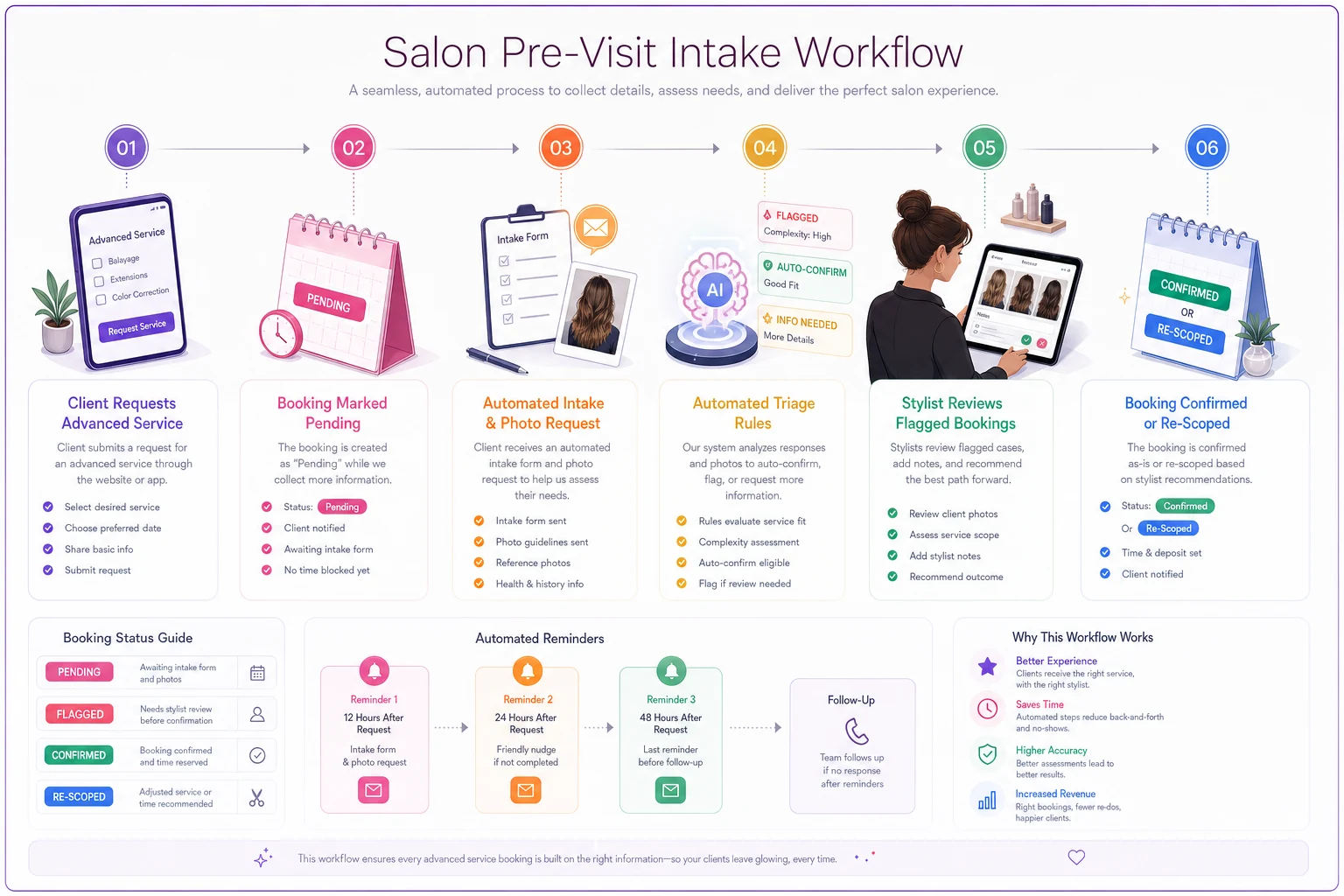
The quiet win is step 5. Reviewing three flagged bookings during a slow moment is a completely different experience than discovering three surprises mid-service on a chaotic Saturday. You're moving the decision to a time when you can actually think.
This is closely related to getting your durations right in the first place. If corrective slots are booked at generic lengths, even perfect intake won't save you — the standardized service durations have to match the real work the photos reveal.
When this makes sense — and when it's overkill
Not every service needs this gate. Forcing it everywhere adds friction that costs you bookings.
When it clearly pays off:
-
Corrective color, major transformations, anything with bleach
-
Keratin, perms, relaxers, chemical straightening
-
Lash lifts, extensions, and any adhesive-based service
-
New clients booking their first chemical service with you
-
Any high-ticket service where a deposit is already involved
When it's a bad idea:
-
Regular blowouts, cuts, styling — a medical intake form here just annoys loyal clients
-
Repeat clients with a stable, documented history and no recent changes
-
Walk-in-driven, quick-turnaround service models where the friction kills the volume
Who should skip it entirely: a barbershop or blow-dry bar doing high-volume, low-chemical work. The screening overhead won't earn its place. This is a tool for salons where a single service can run three-plus hours and involves chemistry on skin.
The nuance most owners miss: this isn't about screening everyone. It's about building one clean lane for the handful of services that carry real risk, and leaving the rest of your booking flow alone.
A real scenario
A two-stylist color-focused salon was running roughly 35 advanced-color appointments a month and kept hitting the same wall — around 4 or 5 a month either ran long because of undisclosed box dye or turned into on-the-spot corrections that pushed the rest of the day late. One near-miss with a client who'd had a prior color reaction — and hadn't mentioned it — was the tipping point.
They put in a pre-visit gate: photos plus a short intake required before any corrective or new-client color got confirmed, with a hard patch-test rule for first-timers. Nothing fancy on the form — six questions and three photos.
Within about two months, mid-service surprises on advanced color dropped to roughly one a month, usually a genuine edge case rather than a preventable one. Two corrective bookings got re-scoped into proper multi-session plans before the appointment, which meant the right slot length and a deposit instead of a scramble. The stylists said the calmer thing wasn't even the time saved — it was walking up to the chair already knowing what they were dealing with. Cancellations tied to "this isn't what I expected" basically stopped, because expectations got reset a week early instead of at minute 40.
The part owners underestimate
The temptation is to treat this as a safety checkbox — something you do to cover yourself legally. It does that, and the documented consent and patch-test trail matters if anything ever goes wrong. But the bigger daily payoff is operational: you stop making service decisions with incomplete information at the worst possible moment.
A well-built salon medical intake form isn't paperwork. It's a filter that moves your riskiest decisions from the chair — where you have no options — to the day before, where you have all of them. The same discipline shows up in how good salons handle their bridal booking process: the high-stakes, long-lead bookings get their own careful intake instead of flowing through the standard funnel.
Start narrow. Pick your two or three highest-risk services, build a short intake and a photo request, set one lead-time rule you'll actually enforce, and route flagged bookings to a stylist before confirming them. You don't need to gate everything. You need to stop being surprised at the 40-minute mark.
Ready to simplify your salon operations?
Join 1,000+ salons using Salnly to save time, reduce scheduling chaos, and deliver better client experiences.