

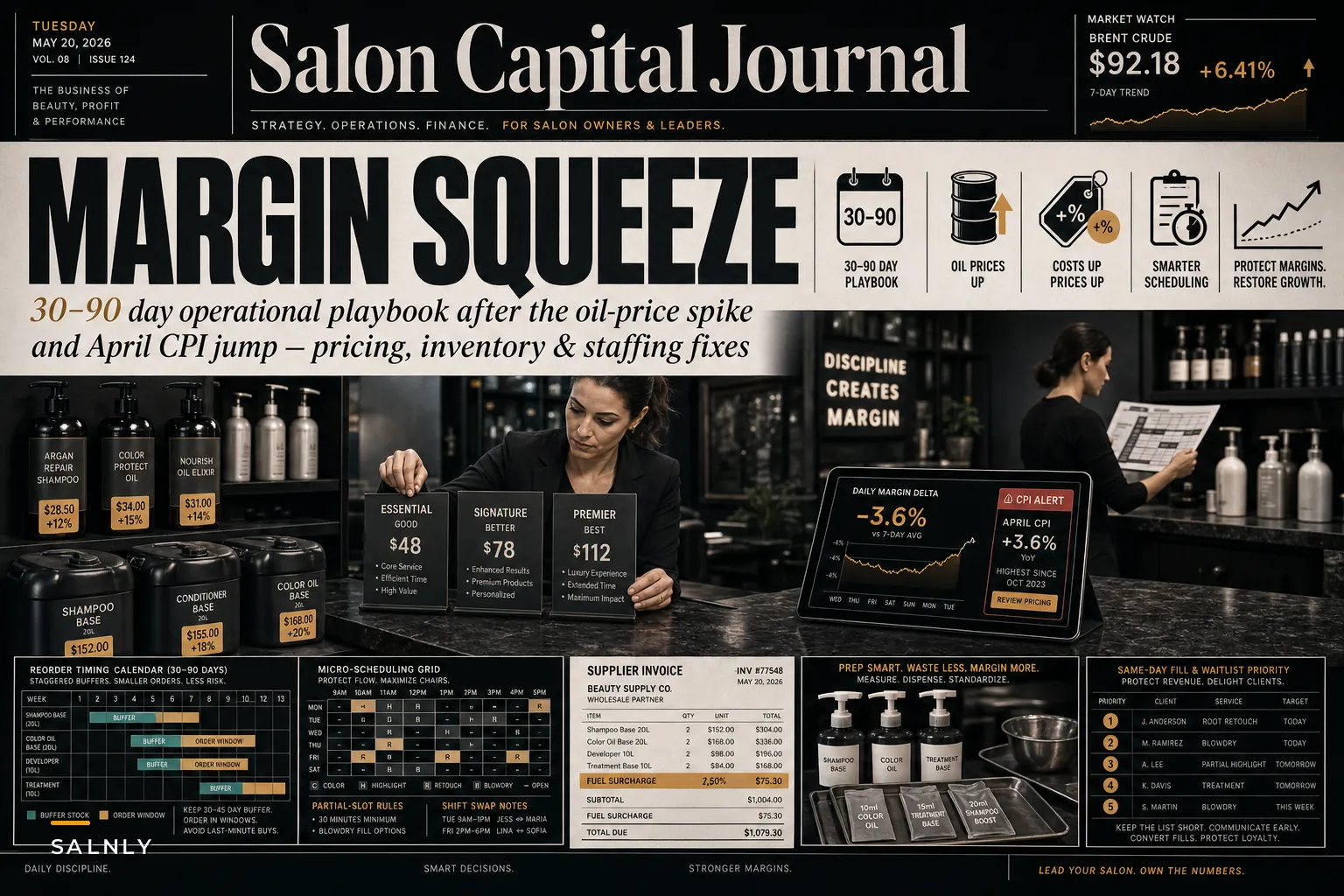

The oil price spike we're seeing right now isn't abstract economics anymore. Reuters reported a 3% climb in oil prices just yesterday on Middle East tensions, and that's landing directly in your P&L. Your color supplier probably sent that awkward email about "fuel surcharges" last week. The utility bill for April just hit, and it's ugly. Even worse, the April CPI data released this week shows broader inflation pressure that's making clients think twice about their usual $200 color appointments.
Most salons handle this wrong. They either panic-raise prices across the board (killing bookings) or absorb the costs hoping it'll pass (destroying margins). Neither works because both ignore how a salon actually makes money when input costs spike.
Three coordinated moves protect you: selective pricing adjustments that protect volume, inventory management that reduces waste exposure, and staffing tweaks that maximize revenue per hour without adding labor cost. Not the generic "raise prices and cut costs" advice you'll find everywhere else, but specific operational adjustments that keep chairs full while protecting your bottom line.
The supply price trap that's killing salon margins right now
Your distributor's 8% price increase hits different than other businesses because of how salons operate. A restaurant can swap suppliers or adjust portions. You're locked into specific color lines your stylists trained on, specific product systems clients expect, and minimum order quantities that force you to carry inventory.
That 8% increase on color products translates to roughly $3-5 per color service in direct product cost. Add the fuel surcharge on deliveries (another $50-150 per month depending on order frequency), plus your utility bill jumping 12-15% from energy costs, and you're looking at $1,800-2,400 monthly in new costs for a typical 6-chair salon.
Everyone treats this as a uniform problem requiring a uniform response. But different services absorb cost increases differently. Your single-process color service that uses $8 in product just became $8.64 — annoying but manageable. Your corrective color using $45 in product jumped to $48.60 — that's real money. Meanwhile, cuts and simple styles barely moved since they're mostly labor, not product.
Worse, the typical salon carries about $4,000-6,000 in retail inventory. That inventory you bought last month at old prices? It's now worth 8% more to replace. Every bottle sold at yesterday's markup is money left on the table. But rush to raise retail prices and you'll kill the impulse purchases that make retail profitable.
This creates a nasty operational squeeze. You need to move prices but can't afford to lose volume. You need to manage inventory tighter but can't risk stockouts. You need to maintain service quality but must reduce product waste.
Stop the bleeding: immediate inventory adjustments that actually work
Most salon inventory systems fail during price volatility because they're built for stability. You order monthly, maintain par levels, and occasionally adjust for seasonality. That system becomes a cash drain when prices jump weekly and demand softens simultaneously.
Stop losing appointments in the chaos.
Salnly helps you book, confirm & manage every appointment—efficiently.
- Centralized appointment management
- Client notifications
- Calendar & staff scheduling
No credit card required
Switch to "volatility ordering" — smaller, more frequent orders that reduce your exposure to price changes. Instead of ordering $3,000 monthly, split into $750 weekly orders. Yes, you might lose some bulk discount, but you avoid getting stuck with expensive inventory if prices drop or demand slows. More importantly, you can adjust faster to actual usage patterns.
Here's what nobody talks about: backbar waste explodes during cost crunches. Stylists subconsciously use more product when they know prices increased, thinking they need to maintain quality. Product usage increases 10-15% in the month following a price increase announcement, even with no service changes.
The fix isn't policing your team. It's restructuring how product gets dispensed. Move to pre-measured color bowls for standard services. Create portion cups for treatments. Switch to pump dispensers that control amounts. One salon I worked with cut product waste by 20% just by switching from squeeze bottles to pumps — that's $400 monthly saved without changing anything else.
Switch to pump dispensers and pre-measured bowls first — they reduce backbar waste fast without changing client experience.
This workflow diagram shows the quick ordering and dispensing steps you can implement to reduce exposure and waste.
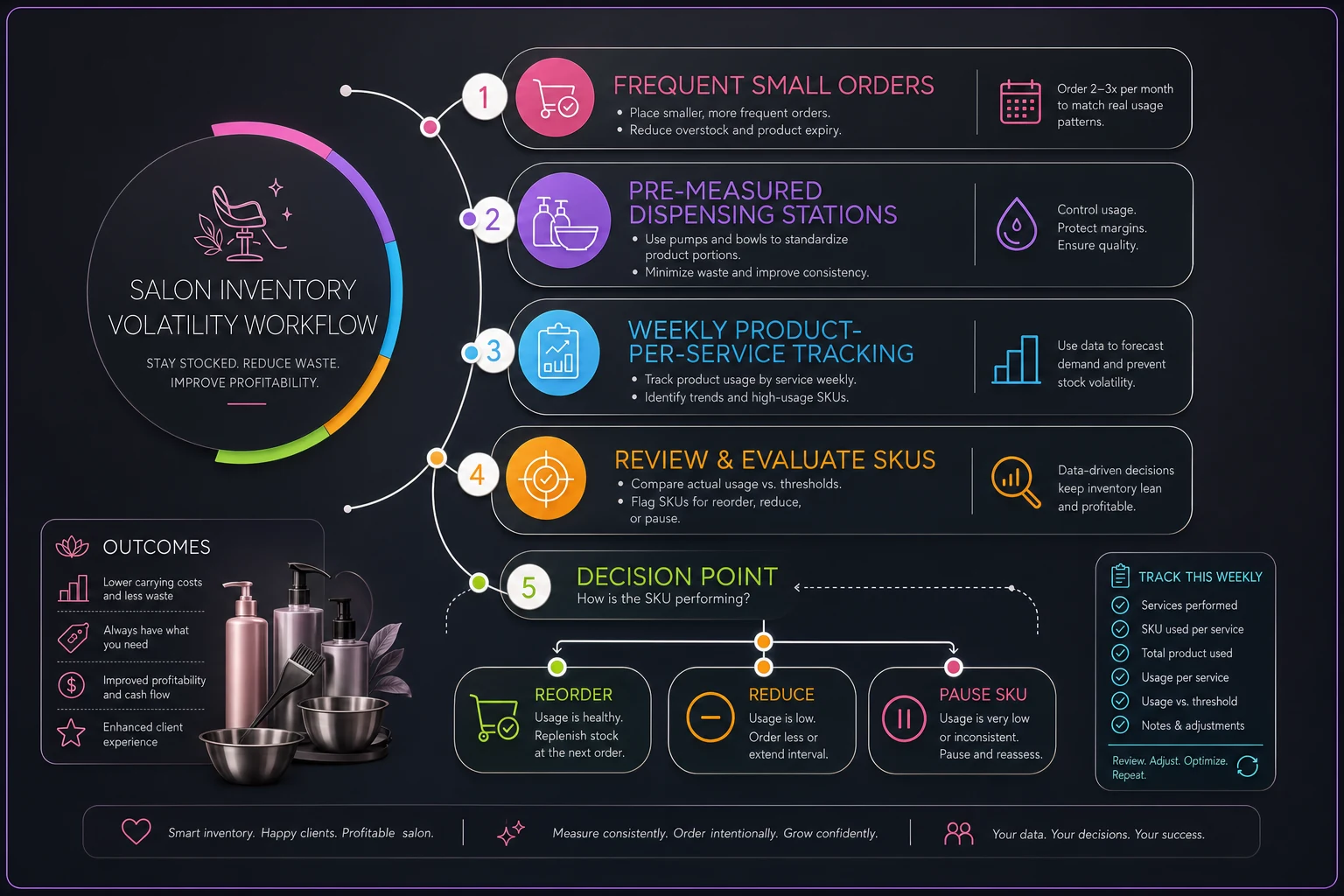
Track your product-per-service ratio weekly, not monthly. In normal times, you might use $8.50 average product cost per color service. During volatility, that number needs watching like a hawk. If it creeps to $9.50, you're bleeding $300-500 monthly in waste for a modest salon. Operational software that tracks this automatically makes the difference between catching drift early versus discovering it at month-end when the damage is done.
Your retail inventory needs different treatment. Stop ordering full product lines. Focus on your top 20% of SKUs that generate 80% of revenue — usually 15-20 products. Let the slow movers sell through without replacement. That frees up cash and reduces your replacement cost exposure. One owner told me she freed up $1,800 in working capital just by not reordering her bottom 30 retail SKUs during a price spike.
Surgical pricing moves that protect bookings
The worst thing you can do right now is announce an across-the-board 8% price increase. That's what everyone else is doing, and it's why their books are thinning out.
Start with your service mix analysis. A typical salon does roughly 40% color services, 30% cuts, 20% treatments, 10% styling.
| Service | Percent |
|---|---|
| color services | 40% |
| cuts | 30% |
| treatments | 20% |
| styling | 10% |
But profit contribution varies wildly. Cuts might be 30% of revenue but 45% of profit because they're labor-heavy, product-light. Complex color might be 25% of revenue but only 15% of profit after product costs.
Protect your volume drivers (usually cuts and simple color), moderately increase your profit drivers (treatments and styling), and significantly adjust your cost-heavy services (corrective color, full highlights). This segmented approach maintains traffic while improving margins.
Specifically, leave men's cuts and single-process color unchanged. These are your frequency drivers — the services that keep clients coming monthly. Raise blowout and treatment prices 5-8% since these are add-ons with high perceived value and low price sensitivity. Bump corrective color and full highlights 10-12% because clients expect these to be expensive and book them less frequently.
Pricing isn't just about the number though. It's about the framing. Don't send a mass email about "rising costs forcing price adjustments" — that screams desperation. Instead, adjust prices silently in your booking system and address it individually if asked. Say something like "We've adjusted pricing on some services to reflect the enhanced techniques and premium products we're using."
One critical move everyone misses: Create a "price protection" window. Tell your regular clients that if they pre-book their next 3 appointments, they lock in current pricing. This drives immediate bookings (cash flow), ensures future volume (profitability), and makes clients feel taken care of (retention). A salon in Phoenix implemented this during the last price spike and pre-booked 400+ appointments in two weeks.
For retail, the approach differs. Instead of raising prices, reduce promotions. That 20% off retail promotion you run monthly? Make it 15%. The buy-two-get-one deal? Pause it. This invisible price increase maintains the shelf price while improving margins. Clients don't notice missing promotions the way they notice price tags changing.
Staffing adjustments that don't require layoffs
When costs spike, the knee-jerk reaction is cutting hours. But reducing staff when demand is already soft just creates a death spiral — worse service leads to fewer bookings leads to more cuts. The smart play is optimizing deployment, not reducing headcount.
First, audit your actual productivity, not scheduled productivity. Most salons schedule based on hope, not history. You've got Sarah scheduled for 8 hours Thursday because that's her regular day, not because Thursday needs 8 hours of Sarah. During volatility, every hour needs justification.
Look at your hourly booking data for the last 8 weeks. Where are the dead zones? Usually Tuesday/Wednesday mornings, late Friday afternoons, and scattered gaps throughout the week. Instead of across-the-board cuts, concentrate your staffing when you actually have demand.
Create "core hours" and "flex hours." Core hours are when you guarantee full staffing — typically Tuesday through Thursday 11am-7pm, Friday-Saturday 9am-6pm. Flex hours are everything else, staffed based on actual bookings. If Monday morning has no pre-books by Thursday, don't open until noon. This can cut 10-15 labor hours weekly without client impact.
But the real innovation is revenue-based scheduling. Instead of scheduling stylists for shifts, schedule them for revenue targets. Sarah doesn't work "Tuesday 9-5." She works "until she hits $400 in services or 5pm, whichever comes first." This creates urgency to fill books and self-regulates labor cost to revenue.
Combine this with strategic service assignment. Your senior stylists costing $30/hour should focus on high-ticket color corrections and transformations. Junior stylists at $18/hour handle maintenance color and cuts. This sounds obvious, but most salons let clients book whoever, regardless of service fit. During margin pressure, that luxury ends.
One tactical move that immediately impacts profitability: Convert your least productive stylist to a "float" role. Instead of their own column, they handle overflow, assists, and walk-ins. This typically improves overall productivity by 15-20% because it eliminates the pressure to fill a weak performer's book while ensuring strong performers never have gaps.
The daily tracking that makes or breaks you
During cost volatility, monthly P&Ls are worthless. By the time you see the damage, it's too late to respond. You need daily visibility into the numbers that actually predict profitability.
-
Service dollars per labor hour (not just productivity percentage)
-
Product cost per service dollar (catches waste creep)
-
Average ticket including retail (shows pricing impact)
-
Pre-book percentage (predicts future volume)
-
Same-day fill rate (indicates demand softness)
Most salons track some of these monthly. During volatility, you need them daily. That 8% product cost increase might be eating 20% of margin if waste simultaneously increased and average tickets dropped. Daily tracking catches this before it becomes terminal.
Simple daily scorecard: Track yesterday's service revenue, divide by total stylists hours worked. That's your revenue per labor hour. Should be $65-80 for healthy salons. Track yesterday's product used (in dollars), divide by service revenue. Should be under 12% for color-heavy salons, under 8% for cut-heavy salons. If either metric drops two days straight, you need immediate intervention.
The pre-book percentage tells you if pricing moves hurt future demand. During normal times, 60-70% pre-book is healthy. During volatility, you want 75%+ because it provides certainty. If pre-books drop below 60%, your pricing went too far or your market is softening faster than expected.
For deeper insight on which metrics actually drive profitability and how to act on them daily, check out our complete guide to salon KPIs that move the needle.
Supplier negotiations nobody teaches you
Your distributor relationships matter more during price spikes than any other time. But most salon owners approach negotiations wrong, asking for discounts the distributor can't give or payment terms that don't help.
The conversation isn't about the 8% increase — that's driven by their costs too. The conversation is about what they can control: delivery fees, minimum orders, payment terms, and product dating. A distributor might not budge on unit price but will often waive delivery fees for larger orders or extend payment terms during volatility.
What to ask for: Extended payment terms (60 days instead of 30), which helps cash flow. Reduced minimum orders, so you can order smaller quantities more frequently. Delivery fee waivers for orders over a certain amount. Product dating guarantees, so you don't get stuck with inventory near expiration. Volume rebates paid quarterly instead of annually.
The script that works: "I understand the price increases are market-driven. I need help managing cash flow during this transition. Can we discuss extended terms or reduced minimums for the next quarter while we adjust our operations?"
Also, this is when secondary suppliers become valuable. Your main distributor might have you locked into exclusive color lines, but they rarely control everything. Shop around for retail products, tools, supplies, and accessories. Even saving 10% on 20% of your purchases helps offset increases elsewhere.
The endgame: building volatility resistance
The salons that thrive during cost shocks aren't just better at responding — they've built operations that resist volatility. This means service menus designed for margin flexibility, client relationships that tolerate price movement, and systems that provide real-time visibility and control.
Start with menu architecture. Stop thinking about services and start thinking about margin bands. Your menu should have high-margin "profit makers" (treatments, styling), moderate-margin "volume drivers" (basic color, cuts), and low-margin "loss leaders" (certain corrections you do for reputation). During stability, you can afford more loss leaders. During volatility, you shift mix toward profit makers.
Client communication strategy matters too. The salons that struggle with price increases are the ones that never talk about value except when raising prices. Build value communication into every interaction. Talk about the education you're investing in, the product quality you maintain, the experience you're crafting. Then price increases become natural progression, not desperate grabs.
But ultimately, surviving volatility requires operational software that gives you control. When you can see daily product usage, adjust pricing instantly, track productivity hourly, and manage inventory precisely, cost spikes become manageable challenges instead of existential threats. The manual tracking and monthly reviews that worked in stable times will kill you during volatility.
The salons weathering this current spike aren't necessarily bigger or better funded. They're operationally tighter, with systems that provide visibility and control when markets get choppy. They adjusted fast because they saw problems early. They protected margins without killing volume because they had precise control over their levers.
The oil shock will pass, inflation will moderate, and your supply costs will stabilize. But the next disruption is always coming. The question isn't whether you'll face another margin squeeze, but whether your operations will be ready when you do.
This playbook isn't just about surviving this spike — it's about building a salon that thrives regardless of what markets throw at you.
Ready to simplify your salon operations?
Join 1,000+ salons using Salnly to save time, reduce scheduling chaos, and deliver better client experiences.